Politics

  • FSFE: storing your data at Microsoft is negligent

    Bill Gates Borg imageIn an article published yesterday, The Guardian describes how Microsoft is actively cooperating with the USA’s NSA. According to the article, Microsoft is providing the NSA with broad access to the communications of anyone using the company’s services, as follows:

    • Microsoft gives the NSA access to encrypted mails on Hotmail, Live.com and Outlook.com, as well as web chat messages;
    • Microsoft provides the NSA with easy access to its SkyDrive storage service, which currently has 250 million users worldwide;
    • Microsoft makes it possible for the NSA to monitor audio and video calls on the Skype service which it acquired in 2011.

    “This makes it clear that trusting Microsoft with your critical company data is downright negligent,” says Karsten Gerloff, President of the Free Software Foundation Europe (FSFE). “In both the public and the private sector, those responsible for security and data protection urgently need to take action to protect their organisations, customers and clients.”

    While it is difficult or impossible to entirely escape surveillance, there are ways to minimise the risk that sensitive data, such as confidential product data or patient records, is intercepted by a third party. Free Software solutions for groupware, office products and operating systems are fully auditable and often data security a priority. End-to-end encryption with free software such as
    GnuPG and off-the-record messaging (OTR) protects data in transit. Products providing secure audio, video and chat communications, such as Jitsi, go a long way towards replacing Skype.

    “We advise companies and all other organisations that wish to protect their data to use free software solutions, to store data in-house wherever possible and to cooperate only with providers whom they trust to protect their customers’ data,” says Gerloff. “Such providers will often use strong encryption, and minimise the amount of data they store. Using smaller providers instead of global IT companies makes it somewhat less likely that customers’ data will be caught in the NSA’s dragnet.”

  • Inadequate interpreter supplied, case adjourned

    Yesterday’s Wales Online carried a report of a court case at Cardiff Magistrates Court involving public order offences by Tamil protesters on 20th June connected with a protest at the city’s Swalec Stadium against the presence of the Sri Lankan cricket team on British soil.

    Hidden in the report was yet more evidence of the failing interpreting contract between the Ministry of Justice (MoJ) and Capita Translation & Interpreting (posts passim), in this instance, the provision of an incomprehensible interpreter.

    An eighth man admitted throwing a stone at a passing car outside the stadium, while a ninth man accused of common assault was unable to submit a plea because he could not understand the Tamil interpreter provided by the court – his case was adjourned until July 23.

    How can the MoJ continue to claim that the contract is working well when courts around the country experience delay, disruption and additional expense?

    If any reader has evidence of court delays for whatever reason (e.g. Capita not providing an interpreter, G4S failing to produce defendant for hearing, etc., they can be reported at https://courtdelays.wordpress.com/.

  • Court ‘interpreters’ being sent to Fire Service College

    Reposted from RPSI Linguist Lounge, with added links.

    Anonymous writes:

    You might be aware that Capita acquired the Fire Service College, the award-winning leader in fire and emergency response training, for £10 million. The Fire Service College, located in Moreton in Marsh – Gloucestershire, gets clients from all over the world, including: the UK, Europe, Middle East and Asia.

    Some of their delegates can’t speak in English, so therefore Capita has tried improving their Fire Service College by bringing their very own, cheap, ‘Interpreters’ to assist the delegates.

    So now, as you can see, the court ‘Interpreters’ which work for Capita are now being sent to the Fire Service College, to interpret for the delegates who are being trained for emergency response; I just hope they can interpret accurately.

    Anyway, Capita called me up and offered me a 3 month interpretation project at the Fire Service College before it was actually official that Capita had acquired the College. I gave it a go, but I didn’t really like it because it was actually quite hard compared to Court Interpreting but it actually looked like Capita hired their best interpreters which have been on the NRPSI.

    However, Capita had told me that I had to arrive the night prior to the day I interpret for the delegates. So, it becomes clear that Capita don’t trust its interpreters and know that they are unreliable.

    Now let’s get to the interesting part, the rates. The normal day is 8:30 to 17:30 with a 1 hour lunch at about 12:00, so for the day (8 hours of full interpreting) you just get paid a flat fee of £140. That’s the amount of 7 hours interpreting in a court. But what was different was that they paid me door-to-door travel time and of course millage [sic].

    Therefore, Capita pay you less, for harder work.

    But on the other hand, Capita do give you free accommodation (which is on-site but not nice at all), they also give you free food; including breakfast, lunch and dinner. Also, there is a bar, gym, swimming pool and some small shops.

    It does look quite appealing, doesn’t it? But it does mean leaving your family for 5 days in the week and giving you only 2 days (Saturday and Sunday) to go back home and spend it with your loved ones.

    If any of you, Interpreters, have been to the Fire Service College, please leave a comment.

    Many thanks.

  • Crapita in the dock this morning

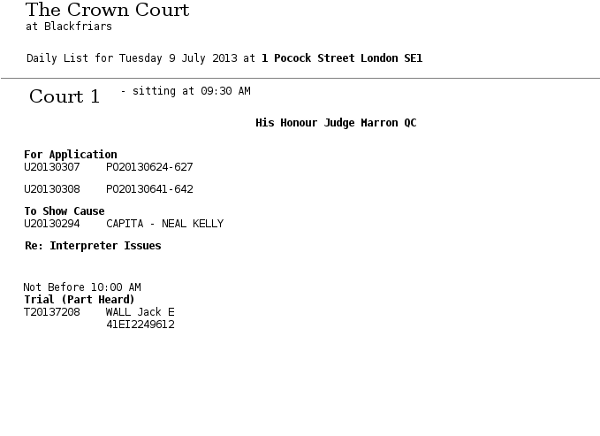
    As the screenshot below shows, Capita, that paragon of outsourcing efficiency, is due to appear at 9.30 at Blackfriars Crown Court in London before His Honour Judge Marron QC regarding “Interpreter Issues”, presumably the failure of Capita Translation & interpreting to fulfil its courts and tribunals interpreting contract with the Ministry of Justice (posts passim).

    screenshot of case listing at Blackfriars Crown Court

    Update: 10.00 am.Peter Shortall has just commented as follows on the RPSI Facebook page:

    Just left Blackfriars CC. It’s being heard in chambers, so I and a lady who had turned up to watch were asked to leave so the judge could talk to the Capita rep privately. So much for transparency!

    Peter also added in an earlier comment that Neal Kelly is Capita’s “relationship manager” who handles “high-level complaints”.

  • Crapita loses contract in double-quick time

    Transport Extra reports that our friends at Capita (posts passim) have lost a contract with a term of 5 years, an option on a further 2 years and worth £100 mn. just eighteen months into the contract.

    The contract was with the DVLA and concerned vehicle excise duty enforcement.

    The contract has now been awarded to rival outsourcing outfit NSL.

    Well done Crapita. How much longer before you lose the courts interpreting contract with the Ministry of Justice? Let’s face it, you’ve been under-performing on that one ever since you took over the under-performing ALS (subsequently rebranded as Capita Translation & Interpreting. Ed.)?

  • France’s Big Brother revealed

    Originally posted on Bristol Wireless yesterday.

    online surveillance imageFollowing recent revelations about massive extent of telecommunications and internet traffic surveillance carried on by the USA’s NSA and the UK’s GCHQ (news passim), revelations have now emerged in Le Monde, one of France’s leading national newspapers.

    In a post today entitled “Revelations about the French Big Brother”, Le Monde reveals that France has a large scale snooping apparatus. The DGSE, the French secret service, is systematically collecting the electromagnetic signals emitted by computers or telephones in France, as well as the traffic between the French and abroad: all of the French population’s communications are spied upon. French politicians are aware of this, but secrecy is the rule: this French Big Brother is clandestine and evades all control.

    What the intelligence service is looking is the metadata; their aim is to know who is talking to whom, allegedly to piece together the links between targets and thus to identify “cells”. The DGSE is thus collecting data on millions of telephone subscribers, plus emails, text messages, faxes, etc., plus all internet traffic sent to the likes of Google, Facebook, Microsoft, Apple, Yahoo, etc. The apparatus is alleged to be invaluable for fighting terrorism, but also enables snooping on anybody.

    The DGSE is therefore collecting billions of items of data which are compressed and stored in Paris on three floors in the basement of its headquarters on the boulevard Mortier. The intelligence service has a supercomputer capable of handling tens of millions of gigabytes, according to Le Monde.

    Other French intelligence services have fully discretionary access to this enormous database; this is termed the “pooling infrastructure”. Certain information can even be used by the police under the cover of “anonymous information”.

    French law has made no provision for the bulk storage of technical data by the secret services. “For years we’ve had virtual authorisation,” one old intelligence services boss confides, “and each agency is happy with it.” A French parliamentarian confirms “that a large part of the electronic communications network in France is actually intercepted and [the data] stored by the DGSE”.

    However, officials deny that the “pooling infrastructure” actually exists.

  • Version 2.0 of OGL released

    Reposted from Bristol Wireless.

    OGL symbolThe British National Archives announced last week that it has released version 2.0 of the Open Government Licence (OGL) following consultation on how the licence could be developed further to reflect new and emerging thinking on the licensing of public sector information.

    The OGL is an open licence allowing information to be used and re-used with virtually no restrictions. It is also part of the UK Government Licensing Framework (UKGLF), which was launched in 2010. A wide range of government and other public sector information can be used and re-used under the OGL, which also forms part of the UK government’s policy on transparency and open data.

    The basic terms and conditions of the Open Government Licence version 2.0 remain the same as the previous version in that it continues to:

    • permit use and re-use of information in any format for both commercial and non-commercial purposes without charge;
    • require re-users to publish an acknowledgment of the source of the information;
    • exclude personal information from the licence;
    • be compatible with other licensing models, such as Creative Commons, and conforms to the Open Definition*.

    What has changed is that National Archives have introduced a separate section of the licence headed ‘Non-endorsement’. This is designed to make it clear that the licence does not permit the re-user to suggest that their versions of the information enjoy any official status or have departmental endorsement.

    The National Archives is also introducing the OGL symbol, a simple way of identifying when information can be used and re-used under the terms of the Open Government Licence. The OGL symbol was developed by The National Archives with help from the Government Digital Service. The OGL symbol, at a glance, shows that information can be used and re-used under open licensing.

    * The definition seeks to define the terms “open”, “open data” and “open content” precisely in the context of data and content so as to ensure “interoperability between different pools of open material.”

  • Put Ada on a bank note

    Reposted from Bristol Wireless.

    The Bank of England recently announced that social and prison reformer Elizabeth Fry, who currently graces the English five pound note, is to be replaced by Sir Winston Churchill, leaving Elizabeth Windsor as the only woman shown on an English bank note – and that’s merely due to an accident of birth.

    Since the announcement, there have been calls from various quarters for another woman on English bank notes, in response to which the Bank of England (also known as “the Old Lady of Threadneedle Street“. Ed.) has hinted that 18th century novelist Jane Austen may be next to grace the back of the ten pound note.

    Naturally, this safe, predictable choice by the Bank of England hasn’t met with universal approval. Why stick with a female representative from the arts when there are plenty available from the sciences?

    image of Ada Lovelace
    Ada Lovelace
    We’ve written before about Ada Lovelace (news passim), who was an English mathematician and writer chiefly known for her work on Charles Babbage‘s early mechanical general-purpose computer, the analytical engine. Her notes on Babbage’s engine include what is recognised as the first algorithm intended to be processed by a machine; thanks to this, she is sometimes considered the world’s first computer programmer.

    A petition has now appeared on the government’s e-petitions site calling for Ada Lovelace’s achievements to be recognised by putting her on a bank note. The petition’s text reads as follows:

    Mervyn King, the Governor of the Bank of England, has announced Winston Churchill will replace social reformer Elizabeth Fry as the face of £5 notes. This means that, other than the Queen, there will be no women featuring on our English bank notes.

    A campaign is already underway to support women on English bank notes:

    http://www.change.org/en-GB/petitions/bank-of-england-keep-a-woman-on-english-banknotes

    We would like to propose Ada Lovelace – Founder of Scientific Computing – as the new face for the £10 note. A true champion of women in science and technology.

    The petition could do with your support. As this post goers to press, it has under 300 signatures (you might like to support the other petition to keep women on English bank notes too. Ed.)

    While we’re talking women on bank notes, how about these women from the sciences and engineering?

    Can you think of any more worthy candidates? Add them in the comments below.

  • How the MoJ treats consultation submissions

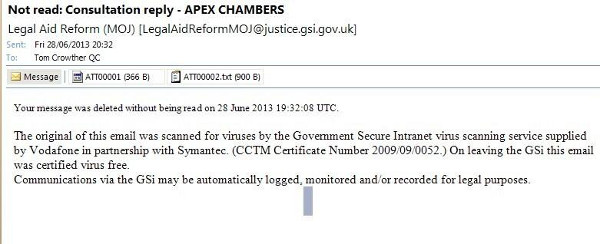
    Courtesy of the Criminal Bar Association’s Twitter account, evidence has emerged of the Ministry of Justice’s attitude to submissions to its recently closed consultation on its proposed changes to legal aid, which masquerade under the misleading title of ‘Transforming Legal Aid’ (posts passim).

    legal_aid

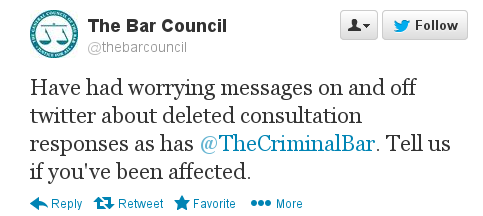
    The Criminal Bar Association isn’t the only organisation that has received such information: the Bar Council has too.

    image of Bar Council tweet of 28th June 2013

    Some cynics have already said that they knew the MoJ wouldn’t bother reading submissions. However, what the top screenshot shows is the deplorable lack of IT skills on show from the mandarins of Petty France: they are too thick to realise that their email system sends the originator a message if that email is deleted without actually being read!

    Update: Doughty Street Chambers has since tweeted that the MoJ are apparently saying the deletions are an “erroneous technical glitch” and nothing has been deleted, as well as that people have been emailing legalaidreformmoj@justice.gsi.gov.uk to ask for a copy of their response so the MoJ can prove they still have those consultation responses.

    Well, that second tweet from Doughty Street just shows how much confidence and trust in the MoJ has eroded.

  • Capita interpreter dispensed with in trial

    Reposted from RPSI Linguist Lounge.

    Marisa Allman writes:

    We started a 3 day hearing on 25th June with my client giving evidence via a Capita interpreter. To begin with she was unfamiliar with the process for taking the oath, simply reading it to the witness and asking for confirmation.

    It then quickly became apparent from the answers to questions posed that the witness was not being asked the question as it had been put in English. After about 40 minutes of questions the other party who was also Punjabi speaking indicated that the interpreter was not interpreting either the question or the response correctly. My own interpreter confirmed this. The witness also complained that the interpreter was confusing her. A decision was taken to dispense with that interpreter and put in a request for another, who arrived at 3:15. The first day of the hearing was therefore effectively lost.

    I can also tell you that in January or February this year I was involved in a case where the Turkish, unrepresented, father had travelled from Moldova for a final hearing. The interpreter called in sick on the morning of the hearing and Capita were unable to provide a replacement. My instructing solicitor was willing and able to find a replacement from another agency but this was not permissible because of the contract with Capita. No hearing took place, the hearing had to be adjourned to May.

Posts navigation