Bristol

  • (Crab) apple blossom time

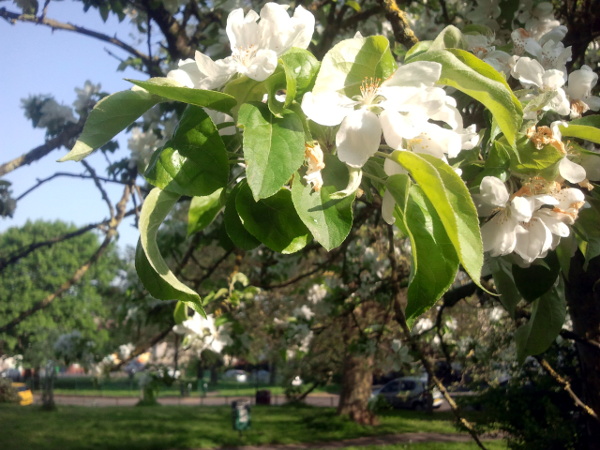
    On my way to the shops this fine May morning, my attention was caught by the beauty of the crab apple (Malus sylvestris) blossom on the tree in the small park that runs up the side of Bannerman Road in Easton, as shown below.

    Crab apple blossom in Bannerman Road
    Crab apple blossom in Bannerman Road

    According to the Woodland Trust, the crab apple is a native UK species which thrives in heavy soil in hedgerows, woods and areas of scrub. It’s one of the ancestors of the cultivated apple and individual trees can live up to 100 years and can grow to about 10 metres in height.

    The common name “crab apple” derives from the tree’s often knarled and crabbed appearance, especially when growing in exposed places.

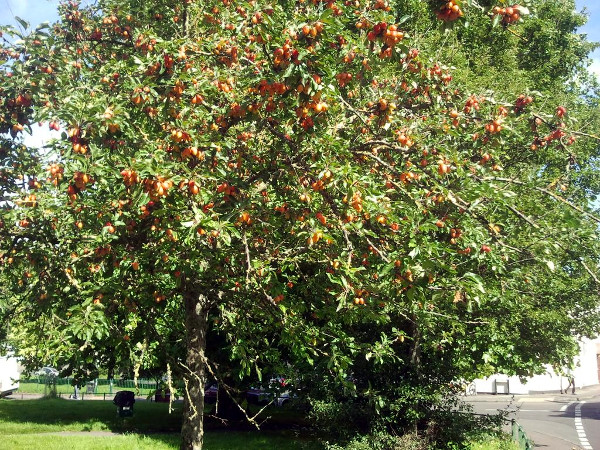
    In the autumn our local tree produces a fine crop of crab apples, as this picture from autumn 2017 shows.

    Bannerman Road's crab apple tree bearing fruit in autumn 2017
    Bannerman Road’s crab apple tree bearing fruit in autumn 2017

    Each autumn I tell myself I shall have to come and gather the fruit to make crab apple jelly. After all, it will be food for free (mostly!).

    As an aide-memoire and incentive to myself, below is the recipe for (crab) apple jelly from my trusty 1950s vintage recipe book (hence the imperial measurements. Ed.).

    Ingredients

    • 4 lbs crab or cooking apples
    • 2 pints water
    • 1 stick cinnamon, or
    • A few cloves, or
    • Strips of lemon rind
    • 1 lb of sugar per pint of juice obtained

    Method
    Wash the apples and wipe. Cut into quarters, but do not remove the skin or core. Put the fruit into a pan with the water and the cinnamon, cloves or lemon peel tied in a piece of muslin. Stew until the fruit is soft. Test for pectin. Remove the muslin bag. Turn the contents of the pan into a jelly bag and leave overnight to strain. Measure the juice and heat in a pan. Add 1 lb of warmed sugar to each pint of juice, stirring until all the sugar has dissolved. Bring to the boil and boil rapidly until the jelly sets when tested on a cold saucer or plate. Remove the scum. Pot and seal whilst still hot.

    Before we leave apple blossom, your correspondent can’t help remembering and old song called “(I’ll Be With You In) Apple Blossom Time“, which he remembers being sung by The Andrews Sisters, which reached no. 5 in the USA in 1941.

    However, the song is nearly 20 years older than the success enjoyed with it by Laverne, Maxine and Patty, having been written by Albert Von Tilzer and lyricist Neville Fleeson and copyrighted in 1920.

  • Local rag now employing greengrocers*

    Changes are taking place at the increasingly downmarket Local World group of regional newspaper titles owned by Trinity Mirror.

    These changes are also being implemented at the Bristol Post, the city’s newspaper of (warped) record, whose online version now masquerades under the misleading title of BristolLive, as any signs of sentience have yet to be medically confirmed.

    As circulation has declined, so have standards to the point where it appears that greengrocers (or should that be greengrocer’s? Ed.) are cheaper to employ than what passes nowadays for journalists – or even journalist’s. This desperate move is amply illustrated by the screenshot below for the latest story lifted from scanning social media.

    headline reads Bristol's s**t cycling infrastructure now has it's own Twitter account

    In the meantime, locals can expect more news from Homophone Corner (that’s a site to be seen. Ed. 😉 ) and hard-hitting stories of the “Hartcliffe man stubs toe on Bristol Bridge” variety and barely concealed advertisements masquerading as restaurant reviews, mostly for places whose obituaries subsequently describe them as “popular” when they inevitably close down less than a year later.

    * Or should that be greengrocer’s? 😉

  • Over £4K – the cost of dropping 6 cigarette ends in Bristol

    Six litter louts have been ordered by magistrates to pay a total of £671.84 each for dropping cigarette ends in central Bristol, making a grand total of £4,031.04, yesterday’s Bristol Post reports.

    The individual total of £671.84 is broken down as follows: £440 fine, £187.84 in prosecution costs and a £44 victim surcharge.

    All the defendants have been given 28 days to pay.

    Cigarette ends are litter too. Disposing of them properly will avoid the risk of a fine.

    They were all originally caught littering on 9th and 10th November last year by civil enforcement officers working for Bristol City Council (the so-called litter police. Ed.) and were issued with £75 fixed penalty notices (FPNs) for their filthiness. Had the penalties been paid within 10 days, the culprits would only have had to pay £50 each.

    As it is, they repeatedly ignored correspondence from Bristol City Council, as well as their summonses to Bristol Magistrates Court, as none of the defendants could be bothered to appear in person.

    On average, more than 1,000 people have been issued with FPNs for environmental crimes such as littering and dog fouling each month since the ‘litter police’ started their work.

    Bristol Clean Streets logoIt’s good to see the City Council taking a tough line on litter. However, far more ‘litter police’ are needed to cover the rest of the city in addition to the centre. They have made the odd foray into a council-owned public park or two and an occasional jolly to Stapleton Road, but far more rigorous action is going to be needed by the local authority if it is to have any hope of meeting the objectives of Mayor Marvin Rees’ Bristol Clean Streets initiative, i.e. that Bristol will be measurably cleaner by 2020 in terms of litter, fly-tipping, fly-posting, graffiti, dog fouling, chewing gum and weeds (especially as the latter were only being eradicated last year if residents made enough of a fuss! Ed.).

    The simple fact is that there would less strain on the public purse and less work for the council in keeping the streets and parks clean if people didn’t drop litter, allow their dogs to foul all over the place, dump fly-tipping and commit other environmental crimes.

    Nevertheless, it is good to see that Bristol City Council and local magistrates are sending out a clear message to litter louts to keep Bristol tidy – or its centre at any rate.

    Finally, in an opinion piece in the Bristol Post, Tristan Cork takes filthy Bristolians to task for the deplorable state residents leave the city’s parks in every time the weather gets warm. Meanwhile the council has warned people who leave rubbish in parks next to overflowing bins that they will be fined £100 if caught and that the “litter police” are now patrolling parks and have been instructed to issue fixed penalty notices for rubbish deposited around bins, as well as anything left on the grass.

  • A bridge renaming too far

    Today I’ve written to my MP, Thangam Debbonaire, about Whitehall’s plans to rename the Second Severn Crossing and lumber it with the uninspiring and sycophantic moniker of the Prince of Wales Bridge.

    Second Severn Crossing
    Second Severn Crossing seen from Severn Beach. Picture courtesy of Wikimedia Commons.

    This move went down really badly in Wales, particularly in view of the total lack of public consultation and many tens of thousands of people have signed a petition objecting to the move, as reported by Wales Online.

    Besides the renaming being described variously as “pathetic“, “insulting” and “patronising” (and there is more than a hint of (neo-)colonialism about it. Ed.), many Welsh residents would like any change of name to be made in honour of someone who has actually done something for Wales, rather than sit around for decades waiting for his mum to die before he can take on her job.

    It now looks to be turning out to be equally unpopular in the West Country as the comments on this Bristol Post report seem to suggest.

    My email to Thangam is transcribed below.

    May I draw your attention to the following piece on the Post’s website: https://www.bristolpost.co.uk/news/bristol-news/backlash-grows-30000-sign-petition-1436994

    It’s not just the Welsh that object to it being renamed after Charles Windsor with no public consultation. I, one of your constituents and a long-term republican, also signed the petition. There are enough structures sycophantically named after the royals in any event.

    Perhaps you would like to join your Welsh colleagues in campaigning against this arbitrary change dreamed up in Whitehall and now being imposed insensitively upon the Westminster Village’s colony over the Severn! 🙂

    Regards, etc.

    Finally, it’s worth mentioning that most locals either side of the Severn estuary will still continue to refer to it as the Second Severn Crossing, no matter what the sycophants in London SW1 ultimately decide what to name it.

  • Railway works on (four) track

    My home is very close to Stapleton Road railway station and for some time now Network Rail has been carrying out its Four Track project up Filton Bank between Bristol Temple Meads and Filton Abbey Wood.

    In the final week of July 2017 and the first two weeks of August that year, the disused viaduct over the old course of the River Frome (culverted for the polluting monstrosity that is the M32 motorway. Ed.) and Stapleton Road. The viaduct was originally decommissioned in the early 1980s, allegedly for safety reasons. Network Rail has released a time lapse video of the viaduct’s demise.

    This June the replacement viaduct will be in situ and hopefully there will be another time lapse video to record its installation.

    Below are a couple of photographs of works now underway for the replacement viaduct.

    Piling works for the new viaduct
    Piling works underway for the new Stapleton Road viaduct.
    General view of the works site for the new viaduct
    General view of the works site for the new viaduct

    Meanwhile, further down towards Temple Meads, trackbed preparation works are well underway at Lawrence Hill station near the site of the Wain Brook culvert (posts passim). Note the use of geotextile beneath the sand.

    Trackbed preparation works at Lawrence Hill
    Trackbed preparation works at Lawrence Hill

    According to Network Rail, the Filton Bank Four-tracking project will:

    • enable a significant increase in the number of passenger trains, helping to meet growing demand;
    • enable an increase in freight operations, supporting our economy;
    • increase the line’s flexibility, reducing disruption as a result of maintenance.

    Since September 2015, Network Rail has been carrying out a broad range of enabling works along Filton Bank, and these will continue up until the new tracks are laid in Autumn 2018. These works include:

    • the provision of a fourth platform at Filton Abbey Wood Station;
    • six major earthwork sites to create new trackbed;
    • around 10 miles of plain line track,12 switch and crossings and three miles of track drainage;
    • upgrades to six underbridges, a new viaduct at Stapleton Road and improvements to three footbridges;
    • resiting of two GSM-R; communications masts;
    • work on around 30 signalling structures;
    • route clearance work at 10 structures.
  • Trinity Mirror local “news” – readers respond

    Ever since the takeover of the Local World newspaper titles by Trinity Mirror in October 2015, several Local World titles seem to or actually have given up on reporting serious local news preferring to give preference to what are essentially advertorials (e.g. restaurant reviews) and trivia instead of the hard work of investigating corruption and wrongdoing in the local corridors of power and/or amongst the
    city’s so-called great and good.

    This certainly seems to ring true if one examines the Bristol Post, the city’s newspaper of warped record.

    Today’s most spectacular piece of trivia from the Temple Way Ministry of Truth concerns an encounter with an unpleasant object in the men’s toilets of McDonalds, not a caterer likely to feature in the aforementioned restaurant reviews (McDonald’s restaurants is a well-known modern oxymoron. Ed.).

    When allowed to comment, Post readers are not shy in expressing their views, as shown by the exchange below on the offending article.

    comments read 1 This is not news and 2 The Post isn't a newspaper

    As alluded to above, most of the Post’s alleged online news content can accurately be described as “clickbait“, which is defined by Wikipedia as “web content whose main goal is to entice users to click on a link to go to a certain webpage or video. Clickbait headlines typically aim to exploit the “curiosity gap,” providing just enough information to make readers curious, but not enough to satisfy their curiosity without clicking through to the linked content“.

  • Driverless vehicles – a nationwide danger?

    Every day in the UK people are being seriously injured or even killed by vehicles which apparently have minds of their own or are not under the control of a human being.

    If you need confirmation of this fact, just open any local newspaper or visit any local news website.

    Police Accident road sign

    Yesterday’s Bristol Post carries such a story of a fatal collision in Burnham-on-Sea in Somerset.

    Bearing the headline “Pensioner driving a mobility scooter dies after being hit by truck in Burnham-on-Sea“, this is a tragic tale, whose first sentence reads:

    An 80-year-old man has died after being hit by a pickup truck while driving his mobility scooter in Burnham-on-Sea.

    Further details are then provided by a police officer who confirms the absence of human intervention the other party involved in the incident. The officer is quoted as saying the following:

    At about 11.50am, a Nissan Navara was travelling along Oxford Street and, having turned into Adam Street, was in collision with the man who was on his mobility scooter.

    Nowhere in the article – short though it is – is there any mention of the Nissan Navara having a driver.

    This phenomenon of vehicles without drivers but with a mind of their own is not confined to the West Country either.

    A quick glance at the Express and Star website reveals that yesterday in the Bewdley and Stourbridge area, another crash occurred in which at least one of the vehicles was driverless.

    The crash involved a black Ford Ka and a black Ford Fiesta.

    The driver of the Ford Ka, an 18-year-old woman, sustained serious head injuries.

    Why is such a peculiar style of wording used for press reports of road traffic collisions? Are the highways and byways of the country really full of driverless, out of control vehicles with a sadistic or psychopathic streak?

    Probably not.

    The likely explanation for this curious style of reporting is that the majority of road traffic incidents ending in collision and injury will involve either insurance liability or criminal liability or both. The wording used carefully avoids attributing any blame.

    Furthermore, these collisions are often referred to as “accidents“. The last thing the majority of road traffic incidents are is accidental since the majority of them involve either driver error, as shown by the graph below.

    Dept of Transport graph showing causes of collisions 2005 to 2014
    Source: Department of Transport

    So, are the country’s roads full of metal boxes intent on causing harm to humans? Unlikely, but they are full of frail, fallible humans in charge of potential killers.

  • This year’s first celandines

    Spotted on Stapleton Road this morning.

    celandines spotted on Stapleton Road on 5th March 2018

    Actually, the plant’s full name is the lesser celandine (Ficaria verna).

    According to the Woodland Trust, lesser celandines may be found along damp woodland paths and tracks, as well as stream banks and in ditches. They also grow well in the shade of hedgerows, in meadows and in gardens: they usually start to flower between January and April each year.

    As one of the first flowers to appear after winter, they provide an important nectar source for early pollinating insects, including some bee species.

    In earlier times, the plant had medicinal and nutritional uses: lesser celandine was once believed to be a remedy for haemorrhoids and was known as ‘pilewort’. It is also high in vitamin C and was used to prevent scurvy.

    Furthermore, the lesser celandine has its place in literature too. William Wordsworth (1770-1850) composed three poems to the plant between 1802 and 1807, of which one – To the Small Celandine – is reproduced below.

    PANSIES, lilies, kingcups, daisies,
    Let them live upon their praises;
    Long as there’s a sun that sets,
    Primroses will have their glory;
    Long as there are violets,
    They will have a place in story:
    There’s a flower that shall be mine,
    ‘Tis the little Celandine.

    Eyes of some men travel far
    For the finding of a star;
    Up and down the heavens they go,
    Men that keep a mighty rout!
    I’m as great as they, I trow,
    Since the day I found thee out,
    Little Flower!–I’ll make a stir,
    Like a sage astronomer.

    Modest, yet withal an Elf
    Bold, and lavish of thyself;
    Since we needs must first have met
    I have seen thee, high and low,
    Thirty years or more, and yet
    ‘Twas a face I did not know;
    Thou hast now, go where I may,
    Fifty greetings in a day.

    Ere a leaf is on a bush,
    In the time before the thrush
    Has a thought about her nest,
    Thou wilt come with half a call,
    Spreading out thy glossy breast
    Like a careless Prodigal;
    Telling tales about the sun,
    When we’ve little warmth, or none.

    Poets, vain men in their mood!
    Travel with the multitude:
    Never heed them; I aver
    That they all are wanton wooers;
    But the thrifty cottager,
    Who stirs little out of doors,
    Joys to spy thee near her home;
    Spring is coming, Thou art come!

    Comfort have thou of thy merit,
    Kindly, unassuming Spirit!
    Careless of thy neighbourhood,
    Thou dost show thy pleasant face
    On the moor, and in the wood,
    In the lane;–there’s not a place,
    Howsoever mean it be,
    But ’tis good enough for thee.

    Ill befall the yellow flowers,
    Children of the flaring hours!
    Buttercups, that will be seen,
    Whether we will see or no;
    Others, too, of lofty mien;
    They have done as worldlings do,
    Taken praise that should be thine,
    Little, humble Celandine!

    Prophet of delight and mirth,
    Ill-requited upon earth;
    Herald of a mighty band,
    Of a joyous train ensuing,
    Serving at my heart’s command,
    Tasks that are no tasks renewing,
    I will sing, as doth behove,
    Hymns in praise of what I love!

    Incidentally, back in 2011, the Daily Mirror christened Stapleton Road “Britain’s worst street” where “murder, rape, shootings, drug-pushing, prostitution, knifings and violent robbery are commonplace“.

    As a local resident for over 40 years, I didn’t agree then and nowadays still don’t agree with or recognise the Mirror’s sensationalist description. Surely somewhere that dangerous wouldn’t be home to such gentle and uplifting life-forms as the lesser celandine, which have inspired such souls as one of the great English Romantic poets?

  • Post exclusive: UK’s Met Office now part of Walmart, Inc.

    In amongst the blizzard of snow-related news coverage, one significant item of information has been overlooked by almost all of the media: the Met Office, formerly an executive agency and trading fund of the UK government’s Department for Business, Energy and Industrial Strategy, is now part of major British supermarket chain Asda Stores Ltd., which is itself owned by US retail giant Walmart, Inc.

    Indeed, the only part of the mainstream media to pick up this news yesterday was the Bristol Post, the city’s newspaper of (warped) record, as shown by the screenshot below of that mighty organ’s home page.

    screenshot bearing the wording Asda - Met Office extends yellow weather warning for ice to cover Bristol and South West

    Unless the above headline and tagging are yesterday’s deliberate mistake by the Temple Way Ministry of Truth, it is most baffling why such a momentous government asset disposal has not been mentioned elsewhere.

    Finally, Walmart is rumoured to be such a hands-on company that the heating in all its stores is controlled from corporate headquarters. This blog trusts that Met Office employees are prepared for such control-freakery.

  • Earliest snowdrops ever

    One of the first signs of spring is snowdrops (Galanthus).

    They make your ‘umble scribes spirits lift knowing that winter will be banished in the not too distant future and spring is waiting in the wings.

    snowdrops photographed this morning on All Hallows Road in Easton

    Above is a picture of snowdrops taken this morning on All Hallows Road in Easton.

    The last time this blog had a specific post on snowdrops, it was dated late January, so these are the earliest flowering snowdrops your correspondent has ever encountered in Bristol.

    Given this early appearance of snowdrops, how long will it be before the next signs of spring – such as hazel catkins opening or flowering croci – occur?

Posts navigation