Politics

  • 2016 – the greenwash continues

    Bristol’s wasted year as European Green Capital (posts passim) may be over, but the greenwash* continues, as shown by the advertising hoarding below by the side of the A4032 Easton Way, a dual carriageway blasted through this inner-city community in the late 1960s or early 1970s to speed motorists from one jam to another. To be more specific, the hoarding itself is conveniently situated next to the traffic lights by the Stapleton Road bus gate, where bored commuters can gawp at it waiting for the lights to change as they suffocate in their own traffic fumes and poison the rest of us.

    poster subvertised with wording Red Trouser Greenwash
    Picture credit: StapletonRd

    As can be seen from the photo, at least one local hasn’t fallen for the greenwash and has said so, pinpointing the source as the trousers of Bristol’s elected mayor. šŸ™‚

    The mayor – and the local authority he runs – had an ideal opportunity during Green Capital Year to tackle some of Bristol’s endemic problems, such as the chronic over-reliance on the motor car, abysmal public transport and the unending stream of litter and fly-tipping blighting the inner city, but decided to do very little on these matters, preferring instead to spend money on pointless art projects and mutual back-slapping events for the great and good.

    * Greenwash (n.), a superficial or insincere display of concern for the environment that is shown by an organisation.

  • An evening’s poaching in Bristol

    My late mother Gladys grew up living next door to the village poacher – a gentleman now long departed called Tom Cook – in her childhood home of Blo’ Norton in Norfolk.

    During my youth in Market Drayton, Shropshire, Derek Podmore – otherwise known as Poddy the Poacher – was another character one encountered who achieved a certain notoriety. At one stage this notoriety reached national level when he featured on the centre pages of the now defunct News of the World after breaking into the Duke of Bedford’s safari park at Woburn Abbey one night and shooting milord’s bison… for a bet.

    I was therefore very pleased to learn that Bristol Radical History Group (BRHG) is organising a talk on poaching by Steve Mills at 7.00 p.m. on Thursday 28th January at Hydra Books in Old Market Street, Bristol, BS2 0EZ (map).

    Entitled “Poaching in the South West: The Berkeley Case“, Steve’s talk will cover the contents of his recent BRHG pamphlet “Poaching in the South West“, which considers the poaching wars in rural areas in the 18th and 19th Centuries and the arms race conducted between the poaching gangs, landowners and gamekeepers. He will also look at the development of the “poaching” laws in the period and the famous Berkeley Case.

    William Hemsley's The young poacher 1874
    William Hemsley, The Young Poacher (1874). Picture courtesy of Wikimedia Commons.

    More information on Steve Mills’ pamphlet here.

  • Send George a Tidy BS5 postcard

    Now landing on Bristol Mayor George Ferguson‘s desk are postcards from residents of BS5 to bring him back down to earth with a thump after being honoured with a prestigious award by Lord Gnome of Private Eye (posts passim).

    one of the Tidy BS5 postcard
    Photo credit: @StapletonRd

    The cards remind George that BS5 residents are fed up with the fly-tipping they have to endure every day, a problem that was neither tackled nor mitigated by council action during the city’s wasted year as European Green Capital (posts passim).

    If you have difficulty getting hold of a postcard, supplies are available from the Up Our Street office in the Beacon Centre in Russell Town Avenue (map).

    Your correspondent took a dozen or so with him to the pub the other night and had no difficulty coming home minus his entire stock of postcards. There are evidently lots of fed up BS5ers out there, George, so you’d better exdigitate on getting to grips with fly-tipping in East Bristol and not just send any postcards you receive down to Streetscene Enforcement to clutter up their desks, as Tidy BS5’s spies down the Counts Louse inform us you are doing. šŸ˜‰

  • Bristol Mayor wins greenwash award

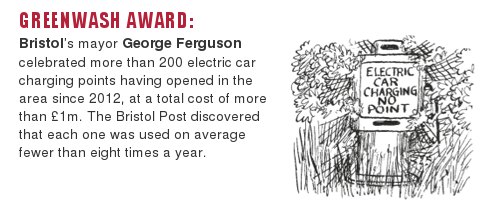
    As a fitting end to Bristol’s year as European Green Capital, Mayor George Ferguson has won the Greenwash Award in Private Eye’s Rotten Boroughs awards for 2015.

    screenshot of Private Eye item

    From your correspondent’s vantage point in the inner city, it has to be said that Bristol’s year as Europe’s beacon of best environmental practice has hardly been crowned with glory, with money wasted on pointless art projects, widespread wildlife habitat destruction and the continuing blight of fly-tipping.

    Will George Ferguson be collecting his award in person from Lord Gnome? šŸ˜‰

  • Home Office defers plans to cut interpreters’ pay

    Today’s Guardian reports that the Home Office has postponed its plans to cut the pay of more than 2,000 interpreters from 1st January 2016. This comes in the wake of a threatened boycott from Home Office interpreters (posts passim), which could cause chaos in the running of the UK’s immigration system.

    According to The Guardian, the Home Office has confirmed that any plans to cut pay will be deferred at least until February while negotiations with the interpreters take place. Considering that Home Office interpreters have not had a pay rise since 2002 (they get a basic Ā£16/hr. on weekdays and slightly more at weekends. Ed.) and the Home Office’s desire to cut what is already fairly meagre pay do not bode well for those negotiations.

    A meeting lasting more than two hours took place between interpreters and the Home Office on 21st December. At the meeting, Home Office civil servants warned the interpreters against speaking to the media in a blatant disregard of the interpreters’ rights under Article 10 of the Human Rights Act 1998. A further meeting between the Home Office and interpreters is planned for the middle of January.

    The Home Office stated as follows after the 21st December meeting: “Following our meeting with the interpreters on 21st December, we intend to defer implementation of this change at least until 1st February 2016 to allow us time to give proper considerations to the views and opinions expressed.”

    Given the government’s arrogant refusal to listen to anyone besides its donors and beneficiaries, it looks like the next linguistic sacrifices on Whitehall’s altar of austerity will be Home Office interpreters, following on from the Ministry of Justice’s interpreters, the overwhelming majority of whom refused to work for the abysmal rates offered by Capita Translation & Interpreting (posts passim) and have been boycotting court and tribunal work for the last couple of years.

  • PI4J writes to Home Office on reduced interpreter pay rates

    PI4J logoProfessional Interpreters for Justice (PI4J), the umbrella group representing over 2,200 NRPSI registered and qualified interpreters working in 135 languages, has written to the Home Office’s Central Interpreters Unit in Liverpool regarding the proposed pay cut for Home Office interpreters which is due to come into effect on 1st January 2016 (posts passim).

    The text of PI4J’s letter is reproduced below.

    Central Interpreters Unit
    Interpreter Operations Unit
    UK Visas & Immigration
    The Capital
    New Hall Place
    Liverpool
    L3 9PP

    By Email: CIU@homeoffice.gsi.gov.uk

    21 December 2015

    Dear Sir/Madam,

    Re: Introduction of reduced rates of Home Office interpreters’ pay from 1st January 2016

    Professional Interpreters for Justice (PI4J) is an umbrella group representing over 2,240 interpreters
    from both the National Register of Public Service Interpreters (NRPSI) and the National Union of British Sign Language Interpreters (NUBSLI). Our aim is to work with government to ensure the quality of interpreting available to the Justice System and in the Public Sector.

    Reliable communication provided by qualified professional interpreters and translators is an essential resource which ensures that justice and human rights are upheld for non-English speakers and deaf people. This is put at risk if standards are dropped and quality is sacrificed.

    On 20th November 2015 interpreters received a notice regarding a reduction in rates to due to take place on all bookings undertaken on behalf of the Home Office (HO), including UK Visas & Immigration, Border Force, Immigration Enforcement and HM Passport Office and any other bookings made through Interpreter Operations Unit, from 1st January 2016 onwards.

    PI4J is extremely concerned about this decision to slash interpreters’ rates of pay, without any
    consultation with or input from interpreters and their representative bodies.

    This decision will most certainly have serious implications for the supply of competent, qualified professional interpreters to the Home Office. These interpreters have provided ongoing linguistic support and expertise to the Home Office over the years, including in many rare and hard-to-find languages.

    Interpreters have demonstrated in the last four years that they can and will refuse to work for low rates set by so-called ‘market forces’, thereby significantly reducing the pool of qualified interpreters and translators available to work in the public services.

    This is evidenced by the detrimental decline within the Ministry of Justice’s Court Interpreting Service since they outsourced to a private agency in 2012. We assume that you are aware of the extensive coverage in the media regarding the subsequent disruption and chaos visited upon the courts and the delays and collapse of court cases, resulting in an enormous waste of time and money and two Parliamentary hearings (see below links).

    PI4J has been at the forefront of the professional interpreters’ campaign against the unacceptable lowering of standards and quality in public service.

    The standard of interpretation is fundamental to allow access to a fair hearing and justice for vulnerable minorities in the asylum and immigration system and to assist enforcement agencies in the prevention and detection of serious crime. They must be afforded equal access to the highest levels of linguistic support.

    Standards must include minimum professional qualifications for Public Service Interpreters (PSI) and BSL/English Interpreters, Deaf interpreters and Sign Language translators, to include mandatory NRPSI/NRCPD/SASLI registration and independent regulation.

    Without these safeguards, access to justice will be denied and human rights and race relations will be jeopardised.

    In addition, we reiterate that in order to attract and retain qualified and experienced professional interpreters and language professionals, equitable and sustainable terms and conditions need to be put in place.

    Professional interpreters invest substantial time, effort and money to gain and maintain their skills. The proposed cut means that Home Office interpreting work will become part of the low-paying industries.

    It is important to point out that there has not been an increase in the Home Office interpreting rates for many years now. They were further eroded by inflation and the growing cost of living in the UK, especially in areas such as London. In addition, failure to provide reimbursement for travel time under 3 hours each way and travel expenses up to 100 miles, particularly in view of the remote locations of many of the Home Office and detainee centres, make the rates even more unattractive.

    Remuneration must reflect the fact that these are gross hourly rates for self-employed interpreters, liable to pay Income Tax and National Insurance, who have no pension, holiday or sick pay, and no job security.

    The impact of the cuts places interpreters’ livelihoods at risk and will mean that public service interpreting will no longer be a viable career. As skilled professionals they will seek to earn a better living in other sectors.

    This in turn will result in reduced quality of language services and a back-log to a system which is already struggling.

    Full support of professional interpreters and appropriate terms & conditions is the only way forward to ensure the quality and success of any future arrangements for the provision of language services in the public service sectors and to avoid a market exit.

    In the interest of all involved and the system itself, we urge you to reconsider this troubling and counterproductive decision.

    Yours faithfully,

    Klasiena Slaney
    For and on behalf of the Professional Interpreters for Justice

    Professional Interpreters for Justice (PI4J) Member Organisations:
    Association of Police and Court Interpreters (APCI) – chairman@apciinterpreters.org.uk
    Cymdeithas Cyfieithwyr Cymru; (CCC) – geraint@cyfieithwyrcymru.org.uk
    Institute of Translation and Interpreting (ITI) – chiefexec@iti.org.uk
    National Register of Public Service Interpreters (NRPSI) – chairman@nrpsi.org.uk
    National Union of Professional Interpreters and Translators, part of Unite the Union (NUPIT)
    – nupit@unitetheunion.org
    National Union of British Sign Language Interpreters part of Unite the Union (NUBSLI)
    – branchsecretary@nubsli.com
    Society of Official Metropolitan Interpreters UK Ltd (SOMI) – board@somiukltd.com
    The Chartered Institute of Linguists (CIOL) – keith.moffitt@ciol.org.uk

    Links:
    Professional Interpreters for Justice (PI4J), includes links to Parliamentary hearings and dossiers of failings
    RPSI Linguist Lounge and Professional Interpreters’ Alliance, collected news reports about the outsourcing of public service interpreting in the UK
    National Register of Public Service Interpreters (NRPSI)
    National Registers of Communication Professionals working with Deaf and Deafblind People (NRCPD)
    Scottish body for training and qualifying British Sign Language interpreters (SASLI)
    National Union of British Sign Language Interpreters (NUBSLI)

  • Statement by leaders of Fair Payment Campaign for HO interpreters

    The leaders of the Fair Payment Campaign for Home Office Interpreters have issued the statement below in response to the Home Office’s plan to cut their pay with effect from 1st January 2016 (posts passim). The statement originally appeared on Linguist Lounge.

    The Fair Payment Campaign for Home Office Interpreters resulted from a notice they received in November 2015 in relation to a reduction in rates due to take place on all bookings undertaken on behalf of the Home Office, including UK Visas & Immigration, Border Force, Immigration Enforcement and HM Passport Office and any other bookings made through Interpreter Operations Unit, from 1st January 2016 onwards.

    Professional qualified Home Office interpreters are standing up against the proposed cuts to our already meagre fees which have been unchanged in at least 13 years. While cuts are being proposed, we contend that we have in fact been subsidising the Home Office over the years by the lack of increase in our fees.

    Many interpreters and their supporters have already written to the Home Office Central Interpreters’ Unit expressing their dismay and opposition to these cuts in rates which were already much eroded through inflation, and mean that it will no longer be feasible for them to continue working in this field.

    This will result in a diminishing pool of qualified, experienced and vetted interpreters for the Home Office, detrimental both to them but especially so to the great number of vulnerable people who depend on reliable interpreting services to put their cases across since they are unable to do so themselves. Their lives may be at stake. The right to a fair hearing is enshrined in international human rights law.

    As a result of our letters and petition, campaign leaders have been invited to meet with CIU senior managers on Monday 21st December 2015. We shall keep colleagues updated as to the outcome of that meeting.

    We shall be listening to what they say, re-iterating the contents of our petition letter and also making a point to stand firm on those points.

    We have it on good authority that the strength and unity of our campaign stands us in good stead: our unity is our strength.

    We shall capitalise on this fact and we must not forget the fiasco with the Ministry of Justice outsourcing of Court Interpreting Services to a private agency in 2012, which resulted in many qualified interpreters declining to continue working in that sector and consequently the lowering of standards and quality of services, causing the delay and collapse of many court cases, as can be verified by the extensive media coverage about this matter which can be found on this Linguist Lounge.

    We have collected hundreds of signatures and many interpreters are still contacting us to join the Campaign.

    We have the support of non-Home Office interpreters, translators and non-linguists. Some of these supporters have also written to CIU about their dismay, disappointment and disgust at what is being proposed.

    The Fair Payment Campaign for Home Office Interpreters also has a social media presence on both Twitter and Facebook.

  • Sign petition to help save RiL

    Routes into Languages logoIn the never-ending austerity drive, the government is now threatening to cut funding to Routes into Languages, a vital resource for language learning in the UK.

    Language learning in the UK has lagged behind other countries – particularly other EU member states – for as long as I can remember and looks likely to get worse if this latest funding cut goes through.

    A petition has been organised on the UK Government and Parliament petition website. The petition’s text reads as follows:

    Routes into Languages (RiL) works with schools and colleges to promote language learning. It works with teachers to develop and roll out innovative projects such as Mother Tongue Other Tongue and the Foreign Language Spelling Bee which benefit students and motivate them to learn languages.

    Routes into Languages has worked tirelessly across the country to develop a range of regional and national networks to support schools and teachers to be innovative, raise students’ aspirations and make the case for language learning.

    To lose this resource would be devastating, the RiL Spelling Bee alone involved 77,000 Year 7 students last year and this is only one example of the work that Routes does to offer free opportunities to all schools.

    Please sign the petition to change this decision.

    At the time I signed, some 6,000 signatures had been added to the petition.

  • Boycott threatened as Home Office ready to cut interpreters’ pay

    image of Theresa May
    What is it about the office of Home Secretary that turns people into control freaks?
    Yesterday’s Guardian reports that the Home Office wants to cut the pay of the estimated 2,000 interpreters it uses in processing immigration claims.

    Interpreters received an email from the Home Office’s central interpreters unit in Liverpool on 20th November notifying them that their pay would be cut from 1st January.

    Interpreters currently receive Ā£16 per hour for working weekdays and slightly more at weekends. In addition, a Home Office interpreter’s first hour of work is paid at an enhanced rate to reflect the time and cost of travelling to appointments; this is being reduced from Ā£48 to Ā£32 on weekdays and from Ā£72 to Ā£46 at weekends.

    Home Office interpreters have not had a pay increase since 2002, i.e. they’ve already had 13 years of de facto pay cuts – and the actual pay cut announced for the New Year will be implemented in various areas of the Home Office’s work, including UK Visas and Immigration, Border Force, Immigration Enforcement and HM Passport Office. For this work they have to be highly trained and undergo counter-terrorism security clearance.

    As a result of this insulting treatment by Theresa May’s department, interpreters are threatening a mass boycott. The boycott is planned to start on 1st January, followed by a series of walk-outs thereafter.

    One unnamed organiser told The Guardian: “There is no strike planned because, as freelancers, we cannot legally do so. We may, however, choose not to accept assignments and that is what the boycott will consist of.”

    “At the moment, the Home Office needs interpreters more than we need them. They do not have any other system currently in place to substitute our services other than for telephone interpreting, which they can outsource to thebigword. They know that if we boycott even for a day, that will cause major disruptions to their business.”

    In addition, the interpreters have written to the Home Office to express their disgust at this disgraceful treatment and the lack of consultation, the latter being a breach by the Home Office of the interpreters’ contractual terms.

    As per usual with this dreadful government, the Home Office spokesperson contacted by The Guardian insisted that the department had done nothing wrong and everything was hunky dory.

    From where I’m sitting, it looks like there’s every chance of a repeat of the drop in professional standards and other farcical states of affairs that occurred when the Ministry of Justice placed interpreting for courts and tribunals in the incompetent hands of Capita Translation & Interpreting (posts passim).

  • No fossil fuel power plant in St Werburghs

    On Wednesday councillors on Bristol City Council’s Development Control Committee B voted overwhelmingly – by 8 votes to 2 with one abstention – to accept the planning officers’ recommendation to refuse an application filed by UK Power Reserve Ltd. for 14 gas-fired generators with 11 metre high flues for a site off Gatton Road.

    The recommendation for refusal was soundly based on both national and local planning guidelines for reasons of noise and air pollution, plus visual amenity.

    drawing of one of the 14 generators refused planning permission
    One of the 14 generators refused planning permission

    The application attracted nearly 700 objections and over 50 personal statements by members of the public, including your correspondent, whose statement is reproduced below.

    I have been a resident of the Easton area for nearly 4 decades.

    I have read the case officer’s report on this application and am pleased to note he has recommended its rejection since it contravenes both local and national planning policies in many regards.

    It should be pointed out that this speculative application – one of 3 for fossil fuel generating plants in Bristol’s less prosperous communities – is being driven by central government’s ideologically-driven mismanagement of electricity production in the UK.

    I live downwind of the proposed facility and feel the air quality in my part of Easton is already bad enough with the traffic pollution from the M32 and Stapleton Road, plus diesel fumes from the nearby railway line.

    By filing this application in the way it did, the applicant has shown contempt both for the local authority and local residents in St Werburghs and Easton.

    Contempt to the local authority is demonstrated by the application’s filing during Bristol’s year as European Green Capital. Nothing further need be said on that point in respect of a generating plant powered by polluting fossil fuels.

    As regards local residents, consultation has been minimal and I believe that the applicant is guilty of what is called ā€œenvironmental racismā€. This is a concept from the United States defined as: ā€œis placement of low-income or minority communities in proximity of environmentally hazardous or degraded environments, such as toxic waste, pollution and urban decayā€.

    If this facility is so clean and aesthetically pleasing to the eye, why did the applicant not decide to site in, say, Stoke Bishop?

    Any future applicant thinking of indulging in further environmental racism in Bristol’s inner city communities will be told very firmly what they can do with their applications and where they can stick their proposed facilities.

    Three local councillors – Rob Telford and Gus Hoyt from Ashley ward – and Lawrence Hill’s Marg Hickman also spoke against UKPR’s plans.

    There was only one speaker from the public gallery in support of the application; and that was from UKPR’s agent. He urged the committee to defer a decision to allow them to mitigate the air quality impact by fitting catalytic converters, reduce noise problems and reduce the height of the chimneys. However, the councillors on the committee gave this late concession short shrift.

    Indeed, the only councillor on the committee to speak in favour of the application was Conservative Richard Eddy (described as a ‘dickhead’ by a fellow councillor. Ed.). He and fellow Tory Kevin Quartley voted in favour of the power plant, whilst Chris Windows, the third Tory on the committee, abstained.

    Two further planning applications for similar plants powered by dirty diesel in Lockleaze and at Avonbank (posts passim) were withdrawn a few days before the meeting. Along with the St Werburgh’s application, they would have formed part of the STOR back-up energy programme subsidised by the Government.

Posts navigation