Bristol Post Balls 3 – everyday sexism
The Bristol Post’s gaffes are not restricted to its website and dead tree version.
Yesterday its Twitter feed yielded the following bit of everyday sexism (and no apology when challenged. Ed.).

The Bristol Post’s gaffes are not restricted to its website and dead tree version.
Yesterday its Twitter feed yielded the following bit of everyday sexism (and no apology when challenged. Ed.).
Below is a screenshot of the story in today’s Bristol Post reporting on Professor Peter Higgs – one of the team that postulated the existence of the particle named after him back in the 1960s – being granted the freedom of the city of Bristol.
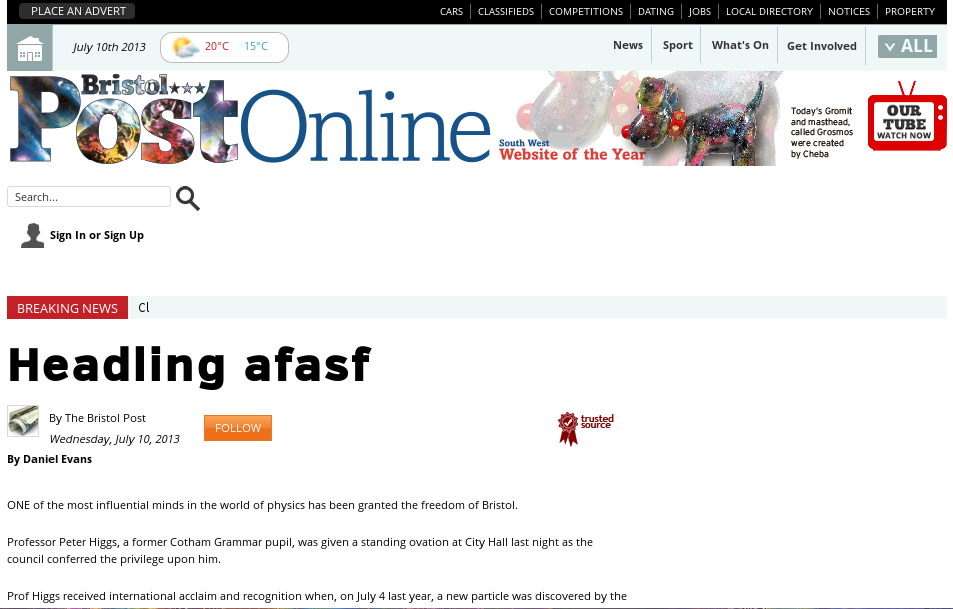
Professor Higgs is a former pupil of Bristol’s Cotham Grammar School.
For a local media report of the event that has a proper headline, I recommend Bristol 24/7’s offering.
Bristol & Avon Family History Society has some interest background information on the history of the Freedom of Bristol and Burgesses, as Freemen (and they were men in medieval times. Ed.) were originally known.
It’s always a good idea to keep one’s ears open walking around the city – or anywhere for that matter.
Yesterday lunchtime when crossing St Philips Bridge (below) my ears heard a real treat – a peregrine falcon in the heart of Bristol.


I’ve seen peregrines before near Bristol, particularly down the Avon Gorge, where I’ve spotted them nesting in the Gorge’s old quarries, but never before in the heart of the city.
Naturally, I was quite excited by this and asked Bristol’s Twitter users how unusual this was. After a couple of hours, I received a reply from naturalist and broadcaster Ed Drewitt, who informed me there was a “family of 3 chicks around Cabot Circus way” (they might help keep the city centre’s gull and feral pigeon population under control. Ed.).
Around my home patch of Easton I have over the years seen both sparrowhawks and kestrels, whilst moving further afield the patchwork of open grassland and woodland on Purdown and Stoke Park is ideal buzzard territory.
Finally, there’s one bird of prey I believe I’d heard that I’d really love someone else to corroborate. Returning home some years ago, I could have sworn I heard a tawny owl hooting in the vicinity of the railway embankment between Stapleton Road and Lawrence Hill railway stations. If anyone else has heard hooting there too, I’ll know I wasn’t imagining things. 🙂
Spot the typographical error in the headline below from today’s online edition of the Bristol Post.

According to its website, the World Wide Web Consortium (W3C) is an international community where its member organisations, a full-time staff and the public work together to develop web standards, whose mission is to lead the Web to its full potential.
These standards have so far been characterised by complete openness: all web standards are open standards.
However, these open standards are now under attack.
There’s a proposal currently before the W3C’s HTML5 Working Group to build DRM (aka Digital Restrictions Management by openistas. Ed.) into the next generation of core web standards. The proposal is called Encrypted Media Extensions or EME.
The people behind EME are the major media companies; having failed to push such illiberal measures as SOPA and PIPA through the US legislature, the Big Media moguls are now going through non-governmental channels to try to sneak digital restrictions into every interaction people have online.

Netflix, Google, Microsoft and the BBC are all rallying behind this ludicrous proposal, which – as stated above – flies in the face of the W3C’s mission.
However, a petition has already been set up to oppose the addition of DRM to HTML5 and 3rd May 2013 has been designated the International Day Against DRM.
The petition page is also available in French.
I’d urge everyone interested in open standards and all other forms of openness – such as open data and open source – to sign the petition; I’ve already done so.
This article is reposted with some minor amendments from Bristol Wireless.
The Bristol Post is not particularly renowned for the quality of its journalism.
This point of view was borne out by its report today on public works in Weston-super Mare, which features the following paragraph:
The species to be planted include silver birch, hazel, Scots pine, Himalayan plain, London plain and common alder. Work on removing the trees is due to start this week.
Himalayan plain? London plain? The Post should be sent to sit in shame in homophone corner until it learns the difference between a plain tree and a plane tree and promises not to make such elementary sub-editing errors in future.
However, the Post is not only guilty of falling victim to homophony and failing to do a bit of basic sub-editing. Indeed it is also guilty of churnalism – “a form of journalism in which press releases, wire stories and other forms of pre-packaged material are used to create articles in newspapers and other news media in order to meet increasing pressures of time and cost without undertaking further research or checking”.
Checking back on the source of the story in question, one arrives at a North Somerset Council news item of 20th February 2013, where – lo and behold – the following sentence appears:
The species to be planted include silver birch, hazel, Scots pine, Himalayan plain, London plain and common alder.
Thus the anonymous Post hack quoted initially has merely repeated the error of the original author of the news in North Somerset.
This blog has pointed out before that North Somerset is a strange place (posts passim), but having an illiterate write news on the council website is just plain perverse.
As an exiled Salopian, the Shropshire Star forms part of my regular online reading.
Imagine my surprise earlier when I discovered that there is a spark of republicanism in my home town of Market Drayton, as shown by the following letter from Draytonian Andrew Lovatt.
While thousands of the Queen’s subjects are born into poverty, her third great-grandchild will be born into a position of high status and comfort.
The royal inequality gap is in direct contradiction to everything that 21st century Britain claims to stand for.
Keep up the good work, Andrew! You probably feel quite lonely. 🙂
Through my role as secretary of Bristol Wireless, I’ve been involved in the campaign against the Government’s proposed Communications Data Bill and today had the article below posted on local news website Bristol24/7.
In June of this year, the Government published its draft Communications Data Bill, dubbed a Snoopers’ Charter by opponents. Under this Bill, internet service providers and mobile operators such as Virgin Media, BT and Vodafone would be obliged to log the internet, email, telephone and text message use and retain this data for 12 months.
Furthermore, the draft Bill also seeks to demand communications data from such social media sites as Facebook and Twitter that are based overseas, as well as search engines like Google.
As such, these powers are overly broad, infringe the citizen’s right to privacy and would divert crucial funds away from other areas of policing at a time when front-line policing is generally facing cuts of some 20%. The serious criminals, terrorists and paedophiles, who the Home Office says this Bill targets, would still be able to avoid detection by taking fairly simple measures. By taking such a broad brush approach, the population of the UK would be transformed from a nation of some 60million citizens to a population of some 60m criminal suspects.
A Joint Committee of MPs and peers was set up to examine the draft Bill. On Tuesday, December 10, the Joint Committee report was published and delivered a damning verdict on the Home Office. It says the Home Office gave “fanciful and misleading” evidence for “sweeping” powers that go beyond what they “need or should”.
Furthermore, the Joint Committee’s report also criticised the projected £1.8 bn. cost of implementing the Bill’s proposals, reckoning that this cost will probably be exceeded “by a considerable margin”. In view of central government’s past record on IT projects, the Committee’s assessment will more than likely prove true.
There is no doubt that current laws to monitor communications are outdated and were not drafted for a digital age where there is more personal data being created than ever before. However, the Communications Data Bill is not the answer. It should not simply be redrafted with minor modifications and resubmitted to Parliament, as the Prime Minister and Home Secretary seem committed to doing, judging from their public statements since publication of the Joint Committee’s damning report.
Even under the present arrangements, 600 public bodies have potential access to citizens’ data and 500,000 surveillance requests were made last year.
The UK needs a full review of surveillance laws before any new laws – such as the Communications Data Bill – are drawn up. The review should consider how pervasive and personal data has become. It should also examine how to bring about proportionate and appropriate powers for the collection, storage and use of our data.
The Home Office has shown itself to be unable to strike an appropriate balance between security and privacy and appears to be wholly ignorant of the technical issues involved with policing online crime, such as the use of encryption. It should take part in a review but must not be allowed to lead it.
The Communications Data Bill is akin to using a sledgehammer to crack a nut and, if implemented would place the UK on a par with repressive regimes like Iran and China, which HM Government likes to criticise for their illiberal measures without being able to recognise their own hypocrisy.
I would urge everyone with an interest in their own privacy and liberties as a citizen to lobby their MPs to kill this Bill and request a review of surveillance laws as outlined above.
Ever since I arrived in Bristol, I’ve been both dismayed and amused in equal amounts by the abysmal standards of English in the local press.
This ancient tradition’s greatest proponent has been the alleged local paper of record, the Bristol Evening Post, whose publication is now reduced to 5 days a week as sales of the dead tree edition decline; its name has likewise been truncated to the Bristol Post.
Today the Post revealed an exclusive. Bristol has a literate cricket ground, presumably able to speak and write, as evidenced by the following Post quote:
The ground, in Nevil Road, St Andrew’s, released a statement this morning.
If the ground really does talk, Gloucestershire [County] CC should be very proud of it since this particular skill is far more impressive than its cricketing record. 😉
Update: 6th November 2012: Jon Eccles has since remarked that the County Ground is “the first sports facility of any kind to pass the Turing test“.
It not just the UK’s Ministry of Justice that’s having trouble with outsourcing (posts passim). Over in Finland Broadcast Text International may now find it hard to fulfil its contracts following the mass resignation of 98 subtitlers.
Finnish blog Av-kääntäjät reports that the 98 subtitlers resigned after being outsourced to Broadcast Text International by major commercial broadcasting company, MTV Media.
All told, a total of 110 subtitlers working under freelance contracts for MTV Media were outsourced on 1st October to BTI International, a subsidiary of Broadcast Text International. Under Finnish law, outsourced employees have a right to resign without notice during the first month after the deal and 98 subtitlers have consequently jumped ship, voicing concerns about their being outsourced to a company that pays its current subtitlers minimal wages, forces them to become entrepreneurs instead of employees, claims copyright to all subtitles produced and refuses to engage in collective bargaining.
Broadcast Text International has not commented so far and has also not responded to the concerns voiced by the subtitlers or responded to invitations from trade unions to open negotiations.
Hat tip: Richard McCarthy