open standards

  • NTP updated to counter attacks

    NTP graphicIt’s that time of year again when summer daylight saving time has just ended in Europe and the developers of the NTP time synchronisation service are responding to a series of new attacks with an update, German IT news site heise reports. With these attacks communication between servers and clients can be manipulated so that the clients receive the incorrect time or no time at all.
    The reference implementation of the NTP time server service is now version 4.2.8p4, with which the developers have closed 13 security holes, including a series of vulnerabilities which four Boston University researchers describe in detail in a research paper (PDF). The researchers succeeded in finding several ways of attacking the time service, including preventing clients of the service from using it, also known as a Denial of Service (DoS) attack and providing them with the wrong time under certain circumstances.

    NTP is used to synchronise the local clocks of all kinds of computers via the network. Various providers make different servers available which a client can query for the current clock time. Nearly all modern operating systems adjust this unnoticed in the background. Nevertheless, there have been attacks in the past on software implementations of this system and on the NTP protocol itself.

    Kiss of death

    Two of the new attacks are characterised mainly by the fact that the attacker does not need to hook up to the connection between client and server as a “man in the middle“. Both kinds of DoS attack take advantage of the so-called “Kiss o’ Death” (KoD) packet to cripple communication between the client and server. The KoD packet tricks the client into thinking that a NTP server is very busy or overloaded and the client should send fewer queries.

    Attackers can now fake packets for all services which a client normally queries for its time; and do so in such a way that the client doesn’t update its internal clock for months or even years on end. The elegant thing about this hack is that the attacker only needs to send very few packets. In the second attack possibility described by the researchers the attacker must fake many client requests and thus force the server to silence the client with KoD packets. This also results in the client no longer updating its clock.

    Both holes (CVE-2015-7704 and CVE-2015-7705) have been plugged in the new version of NTP.

    Time shift

    With 2 further attack methods the researchers succeeded in foisting incorrect clock times on clients. Clients should normally ignore times which differ by more than 1,000 seconds from their system time – the so-called “Panic Threshold“. However, in many configurations this does not apply to NTP queries sent immediately after a reboot of the client. Their system times can therefore be manipulated almost at will if they can be forced to reboot. Cryptography operations can be gerrymandered or DoS attacks conducted on the software running on the client with such a manipulation.

    The intentional fragmentation of IPv4 packets can also be abused to confound a client’s time queries and foist an incorrect time on it. However, this method is very fiddly and the researchers did not want to test in the the wild since it uses the techniques of the decades-old Teardrop attacks and can crash old operating systems. This problem with overlapping TCP/IP packets is not a specific error of the NTP protocol, but of the underlying operating systems.

    Admins should patch NTP

    The Boston University researchers discovered the security holes on 20th August. Their paper has only been published now to give the NTP developers time to plug the holes. The researchers are recommending that admins running NTP servers update them as quickly as possible to version 4.3.8p4.

    Reposted from Bristol Wireless.

  • UK government to switch to open source office suite

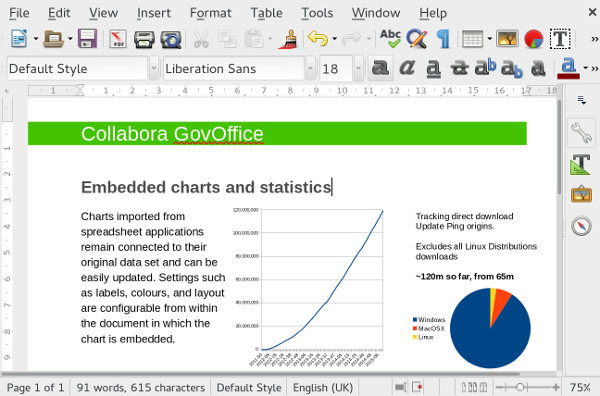
    A new deal announced today between the Crown Commercial Service and open source consultants Collabora will provide public sector organisations with savings on GovOffice, an open source office suite based on LibreOffice.

    Collabora GovOffice is is compatible with both Google Docs and Microsoft Office (including the cloud version Office 365) and includes comprehensive support for the latest version of Open Document Format, which is recommended by the Cabinet Office for use by government organisations.

    With a familiar interface for creating documents, spreadsheets, presentations and more (none of that ribbon nonsense. Ed.), Collabora GovOffice offers considerable cost savings compared to competing proprietary packages.

    GovOffice screenshot

    In addition, the forthcoming Collabora CloudSuite will extend Collabora GovOffice with internet and mobile access for viewing and editing documents, as well as online access in web browsers. IT managers will be able to deploy the cloud software locally, providing remote access to documents.

    The deal covers both Collabora products and applies to all non-profit making government organisations, including those working on behalf of government, either directly or via outsourcing.

  • LibreOffice 5.1 – first bug hunting session announced

    Writing on The Document Foundation blog, Italo Vignoli has announced that a bug hunting session will take place from 30th October to 1st November for LibreOffice 5.1, the next planned major release of this popular open source office productivity suite.

    LibreOffice 5

    Over those 3 days, volunteers and members of the LibreOffice community will check the first alpha of LibreOffice 5.1 for bugs and flaws.

    On those dates, mentors will be available on the QA IRC channel and via email on the QA mailing list from 08.00 a.m. UTC to 10.00 p.m. UTC to help less experienced volunteers to triage bugs.

    People who cannot participate the bug hunting session are always welcome to help chasing bugs and regressions when they have time. There will be a later bug hunting session in December this year to test LibreOffice 5.1 Release Candidate 1.

    Additional information on bug hunting is available on The Document Foundation wiki.

  • ODF is a “financial and social responsibility”

    ODF logoThe Dutch government wants to accelerate the adoption of Open Document Format by the country’s public sector according to a press release by the government’s Standardisation Board.

    On behalf of the government, the Standardisation Board is determined to speed up ODF’s adoption throughout the government.

    This was one of the most important announcements made at the 11th ODF Plugfest held in The Hague, where a group of international developers, EU policy-makers, digital archivists, academics and other experts assembled to discuss the Open Document Format, an XML-based file format for spreadsheets, charts, presentations and word processing documents that was developed with the aim of providing an open, XML-based file format specification for office applications.

    “In view of its extent, the public sector is an important stakeholder when a sound future for office applications is involved”, says Steven Luitjens, the director of Logius, the largest operational IT organisation within the Dutch government. “It is our financial and social responsibility to bring about an improvement. We are therefore increasing our efforts in the Netherlands. We want to play an important role in the huge transition from commercial productivity packages to better, bespoke solutions based on open standards which lies ahead of governments and the private sector.”

    ODF is top priority

    “The need to adopt ODF speaks for itself,” says Nico Westpalm van Hoorn, Chairman of the Standardisation Board, which is concerned with the choice of IT standards for the government. “However, the adoption is proceeding too slowly. ODF is therefore out top priority”.

  • LibreOffice 5.0.2 announced at LibreOffice Conference

    To underline the importance of the event for the community, The Document Foundation (TDF) has today announced the release of LibreOffice 5.0.2 during the opening session of the 2015 LibreOffice Conference in Aarhus, which runs until Friday 25th September.

    LibreOffice 5.0.2 is the second minor release of the LibreOffice 5.0 family, with a large number of fixes over the first minor (5.0.1) release announced in August. Based on feedback from the marketplace, the LibreOffice 5.0 family has so far proved the most popular LibreOffice release ever.

    LibreOffice 5

    LibreOffice 5.02 will offer OpenGL rendering by default on Windows for the first time for those with the very latest Windows drivers. In the event of problems, this functionality is easy to disable by accessing Tools > Options.

    LibreOffice 5.0.2 is aimed at technology enthusiasts, early adopters and power users. For more conservative users and for enterprise deployments, TDF recommends the “still” version: LibreOffice 4.4.5. For commercial deployments, The Document Foundation recommends the backing of professional support by certified people.

    People interested in technical details about the release can access the change logs via the following links: bugs fixed in RC1 and bugs fixed in RC2.

    LibreOffice 5.0.2 is available for immediate download from http://www.libreoffice.org/download/.

  • Dutch public sector to adopt ODF as standard?

    ODF file iconThe Dutch Standardisation Board would like to see the mandatory use of Open Document Format (ODF) for the country’s public sector organisations, according to a report on Joinup giving details of a presentation made by Nico Westpalm van Hoorn to the recent ODF Plugfest held in The Hague.

    Van Hoorn stated that over 450,000 documents are transferred each day between the Dutch central
    government and citizens or companies.

    His presentation contained 3 main messages:

    • The only way reuse of document content is achievable for open data is by using the ODF format;
    • The only way to ensure sustainable access is by using the ODF format; and
    • “This format cannot be opened,” as a remark by a public servant is not acceptable when somebody sends an ODF document.

    Within the Dutch government, ODF is used as the default format for editable documents that are posted online. Documents are by default shared as HTML, PDF (for archiving) and as ODF. Furthermore, all central government workstations are capable of working with ODF, suggesting that civil servants who cannot open the format need some IT training.

    Speaking at the same event, Steven Luitjes, director of Logius – an agency assisting government organisations in building e-government services, admitted that ODF is often ignored by public sector organisations and that a failure to standardise on formats is increasing the cost of public sector IT.

    If the Dutch government does adopt ODF as a standard, this would follow on from the recent announcement of the standard’s adoption by the Italian Ministry of Defence (posts passim) and the UK government’s publication of guidance for the introduction of ODF.

  • LibreOffice & ODF to be adopted by Italian military

    The Italian military is moving to LibreOffice and Open Document Format (ODF), according to Joinup, the EU’s public sector open source news website. This will be Europe’s second largest migration to a free and open source office suite and open standards since the Italian Defence Ministry will be installing LibreOffice on 150,000 machines.

    LibreOffice

    The migration will begin in October 2015 and is expected to be completed at the end of 2016.

    The deployment of LibreOffice will be jointly managed by Libreitalia and the Italian Defence Ministry, with the former providing trainers and the Ministry devising course materials, which will later be released under a Creative Commons licence.

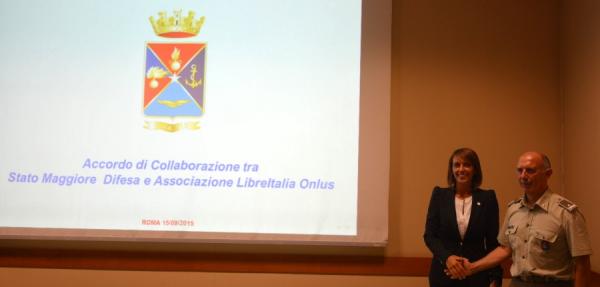
    An agreement between the Ministry and LibreItalia was signed on 15th September in Rome by Rear Admiral Ruggiero Di Biase, General Manager of the Italian Ministry of Defence’s Information Systems and LibreItalia president Sonia Montegiove.

    Sonia Montegiove and Rear Admiral Ruggiero Di Biase

    The Ministry of Defence is the first Italian central government organisation to migrate to open source software for office productivity. On the other hand, many regional public sector organisations have already made this move, such as the Emilia-Romagna region, the provinces of Perugia, Cremona, Macerata, Bolzano and Trento, the cities of Bologna, Piacenza and Reggio Emilia, the Galliera Hospital in Genoa and healthcare ASL 5 in Veneto, to name but a few.

    The Italian Defence Ministry project is also one of Europe’s largest migrations to date to a free and open source office suite. The largest European public sector organisation using free software office suites is currently the French Interior Ministry with some 240,000 desktops. Many French ministries use open source office suites including the Tax Agency, the Finance Ministry, the Ministry of Foreign Affairs and the Ministry of Agriculture. LibreOffice is deployed on some 72,000 PCs within the French Gendarmerie, which also uses Ubuntu Linux as its operating system of choice.

    In June 2014, the autonomous regional government of Extremadura (Spain) confirmed that 10,000 PCs in its healthcare organisation are running open source office applications and that the same is planned for its own 22,000 PCs. In Germany the city of Munich runs also runs LibreOffice on over 17,000 Linux workstations.

  • FSFE supports recognition for User Data Rights

    FSFE logoThe Free Software Foundation Europe (FSFE) has announced today that it supports the publication of the User Data Manifesto 2.0, which aims at defining basic rights for people to control their own data in the internet age. The manifesto is published today and also supported by GNOME, KDE, Netzpolitik.org, ownCloud, Spreed, “Terms of Service – Didn’t Read” and X-Lab.

    Whether for social networking, collaboration or for sharing pictures, among many other activities, users are nowadays increasingly using online services and are thus at more risk than ever of losing control of their own data.

    According to the User Data Manifesto, people should have:

    • Control over user data access;
    • Knowledge of how user data is stored and which laws or jurisdictions are applicable; and
    • Freedom to choose a platform, without experiencing vendor lock-in. The FSFE believes that Free Software is necessary to guarantee this.

    “The recognition of the User Data Rights defined in the manifesto is an important block to build a free society in the digital age”, says Hugo Roy, deputy coordinator of FSFE’s Legal Team and co-author of the User Data Manifesto.

    The manifesto is a good starting point for an important debate about users’ rights online. The FSFE anticipates other organisations joining the effort to promote online services that respects users’ rights and freedoms.

  • LibreOffice 5.0.1 released

    Yesterday The Document Foundation, the German non-profit organisation behind the LibreOffice productivity suite, announced the release of LibreOffice 5.0.1, the first minor release of the LibreOffice 5.0 family.

    This version comprises a number of fixes compared with the major release – version 5.0.0 – announced on 5th August 5. So far, LibreOffice 5.0 is the most popular version of LibreOffice ever, based on the feedback from the marketplace.

    LibreOffice 5.0.1 is aimed at technology enthusiasts, early adopters and power users. For more conservative users and commercial deployments, The Document Foundation recommends LibreOffice 4.4.5. For commercial deployments, The Document Foundation suggests engaging certified professional support.

    Those interested in technical details of the release can consult access the change logs at https://wiki.documentfoundation.org/Releases/5.0.1/RC1 (fixed in RC1) and https://wiki.documentfoundation.org/Releases/5.0.1/RC2 (fixed in RC2).

    LibreOffice 5

    LibreOffice 5.0.1 is immediately available for download and users, free software advocates and community members are encouraged to make a donation to The Document Foundation.

  • Whitehall’s latest open standards consultations

    The British government has announced it is now consulting and seeking comments on its latest open standards proposals.

    The standards on which it is inviting comments are:

    Exchange of location point information
    An open standard for the exchange of location information, allowing coordinates to be translated between systems.

    Exchange of property / place address information
    A proposed standard to define and exchange address information between government departments. This is not about changing your postal address, but it could change the way government records information about your location.

    Publishing vacancies online
    A standard to help citizens searching for government jobs and apprenticeships.

    Once the comment period closes, proposals will be assessed by a panel composed of civil servants and industry specialists, which will decide whether the proposal should go forward for consideration by the Open Standards Board. The Open Standards Board will then make a recommendation about the standard’s adoption across government.

Posts navigation