Open Standards

  • Time to ditch Microsoft 365

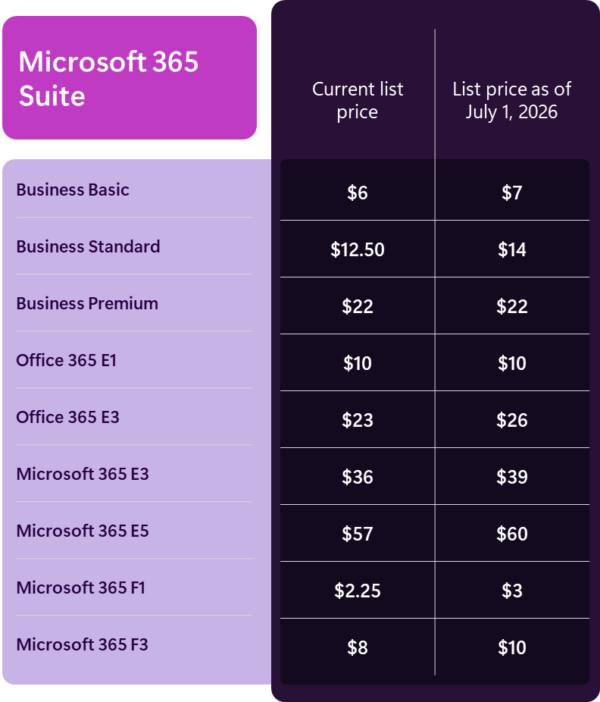
    Microsoft has recently announced it is raising the price of its Microsoft 365 offering from July 2026.

    The new pricing for using Microsoft 365 will be applicable worldwide and as follows.

    Microsoft's pricing for the various MS 365 products from 1st July 2026
    Image courtesy of Microsoft

    Many people will no doubt be considering alternatives to this Microsoft subscription services to help keep business costs in check.

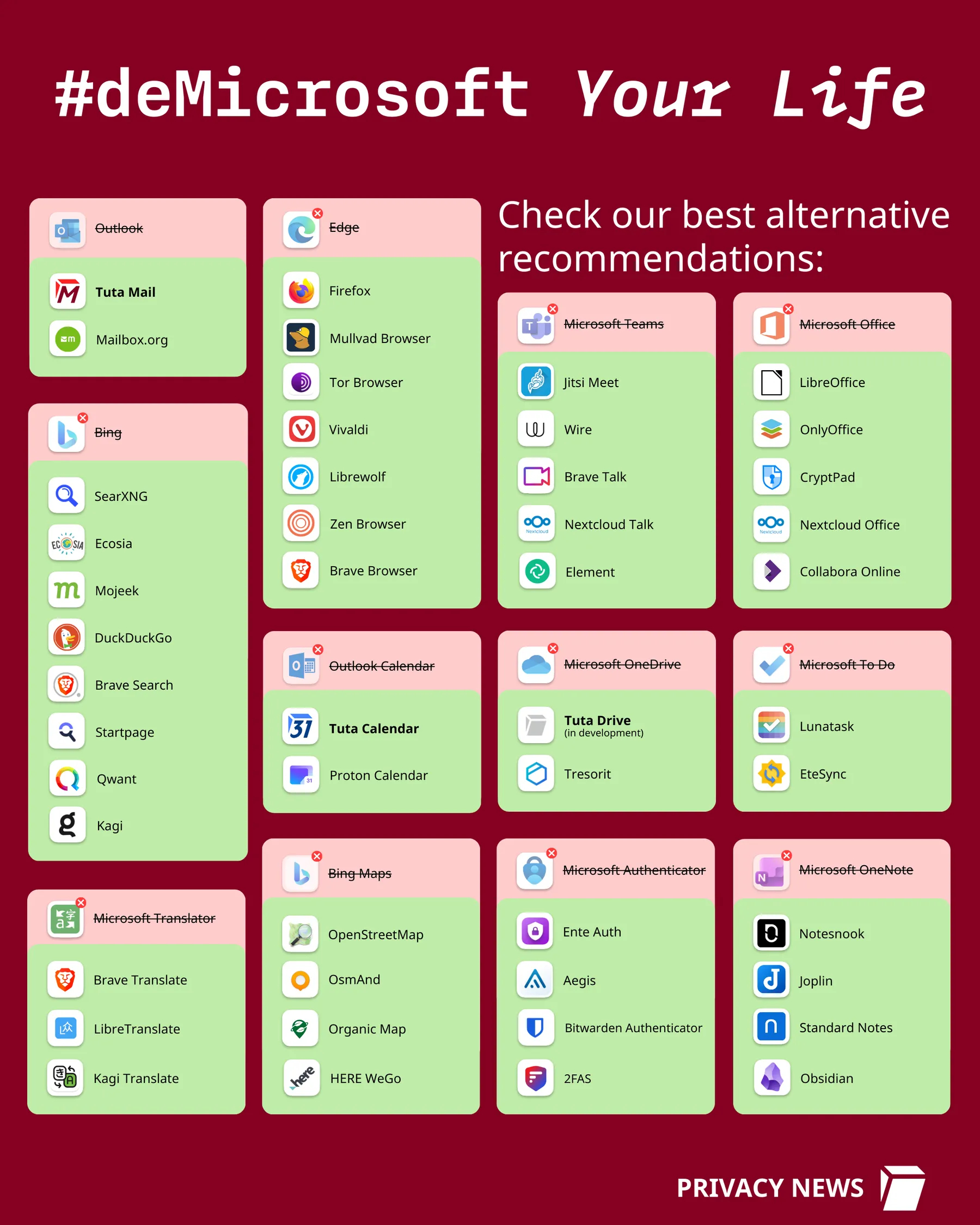
    Fortunately, many free and open source alternatives to the services provided by Microsoft 365 are available, work just as well and won’t cost users a penny. Email provider Tuta.com (recommended! Ed.) has kindly provided a useful summary under the deMicrosoft your life banner which is shown below should you consider ditching Redmond’s overpriced office offering and its other software.

    Free and open source alternatives to Microsoft products
    Click on the image for the full-sized version
  • LibreOffice 25.2.7 released

    The Document Foundation (TDF) has today announced the release of LibreOffice 25.2.7, the final maintenance release for the LibreOffice 25.2 family, which is now available for download. Users of LibreOffice 25.2.x should update to LibreOffice 25.8.x, as LibreOffice 25.2.x is approaching the end of its support period.

    Libre Office banner

    LibreOffice 25.2.7 fully supports two ISO document format standards: the open ODF or Open Document Format (ODT, ODS and ODP) and the closed proprietary Microsoft OOXML (DOCX, XLSX and PPTX) formats.

    Products based on the LibreOffice Technology are available for all major desktop operating systems (Windows, macOS, Linux and ChromeOS), mobile platforms (Android and iOS) plus the cloud.

    For business use, TDF recommends a LibreOffice version optimised for businesses from one of its partner companies, with dedicated value-added features and other benefits such as service level agreements (SLAs) and security patch backports for three to five years.

    Manuals for the LibreOffice 25.2 family are also available in many languages for download. Furthermore, end users can get first-level technical support from volunteers on the user mailing lists and the Ask LibreOffice website.

    Finally, LibreOffice users, free software advocates and community members can support The Document Foundation and the LibreOffice project by making a donation.

  • LibreOffice advises don’t use OpenOffice!

    The developers of LibreOffice, the most popular free and open source alternative to Microsoft’s ubiquitous office suite, are advising against the use of its OpenOffice progenitor due to security vulnerabilities and its lack of development, German news site heise reports.

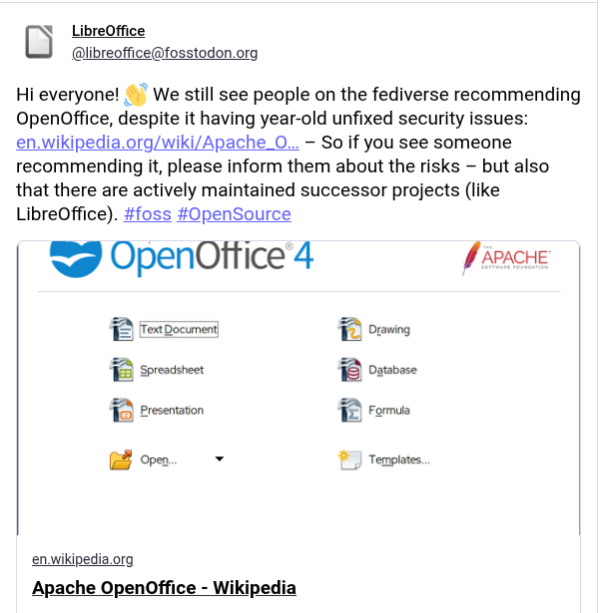
    In a post on Mastodon, they point to security vulnerabilities that have been known for years but still remain unfixed. According to minutes of the Apache board meeting in March 2025, there are three security vulnerabilities in OpenOffice that are more than a year old. This has been confirmed by a representative of the Apache Software Foundation (ASF) security team.

    Post reads 
Hi everyone! We still see people on the fediverse recommending OpenOffice, despite it having year-old unfixed security issues. So if you see someone recommending it, please inform them about the risks - but also that there are actively maintained successor projects (like LibreOffice).

    According to the record there are numerous other, previously unaddressed issues with OpenOffice software, including vulnerabilities have existed since at least November 2023. “We are making progress in identifying improvements to address these issues,” the ASF security team representative explains.

    LibreOffice: Apache Foundation is harming open source

    Furthermore, the LibreOffice developers accuse the ASF of not developing OpenOffice actively any more, but of feigning to do so with minor changes to HTML tags and blank lines. This harms the entire open source community. The ASF has not commented on these allegations. However, OpenOffice has an active project management committee and retains its status as a top-level project within the ASF, according to spokesperson Brian Proffitt. In fact, the recent commits in the OpenOffice GitHub repository have primarily consisted of correcting typographical errors and making minor amendments to translations.

    The current version of OpenOffice, 4.1.15, was released in December 2023. It included several bug fixes and dictionary updates, whilst it last received new features with the release of version 4.1 in April 2014. In the light of this, the LibreOffice team recommends using alternatives and in particular its own office suite.

  • Happy anniversary Open Document Format

    ODF logoToday marks the 20th anniversary of the ratification of the Open Document Format (ODF) as an OASIS standard. Two decades after its approval in 2005, ODF is the only open standard for office documents, promoting digital independence, interoperability and content transparency worldwide.

    Even though it was originally created as an XML-based format to enable universal access to documents across platforms and software from different vendors, ODF has become a technology policy pillar for governments, educational institutions and organisations that choose open, vendor-independent formats to assert their digital sovereignty.

    ODF is the native file format of LibreOffice, the most widely used and well-known open source office suite and is supported by a wide range of other applications, including Microsoft’s ubiquitous office suite.

    ODF has been adopted as an official standard by the ISO (as ISO/IEC 26300) and by many governments on all continents to support digital sovereignty strategies and public procurement policies to ensure persistent and transparent access to content. These administrations include the UK government, which has comprehensive information on sharing and collaborating on government documents using ODF.

    If a reason were required besides those referred to above, one only has to hear the words of Eliane Domingos, Chair of The Document Foundation (TDF), the organisation behind LibreOffice: “In a world increasingly dominated by proprietary ecosystems, ODF guarantees users complete control over their content, free from restrictions”.

  • German state to move to ODF

    ODF file iconGermany’s IT Planning Council, whose duties include IT co-ordination, standards, administrative digitisation and e-government projects, published its decision on open formats for document exchange a couple of days ago. In particular, it specifically mentions the Open Document Format (ODF) as an example of the open formats being used to a greater extent.

    The decision itself consists of three sections, as follows:

    1. The IT Planning Council recognises that open exchange formats are necessary for nationwide collaboration and welcomes the resolution of the Digital Ministers’ Conference. Open formats and open interfaces are an important building block for the necessary process of setting the German public sector on the road to greater digital sovereignty and innovation.

    2. The IT Planning Council is committed to ensuring that open formats such as the Open Document Format (ODF) are increasingly used in the public sector and become the standard for document exchange by 2027. It has commissioned the Standardisation Board to implement this.

    3. The IT Planning Council further recognises that the exchange of documents via email is no longer appropriate for cross-border collaboration, especially for the preparation and follow-up of ministerial conferences, and advocates – in line with the approach of the First Ministers Conference (MPK) – the use of open collaboration solutions in inter-state cooperation. It instructs the Federal IT Co-ordination organisation (FITKO) to present a plan for providing a collaboration solution by its 48th meeting.

    The decision is sure to receive widespread support from the opensource community, as has already happened with The Document Foundation, curators of the LibreOffice suite.

  • LibreOffice 25.2 video subtitled in 17 languages

    LibreOffice 25.2, the latest stable release* of this popular free and open source office suite, contains many new features, which are described in the video below.

    Furthermore, The Document Foundation blog reports that the but has subtitle translations in 17 languages, thanks to our awesome localisation communities!

    In addition, the blog post also includes an appeal for volunteers prepared to help with localisation.

    The video can also be viewed on Peertube, for those who don’t wish to hand their data to the Google subsidiary. 😀

    * = Your ‘umble scribe is currently using a pre-release version – 25.8.0.0alpha0+ – of the software. As intimated by the version number, the second version release this year will take place in August.

  • EU common charger rules implemented

    USB-C connector. Image courtesy of Wikimedia CommonsAs of yesterday, 28th December 2024, EU-wide rules came into effect standardising the charging ports for mobile phones and other portable electronic devices, meaning that henceforth all new devices sold in the EU must support USB-C charging.

    This will hopefully reduce the number of chargers consumers need to buy, help minimise electronic waste and simplify everyday life.

    Some benefits of the common charger are as follows:

    • Increasing consumer convenience: Users can charge their mobile phones and other similar electronic devices with one USB-C charger, regardless of the device brand.
    • Reducing e-waste: Discarded and unused chargers account for about 11,000 tonnes of e-waste annually within the European Union. The new rules encourage reusing chargers, thus helping to reduce the environmental footprint.
    • Saving money: Consumers will now be able to buy new electronic devices without a charger, helping them save approximately €250 million a year on unnecessary charger purchases.
    • Harmonising fast charging technology: New rules help to ensure that charging speed is the same when using any compatible charger for a device.

    The EU’s Common Charger Directive was approved by the Council of the EU in October 2022. Manufacturers were given a transition period to adjust their designs and ensure compliance. From 28 December 2024, the rules apply to mobile phones, tablets, digital cameras, headphones, headsets, video game consoles, portable speakers, e-readers, keyboards, mice, portable navigation systems and earbuds sold in the European Union. The new rules will also apply to laptops with effect from 28th April 2026.

  • Rotten Apple claims DMA’s interoperability violates fundamental rights

    The Free Software Foundation Europe (FSFE) writes that interoperability – a key enabler of software freedom – is under serious threat in the EU from vested US technology interests.

    Apple, rotten to the core.Apple has initiated a legal battle against the European Commission to prevent third-party software developers from accessing essential software and hardware functions of Apple devices. The FSFE believes that control of interoperability should not at the discretion of companies like Apple.

    Consequently the FSFE is taking action, intervening in the EU’s action against Apple to defend interoperability and software freedom. The EU’s Digital Markets Act (DMA) imposes anti-monopoly obligations on very large companies like Apple (they are termed “gatekeepers” in the law. Ed.), forcing the likes of Apple to allow interoperability and granting access seekers (app stores, browsers, payment systems, etc.) free-of-charge access to its APIs. The law mandates the same level of interconnection enjoyed by Apple to third-party software developers – something which Apple is trying to avoid. Apple claims preposterously that interoperability in the DMA violates fundamental rights.

    In contrast, the FSFE argues that interoperability is a cornerstone of public interest in digital markets: interoperability ensures that users and developers have the freedom to choose and create solutions that best meet their needs, rather than being locked into a single environment controlled by a dominant market player like Apple. Free software solutions cannot compete with Apple ‘services’ without effective interoperability, as they are denied access to essential functions on Apple devices, resulting in poorer performance and functionality.

  • Schleswig-Holstein wants to continue switch to open source

    Schleswig-Holstein coat of armsThe government of the German federal state of Schleswig-Holstein is doing further work to implement its aspiration “to consider digital sovereignty holistically” and to switch extensively to free software for its administration, German news site heise reports. Furthermore, it published a strategy (PDF) for “Open Innovation and Open Source” last Monday. The starting signal was the change to LibreOffice as the standard office suite from some 25,000 workstations in April. The new strategy describes the additional measures towards the envisaged “digitally sovereign IT workstation”. This accordingly includes switching to the +1.Linux operating system. This is described as a “suitable and professionally supported” distribution for public sector with a modern, easily adaptable interface.

    In its strategy paper, the government describes the switch to the open ODF (Open Document Format) file format, an open co-operation platform based on NextCloud, as well as Open Xchange groupware with email, calendar and address book as additional measures. In addition to these the plan for “digitally sovereign basic services and specialist services” and a suitable telephony system called Oskar (Open Source Communications Architecture).

    “As frictionless as possible”

    Microsoft Windows, Office, Teams & Co. will be a thing of the past. “The prerequisite for the widespread use of open source products is that the usual functionalities at least function reliably at the same quality,” emphasises Digital Minister Dirk Schrödter (CDU). “We will make the transition as smooth as possible for employees and support the well-planned migration process with training.”

    “Public administration would not be able to function today without smoothly working digital systems,” says Schrödter, promoting the migration. Authorities need “reliable IT components, the purchase of which guarantees freedom of choice, customisation options, competition and control over their own digital infrastructure.” Ensuring digital sovereignty is “at least as important as energy sovereignty”. It is also important to avoid a heavy dependence on proprietary providers.

    “Fundamental change in work culture”

    The state government also hopes for improved IT security, lower costs, more data protection and easier interaction between different systems. An earlier government had set a goal of “completely replacing” Microsoft & Co. in 2017, whilst the previous coalition backed off a bit in 2022, but stuck to the plan in principle.

    The conditions for a switch could hardly be better now, says Schrödter: “The clear trend towards collaborative, location-independent collaboration in the cloud offers a unique opportunity to take the path to digital sovereignty at a time when a fundamental change in work culture is already imminent.”

    Schleswig-Holstein sees the promotion of the regional digital economy as a modern form of industrial policy. “Instead of investing our IT funds in licence fees, we use them to finance development and support contracts,” explains Schrödter. Overall, this strengthens Schleswig-Holstein as a location.

    Other areas of action include the establishment of an Open Source Program Office (OSPO) in the state administration, a strengthening of the DigitalHub.SH, which is intended to connect offices and companies and a stronger focus on more participation via open government with independently verifiable hardware and software. The state also wants to participate in the German Administrative Cloud in order to join the German Centre for Digital Sovereignty (Zendis). The federal government is also pushing ahead with its own open source office suite, openDesk.
  • New point release for LibreOffice 24.2

    The blog of The Document Foundation (TDF) has today announced the sixth point release of LibreOffice 24.2 for Linux MacOS and Windows, which it is describing as “the best choice for privacy-conscious users and digital sovereignty“.

    LibreOffice 24.2.6 banner

    This point release includes over 40 bug and regression fixes over LibreOffice 24.2.5 to improve the software’s stability, plus interoperability with legacy and proprietary document formats. LibreOffice 24.2.6 is aimed at mainstream users and business environments.

    LibreOffice for business

    For business use, TDF strongly recommends the LibreOffice Enterprise family of applications from ecosystem partners with a range of dedicated value-added features, long-term support and other benefits such as SLAs.

    Next week, power users and technology enthusiasts will be able to download LibreOffice 24.8.1, the first minor release of the recently announced new version with many bug and regression fixes.

    As per usual, LibreOffice users, free software advocates and community members are invited to support The Document Foundation with a donation.

    Download LibreOffice 24.2.6. Please note that the minimum requirements for proprietary operating systems are Windows 7 SP1 and macOS 10.15.

Posts navigation