France is to begin replacing Microsoft Windows on the desktop with Linux, the French Digital Ministry has announced.
This change is part of a broader initiative to reduce reliance on non-European digital technologies. Each ministry will be required requires each ministry, to develop a plan by autumn 2026 addressing desktop systems, collaboration tools, antivirus software, AI, databases, virtualisation, and network equipment.
In addition to government departments migrating from Windows to Linux, the National Health Insurance Fund announced a few days ago it was moving its 80,000 employees to France’s own interministerial digital platform’s tools (Tchap secure messaging, Visio and FranceTransfert for the document sharing).
Announcing the initiative, Public Accounts Minister David Amiel remarked as follows:
The State can no longer simply acknowledge its dependence; it must break free. We must become less reliant on American tools and regain control of our digital destiny. We can no longer accept that our data, our infrastructure and our strategic decisions depend on solutions whose rules, pricing, change and risks we do not control. The transition is underway: our ministries, our operators and our industrial partners are now embarking on an unprecedented initiative to map our dependencies and strengthen our digital sovereignty. Digital sovereignty is not an option.
The new pricing for using Microsoft 365 will be applicable worldwide and as follows.
Image courtesy of Microsoft
Many people will no doubt be considering alternatives to this Microsoft subscription services to help keep business costs in check.
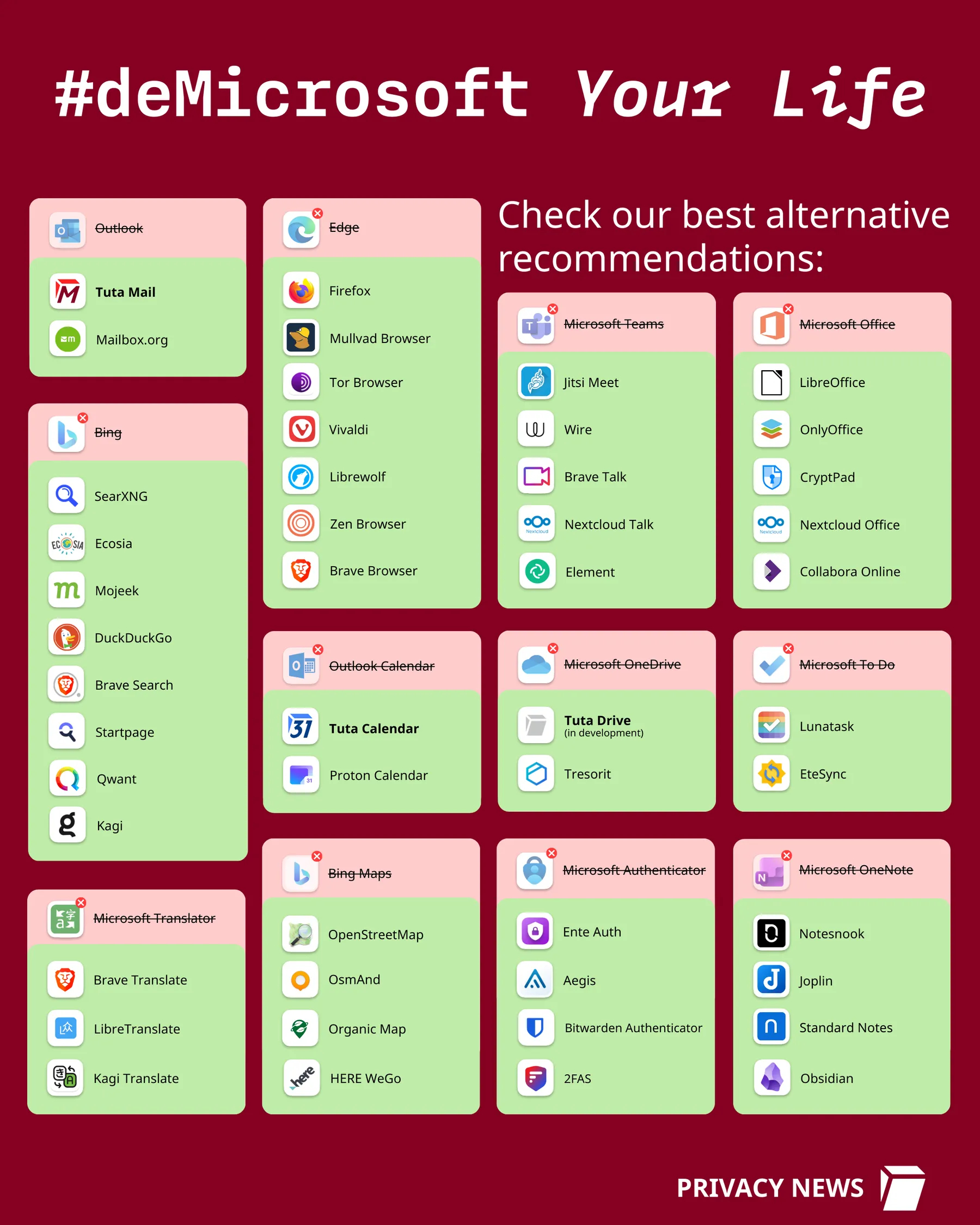
Fortunately, many free and open source alternatives to the services provided by Microsoft 365 are available, work just as well and won’t cost users a penny. Email provider Tuta.com (recommended! Ed.) has kindly provided a useful summary under the deMicrosoft your life banner which is shown below should you consider ditching Redmond’s overpriced office offering and its other software.
It’s just been announced that the Free Software Foundation Europe (FSFE) and the Linux User Group Bolzano-Bosen-BUlsan (LUGBZ) have presented VLC president and core developer Jean-Baptiste Kempf with the European SFS award at the Bozen Free Software Conference (SFSCON) for his long-term dedication to the project. What began as a student initiative has, through his continuous effort, evolved into one of the most widely used media players with hundreds of millions of users worldwide.
Picture by NOI Techpark – Marco Parisi CC-BY-SA 4.0.
Born as a student project in 1996, this software has evolved into an essential, all-in-one media player that plays almost anything effortlessly. Originally a simple network streaming client, it has grown into a powerful universal media player that continues to evolve and impress.
“For many people running non-free operating systems, it was the very first Free Software they ever installed. For many people running Free Software, it saved them from installing and booting into a proprietary operating system”, declared FSFE president Matthias Kirschner during the award ceremony.
Jean-Baptiste Kempf joined the project as a student and when it was in danger of dying after the graduation of its original developers, he took the reins. With the help of other core developers, he transformed it into the indispensable media player we enjoy on today.
Over the years, Mr Kempf has become not only the president of VideoLAN, which hosts the project itself, but also one of the lead developers of VLC media player and the founder of VideoLabs. “It’s small, fast, friendly, and seems to understand everything you throw at it. I have always thought of it as the program that eats everything”, said Raphael Barbieri, a member of LUGBZ, during the winner’s announcement.
Accepting the award, Mr Kempf said: “I am extremely honoured to receive the European SFS Award. The Free Software multimedia community is quite niche and unknown, but we work hard so that video content can be free, can be played and processed. The work done around the VideoLAN community has been tremendous, despite its little resources. I want to thank the whole VideoLAN and FFmpeg teams, who spend their time on those projects, often with little recognition“.
The European SFS Award recognizes individuals whose work has made a significant and sustained difference in advancing Free Software across Europe. Since 2023 it has been presented jointly by LUGBZ and the FSFE and honours those whose efforts strengthen software freedom, community building and the ethical foundations of technology.
The Document Foundation (TDF) has today announced the release of LibreOffice 25.2.7, the final maintenance release for the LibreOffice 25.2 family, which is now available for download. Users of LibreOffice 25.2.x should update to LibreOffice 25.8.x, as LibreOffice 25.2.x is approaching the end of its support period.
LibreOffice 25.2.7 fully supports two ISO document format standards: the open ODF or Open Document Format (ODT, ODS and ODP) and the closed proprietary Microsoft OOXML (DOCX, XLSX and PPTX) formats.
Products based on the LibreOffice Technology are available for all major desktop operating systems (Windows, macOS, Linux and ChromeOS), mobile platforms (Android and iOS) plus the cloud.
Finally, LibreOffice users, free software advocates and community members can support The Document Foundation and the LibreOffice project by making a donation.
The International Criminal Court (ICC/CPI) in The Hague wants to become independent of US technology out of fear of reprisals from Donald Trump, the vindictive and bullying forty-seventh president of the United States (who is on a mission to Make America Grate Again, or something similar. Ed.), German news site heise reports.
The International Criminal Court in The Hague. Image courtesy of Wikimedia Commons.
The institution plans to replace the Microsoft software currently used in its workplaces with OpenDesk, an open source software suite currently being developed by Zendis, a company owned by the German Federal government.
The decision was taken due to the sanctions imposed by the current US Trump regime against court employees such as Chief Prosecutor Karim Khan, under which Microsoft simply blocked Mr Khan’s access to email account. He was therefore forced to switch to the Swiss email service Proton. Back in May the ICC/CPI stated its work had virtually been paralysed due to its heavy reliance on service providers like Microsoft.
Furthermore, it is believed the US government in Washington is considering further measures against the International Criminal Court, which could also severely restrict its ability to function.
Achieving Digital Sovereignty
While the International Criminal Court only has 1,800 employees that need to be freed from dependency on US software, this can be regarded as a sign that geopolitics is increasingly concerned with technology. Business and politics recognise the dependence on US tech companies is a problem, particularly because the current US regime is using technology as a bargaining chip.
Politicians and thus by implication the parties to which they owe their allegiance have a relationship with the truth that can be described diplomatically as problematic and at worst non-existent.
Perhaps the most egregious example of being less than truthful was posted on the X/Twitter account of Reform UK Ltd., a limited company masquerading as a political party, the latest incarnation of the cult dedicated to the promotion and adoration of a perennial charlatan commonly known as Nigel Paul Farage, who also just happens to be a great pal of the disgraced former 45th president and current disgraceful 47th president of the United States of America, insurrectionist, convicted felon, adjudicated sexual predator, business fraudster, congenital liar and golf cheat commonly known as Donald John Trump, who is on a one-man mission to Make America Grate Again (or something similar. Ed.). Whether Farage’s adoration is reciprocated in equal measure is not known. given The Felon‘s disposable relationships with the rest of the human race.
What the Farage Fan Club posted on X/Twitter is shown below.
There’ll be bullshit over the white cliffs of Dover…
So far, so patriotic at a first casual glance – the white cliffs, a union flag, Churchill at Buckingham Palace, a Royal Navy ship is glorious monochrome and any reference to the Brits in WW2 would be incomplete without a Spitfire.
However, this impression is debunked the closer one looks at the image. We’ll come back to the Spitfire, but first let’s look at that naval vessel used by Reform’s graphics whizz-kids. A special research technique otherwise known as using a search engine for five minutes reveals it is in fact HMS Vanguard, the last battleship ever to be built. Although her construction started during the war, she did not enter into naval service until 1946, i.e. after VE Day and even VJ Day, which marked the final official end of hostilities.
The vessel’s identity can be easily confirmed by looking at one of the photographs used by Wikipedia; the motor launch can be seen in both the image on Wikipedia and in the much edited image used by Reform.
HMS Vanguard. Image courtesy of Wikimedia Commons.
Now let’s return to that Spitfire. Doing an image search for a Spitfire with the roundel identification AI yields not a single result; and your ‘umble scribe can find no reference anywhere to an actual squadron with that identification. Besides that, a search for AI or A1 Spitfire squadron identifications yielded zero results. Furthermore, the aircraft itself has a very glossy appearance, a feature that was shared by all the Spitfire images produced by generative AI that came up in your correspondent’s search. The conclusion I’ve reached is that the Spitfire exists solely in digital format and has never actually flown, let alone seen active service. This seems very reminiscent of the dishonesty shown by the equally right-wing British National Party, who attracted much derision in 2009 when in a supposedly patriotic poster where they used a Spitfire flown by a Polish squadron.
A final reminder to Farage and his fellow travellers; your side surrendered unconditionally on 8th August 1945.
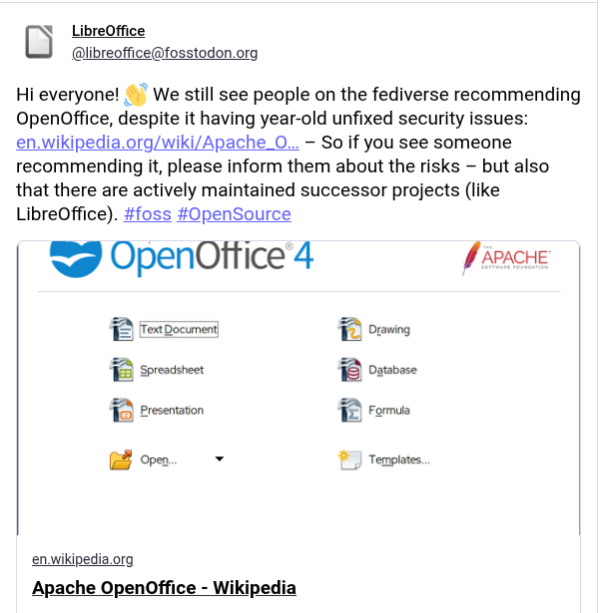
The developers of LibreOffice, the most popular free and open source alternative to Microsoft’s ubiquitous office suite, are advising against the use of its OpenOffice progenitor due to security vulnerabilities and its lack of development, German news site heise reports.
In a post on Mastodon, they point to security vulnerabilities that have been known for years but still remain unfixed. According to minutes of the Apache board meeting in March 2025, there are three security vulnerabilities in OpenOffice that are more than a year old. This has been confirmed by a representative of the Apache Software Foundation (ASF) security team.
According to the record there are numerous other, previously unaddressed issues with OpenOffice software, including vulnerabilities have existed since at least November 2023. “We are making progress in identifying improvements to address these issues,” the ASF security team representative explains.
LibreOffice: Apache Foundation is harming open source
Furthermore, the LibreOffice developers accuse the ASF of not developing OpenOffice actively any more, but of feigning to do so with minor changes to HTML tags and blank lines. This harms the entire open source community. The ASF has not commented on these allegations. However, OpenOffice has an active project management committee and retains its status as a top-level project within the ASF, according to spokesperson Brian Proffitt. In fact, the recent commits in the OpenOffice GitHub repository have primarily consisted of correcting typographical errors and making minor amendments to translations.
The current version of OpenOffice, 4.1.15, was released in December 2023. It included several bug fixes and dictionary updates, whilst it last received new features with the release of version 4.1 in April 2014. In the light of this, the LibreOffice team recommends using alternatives and in particular its own office suite.
Today marks the 20th anniversary of the ratification of the Open Document Format (ODF) as an OASIS standard. Two decades after its approval in 2005, ODF is the only open standard for office documents, promoting digital independence, interoperability and content transparency worldwide.
Even though it was originally created as an XML-based format to enable universal access to documents across platforms and software from different vendors, ODF has become a technology policy pillar for governments, educational institutions and organisations that choose open, vendor-independent formats to assert their digital sovereignty.
ODF is the native file format of LibreOffice, the most widely used and well-known open source office suite and is supported by a wide range of other applications, including Microsoft’s ubiquitous office suite.
ODF has been adopted as an official standard by the ISO (as ISO/IEC 26300) and by many governments on all continents to support digital sovereignty strategies and public procurement policies to ensure persistent and transparent access to content. These administrations include the UK government, which has comprehensive information on sharing and collaborating on government documents using ODF.
If a reason were required besides those referred to above, one only has to hear the words of Eliane Domingos, Chair of The Document Foundation (TDF), the organisation behind LibreOffice: “In a world increasingly dominated by proprietary ecosystems, ODF guarantees users complete control over their content, free from restrictions”.
Germany’s IT Planning Council, whose duties include IT co-ordination, standards, administrative digitisation and e-government projects, published its decision on open formats for document exchange a couple of days ago. In particular, it specifically mentions the Open Document Format (ODF) as an example of the open formats being used to a greater extent.
The decision itself consists of three sections, as follows:
1. The IT Planning Council recognises that open exchange formats are necessary for nationwide collaboration and welcomes the resolution of the Digital Ministers’ Conference. Open formats and open interfaces are an important building block for the necessary process of setting the German public sector on the road to greater digital sovereignty and innovation.
2. The IT Planning Council is committed to ensuring that open formats such as the Open Document Format (ODF) are increasingly used in the public sector and become the standard for document exchange by 2027. It has commissioned the Standardisation Board to implement this.
3. The IT Planning Council further recognises that the exchange of documents via email is no longer appropriate for cross-border collaboration, especially for the preparation and follow-up of ministerial conferences, and advocates – in line with the approach of the First Ministers Conference (MPK) – the use of open collaboration solutions in inter-state cooperation. It instructs the Federal IT Co-ordination organisation (FITKO) to present a plan for providing a collaboration solution by its 48th meeting.
LibreOffice 25.2, the latest stable release* of this popular free and open source office suite, contains many new features, which are described in the video below.
Furthermore, The Document Foundation blog reports that the but has subtitle translations in 17 languages, thanks to our awesome localisation communities!
In addition, the blog post also includes an appeal for volunteers prepared to help with localisation.
The video can also be viewed on Peertube, for those who don’t wish to hand their data to the Google subsidiary. 😀
* = Your ‘umble scribe is currently using a pre-release version – 25.8.0.0alpha0+ – of the software. As intimated by the version number, the second version release this year will take place in August.
 France is to begin replacing Microsoft Windows on the desktop with Linux, the French Digital Ministry has announced.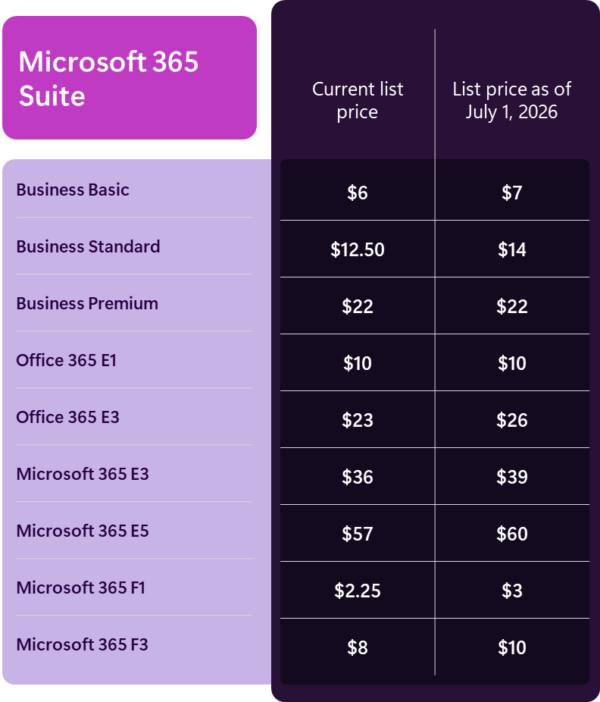
 The VLC media player is a great piece of software which your ‘umble scribe has been using since he was rookie on Windows 9* machines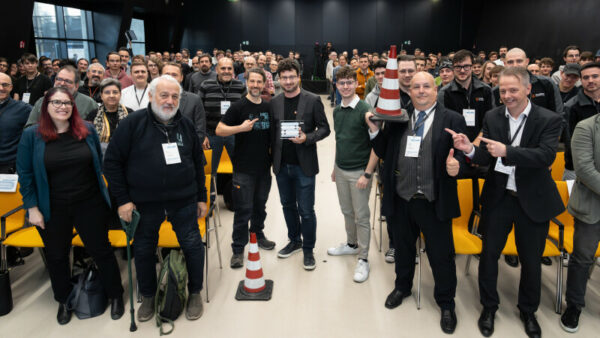




 Today marks the 20th anniversary of the ratification of the
  Germany’s IT Planning Council, whose duties include IT co-ordination, standards, administrative digitisation and e-government projects, published its