Why open standards and formats are important
This cartoon strip will tell you the why of the title just as eloquently as I could (possibly more eloquently! Ed.).

Don’t forget that it’s Document Freedom Day on Wednesday 26th March (posts passim).
This cartoon strip will tell you the why of the title just as eloquently as I could (possibly more eloquently! Ed.).
Don’t forget that it’s Document Freedom Day on Wednesday 26th March (posts passim).
 The government of Italy’s Autonomous Province of South Tyrol wants to save &euro 1 mn. per year by using free software, according to a press release issued last week.
Public sector organisations took the first step towards the use of free software nearly one year ago with the change to the LibreOffice productivity suite (news passim). On 11th March 2014 the regional government decided to continue to pursue this route and to resort to the use of open source where possible. “We are expecting savings of one million Euro per year through free software,” declares governor Arno Kompatscher.
“The use of proprietary or free software has in the meantime degenerated into almost a religious war, not only in the public sector, but also in private businesses,” Kompatscher continued, speaking after a regional government meeting.
During the preceding legislature period the region and regional government had already made a decision in principle to opt for the use of free software. In June last year the first major step towards free software was made with the change from MS Office to LibreOffice. The regional government alone migrated 7,000 to the open source office suite.
Governor Kompatscher stressed that it was not a matter of using free software exclusively, but to find the best solution as regards citizens: “We’re standing by using free software. However, it’s not a matter of deciding between free and proprietary software, but between requirements.” Free software, according to Kompatscher, is not always suitable, but: “Citizens must always have access to public sector documents without having to resort to paid-for software as well. That is the key issue”.
The city of Munich is acting as an example for the use of free software in government. “For example, Munich’s city council is using free software; in spite of this ten per cent of its computers are still running proprietary programs. We’re aligning ourselves with this. There will be no either or; the principal objective is friendliness towards citizens,” Kompatscher emphasises.
The governor also refers to the potential savings arising from free software: “A very, very large amount of money is involved. The target is savings of one million euro per year.” Just from its first major step, switching to LibreOffice should save the regional government paying Microsoft some €600,000 in licence fees in the next few years.
 Document Freedom Day is a day for celebrating and raising awareness of open standards and formats; it takes place on the last Wednesday in March each year. On this day people who believe in fair access to communications technology teach, perform and demonstrate.
Document freedom means documents that are free can be used in any way that the author intends. They can be read, transmitted, edited, and transformed using a variety of tools. Documents that aren’t free – like Microsoft Office’s .docx, .xlsx, .pptx, etc. – are locked to some particular software or company. Their author cannot choose how to use them because they are controlled by technical restrictions. This is akin to having a racehorse and never letting get above a trot.
However, document freedom is about more than spreadsheets, presentations and word processing documents. Document freedom embraces all forms of data, including artwork, sheet and recorded music, emails and statistics. These can all be stored in ways which empower users, but they can also be stored in formats which constrain and manipulate us at enormous cost.
Open standards are formats which everybody can use free of charge and restriction. They come with compatibility “built-in” – the way they work is shared publicly and any organisation can use them in their products and services without asking for permission. Open Standards are the foundation of cooperation and modern society. Today we celebrate the 25th anniversary of the world wide web – a vital resource that relies on open standards to work. Read more on open standards.
You can get involved in Document Freedom Day by organising local activities, distributing fliers, adding a banner on your blog, donating money, and much more. See the Document Freedom Day site for more ideas and information.
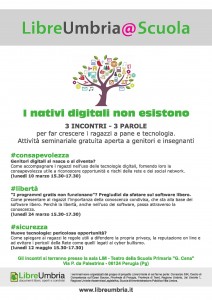 The first of three free seminars organised by LibreUmbria – the organisation promoting free and open source software in Italy’s Umbria region – aimed at parents and teachers is being organised at the Giovanni Cena primary school in Perugia at 3.30 pm on Monday 10th March, the LibreUmbria blog reports.
For some months the LibreUmbria working group has been making contact with a number of Umbrian schools in order to take free software into classrooms. They wish to start with primary schools where it is easy to raise children on open source (and there’s some great free and open source education software available at primary level. Ed). LibreUmbria’s wave of training is being heralded in with the arrival of spring thanks to collaboration with Perugia’s Terzo Circolo Didattico, which helped get this LibreUmbria experiment off the ground.
The LibreUmbria@Scuola programme will include three seminars on the subjects of awareness, freedom and security. Each word will address one aspect of new technology and open up a debate with attendees.
The seminars will be followed by two courses on the LibreOffice productivity suite in multimedia classrooms: one aimed at parents and another at teachers, who will in turn act as mentors and recommend them to colleagues and then to children in accordance with the cascade training approach.
Just to emphasize the need for a digital culture that generates awareness, the title of the events being arranged by LibreUmbria is “Digital natives do not exist”. That awareness is currently lacking and there are as yet no “natives”.
 The Cabinet Office’s consultation on open standards for document exchange with government departments (posts passim), which was due to end yesterday, 26th February 2014, has now been extended until 5.00 pm on Friday, 28th February 2014.
According to a Cabinet Office spokesman, the reason for the extension is as follows:
This is because the Standards Hub server went down last night at about 10pm, as a result of which some people were unable to submit their comments to the proposals.
The file formats being proposed as standards by the Cabinet Office are:
So far it would appear that most respondents to the consultation are supporting this welcome move to openness by the UK government and Microsoft’s shills are thin on the ground.
 Just a few days after it was reported that scores of donated Linux laptops were languishing unused in Romania’s schools (posts passim), the country’s Ministry of Education is urging the schools to consider switching to free and open source operating systems and software, according to Joinup, the EU’s public sector open source news website. The Ministry confirmed this will help the schools to avoid legal problems from using unlicensed proprietary software.
The new policy follows the expiry of an agreement between the Ministry and Microsoft. The Ministry is now urging schools to switch to open source alternatives, revert to earlier versions or buy new licences.
The Ministry itself is no stranger to free and open source, using Linux and the Nginx web server. Furthermore, it has also published a recommended list (PDF, Romanian) of free and open source software for use in schools, which includes Edubuntu, the educational remix of Ubuntu Linux, desktop applications based on the Gnome window manager and other free and open source favourites, such as the LibreOffice productivity suite, Gimp graphics package and Scribus desktop publishing software.
 It may have escaped the notice of most of the country, but the Cabinet Office is currently consulting on the use of open formats, e.g. ODF, HTML, TXT and CSV, for documents when sharing them or collaborating with government on them.
As an ardent supporter of open standards and open formats, I decided it was my civic duty to support the Cabinet Office’s welcome move to openness, all the more so as Microsoft was asking its pals in an open letter (in closed .docx format. Ed.) to try and water down the move to ODF by having its OOXML format adopted as well.
My comments on the government’s proposals were as follows:
I too welcome and wholeheartedly support the move to open standards and file formats and away from vendor lock-in and proprietary file formats, access to which is solely at the whim of software vendors. No single company should have a monopoly on the formats used for official documents and documents of record.
In particular, I welcome the move to Open Document Format. I have been using ODF for many years in my role as company secretary of an IT co-operative and we have the satisfaction that our successors and future historians will be able to read our online and offline records without accessibility to our records being at the whim of a software supplier with a quasi-monopoly on office productivity products.
Furthermore, I would advise against any use of OOXML (also known as Office Open XML), which is not a truly open standard and hasn’t even been implemented properly by the company that created it.
I trust that you will implement open documents standards with all speed, after which you then need to tell other bodies, such as schools, local authorities, the community and voluntary sectors, that there are viable alternatives to proprietary file formats.
Another thought: in the UK there are various timescales – 30, 50 & 100 years – for the release of documents to the public. This implies that whatever the format, we will still need to be able to read them 100 years from now. There is no reason to suppose that Microsoft will be around then, so using a proprietary format as a standard must surely be an unacceptable risk for the readability of public documents.
If you wish to support the move to open standards and formats by HM Government, you have one day left as the consultation closes tomorrow.
The Document Foundation’s blog has announced that the LibreOffice Conference 2014 will be held at the University of Bern in Switzerland from 3rd September to 5th September.
It is being organised jointly by CH Open, the Swiss Open Systems User Group, and the Research Centre for Digital Sustainability of the Institute of Information Systems at the University of Bern.
“Holding the LibreOffice Conference in the city of Bern will definitely improve the awareness of Open Source software in Switzerland, and hopefully trigger the migration process in public administrations which has already started in France, Germany and Italy”, say organising committee members Nicholas Christener and Matthias Stürmer.

Bern is the federal city of Switzerland (i.e. its de facto capital. Ed.) and the seat of the parliament, government and administration of the Swiss Confederation, the Canton of Bern and the City of Bern. Its old city district has been a UNESCO world heritage site since 1982.
Anyone who uses MS Office will know that .docx (otherwise known as Microsoft Word Office Open XML Format. Ed.) is a file format used by MS Word.
As a proprietary file format, there’s always a risk of vendor-lock-in with .docx and its fellow Office file formats.
That said, this vehicle rental firm has an most apposite slogan on its vehicles, particularly as Microsoft has now moved MS Office onto subscription licensing with MS Office 365.
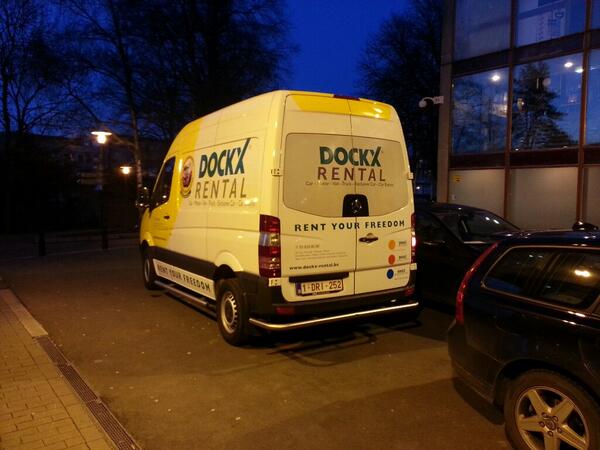
To avoid renting freedom where your data is concerned, this blog recommends using free and open document formats, like Open Document Format (ODF).
Next month sees Document Freedom Day 2014 (DFD) being held on 26th. DFD’s aims are to promote information accessibility and raise awareness of open standards. More details and resources are available on the DFD website.
Hat tip: FSFE
On Wednesday the UK’s Government Digital Service (GDS) held an event called Sprint 14, in which it invited Ministers, civil servants, suppliers and the media along to showcase some major new digital public services for the first time.
Among the speakers was Cabinet Office Minister Francis Maude, who in his speech made some interesting and welcome noises about document formats:
Today I can announce that we’ve set out the document formats that we propose should be adopted across government – and we’re asking you to tell us what you think about them.
He then continued with equally welcome and interesting noises on open standards:
Technical standards for document formats may not set the pulse racing – it may not sound like the first shot in a revolution. But be in no doubt: the adoption of open standards in government threatens the power of lock-in to propriety vendors yet it will give departments the power to choose what is right for them and the citizens who use their services.
The documents formats referred to by Mr Maude in his speech can be found on the Cabinet Office’s Standards Hub section of its website on the Sharing or collaborating with government documents webpage, which states
When dealing with citizens, information should be digital by default and therefore should be published online. Browser-based editing is the preferred option for collaborating on published government information. HTML (4.01 or higher e.g. HTML5) is therefore the default format for browser-based editable text. Other document formats specified in this proposal – ODF 1.1 (or higher e.g. ODF 1.2), plain text (TXT) or comma separated values (CSV) – should be provided in addition. ODF includes filename extensions such as .odt for text, .ods for spreadsheets and .odp for presentations.
Whilst the government has conceded that open formats and standards should be used when dealing with citizens, how long will it take for changes to take place before editable documents intended for use by we peasants citizens will be available in anything other than the quasi-ubiquitous MS Office formats currently provided?