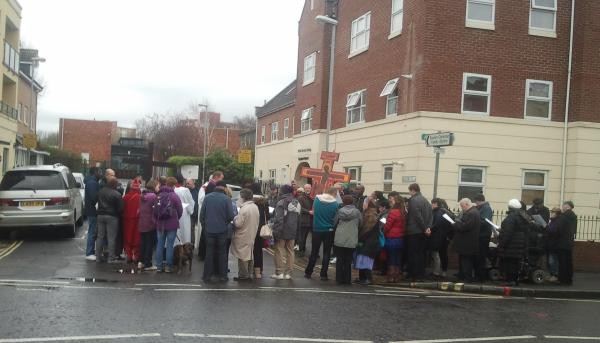
When venturing out onto Stapleton Road earlier today, an unusual sight met my eyes – an open-air church service for Good Friday, the Christian holiday commemorating the crucifixion of Jesus Christ and his death at Calvary.
Seeing the service in progress prompted me to look at the etymology of Good Friday. From whence does it originate.
According to Wikipedia, the etymology of the term “good” in the context of Good Friday is disputed, with some sources claiming it is from the senses pious, holy of the word “good“, whilst others contend that it is a corruption of “God Friday“. The Oxford English Dictionary supports the first etymology, giving “of a day or season observed as holy by the church” as an archaic sense of good and providing examples of good tide meaning “Christmas” or “Shrove Tuesday” and Good Wednesday meaning the Wednesday in Holy Week.
In German-speaking countries Good Friday is generally referred as Karfreitag (Kar from Old High German kara ‘bewail‘, ‘grieve‘, ‘mourn‘; Freitag for ‘Friday‘): Mourning Friday. The Kar prefix is an ancestor of the English word care in the sense of cares and woes; and thus mourning. The day is also known as Stiller Freitag (Silent Friday) and Hoher Freitag (High Friday, Holy Friday) in German-speaking countries.
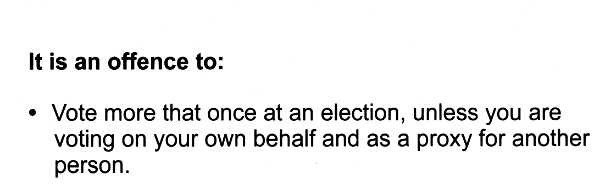
Yesterday I received my poll card from Bristol City Council cunningly inviting me to put a cross on pieces of paper in the forthcoming general election and council election both being held on Thursday, 7th May.
Spot the proofreading howler on the back of the poll card!
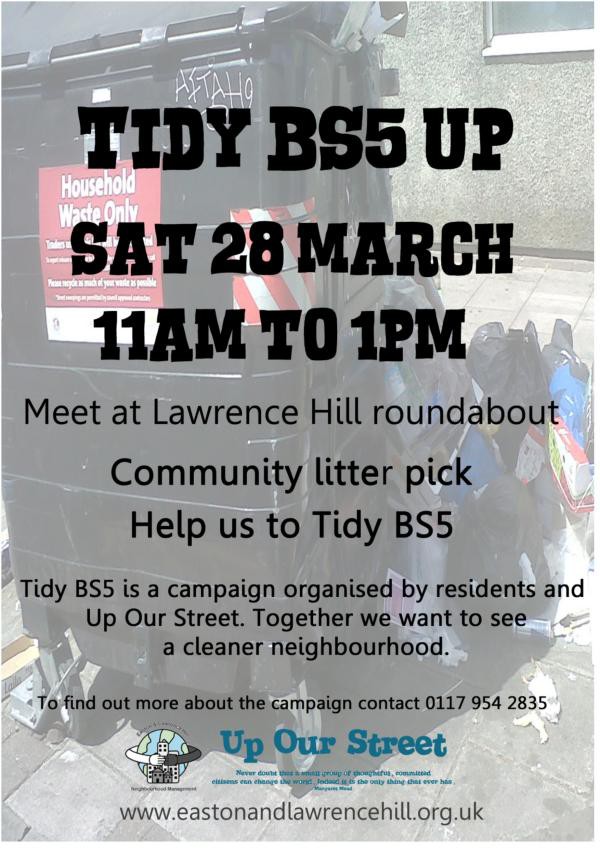
Saturday 28th March dawned grey and drizzly for the TidyBS5 Big Clean organised by Up Our Street and local residents.
For your correspondent it dawned even earlier; the alarm clock was set for 6.00 a.m. to ensure he was sufficiently awake to be interviewed down the line about TidyBS5 and the event on BBC Radio Bristol by their Saturday breakfast show presenter Ali Vowles.
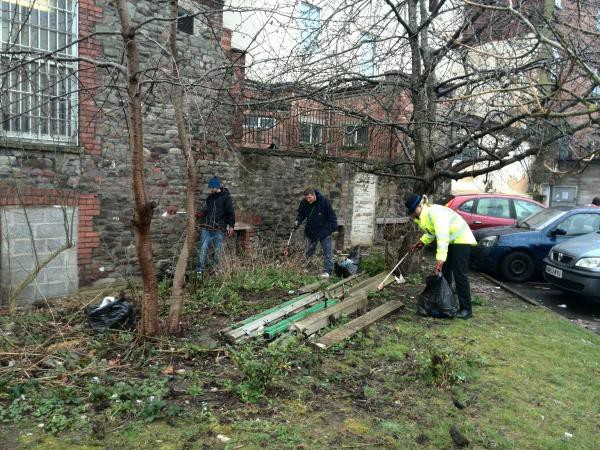
However, the rain did not put off an amazing 33 people – including one PCSO from Trinity Road Police Station – turning up at Lawrence Hill roundabout at 11.00 a.m. to help remove litter from the area for a couple of hours. Indeed, such a number of participants was so unprecedented that more litter pick equipment had to be ferried down from the Up Our Street Office.
Photo courtesy of Lorena Alvarez
Also amongst the hardy souls who turned up was a contingent from the Good Gym, which takes exercise out of the gym. Members runs to a venue, help a local community project and then run back. Your ‘umble scribe is very pleased we attracted their support.
Photo courtesy of Lorena Alvarez
Local councillor Marg Hickman also attended to show her support. Wouldn’t it be good if we could get Bristol Mayor George Ferguson to turn out for the next one and put some physical effort into Bristol’s year as European Green Capital? 😉
After receiving safety instructions (avoid picking up broken glass, no needles, etc. Ed.) we then scattered to various sites around the area to get work.
Photo courtesy of Anthea Sweeney
Areas cleaned included:
The grassed island in then centre of Lawrence Hill roundabout;
The grassed area fronting Lawrence Hill at the end of Payne Drive;
Public open space along Croydon Street;
The old course of the River Frome beneath the railway adjacent to the Coach House off Stapleton Road; and
The area of grass and shrubbery alongside the former Earl Russell pub (the ‘Big Russell’. Ed.) and Lidl on Lawrence Hill.
A fantastic amount of rubbish was removed and collected later in the weekend by Bristol City Council.
Early this morning the demolition crews finally starting their assault on the 1860s school in Marybush Lane, Bristol (posts passim).
Within a couple of hours the demolition contractors had all but flattened the Pennant sandstone and Bath stone structure built by eminent Victorian architect and Aesthetic Movement member, E.W. Godwin, as shown in the photos below.
More of East Bristol’s heritage turned to dust
One less of Godwin’s works now survives for people to appreciate. In Bristol his only remaining works are – to the best of my knowledge – the grade II*-listed Carriageworks on Stokes Croft dating from 1862 and his refurbishment of St. Philip & St. Jacob Church, which lies just across Tower Hill from Marybush Lane and was contemporaneous with the building of the school.
The efforts of The Victorian Society and local campaigners to save the school from demolition by the vandals from the site’s owners, the Homes & Communities Agency, have therefore been in vain. When objections were first raised to its demolition, the HCA displayed both ignorance and arrogance. Firstly, it denied that the school had been designed by Godwin. When presented with incontrovertible evidence by opponents, it then had the arrogance to deny its initial ignorance.
I shall shed a tear into my beer tonight for this loss of yet another part of East Bristol’s history and heritage. The east side of Bristol, traditionally its poorer side, has long been treated with contempt and disregarded by both the city’s great and good and outsiders; and this latest vandalism just confirms that.
If a future walk by Bristol Radical History Group is ever done on the unemployed, a halt in Marybush Lane – no doubt in front of some cheap and nasty residential development, will be prefaced by the words, “On this site used to stand…”, a growing phenomenon in a city where only the heritage of the great and good seems to be valued.
So in conclusion well done Mayor George Ferguson and Bristol City Council for failing to lift a finger to save Godwin’s school and well done HCA for an act of heritage vandalism committed without compunction.
Bristol City Council’s streetscene enforcement officers (the local authority’s litter and fly-tipping police. Ed.) are currently active in the Stapleton Road area of Bristol 5.
One of the major problems with which they’ve been getting to grips is that of traders fly-tipping in the streets and dumping their waste in the communal bins intended for household waste only.
Trade waste – in this case lots of flattened cardboard packaging – fly-tipped by a communal bin in Pennywell Road, Easton
Tidy BS5 campaigners are actively assisting the enforcement officers in the efforts by identifying suspected offenders and directing officers to regular sites for the fly-tipping of trade waste.
Traders are supposed to pay for their own waste disposal. By abusing the facilities provided for residents, they may be saving themselves money on their waste contracts, but are also insulting the community whose members constitute their customers; and that has to stop.
So far, the council has handed out 5 fixed penalty notices of £300 each to local traders for waste matters and more are clearly needed before their work is done, if it ever will be.
In the meantime, if you’ve got time free on Saturday, don’t forget to turn out for the Tidy BS5 Big Clean community litter pick, meeting at 11 a.m. at Lawrence Hill roundabout. Yours truly will be rising slightly earlier as BBC Radio Bristol wishes to interview me on its breakfast show.
Today’s Bristol Post carries a piece by Gavin Thompson about the activities of property developers in Bedminster that has a novel twist – a maternal blueprint – as shown by the screenshot below.
Bedminster has so far escaped the worst attentions of property developers who’ve been allowed a very free hand by Bristol City Council to wreck the city’s outstanding heritage with cheap and nasty modern developments, as is happening currently on the site of the Ebenezer Chapel in Midland Road in St Philips (posts passim).
This morning on my walk from home in Easton to the Bristol Wireless lab in Bedminster, my eye was caught by blackthorn blossom standing out white against the blue sky.
Blackthorn blossom in Lawford’s Gate, Bristol
Blackthorn (prunus spinosa) derives its name from its thorny nature and its very dark bark.
As its Latin name denotes, it is a member of the plum family. Its fruits – sloes – are well known for their bitterness, unless picked after they’ve been bletted, i.e. attacked by autumn frosts. Their best-known use is for making sloe gin.
Sloes. Note the thorns. Image courtesy of Wikimedia Commons
The modern English word sloe comes from the Old English slāh. The same word is noted in Middle Low German, historically spoken in Lower Saxony. Similar words are found in other languages with Teutonic roots.
With its savage thorns, blackthorn has traditionally been used for making a hedge against cattle or a “cattle-proof” hedge.
Bristol has a long and proud history stretching back beyond Saxon times.
However, it also has a slightly shorter and not so proud history of allowing important heritage and buildings of historical interest to disappear under the demolition contractor’s wrecking ball, particularly in East Bristol, long treated with contempt by the city fathers.
This contempt for the heritage of East Bristol has been eloquently illustrated in recent times.
First there was the loss some 10 months ago of the fine Victorian school in Avonvale Road (posts passim). With the connivance of Bristol City Council, this was sacrificed on the altar of bland modern architecture sponsored by the academy schools programme.
The loss of Avonvale Road school was followed just one month later by the demolition of Ebenezer Chapel in Midland Road, the last non-conformist chapel in that part of the city and a rare example of a Romanesque style chapel (posts passim) in contrast to the more usual Gothic style. The site of the Ebenezer Chapel is now occupied by a bland, modern block of flats.
A third important building in East Bristol is now under threat of demolition by its owners, the Homes & Communities Agency, who in my opinion don’t know what a treasure they’ve got in their property portfolio. It’s on the left in the photo below.
The old ambulance station site in Tower Hill. Photo used by kind permission of Chris Brown
What the picture shows is the site of Bristol’s old ambulance station in Tower Hill. The tracked vehicle on the right is sitting atop the remains of the uninspiring 1960s building forming part of the station complex. The most interesting part of the site is the stone building on the left.
That building dates from circa 1860 and was originally the parish school in Marybush Lane built for St. Philip and St. Jacob Church. It was designed by eminent Victorian architect and designer E.W. Godwin, a local boy whose best-known building is Northampton’s Guildhall. Godwin was born Old Market Street in 1833 and is believed to have attended St. Philip and St. Jacob as a worshipper. Locally Godwin also designed the grade II*-listed Carriageworks building on Stokes Croft, an early example of the Bristol Byzantine style.
The Victorian Society is calling on the Mayor of Bristol, George Ferguson, to step in to save the former school, which has been refused spot listing, despite its local historical importance. The Victorian Society’s Conservation Adviser, Sarah Caradec, said: “Bristol should take this last minute opportunity to save this early example of Godwin’s work in the area he was born and brought up in. Far too many examples of Godwin’s work have already been lost. Although English Heritage rejected an application to spot list the building, it recognised its strong local interest as an early Godwin building, as well as its group value with the associated Grade II*-listed Church of St Philip and St Jacob, which were restored by Godwin in the 1860s. We urge the Mayor of Bristol to recognise the building’s value and act now to ensure that the HCA build around it.”
It’s not just the connection with Godwin that makes the old school valuable. If it disappears beneath the wrecking ball, an important part of Bristol’s working class history will also be lost.
During the harsh economic times of the 1930s when millions were out of work, the Bristol branch of the National Unemployed Workers Movement (NUWM) held its meetings at the school. Bristol Radical History Group has material related to the activities of NUWM in Bristol, whilst the excellent BRH publication Bread or Batons?, written by Dave Backwith and Roger Ball, can be purchased from Hydra Books in Old Market Street.
Today this blog can reveal exclusively that the much-maligned Bristol Post has discovered time travel. This was shown by an item published today, 20th March, entitled “Seven things to do in Bristol tomorrow, March 17“.
I’m now waiting for the follow-up article from the Post detailing how I can travel back in time to do those aforementioned seven things. 🙂
A week ago yesterday, there was a meeting of the TidyBS5 task force with council officers and Councillor Marg Hickman at the offices of Up Our Street.
It was a good opportunity for the officers to update community volunteers on what the council has done, is and will be doing.
Jane Street in Redfield earlier today
For Stapleton Road a deep clean is planned for this year; this will mean giving the footways a thoroughly good scrub and removing chewing gum from their surfaces. In addition, hanging baskets will be provided on approx. 30 lamp posts to help make the street a bit more colourful and attractive.
The city council’s streetscene enforcement team has now moved into the area and has already had some success: 5 traders have been issued with £300 fixed penalty notices for abusing the communal bins intended for household waste only. In addition, some minor offenders have been fined smaller amounts.
Turning to communal bins, task force members have been invited to assist in devising the communal bins consultation that the council is organising for the Stapleton Road corridor. Two task force members, Hannah and myself, informed officers that we were monitoring clearance times after fly-tipping had been reported. From my own monitoring since then, communal bins seem to be implicated in some 60% of sites notified to the council.
After the update from the offices, it was pointed out to them that, while all this attention being lavished on the Stapleton Road area was appreciated, it should not detract from equally bad problems along the Lawrence Hill/Church Road corridor, home to the infamous Jane Street (see above).
During my discussion on social media with BCC’s Chief Enterprise Architect Gavin Beckett about open standards (posts passim), he invited me to submit feedback on using the council website; this will be done from the aspect of reporting street cleaning matters, where the website still has a couple of interesting foibles.
Up Our Street is organising a community litter pick on Saturday 28th March from 11 am to 1 pm. Volunteers are asked to assemble at Lawrence Hill roundabout (map). For more details, contact Lorena on 0117 954 2835.