If you’re having difficulty in understanding what’s happening with the militants of Islamic State in Iraq and Syria at the moment without going any further back than Bush War II (the overthrow of Saddam Hussein – and the roots of the conflicts and tensions in the region do go back to at least the end of World War 1 and the Treaty of Versailles! Ed.) then Aubrey Bailey of Fleet in Hampshire has provided a concise and not too confusing potted guide.
Some sub-editors in the Malaysian press are perhaps over-conscientious in their work, as shown in the image below, where US rapper 50 Cent (name on birth certificate: Curtis James Jackson III. Ed.) has been converted into the local currency, the ringgit!
On 7th August Staffordshire police stopped Romanian-born Silviu Croitoru on the A34 London Road in Newcastle-under-Lyme: 47 year-old Croitrou – now resident in Trent Vale, Stoke-on-Trent – was driving his mobility scooter at the time and gave reading of 95 microgrammes of alcohol in 100 millilitres of breath; the legal limit is 35 microgrammes.
Magistrates at the North Staffordshire Justice Centre in Newcastle-under-Lyme adjourned the case to arrange for the attendance of an interpreter and to allow time for defence representations.
One would have thought that if the defendant required an interpreter, this should have been noted and arranged for the initial hearing, but waste and incompetence seem to be endemic in the justice system nowadays.
The No campaign against Scottish independence has since the outset been playing on people’s uncertainties about the fate of an independent Scotland to such an extent that supporters of independence have dubbed it Project Fear.
In recent times, some of these have included some strange arguments, such as the one illustrated below.
That’s right! Project Fear has now put the idea in the minds of Caledonian petrolheads that they could lose the likes of Clarkson & Co.
I can think of nothing more that would make me vote yes were I a Scot and was eligible to partake in the referendum.
Barack Obama, in addition to being 44th President of the United States of America, now has a new title to add that of his hitherto highest office; he’s the Messiah (i.e. the anointed one. Ed.) to the Formicidae family of creatures.
Either that or some redneck Republican from the state of Washington cannot spell Antichrist! 🙂
Siblings at Bury Ditches picnic area. Picture by Hilary Midgley.Each year one of my great delights is to go walking in Shropshire with my sister Hilary for a couple of days (posts passim). This year’s annual sibling saunter did indeed take place last week, but with one important change: our brother Andrew was able to join us for the first time on Thursday evening (after Hilary and I had done our inaugural afternoon walk) and take part in Friday’s walk.
After meeting up in the late morning in Craven Arms and some light refreshment, Hilary and myself set out on a 6 miles circular walk to Flounders’ Folly on Callow Hill and back, following an excellent route provided by the AA. The folly was built in 1838 by Benjamin Flounders – a prominent English Quaker and local businessman originally from Yorkshire – and fell into disrepair in the 20th century, but was restored in 2004-5 by the Flounders’ Folly Trust with aid from the National Lottery. It’s now open to the public one day per month so people can climb to the viewing platform at the top of the 78 stairs and enjoy wonderful views of the Malverns, the Black Mountains, Cader Idris and much more. The route up to the folly consisted of a steep climb through active forestry workings, but the view from the top was well worthwhile.
Flounders’ Folly
The route back from the folly was through pasture along the Quinny Brook and the River Onny. Our return to Craven Arms was perfectly timed; we’d just arrived back when the rain started. 🙂
As with last year, we stayed at Clun Youth Hostel, a converted water mill with most of the mill machinery still intact. The remains of the millpond can still be seen just up the road by the Memorial Hall and there are rumours that it is to be restored. The volunteer wardens at the hostel were most helpful and hospitable, whilst fellow hostellers didn’t snore too much!
The following morning after breakfast we set out from the hostel to visit the motte and bailey at Lower Down and the Iron Age hill fort at Bury Ditches on a circular route measuring somewhat over 8 miles. The route out to Lower Down meandered through farmland, including a couple of sunken lanes reputed to have been used by monks, and woodland. Towards Lower Down, some splendid views were had of the Stiperstones and Corndon Hill, high point of one of last year’s walks.
Lower Down’s motte and bailey can be viewed by going through the kissing gate next to the telephone box and pillar box. The field in which they are sited is also reputed to contain medieval settlement remains.
Plan of Bury Ditches hill fort on the toposphereAfter Lower Down there followed a long climb (during which the rain commenced. Ed.) up to the Bury Ditches picnic area where lunch was taken, followed by the long, gradual ascent up to the hill fort itself. The entry into the hill fort is from the north east through 3 sets of concentric earth bank defences. When the fort was originally constructed about 2,500 years ago, these earth banks would have been surmounted by wooden palisades. In the steady drizzle, we wandered up to the toposphere in the centre of the fort to admire the views and get our bearings as we had to leave hill fort via its south west entrance/exit. As we approached the exit, the rain eased off and out came the cameras to record our visit.
Andrew admires the defensive banks at Bury Ditches
Descending from Bury Ditches, we then dropped down through woodland a giant sequoia to skirt Steppleknoll to return across the fields (where red kites were seen) to Clun and a welcome couple of pints in The Sun Inn. We can recommend the restorative properties of the Three Tuns Brewery’s beer, as we all sampled the Porter and found it excellent, whilst your correspondent also savoured the very hoppy IPA.
Both days’ walks included a ford too, although neither was particularly deep, as shown by the one through the Quinny Brook on the Callow Hill walk.
The author testing the depth of the ford. Picture courtesy of Hilary Midgley.
Planning has already started for next year for a visit to another hill fort near Craven Arms and returning via Stokesay Castle, as well as an exploration of Offa’s Dyke south of Newcastle on Clun.
By now, you are probably asking what all this has to do with the testicle legs in the title. Well, the title of this post originates from a snatch of conversation when we were negotiating some rough, muddy ground. I remarked that one needed ‘festival legs‘ to cope. When I repeated my remark since it hadn’t been heard clearly, back came the reply: “I thought you said testicle legs!”
Bristol likes to regard itself as a place of innovation.
Bearing this inventive spirit in mind, contractors working in Old Market Street for Bristol City Council have invented a new public conveyance vehicle – the bup.
A spokesperson for Bristol City Council said: “We take the misspelling of road marking very seriously and will soon be appointing an expensive CONsultant to advise us of the best possible solution.” (That quotation was made up, wasn’t it? Ed.)
One of the oldest districts of Bristol is Redcliffe (or Redcliff. Ed.).
According to its Wikipedia entry, Redcliffe – the more common spelling – was once part of the manor of Bedminster before its absorption into the city of Bristol in the 13th century.
However, the spelling of Redcliff(e) has long caused controversy.
Richard Ricart, a town clerk of Bristol, in his The Maire of Bristowe is Kalendar, written between 1480 and 1508 and recording the history of Bristol since the 12th century, refers throughout to Redcliff, although there is also an occasional unusual reference to Redecliff. Both appear in this extract documenting the digging of St. Augustine’s Trench (later renamed St. Augustine’s Reach. Ed.) in 1240:
This yere was the Trenche y-made and y-caste of the ryvere, fro the Gybbe Tailloure unto the key, by the maanovre of alle the Cominalte, as wele of Redcliff warde as of the Towne of Bristowe. And the same tyme thenhabitaunts of Redecliff were combyned and corporatid with the Town of Bristowe. And as for the grounde of Seynt Austyn’s side of the forseid ryver hit was yeve and grauntid to the Cominaltee of the seid Towne by Sir William a Bradstone then Abbot of Seynt Austyns for certeyn money therfore to hym paide by the seide Cominaltee. As appereth by olde writyng therof made bitwene the forseid Maire and Cominaltee and the seid Abbot and Covent.
Redcliff these days tends to appear mostly in street names, such as Redcliff Street – the ancient road leading from Bristol Bridge to the former Redcliffe Gate in the city’s medieval walls – whilst Redcliffe is the more common version.
A couple of quick text searches via Google of Bristol City Council’s website for Redcliff and Redcliffe gives the following results.
Redcliff: 1,120 results
Redcliffe: 4,020 results
However, confusion as the spelling of Redcliff(e) has a long history. This is amply illustrated by the painting below by James Johnson entitled Redcliffe Street. It was painted around 1825 and hangs in Bristol City Museum & Art Gallery.
Image courtesy of Wikimedia Commons
Kerry McCarthy, MP for Bristol East, has now stepped into this confusing orthographic and municipal muddle via the following tweet dated August 21st.
@wood5y I'm thinking of starting a campaign for the council to agree one way of spelling Redcliffe/ Redcliff and to stick to it. Are you in?
Before boundary changes preceding the 2010 election, Redcliff(e) was part of Kerry’s Bristol East constituency.
It has to be conceded that there is plenty of merit in Kerry’s suggestion, although she maintains she was only ‘moaning in Twitter’.
Bristol is nevertheless one of those places which changes at a glacial pace and place names in Bristol are frequently named after long-vanished owners/occupiers. For instance, most older inhabitants of the city still refer to the local authority’s headquarters as the Council House (pronounced Counts Louse locally. Ed.), even though one of the first acts of elected Mayor George Ferguson was to rename it with the American-sounding City Hall in a cosmetic exercise.
Does Kerry’s campaign have any chance of success? Your views are welcome in the comments below.
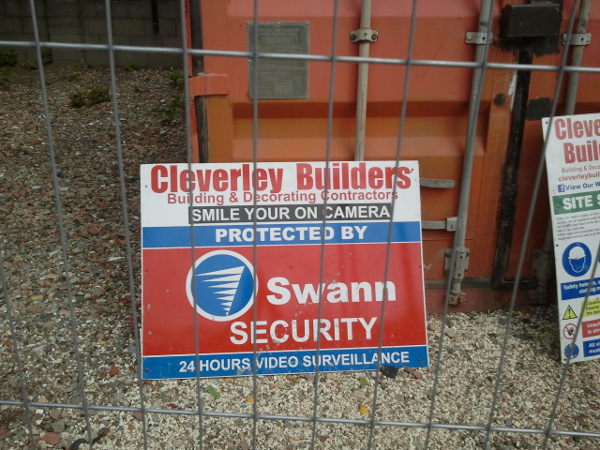
Seen this morning on Church Road, Lawrence Hill, Bristol.
The person who wrote the copy must have fallen asleep in English classes when the difference between the abbreviated second person conjugation of the verb ‘to be’ and the second person possessive adjective was being explained.
Never mind, poor English skills don’t seem to have been a barrier to employment with Cleverley Builders of Whitchurch, Bristol or Swann Security; it was uncertain to your correspondent as to who had produced the sign. However, the ability to lie on signage is also valued by Cleverley Builders and/or Swann Security as no evidence of the physical presence of video surveillance equipment could be discerned.
If the author of the sign happens to read this, help is at hand to assist you in learning the distinguish them.
Neither of my parents, both of whom left school at 14 years of age and received not much more than a primary education in rural Norfolk in the 1930s and 1940s would not have made such a glaring mistake in English – a mistake which seems all too commonplace amongst the beneficiaries of the modern British education system.