ODF

  • UK government to switch to open source office suite

    A new deal announced today between the Crown Commercial Service and open source consultants Collabora will provide public sector organisations with savings on GovOffice, an open source office suite based on LibreOffice.

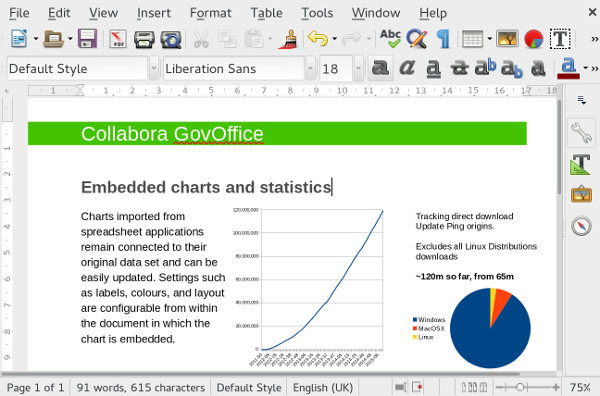
    Collabora GovOffice is is compatible with both Google Docs and Microsoft Office (including the cloud version Office 365) and includes comprehensive support for the latest version of Open Document Format, which is recommended by the Cabinet Office for use by government organisations.

    With a familiar interface for creating documents, spreadsheets, presentations and more (none of that ribbon nonsense. Ed.), Collabora GovOffice offers considerable cost savings compared to competing proprietary packages.
    GovOffice screenshot

    In addition, the forthcoming Collabora CloudSuite will extend Collabora GovOffice with internet and mobile access for viewing and editing documents, as well as online access in web browsers. IT managers will be able to deploy the cloud software locally, providing remote access to documents.

    The deal covers both Collabora products and applies to all non-profit making government organisations, including those working on behalf of government, either directly or via outsourcing.

  • LibreOffice 5.1 – first bug hunting session announced

    Writing on The Document Foundation blog, Italo Vignoli has announced that a bug hunting session will take place from 30th October to 1st November for LibreOffice 5.1, the next planned major release of this popular open source office productivity suite.

    LibreOffice 5

    Over those 3 days, volunteers and members of the LibreOffice community will check the first alpha of LibreOffice 5.1 for bugs and flaws.

    On those dates, mentors will be available on the QA IRC channel and via email on the QA mailing list from 08.00 a.m. UTC to 10.00 p.m. UTC to help less experienced volunteers to triage bugs.

    People who cannot participate the bug hunting session are always welcome to help chasing bugs and regressions when they have time. There will be a later bug hunting session in December this year to test LibreOffice 5.1 Release Candidate 1.

    Additional information on bug hunting is available on The Document Foundation wiki.

  • LibreOffice 5.0.2 announced at LibreOffice Conference

    To underline the importance of the event for the community, The Document Foundation (TDF) has today announced the release of LibreOffice 5.0.2 during the opening session of the 2015 LibreOffice Conference in Aarhus, which runs until Friday 25th September.

    LibreOffice 5.0.2 is the second minor release of the LibreOffice 5.0 family, with a large number of fixes over the first minor (5.0.1) release announced in August. Based on feedback from the marketplace, the LibreOffice 5.0 family has so far proved the most popular LibreOffice release ever.

    LibreOffice 5

    LibreOffice 5.02 will offer OpenGL rendering by default on Windows for the first time for those with the very latest Windows drivers. In the event of problems, this functionality is easy to disable by accessing Tools > Options.

    LibreOffice 5.0.2 is aimed at technology enthusiasts, early adopters and power users. For more conservative users and for enterprise deployments, TDF recommends the “still” version: LibreOffice 4.4.5. For commercial deployments, The Document Foundation recommends the backing of professional support by certified people.

    People interested in technical details about the release can access the change logs via the following links: bugs fixed in RC1 and bugs fixed in RC2.

    LibreOffice 5.0.2 is available for immediate download from http://www.libreoffice.org/download/.

  • Dutch public sector to adopt ODF as standard?

    ODF file iconThe Dutch Standardisation Board would like to see the mandatory use of Open Document Format (ODF) for the country’s public sector organisations, according to a report on Joinup giving details of a presentation made by Nico Westpalm van Hoorn to the recent ODF Plugfest held in The Hague.

    Van Hoorn stated that over 450,000 documents are transferred each day between the Dutch central
    government and citizens or companies.

    His presentation contained 3 main messages:

    • The only way reuse of document content is achievable for open data is by using the ODF format;
    • The only way to ensure sustainable access is by using the ODF format; and
    • “This format cannot be opened,” as a remark by a public servant is not acceptable when somebody sends an ODF document.

    Within the Dutch government, ODF is used as the default format for editable documents that are posted online. Documents are by default shared as HTML, PDF (for archiving) and as ODF. Furthermore, all central government workstations are capable of working with ODF, suggesting that civil servants who cannot open the format need some IT training.

    Speaking at the same event, Steven Luitjes, director of Logius – an agency assisting government organisations in building e-government services, admitted that ODF is often ignored by public sector organisations and that a failure to standardise on formats is increasing the cost of public sector IT.

    If the Dutch government does adopt ODF as a standard, this would follow on from the recent announcement of the standard’s adoption by the Italian Ministry of Defence (posts passim) and the UK government’s publication of guidance for the introduction of ODF.

  • LibreOffice & ODF to be adopted by Italian military

    The Italian military is moving to LibreOffice and Open Document Format (ODF), according to Joinup, the EU’s public sector open source news website. This will be Europe’s second largest migration to a free and open source office suite and open standards since the Italian Defence Ministry will be installing LibreOffice on 150,000 machines.

    LibreOffice

    The migration will begin in October 2015 and is expected to be completed at the end of 2016.

    The deployment of LibreOffice will be jointly managed by Libreitalia and the Italian Defence Ministry, with the former providing trainers and the Ministry devising course materials, which will later be released under a Creative Commons licence.

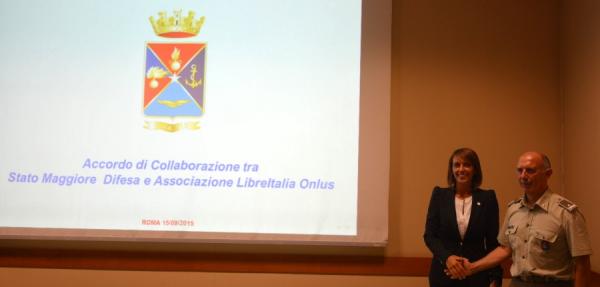
    An agreement between the Ministry and LibreItalia was signed on 15th September in Rome by Rear Admiral Ruggiero Di Biase, General Manager of the Italian Ministry of Defence’s Information Systems and LibreItalia president Sonia Montegiove.

    Sonia Montegiove and Rear Admiral Ruggiero Di Biase

    The Ministry of Defence is the first Italian central government organisation to migrate to open source software for office productivity. On the other hand, many regional public sector organisations have already made this move, such as the Emilia-Romagna region, the provinces of Perugia, Cremona, Macerata, Bolzano and Trento, the cities of Bologna, Piacenza and Reggio Emilia, the Galliera Hospital in Genoa and healthcare ASL 5 in Veneto, to name but a few.

    The Italian Defence Ministry project is also one of Europe’s largest migrations to date to a free and open source office suite. The largest European public sector organisation using free software office suites is currently the French Interior Ministry with some 240,000 desktops. Many French ministries use open source office suites including the Tax Agency, the Finance Ministry, the Ministry of Foreign Affairs and the Ministry of Agriculture. LibreOffice is deployed on some 72,000 PCs within the French Gendarmerie, which also uses Ubuntu Linux as its operating system of choice.

    In June 2014, the autonomous regional government of Extremadura (Spain) confirmed that 10,000 PCs in its healthcare organisation are running open source office applications and that the same is planned for its own 22,000 PCs. In Germany the city of Munich runs also runs LibreOffice on over 17,000 Linux workstations.

  • LibreOffice 5.0.1 released

    Yesterday The Document Foundation, the German non-profit organisation behind the LibreOffice productivity suite, announced the release of LibreOffice 5.0.1, the first minor release of the LibreOffice 5.0 family.

    This version comprises a number of fixes compared with the major release – version 5.0.0 – announced on 5th August 5. So far, LibreOffice 5.0 is the most popular version of LibreOffice ever, based on the feedback from the marketplace.

    LibreOffice 5.0.1 is aimed at technology enthusiasts, early adopters and power users. For more conservative users and commercial deployments, The Document Foundation recommends LibreOffice 4.4.5. For commercial deployments, The Document Foundation suggests engaging certified professional support.

    Those interested in technical details of the release can consult access the change logs at https://wiki.documentfoundation.org/Releases/5.0.1/RC1 (fixed in RC1) and https://wiki.documentfoundation.org/Releases/5.0.1/RC2 (fixed in RC2).

    LibreOffice 5

    LibreOffice 5.0.1 is immediately available for download and users, free software advocates and community members are encouraged to make a donation to The Document Foundation.

  • ODF 1.2 published as international standard

    The Open Document Format for Office Applications (ODF) Version 1.2, the native file format of the free and open source LibreOffice productivity suite and many other applications, has been published as International Standard 26300:2015 by ISO/IEC.

    TDF ODF 1.2 bannerODF defines a technical schema for office documents including text documents, spreadsheets, charts and graphical documents like drawings or presentations.
    “ODF 1.2 is the native file format of LibreOffice. Today, ODF is the best choice for interoperability, because it is widely adopted by applications and is respected by applications in every area”, says Thorsten Behrens, Chairman of The Document Foundation. “ODF makes interoperability a reality and transforms the use of proprietary document formats into a relic of the past. In the future, people will tell stories about incompatible document formats between two releases of proprietary office suites as a bygone problem”.

    ODF is developed by the OASIS consortium. The current version of the standard was published in 2011 and then was submitted to ISO/IEC in 2014.

    The standard is available in three parts – schema, formula definition and packages – from the repository of Publicly Available Standards as a free download, as follows:

    1. Schema
    2. Formula Definition
    3. Packages

    The standard is also available from the OASIS ODF TC website.

    ODF 1.2 is supported by all the leading office suites and by a large number of other applications. It has been adopted by the UK Cabinet Office as the reference for all documents exchanged with the UK Government (posts passim) and is currently proposed as the reference standard by the Référentiel Général d’Interopérabilité 1.9.9 of the French Government. In addition, ODF 1.2 has been adopted by many European public sector organisations. Furthermore, in Brazil, ODF is part of the electronic government programme – Progranma do Governo Eletrônico (e-PING).

  • Bari to migrate 75% of workstations to LibreOffice

    Bari Today reports that the Municipality of Bari is migrate 75% of its workstations to the free and open source LibreOffice productivity suite during the current year.

    LibreOffice

    According to Alessandro Tomasicchio, the councillor with responsibility for technological innovation, “In this way we guarantee the participation of citizens in public sector decision-making.”

    In addition, the council is adopting ODF – the standard file format of LibreOffice and other open source office suites – as the standard file format that meets all the authority’s technical requirements.

    Management of the project entails various kinds of skills, from the analysis of flows of documents within the council to the management of interactions between users and IT systems. Great attention has been paid to staff training and internal communication, which are regarded as fundamental elements for achieving the local authority’s goal.

    After analysing the software solutions available and practical testing, the Innvoation Department decided to adopt the free and open source LibreOffice suite, which is compatible with other proprietary office suites, including MS Office currently used by Bari.

    The choice of LibreOffice, unlike proprietary software, is compliant with the provisions of Article 68 of the [Italian] Digital Administration Code and the Apulia Region‘s law on the adoption and promotion of open source by public sector organisations.

    By the end of the current year at least 75% of Bari’s workstations will migrate from Microsoft Office to LibreOffice.

    Antonio Cantatore, head of Bari’s Innovation Department also stated that one reason for switching to LibreOffice would be major savings in the total cost of ownership (TCO). By not having to pay licence fees to Microsoft for the Office package currently installed on 1,700 of Bari’s workstations, the local authority is looking at costs savings €75,000 +VAT.

  • Registration is open for 2015 LibreOffice conference

    Registration for the 2015 LibreOffice Conference, which will be hosted by the Danish city of Aarhus from 23rd to 25th September (posts passim), is now open, The Document Foundation blog has announced.

    LibreOffice Conference 2015 logo

    Attendees can register at http://conference.libreoffice.org/2015/registration/.

    The Call for Papers is still open until 15th July 15, 2015. Tracks for papers are based on Development, Quality Assurance, Localization, Documentation and Native Language Projects, Ease of Use, Design and Accessibility, Migrations and Deployments, Certifications and Best Practices, ODF, Document Liberation and Interoperability and Building a Business around LibreOffice.

    The conference website also includes some practical info about travel and accommodation.

    This year’s conference is being sponsored by CIB, Collabora, Google, Magenta and RedHat.

  • LibreOffice 2015 Conference – call for papers

    The call for papers for this year’s LibreOffice Conference has today been announced on Twitter by Collabara’s LibreOffice team.

    LibreOffice Conference 2015 logo

    Proposals should be submitted by 15th July 2015 in order to guarantee that they will be considered for inclusion in the conference programme.

    The conference programme will be based on the following topics:

    • Development, APIs, Extensions, Future Technology;
    • Quality Assurance;
    • Localisation, Documentation and Native Language Projects;
    • Appealing Libreoffice: Ease of Use, Design and Accessibility;
    • Enterprise and Public Sector Deployments and Migrations, Certifications and Best Practices;
    • Open Document Format, Document Liberation and Interoperability; and
    • Building a successful business around LibreOffice.

    Aarhus montageThis year’s event will be held in Aarhus, Denmark’s second city, from 23rd to 25th September inclusive.

    Venue

    The venue will be a completely new venue on the harbour in Aarhus called “Dokk1 – Urban Media Space Aarhus“.

    Urban Media Space is described as “a flexible and dynamic sanctuary for everyone in search of knowledge, inspiration and personal development – an open and accessible learning environment supporting democracy and community and is also going to be an example of the library of the future.”

    Conference communication channels

    The official communication channel during the conference will be the conference mailing list, conference@global.libreoffice.org. All participants will automatically be subscribed to that list, whilst the archives can be browsed at http://listarchives.libreoffice.org/global/conference/.

    Primary Danish conference contacts

    The primary conference contacts in Denmark have likewise been announced; they are:

    • Carsten Agger (Open Space Aarhus);
    • Line Dybdahl (Municipality of Aarhus);
    • Leif Lodahl (LibreOffice Denmark); and
    • René Lagoni Neukirch (LibreOffice Denmark).
Posts navigation