Last week’s post on east Bristol’s Wain Brook (posts passim) attracted considerable interest on social media amongst local residents with a love of local history and maps.
These interested parties included a member of the original team that put together the online Know Your Place mapping project, who commented further that he’s currently working on a flood mapping project that will include a number of Bristol’s hidden watercourses.
Yesterday another peek over the bridge parapet at Lawrence Hill revealed that there’s now less of the Wain Brook to be seen as the works progress: it can still be seen flowing left to right in the masonry inspection chamber.
However, this hidden watercourse will soon disappear once more beneath the trackbed: and who knows how long will pass before it once more sees the light of day.
Metal plates cover the top of the Wain Brook culvert
The “FourTracking” entails increasing the capacity up Filton Bank by replacing the two sets of tracks that were removed between some 35 and 40 years ago. The route up Filton Bank is used by mainline services to both South Wales and the Midlands, as well as by local rail services.
On the section of Filton Bank between Dr Day’s Junction and Stapleton Road station, the majority of the current work entails clearing away 3 decades of detritus and refurbishing the infrastructure, including the original drains in the cutting. At Lawrence Hill station, this has included refurbishing a culvert, as I found out looking over the railway bridge the other day.
A small culvert being refurbished right next to Lawrence Hill railway bridge. What hidden waters does it contain?
I was intrigued by the slight curvature of the culvert as drains are normally straight. What could this be?
To find the answer your ‘umble scribe had to search maps dating back to the late 19th century. These are available through Bristol City Council’s Know Your Place website.
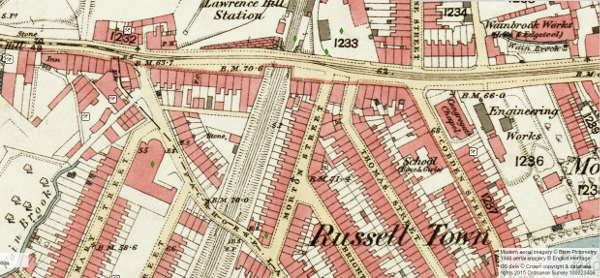
No clues were forthcoming from the 20th century maps and other resources available. However, the 1880 Ordnance Survey mapping for Lawrence Hill revealed what the culvert actually was. It carries the Wain Brook – one of Bristol’s hidden watercourses – under the railway.
If you examine the image below, it will be noted that Lawrence Hill railway bridge lies between the two sections of the Wain Brook then running above ground – one to the right of the bridge past the “Wainbrook Works” and the other section to the left past open ground (now a park).
Very little information is available online about the Wain Brook itself. Judging from the map evidence its source seems to be in the region of Plummers Hill in St George and in times gone by it flowed across the fields that were to become St George Park. After the park’s creation, the Wain Brook was used to feed its ornamental lake.
From can be surmised from the sparse clues available, from Lawrence Hill the Wain Brook – still in culvert – flows down Lincoln Street (site of the Wain Brook Elderly Persons Home. Ed.), past Gaunt’s Ham Park and through St Philips and the Dings (where some 200 years ago it flowed through withy beds) to empty into the River Avon at a point near Bristol Temple Meads station.
In the early 1800s Barton Hill was described as a small rural hamlet comprising mainly of wheat fields and orchards with a stream, The Wain Brook, running through and dominated by two large houses namely, Tilley’s Court and Royal Table House.
The earliest historical reference to the Wain Brook that my research has turned up dates back to the 13th century, when in the manor of Barton Regis (present-day Barton Hill) there was a meadow belonging to St Mark’s Hospital called ‘Wainbroke’ (after the Wain Brook) that extended between the ‘meadow of the hospital of St Lawrence of Bristol and the meadow formerly of Richard de Pisa’.
The hospital of St Lawrence of Bristol was Bristol’s medieval leper colony (St Lawrence was the patron saint of lepers and leper colonies were always established beyond the built-up areas of medieval towns and cities. Ed.), which was founded by King John in 1208 when he was Earl of Mortain. The hospital’s establishment gave its name to the whole area. Lawrence Hill roundabout now occupies the vicinity of the site where the hospital is thought to have stood.
If readers have further information to add about the Wain Brook, please feel free to comment below.
In the world of metrology there are standardised and internationally-recognised units of measurement such as the metre for linear distance, gram for weight and litre for liquid measurement.
In everyday life there are also informal units of measurement used by people to give or gain an idea of the magnitude of a particular phenomenon.
In terms of surface area, for instance, there’s the football pitch. Imperial Tobacco, my employers many years ago, used to like to boast that the cigarette production hall at W.D. & H.O. Wills’ factory in Hartcliffe, Bristol, (once the largest cigarette factory in Europe. Ed.) had an unobstructed floor area, i.e. free of the pillars supporting the roof structure, equivalent to three football pitches. Another common measurement for surface area is the Wales, particularly for larger items than football pitches.
Also in common use for informal metrics are the double-decker bus and cricket pitch, both for linear distance.
This plethora of informal measurements has now been joined by a newcomer, the Stockholm, courtesy of the Bristol Post, the city’s newspaper of warped record.
Stockholm: once just the capital city of Sweden, now a unit of measurement. Image courtesy of Wikimedia Commons.
Reporting yesterday on the shameful fact that Bristol, in spite of its huge housing crisis, now has 5,785 empty homes in the city, the Post then goes on to introduce Sweden’s capital as a new unit of measurement specifically for vacant homes, stating:
Nationally, there are now just short of a million (980,565) properties deemed uninhabited – about the same amount as the entire housing stock of Stockholm.
There you have it.
Finally, a word of caution, under no circumstances should the Stockholm as a measurement of empty homes ever be compared with so-called Stockholm syndrome, a psychological condition in which hostages develop a psychological alliance with their captors as a survival strategy during captivity.
If readers do happen to come across any further undocumented units of measurement, please alert your ‘umble scribe via the comments below.
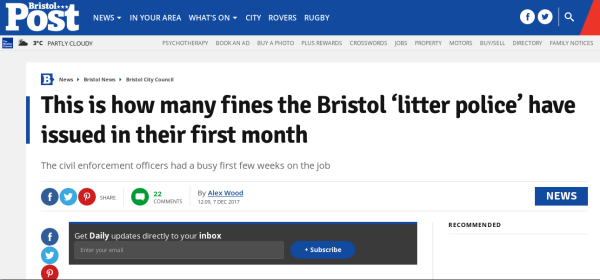
Yesterday’s Bristol Post reported on the first month of operation of what it’s dubbed the “litter police”, the private contractors brought in by Bristol City Council to take enforcement action on such environmental crimes as dropping cigarette ends, littering, failing to clear up the mess of one’s dog, tagging and spitting.
They’ve had a busy first month, issuing 1,368 fixed penalty notices with a total value of nearly £70,000.
Whilst this long overdue enhanced enforcement against the untidy is welcome (as a founder of Tidy BS5 I wholeheartedly support their engagement by BCC. Ed.), it’s not the numbers that interest me, but the Post’s choice of language, particularly at the top of the article, which is reproduced below.
Look between the headline and the byline and you’ll see the following sentence: “The civil enforcement officers had a busy first few weeks on the job“.
All you Brits can stop sniggering.
Now!
“On the job” in the sense of something related to work is, to the best of my knowledge, an import from American English that has in recent decades started appearing increasingly in British corporate jargon. During my youth over 4 decades ago, the phrase had only one meaning and that had salacious connotations.
Collins Dictionary gives the following definitions for the phrase in British English:
actively engaged in one’s employment;
(taboo) engaged in sexual intercourse.
As regards the first definition, this could cover tuition given during employment (e.g. on the job training): no further explanation is required for the second.
Last weekend once again saw your ‘umble scribe and his friend André helping out (posts passim) with the 2 major elements – bonfire and fireworks respectively – of the Trinity Centre‘s Bonfire Night event, which was recast this year as a “Festival of Light“.
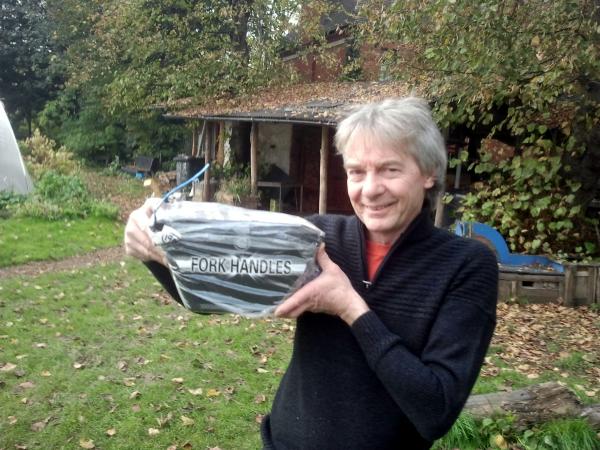
While setting up, André showed me one of the fireworks he would be setting off. It’s shown in the picture below.
As he remarked at the time, it’s good to know firework manufacturers have a sense of humour, let alone one that harks back to a classic of British TV comedy dating from 1976 originally written by one Gerald Wiley.
Once again, my thanks to the good folks at Trinity for a great event.
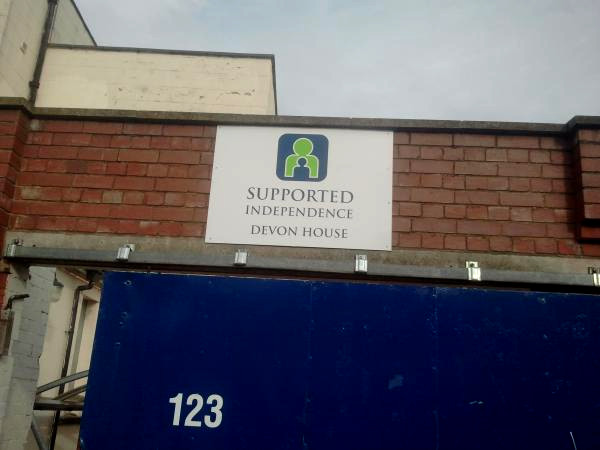
Spotted on Devon House in Whitehall Road, Bristol, this morning.
This fine old building, which has a Georgian core, is currently being refurbished for some sort of supported or sheltered housing scheme.
However, whoever thought up the “Supported Independence” text on the sign doesn’t really understand English and probably couldn’t even begin to say what constitutes an oxymoron, i.e. an epigrammatic effect, by which contradictory terms are used in conjunction. .
This coming Saturday 23rd September, Up Our Street will be organising a work day on the Bristol and Bath Railway Path from 10am to 3pm.
Up Our Street will be testing a ‘Play Zone’ on the Bristol and Bath Railway Path for four weeks to see if small interventions can improve the experience of the path for all users.
Volunteers are needed to get involved with painting and stencilling, cutting back vegetation, litter picking and making a sculpture. Ideas for further possible improvements will also be welcome.
In return volunteers will be offered lunch, tea and a rewarding day in return. This project is supported by URBACT and is part of a community research project with the University of Bristol.
To take part, please come to Owen Square Park (map).
For further details or express your interest, contact Celia on community [at] eastonandlawrencehill.org.uk or telephone 0117 954 2834.
Worth more than the PM?Whenever there’s a new appointment to a senior, high-paying post in the British public sector, the press and their pals in the rest of the country’s media are queuing up to make the inevitable comparison with the salary of the Prime Minister.
The latest example of this is the coverage of the appointment of Dr Patricia Greer by Bristol’s newspaper of (warped) record, the Bristol Post.
“New Bristol bureaucrat to be paid more than the Prime Minister“, thunders the headline in a piece posted yesterday on the paper’s website.
This is reinforced in the article’s first 2 sentences.
Bristol’s newest public servant is to be paid a whopping £150,000 a year – more than Prime Minister Theresa May.
The chief executive of the West of England Combined Authority will be paid more than double the amount received by her boss, Metro Mayor Tim Bowles.
First a bit of background: the West of England Combined Authority (WECA) is made up of three of the local authorities in the region – Bath & North East Somerset, Bristol and South Gloucestershire. North Somerset decided not to join in this additional level of local bureaucracy, but has said it will co-operate with WECA on transport matters.
WECA was imposed top-down by central government in the last round of so-called “devolution”. There was no referendum to legitimise its establishment, merely the usual inadequate consultation from the local authorities involved. WECA comes under a so-called “Metro Mayor”, the incumbent being Tory Tim Bowles who was elected in May 2017 on a turnout of less than one-third of the electorate.
Its detractors refer to WECA as Avon County Council Mk. 2, a reference to a previous unpopular round of local government reform.
Worth £143K a year, or not worth the paper she’s written on?Anyway, back to the PM’s pay. Theresa May, the present occupier of 10 Downing Street, is currently paid an annual salary of £143,462 for doing Prime Minister impressions. Other senior ministers are on similar amounts once their parliamentary salaries are included.
However, to my way of thinking, the comparison of senior public sector employees’ remuneration with the Prime Minister’s pay is erroneous on a number of counts.
In the first place both Prime Minister and the Metro Mayor are elected offices: their holders find their way to their desks via the ballot box. WECA’s chief executive is appointed, presumably by a small body of individuals; the electorate has no say in who gets their feet under the big desk on the deep pile carpet.
Secondly, there are many appointed officers in the public sector whose pay is more on a level with those in the private sector. Take for example the large quantities of gold showered on the vice-chancellors of English universities such as Bath, which has resulted in resignations from that institution’s council.
Another comparison that could be taken into account is budgets. WECA will be receiving funding of £30m a year for 30 years, which is really just petty cash in public sector terms when stood next to the 2015 figure of running the NHS (£115,398m. Source: Cabinet Office).
Perhaps a fairer comparison would be with the PM’s senior civil servant, namely the Cabinet Secretary, the country’s most senior civil servant, who acts as the senior policy adviser to the Prime Minister and Cabinet and as the Secretary to the Cabinet. The post is currently held by Sir Jeremy Heywood, for which he receives an annual salary of £195,000.
Whilst this may be a fairer comparison, there’s one major drawback. Whereas most people could readily identify the Prime Minister when questioned, how many members of the public could readily name the Cabinet Secretary.
The media deal with certainties and the familiar, hence measurements related to the size of football pitches (and Wales! Ed. and, by extension, comparisons of those in high office with the PM’s pay packet.
The shambles that is the Ministry of Justice’s outsourcing of court interpreting services continues, although it does not have such a high media profile these days.
Today’s Bristol Post reports that a judge was forced to use Google Translate to discuss a case with the defendant.
Bath resident Jaroslaw Nowacki was appearing at Bristol Crown Court on Wednesday 30th August to answer a charge of possession of a kitchen knife in a public place without good reason or lawful authority.
However, His Honour Judge Euan Ambrose was unaware until the hearing that Nowacki would need the services an interpreter.
After confirming the defendant was originally from Poland, the judge decided to adjourn the plea hearing until 6th September to arrange for an interpreter to be in attendance.
The Post continues:
But due to Nowacki’s limited grasp of English, he did not understand what he was being told and Judge Ambrose turned to Google Translate to get his message across.
“Whether Google Translate will accurately translate what I want to say I don’t know,” said the judge.
After spending several minutes typing out a message, Judge Ambrose printed it off and it was handed to Nowacki for him to read in the dock.
Nowacki then confirmed that he understood the message and the case was adjourned.
The shadowy East Bristol Tourist Board has recently been in action, welcoming visitors to Barton Hill, an ancient settlement recorded as Barton [Regis] in the Gloucestershire pages of the 11th century Domesday Book.
Barton itself derives from the old English ‘bere-tun‘ corn farm, outlying grange of barley farm.
From the visit of the Domesday assessors to the present day much has changed. The area still has one church, now St Luke’s, but the two mills mentioned in 1086 have long vanished. However, the area’s changes over the centuries – and those of surrounding districts – are being charted by the Barton Hill History Group.
This cheery message above can be found at the junction of Ducie Road (formerly Pack Horse Lane; there’s a street name that could tell a story. Ed.) with Lawrence Hill.
Have a nice day, y’all! 😀
Update 20/08/17: The cheery welcome message has now been painted over. Does this mean visitors to Barton Hill are no longer welcome? In the immortal words of Private Eye: I think we should be told!