Irony
The front page of today’s Bristol Post.

Meanwhile over at BBC Bristol, their headline for the story reads ‘Keynsham stand-off: Police shoot suspect in wheelchair’.
The front page of today’s Bristol Post.
Meanwhile over at BBC Bristol, their headline for the story reads ‘Keynsham stand-off: Police shoot suspect in wheelchair’.
We learn from Accessible Bristol that tomorrow, Thursday 9th May is Global Accessibility Awareness Day (GAAD). On that day people all over the world will be coming together to spread the word about accessibility and Accessible Bristol will be among them.
Throughout the day the Accessible Bristol team be on Twitter answering your questions about technology and accessibility, as well as tweeting useful accessibility tips and resources.
Tweet your questions to @AccessibleBrstl and use the #GAAD hashtag to keep track of Global Accessibility Awareness Day activities.
However, Accessible Bristol also has a challenge for the people in Bristol and the South West for 9th May and challenge you to do at least one of the following things on 9th May:
This post originally appeared on Bristol Wireless.
Over the long weekend I took a walk over Purdown and through Eastville Park in Bristol, enjoying the sunny weather.
Spring has finally arrived, as shown by the appearance of cowslips in the old pasture on Purdown.

However, I was more intrigued by the ‘Lost Ferrets’ posters I saw descending towards the park at Snuff Mills.

This coming Monday 29th April Bristol Radical History Group and Bristol & District Hazards Group are jointly organising an evening talk entitled ‘Blacklisting’ at 7.30pm at Tony Benn House, 92 Victoria Street, Redcliffe, Bristol BS1 6AY (map) to mark Workers’ Memorial Day.
Politicians and employers like to portray the blacklisting of trade union members for their health & safety activities as a thing of the past. That does not correspond with the reality of life for those who continue to stick their neck out to protect themselves, their workmates and the public. Indeed, here in Bristol builders and electricians who were members of trade unions were banned from taking part in the building of Cabot Circus shopping centre, it has emerged.
The talk will feature 2 speakers.
Firstly, Di Parkin is a historian and has published “60 Years of Struggle“, the history of Betteshanger, a militant Kent pit. She will speak about the actions of the Economic League who provided blacklisting information to employers in the 1970s and the impact this had in places such as British Leyland’s Cowley car works and the Kent coalfield.
Secondly, an electrician who’s an active member of Unite, a shop steward and who has worked in the construction industry for 40 years will talk about his experiences of victimisation and the campaign against blacklisting.
Donations from attendees will be welcome.
In ‘A Shropshire Lad’ published in 1896, A. E. Housman (1859–1936) wrote:
Loveliest of trees, the cherry now
Is hung with bloom along the bough,
And stands about the woodland ride
Wearing white for Eastertide.Now, of my threescore years and ten,
Twenty will not come again,
And take from seventy springs a score,
It only leaves me fifty more.And since to look at things in bloom
Fifty springs are little room,
About the woodlands I will go
To see the cherry hung with snow.
It’s a poem that has stayed with me throughout life since I first heard it and memorised it at Market Drayton Junior School in Shropshire some five decades ago: and I must agree with dear old A.E.; the cherry is a lovely tree. The Japanese even have a cherry blossom festival.
Eastertide was early this year in March and was unusually cold, so the cherry trees still had bare boughs then.
They’ve only just started blooming properly in Bristol now.

A Shropshire Lad is available free from Project Gutenberg.
Just when we were all thinking the Green Party was composed of gentle, tree-hugging vegans, along comes Bristol’s Councillor Gus Hoyt…

For the credulous, there is an alternative explanation: Gus was let down (yet again!Ed.) by the predictive texting software on his iPhone, but if you’ll believe that, you’re daft enough to vote for him. 😉
On my way into the Bristol Wireless lab, I pass by the former Quakers’ Burial Ground opposite St Mary Redcliffe Church, now a pleasant, small green space amid the bustle of the city.
Right at the back of the Burial Ground set into the sandstone of Redcliffe Hill itself is a small cave, now barred by a wrought iron gate, as shown in the picture below.

According to the plaque to right of the entry, the cave was first used as a hermit’s habitation in the 14th century when John Sparkes (or Sparke, according to some sources. Ed.) was installed in 1346 by Thomas Lord Berkeley to pray for him and his family. The plaque continues by saying that the cave continued to be occupied by successive hermits until the 17th century.
If the date of 1346 is true, the only Thomas Lord Berkeley to whom the text on the plaque could possibly refer is the third Baron de Berkeley (circa 1293 or 1296 – 27 October 1361), 8th feudal Baron Berkeley, also known as Thomas the Rich, whose ancestral home was Berkeley Castle in Gloucestershire.
Thomas definitely needed someone to pray for him. In 1327 Thomas was made joint custodian of the deposed King Edward II of England, whom he received at Berkeley Castle where he died, believed to have been murdered by an agent of Isabella of France (also known as the ‘She-Wolf of France’. Ed.), Edward’s wife, and Roger Mortimer, 1st Earl of March (whose daughter Margaret, was Thomas’ first wife. Ed.), on 11th October 1327.
Thomas de Berkeley was tried an accessory to the murder of the Edward II by a jury of 12 knights in the 4th year of King Edward III of England, but was honourably acquitted.
The land where the hermit’s cave now stands was acquired by the Religious Society of Friends (otherwise known as the Quakers) in 1667 and used as a burial ground until 1923. The gravestones from the former burial ground are now stacked in the hermit’s cave. The earliest recorded memorial is dated 1669 and the latest 1923, whilst the ages of the dear departed range from eight months to 99 years.
According to the plaque, some well-known Bristol Quaker names are included amongst the memorials, i.e. Alloway, Grace, Harford, Houlden, Jennings, Ring, Smyth, Wall and Whitworth.
My friend Julien remembers resorting to the hermit’s cave for a crafty smoke when he was a pupil at nearby St Mary Redcliffe & Temple School.
The burial ground was handed over by the Quakers to Bristol City Council in 1959 – presumably to help allow the local environment and heritage to be destroyed by the council’s highway engineers (including the demolition of the world’s first lead shot tower. Ed.).
Yesterday’s Bristol Post carried a report on the start of building works at Wapping Wharf down by the city docks.
On the whole the report is fairly bland and it looks like a standard bit of blurb produced from a property developer’s press release.
Nevertheless, one sentence in particular drew my attention. It reads:
In recent days large machinery has moved to the site to prepare for the start of remediation and ground works.
After reading that, I began wondering how many of the Post’s readers know what remediation works actually are or what they involve.
Turning to the dictionary, remediation is defined as “the act or process of correcting a fault or deficiency.”
Correcting a fault or deficiency sounds fairly harmless and definitely a good thing to do, doesn’t it?
However, one has to add the word ‘site’ or ‘environmental’ to remediation to get at its actual meaning as used in the Post’s report, which is cleaning up pollution or contaminated land.
There are various means of effecting remediation, depending on the contamination or pollutant involved, but one very common means (and one which has been used extensively in the past by developers in Bristol. Ed.) is the use of heavy plant to dig up the contaminated soil, load it into lorries and cart it off to a toxic waste dump.
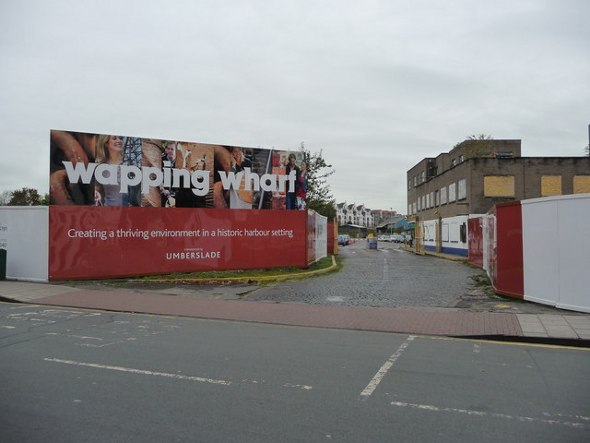
In the 18th and 19th centuries the Wapping Wharf site accommodated some as yet unspecified industrial buildings, but a contaminated land survey of the site mentioned in a Bristol City Council document from 2006 revealed contamination by heavy metals, hydrocarbons and solvents, hence the need for the clean-up.
Finally, a small piece of advice: if you know of any remediation works taking place, for the sake of you health do try not to be downwind of them, especially in dry and/or windy weather.
To paraphrase the Duke of Edinburgh’s famous retort from 1962, the Bristol Post is a bloody awful newspaper. Every day it manages to show its ignorance of the districts of Bristol, greengrocer’s apostrophes are not unknown and the command of terminology shown by its journalists is abysmal.
As regards the latter, there was a prime example in this article about cannabis farms, as follows:
Gardeners often appear in court with a translator and cases regularly detail how electricity at the grow houses is bypassed from the mains.
In court with a translator? My heart sank. The writer has clearly not been following this blog or other sources about the interpreting fiasco in the English courts (posts passim). Moreover, he has clearly never read my early post on the BBC’s never-ending confusion of interpreters with translators.
For the benefit of passing Post journalists, I shall once again quote from that article about the difference between the two:
…here’s a brief explanation of the difference between interpreting and translation: interpreting deals with the spoken word, translation with the written word.
Simple isn’t it? So simple on would think even a Bristol Post hack would be able to understand the difference. 🙂
The two places where I’ve lived the longest are Bristol (where I’ve lived since graduation) and Market Drayton (where I grew up). These 2 places are ones I’d call home.
It’s therefore quite a surprise for me to find the two of them brought into close contact by a writer who lived 6 centuries ago.
I’m currently reading ‘The Maire of Bristowe is Kalendar’ by Richard Ricart, who became clerk to the Mayor of Bristol in 1478 in the reign of Edward IV, (re)printed in 1872 by the Camden Society and available from the Internet Archive.

Ricart recorded Bristol’s history from 1217, mentioning the name of the mayor and other chief officers of the town (Bristol did not become a city until the reign of Henry VIII. Ed.), along with major national or local events.
Imagine my surprise at the following text – in the original Middle English – appearing at the end of the entry for 1459:
And the Sondaye by fore Mighelmas, James Lorde of Audeley was slayne at Blourehethe besides Drayton in the countee of Stafford.
In modern English: “And the Sunday before Michaelmas, James, Lord of Audley was slain at Blore Heath near Drayton in the county of Stafford”.
The Battle of Blore Heath, which was fought on 23rd September 1459, was an echo from my childhood: as a child I’d looked for Audley’s Cross – marking the spot where Audley allegedly fell – from the tops of buses, whilst a popular childhood haunt was Salisbury Hill just outside Market Drayton, so called because it was where Lord Salisbury’s troops had apparently spent the night before the battle.
Besides exhaustive detail, the Blore Heath 1459 website has a brief introduction to the battle, as follows:
In September 1459 the armies of the House of Lancaster and the House of York met on a damp Sunday morning at Blore Heath and fought the battle which would begin the English Wars of the Roses. Thousands of men from across England fought and died in a bloody battle, which lasted for the rest of that day.
Legend has it that Queen Margaret of Anjou watched the battle from the nearby Mucklestone church tower, only to flee when she realised her army had lost. A stone cross still stands on Blore Heath to this day, to mark the spot where the Lancastrian leader is said to have been killed.