Oddities

  • Clowns and palaces, dogs and vomit

    Elizabeth Mary Truss, alleged Prime Minister of the English EmpireYesterday, one Mary Elizabeth Truss, inexplicably elevated to leadership of the Conservative Party by its members, resigned as the Prime Minister of the English Empire (which some still call the United Kingdom. Ed.).

    She was in office for a mere 45 days – the shortest tenure of any UK prime minister. Her nearest rival for that accolade is George Canning, who survived in office for 119 days before dying due to ill health in 1827.

    In her brief period of office, Truss proved just how incompetent and out of her depth she was in Number 10. In just 45 days Truss exhibited amply that she would be out her depth on a damp pavement, even though this was glaringly obvious during her time pretending to be foreign secretary (posts passim).

    In those few weeks, she has managed to do lasting damage, not least with a disastrous mini-budget, featuring included the biggest tax cuts since 1972, funded by a vast expansion in borrowing. This resulted amongst other things in a run on the pound, Bank of England market interventions and a rise in interest rates, particularly for those with mortgages to pay. This mini-budget cooked up by Truss and her then Chancellor of the Exchequer Kwasi Kwarteng; a budget from two passionate advocates of the free market that was roundly rejected by the markets themselves.

    How embarrassing.

    Alexander Boris de Pfeffel Johnson The campaign to replace Truss has now started and, although no-one has yet announced any intentions to stand for the Tory leadership, one possible contender has already been mooted: the disgraced former party-time alleged prime minister, one Alexander Boris de Pfeffel Johnson, a man whose journey to adulthood clearly involved the surgical removal of anything resembling integrity, whilst his narcissism was being force-fed like a goose destined to end up as the raw material for foie gras.

    Johnson’s term of office ended ignominiously with mass resignations – sixty in all – from his administration, during which 10 Downing Street became party central for politicians, civil servants and Conservative party workers during the coronavirus pandemic, the Partygate scandal.

    Johnson is still under investigation for misleading the House of Commons over Partygate. If found guilty, ordinary members of Parliament are suspended from the House, whilst government ministers so found are expected to resign their portfolio.

    Returning to Johnson’s buffoonery, there’s an old Turkish adage which seems eminently pertinent to Johnson, given his Turkish ancestry.

    When a clown moves into a palace, he doesn’t become a sultan. The palace becomes a circus.

    Upon his departure from Downing Street, Johnson memorably compared himself to Lucius Quinctius Cincinnatus*, a 5th century Roman statesman and politician who retired from public life and “returned to his plough”, only to return later to lead as its dictator.

    However, your ‘umble scribe believes that Johnson should forget any allusions to Cincinnatus* if he is seriously contemplating being a candidate to regain the Tory leadership. A more apposite comparison comes from the book of Proverbs in the Old Testament, Proverbs 26:11 to be specific.

    As a dog returneth to his vomit, so a fool returneth to his folly.

    * = Cincinnatus’ second term as dictator lasted a mere 21 days before his resignation. However, even a further 21 days of Johnson would be 21 days too many.

    PS: never trust a man who combs his hair with a balloon! 😀
  • Shropshire Star exclusive: Clun migrates 50 km

    Clun in the far south-west of Shropshire is quite a sleepy place with romantic castle ruins, some fine real ale pubs, a wonderful youth hostel in a former water mill and the Offa’s Dyke Path within staggering distance.

    It is a world away from Telford, the largest urban area within the ceremonial county with a population of 185,600.

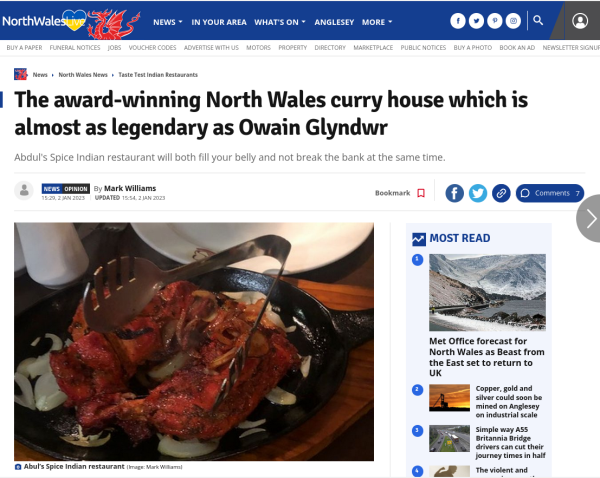
    Nevertheless, Friday’s Shropshire Star reported that due to dodgy website tagging and editing, Clun has moved 50km (that’s 30 miles in old money. Ed.) and has now been absorbed into the unitary authority of Telford & Wrekin, as shown by the following screenshot.

    Screenshot of Shropshire Star article placing Clun within Telford

    The reaction of the good burghers of Clun to the news of the town’s eastward migration has not yet been reported. 😀

    However, the fact that the article’s tagging bears no relationship to the copy hints that the tags are edited by a different person to the one writing the actual report.

  • Twins?

    A couple of days ago, your ‘umble scribe escaped his normal stomping ground to visit the local castle in Caldicot (Cil-y-Coed) in Monmouthshire, South Wales, which has existed in some form since about 1100.

    Caldicot Castle entrance

    The tour of the castle and environs was followed by a splendid breakfast at the Aroma Café in the centre of Caldicot.

    Travelling back to Severn Tunnel Junction on the outskirts of Rogiet for the return train entailed joining the Wales Coast Path just past Caldicot railway station, where your correspondent observed the station sign was looking somewhat the worse for wear.

    Caldicot station sign

    Note the heavy peppering by air pistol or shotgun pellets.

    Your ‘umble scribe could not help but be reminded on what seems to be a tradition on Crete of taking potshots at road signs.

    Cretan road sign with ammunition holes
    Image courtesy of Wikimedia Commons

    On Crete there is a tradition of firing off weapons at such celebrations as marriages and the island is also reputed to have the highest level of gun ownership in the entire EU. According to Greek news site Ekathiremini, there are estimated to be between 600,000 and one million illegal firearms on Crete, which has a population (2021 figure) of 617,360.

    Are Cretans carrying on a tradition of their homeland in South Wales or is this local traditional vandalism? Have your say in the comments.

  • Red menace in SW1

    Your ‘umble scribe recalls a phrase from his Cold War childhood – the Red Menace. This was a term used at that time to describe the Soviet Union or an “international communist conspiracy”; an alternative was the Red Scare. By the time of the Cold War, the Russian revolution and establishment of the Soviet Union caused widespread concern among the political elites of the major powers for many decades.

    However, Larry the Downing Street cat (aka Chief Mouser to the Cabinet Office. Ed.) has been dealing with a red menace of his own in the shape of Reynard the Fox.

    Any connection of Larry’s interloper with Keir Starmer’s Labour Party should be dismissed. The fox’s colouration far too dubious to be allowed into his nominally red party. 😀

  • Standards?

    DVSA logoThe government’s Driver and Vehicle Standards Agency (DVSA) is based in Croydon Street in the Easton area of Bristol. It is based in Berkeley House (not to be confused with its city centre namesake which houses students. Ed.), former headquarters of the Bristol Omnibus Company.

    According to its Wikipedia page, the DVSA is responsible for:

    • setting the standard for safe and responsible driving and riding;
    • carrying out theory and practical driving tests for all types of motor vehicles;
    • maintaining the register of approved driving instructors;
    • approving training bodies and instructors to provide compulsory basic training and direct access scheme courses for motorcyclists;
    • running the tests that allow people to join and stay on the voluntary register of driver trainers who train drivers of car and van fleets;
    • setting the standards for the drink-drive rehabilitation scheme, running the scheme and approving the courses that offenders can take;
    • conducting annual testing of lorries, buses and trailers through authorised testing facilities (ATFs) and goods vehicle testing stations (GVTS);
    • conducting routine and targeted checks on vehicles, drivers and operators ensuring compliance with road safety legislation and environmental standards;
    • supervising the MOT scheme so that over 20,000 authorised garages carry out MOT tests to the correct standards;
    • providing administrative support to the regional Traffic commissioners in considering and processing applications for licences to operate lorries, buses, coaches and registered bus services;
    • conducting post-collision investigations;
    • monitoring products for manufacturing or design defects, highlighting safety concerns and monitoring safety recalls;
    • providing a range of educational and advisory activities to promote road safety.

    However, judging from the present environs of Berkeley House, your correspondent wonders how good a job the DVSA is actually doing.

    Firstly, there’s a toppled 20 mph sign at the junction of Lawrence Hill and Croydon Street immediately opposite the DVSA’s premises. The agency’s logo is on the sign behind the pale blue fence in the background to the crash site.

    Toppled 20 mph speed limit sign outside DVSA headquarters

    Now let’s move a bit further west down Croydon Street following the site’s blue-painted steel railings…

    Railings demolished by vehicle collision outside DVSA headquarters

    No further comment is necessary from your ‘umble scribe, except maybe to paraphrase Oscar Wilde’s Lady Bracknell: ‘To crash once Mr Worthing, may be regarded as a misfortune; to crash twice looks like carelessness.’. 😀

  • Reach Welsh titles’ exclusives: Hurricane Ian drops rain on Wales

    At the time of writing, Hurricane Ian, the ninth named hurricane of this year’s Atlantic hurricane season, is off the coast of North and South Carolina on the eastern seaboard of the United States. Any remnant of said hurricane, downgraded to a tropical storm by the time it starts crossing the Atlantic, is not expected to dump any of its remaining rain on the shores of Great Britain for many days yet.

    The exact location of Hurricane Ian comes courtesy of the USA’s National Hurricane Center, as shown below.

    Image from National Hurricane Center showing current location of Hurricane Ian

    However, this has not stopped both Wales Online and the Daily Post (aka North Wales Live. Ed.), the 2 Reach plc regional news titles covering North and South Wales respectively, from coming up with similar misleading stories (fairy tales surely? Ed.) on today’s pages of their respective ‘news‘ websites. The Daily Post story can be seen here and the Wales Online story here. Note also the use of ‘amid‘ in the Wales Online headline (posts passim).

    Headline reads Hurricane Ian LIVE updates as US storm fall out hits North Wales with gale-force winds and downpours
    Which hurricane, Daily Post?
    Headline reads Live updates as rain and wind set to hit Wales amid expected Hurricane Ian fallout
    Same question to you, Wales Online.

    If the fourth estate cannot even get the names and locations of extreme weather events correct, what else should they not be trusted about?

  • The tannery ghost?

    Wellington Road in St Judes runs along the west bank of the River Frome (aka the Danny in east Bristol. Ed.) offering views of the industrial buildings on the far bank.

    View of J. Scadding & Son's timber yard featuring brick remains of former tannery on the site
    The ghost of building past in the timber yard

    In front of the more modern timber sheds erected by current site occupants J. Scadding & Son, are some older structures of brick and stone, which appear to be nineteenth century industrial buildings. In the 19th century the banks of the Frome were densely crowded with industrial buildings, particularly for processes that required ready access to an abundant supply of water, such as brewers and tanners.

    A quick search through the vintage maps on Bristol City Council’s excellent Know Your Place website reveals that Scadding’s current site was occupied by the Earlsmead Tannery in the late 19th century, whilst Scadding’s website reveals the company only moved to the site in the mid-1950s..

    Late 19th century Earlsmead Tannery
    Site of Scadding’s timber yard in the late 19th century.

    Could those standing walls be Earlsmead Tannery’s remains?

  • Shropshire Star journalist gives up after enigmatic byline

    The screenshot below is the full extent of an article* which has appeared this morning on on the Shropshire Star website.

    Headline reads Aldi seeks go-ahead for signs at new Shrewsbury store
    You’ve got the headline, what more do you want?

    Given the modern journalistic tendency of trying squeeze the whole story into the headline, perhaps there was no need to write much more than a tokenistic byline, concerning which your ‘umble scribe would be most grateful if any readers knowing what the gfgfgfg byline signifies could offer their thoughts in the comments below. Thanks! 😀

    * = The article has since been removed.

  • Red kites and romantic ruins

    Your ‘umble scribe has just spent an enjoyable week’s walking with his sister (and her dog) in the Vale of Llangollen, an area which neither of us has visited for over 50 years.

    Llangollen itself is named after St Collen, a 7th century Welsh monk who is said to have arrived in Llangollen by coracle and founded a church beside the river there. No other churches in Wales are dedicated to him.

    One day’s walking was taken up with a gentle amble down to the Horseshoe Falls, a diversion to the parish church of St Tysilio in Llantysilio (recommended for its medieval woodwork and memorials. Ed.), then a gentle amble into Llangollen for lunch, followed by a short and vigorous climb up to the romantic ruins of Castell Dinas Brân, a 13th century castle set in the midst of prehistoric earthworks, which we had both visited separately in our youth.

    Castell Dinas Brân seen from the Panorama walk
    Castell Dinas Brân seen from the Panorama walk. Image courtesy of Wikimedia Commons.

    Word has it Victorian visitors to the castle ruins used to take their afternoon teas up there with them to enjoy whilst admiring the splendid views to the east across the Cheshire Plain and the more rugged scenery closer to hand up the Eglwyseg valley.

    When had just started our descent, we noticed a red kite patrolling the skies just above the castle ruins. Apologies for the less than perfect picture, which fortunately still shows the bird’s angled wings and distinctive forked tail.

    Red kit above Castell Dinas Brân

    Here’s a slightly better shot of a Welsh red kite courtesy of Wikimedia Commons.

    At one time persecution had reduced the country’s red kite population to a small rump mostly around Tregaron in Ceredigion, legal protection (they are covered by Schedule 1 of the Wildlife and Countryside Act. Ed.) and reintroduction schemes have now seen the bird’s population start to recover. Those schemes have seen the birds reintroduced to Scotland, central Wales and central England, especially the Chilterns. The present UK breeding population is estimated by the RSPB to be some 4,600 pairs. Its current distribution can be seen on the following map.

    Red kite distribution. Map courtesy of Wikimedia Commons
    Red kite distribution. Map courtesy of Wikimedia Commons. Blue denotes resident populations.

    As a child, your ‘umble scribe remembers reading in wildlife books that red kites were once so widespread, they were a common urban pest in the 16th century. Were they to repopulate urban areas that would make their reintroduction schemes the most successful to date: as part of their diet is derived from scavenging, they would thrive in our streets paved with discarded takeaway containers.

Posts navigation