A couple of days ago, your ‘umble scribe escaped his normal stomping ground to visit the local castle in Caldicot (Cil-y-Coed) in Monmouthshire, South Wales, which has existed in some form since about 1100.
The tour of the castle and environs was followed by a splendid breakfast at the Aroma Café in the centre of Caldicot.
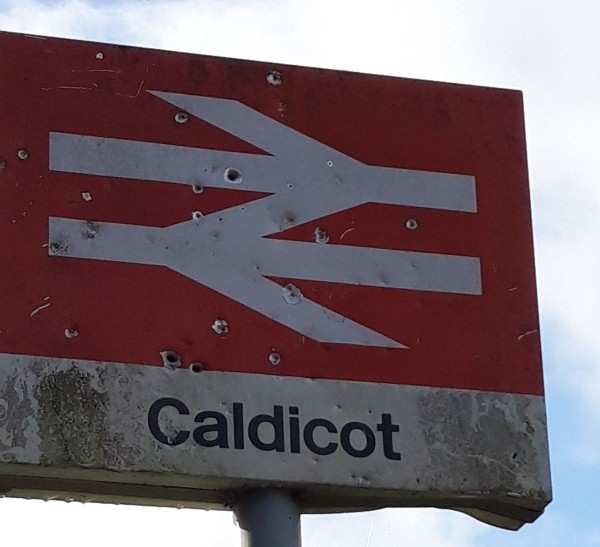
Travelling back to Severn Tunnel Junction on the outskirts of Rogiet for the return train entailed joining the Wales Coast Path just past Caldicot railway station, where your correspondent observed the station sign was looking somewhat the worse for wear.
Note the heavy peppering by air pistol or shotgun pellets.
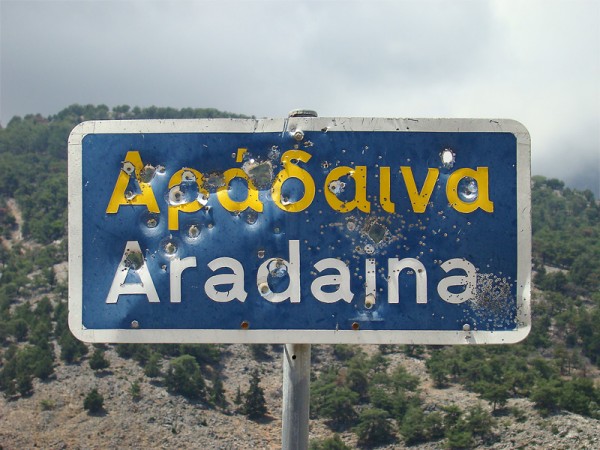
Your ‘umble scribe could not help but be reminded on what seems to be a tradition on Crete of taking potshots at road signs.
Image courtesy of Wikimedia Commons
On Crete there is a tradition of firing off weapons at such celebrations as marriages and the island is also reputed to have the highest level of gun ownership in the entire EU. According to Greek news site Ekathiremini, there are estimated to be between 600,000 and one million illegal firearms on Crete, which has a population (2021 figure) of 617,360.
Are Cretans carrying on a tradition of their homeland in South Wales or is this local traditional vandalism? Have your say in the comments.
Your ‘umble scribe recalls a phrase from his Cold War childhood – the Red Menace. This was a term used at that time to describe the Soviet Union or an “international communist conspiracy”; an alternative was the Red Scare. By the time of the Cold War, the Russian revolution and establishment of the Soviet Union caused widespread concern among the political elites of the major powers for many decades.
However, Larry the Downing Street cat (aka Chief Mouser to the Cabinet Office. Ed.) has been dealing with a red menace of his own in the shape of Reynard the Fox.
Any connection of Larry’s interloper with Keir Starmer’s Labour Party should be dismissed. The fox’s colouration far too dubious to be allowed into his nominally red party. 😀
The government’s Driver and Vehicle Standards Agency (DVSA) is based in Croydon Street in the Easton area of Bristol. It is based in Berkeley House (not to be confused with its city centre namesake which houses students. Ed.), former headquarters of the Bristol Omnibus Company.
According to its Wikipedia page, the DVSA is responsible for:
setting the standard for safe and responsible driving and riding;
carrying out theory and practical driving tests for all types of motor vehicles;
maintaining the register of approved driving instructors;
approving training bodies and instructors to provide compulsory basic training and direct access scheme courses for motorcyclists;
running the tests that allow people to join and stay on the voluntary register of driver trainers who train drivers of car and van fleets;
setting the standards for the drink-drive rehabilitation scheme, running the scheme and approving the courses that offenders can take;
conducting annual testing of lorries, buses and trailers through authorised testing facilities (ATFs) and goods vehicle testing stations (GVTS);
conducting routine and targeted checks on vehicles, drivers and operators ensuring compliance with road safety legislation and environmental standards;
supervising the MOT scheme so that over 20,000 authorised garages carry out MOT tests to the correct standards;
providing administrative support to the regional Traffic commissioners in considering and processing applications for licences to operate lorries, buses, coaches and registered bus services;
conducting post-collision investigations;
monitoring products for manufacturing or design defects, highlighting safety concerns and monitoring safety recalls;
providing a range of educational and advisory activities to promote road safety.
However, judging from the present environs of Berkeley House, your correspondent wonders how good a job the DVSA is actually doing.
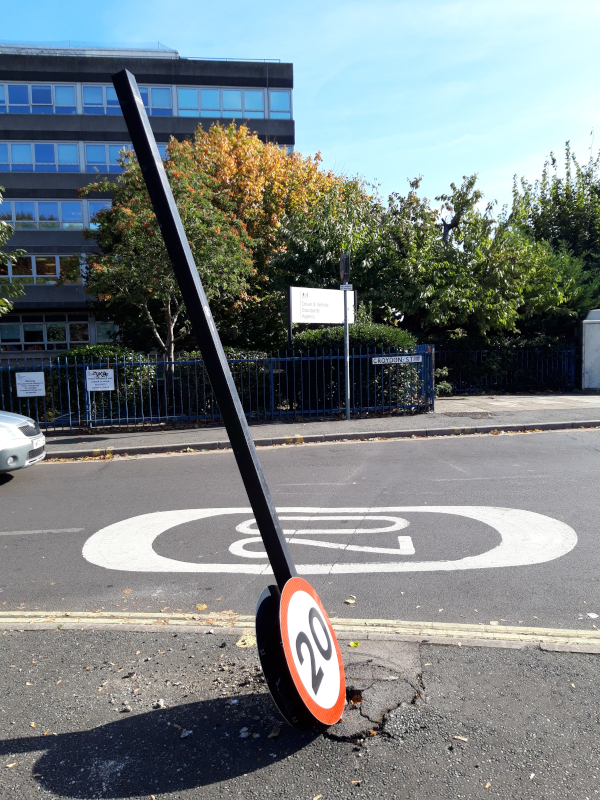
Firstly, there’s a toppled 20 mph sign at the junction of Lawrence Hill and Croydon Street immediately opposite the DVSA’s premises. The agency’s logo is on the sign behind the pale blue fence in the background to the crash site.
Now let’s move a bit further west down Croydon Street following the site’s blue-painted steel railings…
No further comment is necessary from your ‘umble scribe, except maybe to paraphrase Oscar Wilde’s Lady Bracknell: ‘To crash once Mr Worthing, may be regarded as a misfortune; to crash twice looks like carelessness.’. 😀
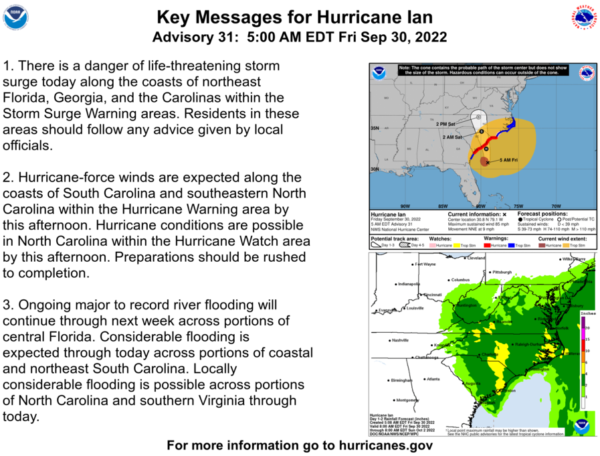
At the time of writing, Hurricane Ian, the ninth named hurricane of this year’s Atlantic hurricane season, is off the coast of North and South Carolina on the eastern seaboard of the United States. Any remnant of said hurricane, downgraded to a tropical storm by the time it starts crossing the Atlantic, is not expected to dump any of its remaining rain on the shores of Great Britain for many days yet.
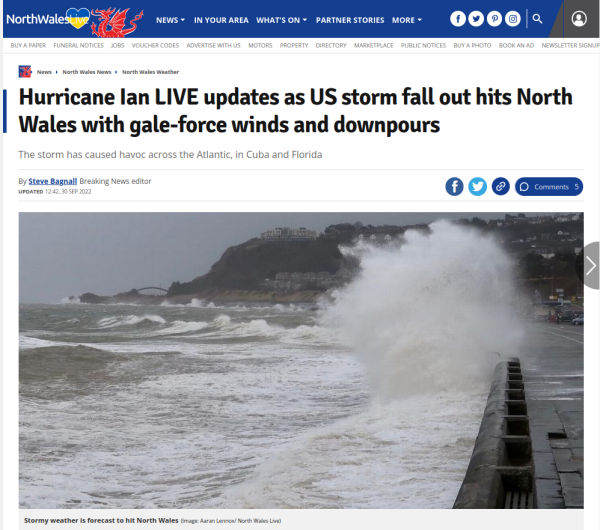
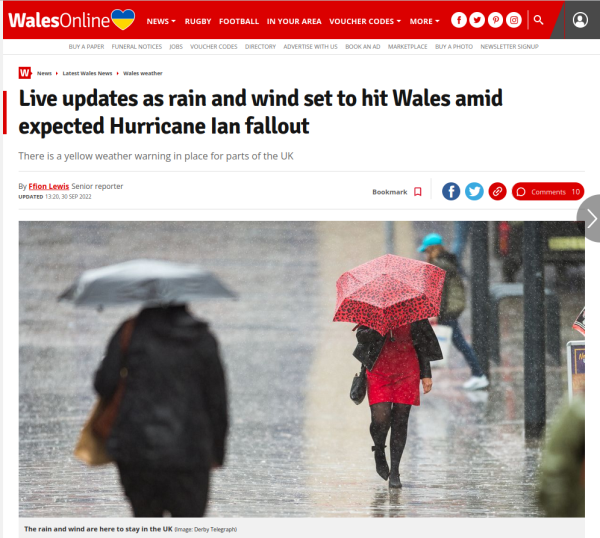
However, this has not stopped both Wales Online and the Daily Post (aka North Wales Live. Ed.), the 2 Reach plc regional news titles covering North and South Wales respectively, from coming up with similar misleading stories (fairy tales surely? Ed.) on today’s pages of their respective ‘news‘ websites. The Daily Post story can be seen here and the Wales Online story here. Note also the use of ‘amid‘ in the Wales Online headline (posts passim).
Which hurricane, Daily Post?Same question to you, Wales Online.
If the fourth estate cannot even get the names and locations of extreme weather events correct, what else should they not be trusted about?
Wellington Road in St Judes runs along the west bank of the River Frome (aka the Danny in east Bristol. Ed.) offering views of the industrial buildings on the far bank.
The ghost of building past in the timber yard
In front of the more modern timber sheds erected by current site occupants J. Scadding & Son, are some older structures of brick and stone, which appear to be nineteenth century industrial buildings. In the 19th century the banks of the Frome were densely crowded with industrial buildings, particularly for processes that required ready access to an abundant supply of water, such as brewers and tanners.
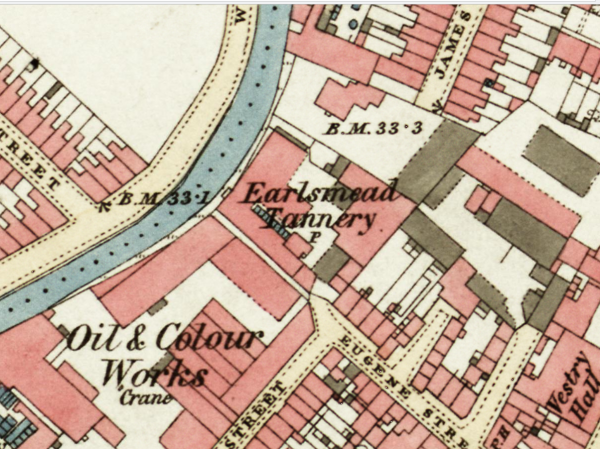
A quick search through the vintage maps on Bristol City Council’s excellent Know Your Place website reveals that Scadding’s current site was occupied by the Earlsmead Tannery in the late 19th century, whilst Scadding’s website reveals the company only moved to the site in the mid-1950s..
Site of Scadding’s timber yard in the late 19th century.
Could those standing walls be Earlsmead Tannery’s remains?
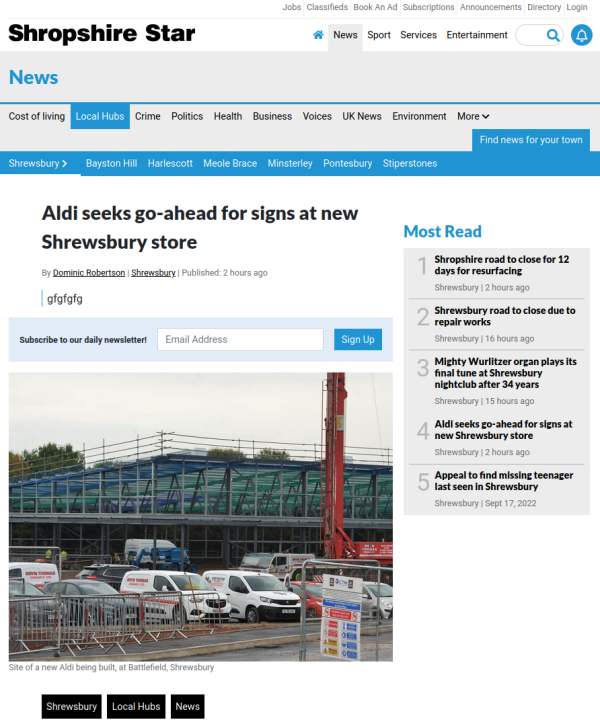
The screenshot below is the full extent of an article* which has appeared this morning on on the Shropshire Star website.
You’ve got the headline, what more do you want?
Given the modern journalistic tendency of trying squeeze the whole story into the headline, perhaps there was no need to write much more than a tokenistic byline, concerning which your ‘umble scribe would be most grateful if any readers knowing what the gfgfgfg byline signifies could offer their thoughts in the comments below. Thanks! 😀
Your ‘umble scribe has just spent an enjoyable week’s walking with his sister (and her dog) in the Vale of Llangollen, an area which neither of us has visited for over 50 years.
Llangollen itself is named after St Collen, a 7th century Welsh monk who is said to have arrived in Llangollen by coracle and founded a church beside the river there. No other churches in Wales are dedicated to him.
One day’s walking was taken up with a gentle amble down to the Horseshoe Falls, a diversion to the parish church of St Tysilio in Llantysilio (recommended for its medieval woodwork and memorials. Ed.), then a gentle amble into Llangollen for lunch, followed by a short and vigorous climb up to the romantic ruins of Castell Dinas Brân, a 13th century castle set in the midst of prehistoric earthworks, which we had both visited separately in our youth.
Castell Dinas Brân seen from the Panorama walk. Image courtesy of Wikimedia Commons.
Word has it Victorian visitors to the castle ruins used to take their afternoon teas up there with them to enjoy whilst admiring the splendid views to the east across the Cheshire Plain and the more rugged scenery closer to hand up the Eglwyseg valley.
When had just started our descent, we noticed a red kite patrolling the skies just above the castle ruins. Apologies for the less than perfect picture, which fortunately still shows the bird’s angled wings and distinctive forked tail.
Here’s a slightly better shot of a Welsh red kite courtesy of Wikimedia Commons.
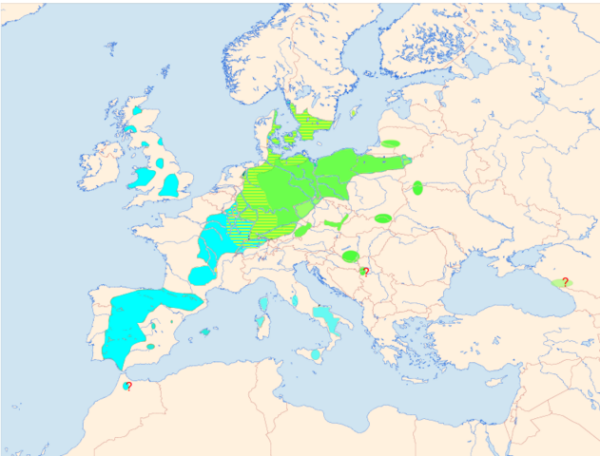
At one time persecution had reduced the country’s red kite population to a small rump mostly around Tregaron in Ceredigion, legal protection (they are covered by Schedule 1 of the Wildlife and Countryside Act. Ed.) and reintroduction schemes have now seen the bird’s population start to recover. Those schemes have seen the birds reintroduced to Scotland, central Wales and central England, especially the Chilterns. The present UK breeding population is estimated by the RSPB to be some 4,600 pairs. Its current distribution can be seen on the following map.
Red kite distribution. Map courtesy of Wikimedia Commons. Blue denotes resident populations.
As a child, your ‘umble scribe remembers reading in wildlife books that red kites were once so widespread, they were a common urban pest in the 16th century. Were they to repopulate urban areas that would make their reintroduction schemes the most successful to date: as part of their diet is derived from scavenging, they would thrive in our streets paved with discarded takeaway containers.
Automatic Number Plate Recognition (ANPR) surveillance seems to be on the rise since your ‘umble scribe first reported on its use by B&NES for access control to the council’s rubbish tips recycling centres some years ago.
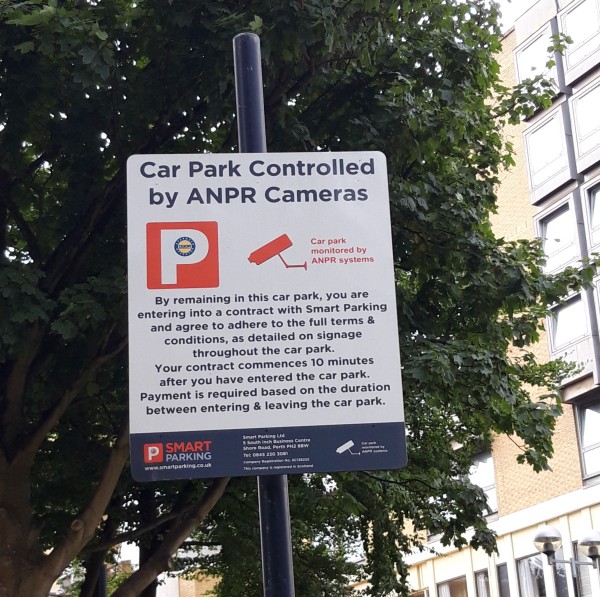
It’s now being used by parking management companies to catch drivers who overstay their welcome in private car parks, as shown by the example below spotted in central Bristol today outside the snappily named Double Tree by Hilton hotel on Redcliffe Way.
Somebody’s watching you…
The hotel car park in question is ‘managed’ by Smart Parking, whose website boasts the company is ‘Reinventing the Parking Experience’. The manner in which Smart Parking is ‘reinventing’ parking (minus the experience. Ed.) can best be described by your correspondent as ‘Orwellian‘.
The adjective Orwellian is no exaggeration if one peruses the company’s marketing brochure to glean how ANPR is used. It states:
Smart Parking’s automatic number plate recognition (ANPR) / license plate recognition (LPR) parking system is a simple, efficient and cost-effective way of off-street
car park management. Cameras placed at entry and exit points take a timed photo of the number plate of each vehicle entering and exiting the premises. Customers then simply pay and walk, using their license place as identification. We can also configure sites to have validated parking which can include permit only, staff only, free limited time parking and definable grace periods, to name a few.
As with our other solutions, SmartANPR/LPR work with the SmartCloud platform to deliver occupancy, stay rates and enforcement efficiency reporting for car park management and future planning.
Note the American English usage of license.
Of course, for any users who outstay their welcome, the company wants to make a profit with its penalty charges (note to any passing journalists, despite your constantly referring to these charges in your copy as ‘fines‘, they are in fact invoices; only the judicial authorities can impose fines. 😀 Ed.) and so needs to obtain details of the vehicle’s keeper from the DVLA. The DVLA is more than willing to divulge this information for a fee, as confirmed by the answer to a Freedom of Information Act request from 2012.
The law allows the DVLA to disclose vehicle keeper information to those who can demonstrate a reasonable cause for requiring it. Reasonable cause is not defined in legislation but the Government’s policy is that it should relate to the vehicle or its use, following incidents where there may be liability on the part of the driver.
The DVLA also charges a fee for the disclosure of this information, as the response further clarifies:
The fees levied by the DVLA for Fee Paying Enquiries are set to recover the costs of processing requests and ensure that the cost is borne by the requester and not passed onto the taxpayer.
Even so, the agency has fallen foul of the Information Commissioner’s Office for “not using the correct lawful basis to disclose vehicle keeper information“, as The Guardian reported a few months ago.
Your correspondent feels an urge to submit another FoI request for the DVLA to enquire about the amount of money received by the agency for this service, but has more than a suspicion such a request would be refused on the grounds of commercial confidentiality.
Staying in Glasgow for a few days for my niece’s wedding, your correspondent cannot help comparing and contrasting the differences between how Glasgow and Bristol City Councils set about tackling the public nuisance and environmental crime of fly-tipping, particularly as regards the use of public notices for enforcement and dissuasion.
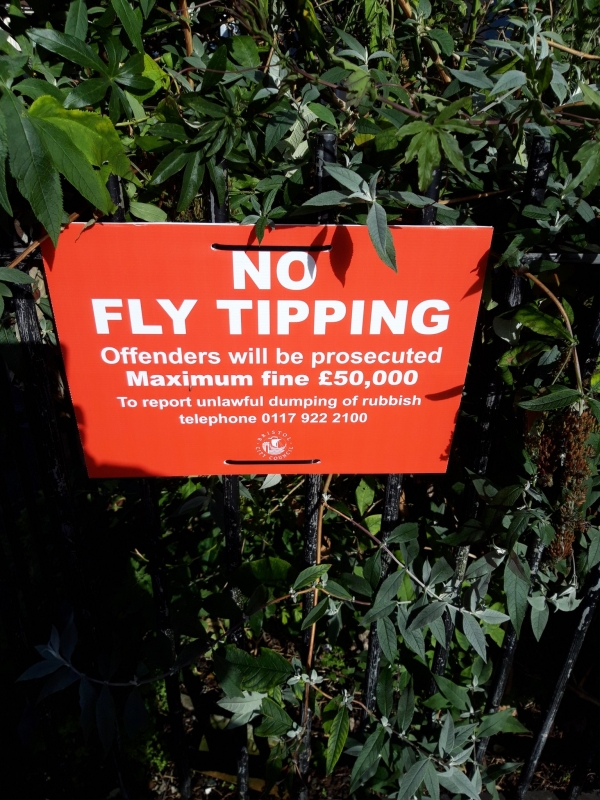
Exhibit A: the public notices used by Bristol City Council.
This is an A5-sized sign with no redeeming graces, which threatens the maximum possible fine under law of £50,000 (no mention of the alter#native maximum penalty of 6 months’ imprisonment or a combination of the two. Ed.). Should anyone feel public -spirited enough to fancy reporting any fly-tipping, the public is directed to the council’s main switchboard number, with no mention of the very convenient option of reporting fly-tipping online.
Exhibit B: a public notice used by Glasgow City Council, as seen in Holmlea Road.
The initial difference is the size of the notice: at least A4 instead of A5, i.e. twice the size. There’s no mention of any maximum penalty, but residents are encouraged to report Dumb Dumpers via a 24-hour 0845 number. 0845 telephone numbers are “business rate numbers” (otherwise known as “non-geographical premium rate phone numbers“, for which the charge for mobile telephones and landlines is “up to 7p and your phone company’s access charge“. The UKPhoneIfo website warns that “charges for dialling 0845 numbers can be significantly higher – up to 41p per minute” when calling from a mobile number and that “when an 0845 number is called, the call recipient receives a small share of the call cost.” This number is a Scotland-wide number for reporting fly-tipping (there’s also a pan-Scottish Dumb Dumpers reporting website too, Ed.), in addition to which Glasgow City Council website also offers online reporting of fly-tipping and other environmental crimes.
Two more differences to Bristol are apparent: the locations of the council rubbish tips (civic amenity sites) are given in a further attempt to change anti-social behaviour, whilst finally residents are reminded that the state of the neighbourhood is their responsibility, as well as that of the council.
There are lessons that Bristol City Council could learn from Glasgow, as long as it ditches the not invented here attitude that seems to pervade the corridors of the Counts Louse.
One final note: even though the city is still being tidied up following the end of the recent Scottish bin collectors’ strike, your correspondent’s overall impression is that the streets of Glasgow are not as filthy as those of Bristol. Whether this is due to belittling and disparaging those who despoil the urban area as Dumb Dumpers has yet to be proven empirically, but is another tactic BCC could try, if so inclined.

 The government’s