Vowel movement
Proofreading is a skill requiring meticulous attention to detail. However, something clearly went wrong in respect of this camera advertisement, as the product description sounds really crappy. 😉

Hat tip: Agata McCrindle.
Proofreading is a skill requiring meticulous attention to detail. However, something clearly went wrong in respect of this camera advertisement, as the product description sounds really crappy. 😉
Hat tip: Agata McCrindle.
The screenshot below from today’s Bristol Post reveals an interesting succession of articles – the first on biscuits and and the second on obesity.
What point is the online editor trying to make?

The media have been awash this morning with reports of Facebook’s acquisition of WhatsApp.
WhatsApp is a mobile messaging company; or it was until the story fell into the hands of the illiterati in the BBC newsroom, who suffered one of their periodic vowel movements. 🙂

Hat tip: Gala Gil Amat.
Murphy’s Law was working well when Lakewood High School of St Petersburg in Florida decided to hold a literacy event for parents back in 2012 (on 29th February apparently to tie in with the leap year. Ed.), as shown by the illuminated sign below.
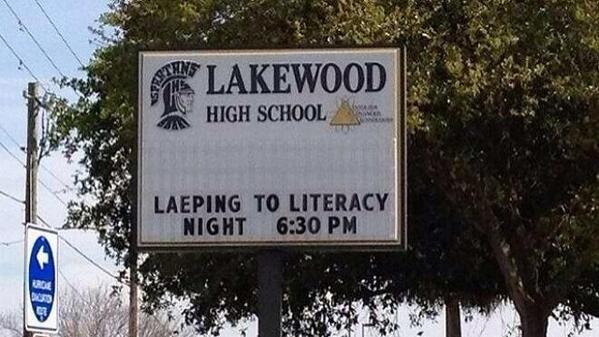
NBC News has full details in its report.
So far winter in Bristol has been not like winter at all; it’s been mostly mild and rather wet.
As a result some of the local trees – like this cherry in Castle Park (picture taken this morning. Ed.) – are somewhat confused and believe it’s spring already, judging by the display of blossom.

However, where Castle Park is concerned, it’s not just its cherry trees that are confused. Its custodians – Bristol City Council – are confused too.
According to the council’s Central Area Action Plan (CAAP) the western end of Castle Park is a prime development opportunity and has been earmarked for covering in concrete at a time when the city has enough empty shops, offices and other commercial space to cope with another recession besides the one that is allegedly now at an end.
This act of municipal largesse to developers comes in spite of the fact that over 95% of CAAP consultation responses relating to Castle Park were against any development that would mean building on the park and that it’s only some 5 or 6 years since the council encountered firm opposition from Bristolians the last time it proposed developing this bit of Castle Park.
Once again, there’s a petition against the development of Castle Park. Its preamble reads as follows:
As a resident of Bristol, I am dismayed at and object to the proposals in the current Bristol Central Area Plan to build on green space and to cut down some 40 mature trees in the St Mary le Port area of Castle Park and in the High St and Wine St which border it.
Whilst the old disused buildings there are indeed in need of refurbishment and bringing into use, I do not accept that to do so it is necessary to build on any of the existing green space surrounding the buildings or to cut down the trees, which is what the proposals would mean.
Further, this is hardly in line with Bristol being the European Green Capital in 2015.
In the centre of Manchester on Boxing Day (allegedly)…

This scene was probably repeated in every large town and city in the UK yesterday.
Such uncritical and unquestioning behaviour has given rise to the portmanteau word ‘sheeple‘.
Hat tip: Tripe Marketing Board
I’ve been aware of Scott, Amundsen, Shackleton et al. and their expeditions to Antarctica since my childhood and on Christmas Eve this year was made aware through social media of the exploits of the 1902-1904 Scottish National Antarctic Expedition.
Although its work was overshadowed by more prestigious expeditions, the Scottish National Antarctic Expedition nevertheless completed a full programme of exploration and scientific work, including the establishment of the first manned meteorological station in Antarctic territory, as well as the discovery of new land to the east of the Weddell Sea.
Below is a photograph taken on that expedition; a suitably light-hearted one of piper Gilbert Kerr serenading a penguin.

However, penguins did more for the expedition than provide an audience for pipers. They were a regular item on the menu too!
A typical day’s diet there might have been: breakfast of porridge and penguin eggs, with bacon on Wednesdays and Thursdays and coffee or cocoa week about. Lunch of eggs with bully beef or bread and cheese and tea. Dinner of penguin “hare soup”, then stewed penguin, with some farinaceous pudding or preserved fruit to follow.
The above comes from the text accompanying a splendid photo of Bill Smith, the expedition’s cook from Glasgow Digital Library, which has a fine collection of photographs from the expedition. I also love the final sentence on the page too for its description of Smith:
Smith’s substantial physique is a good advertisement for the value of his own work.
Season’s greetings all.
A message to all businesses: if you sack a member of staff, you should consider changing your Twitter password, particularly if that person had access to the account.
The Plough, a pub in Great Haseley, Oxfordshire, didn’t… and at the time of posting it has nearly 1,700 followers.
You can enjoy the results in the screenshot below.

Update 12 noon, 16/12/13: According to Buzzfeed, Jim Knight, the chef in question, created the Twitter account with the permission of his now former employers. Furthermore, he has also now been offered a new job, in which I wish him well. 🙂
Hat tip: Eugene Byrne