Horses and cattle are both ungulates, i.e. both use the tips of their toes to support their whole body weight whilst moving. Both cows and horses have hooves.
A horse is an odd-toed ungulate with a long hairy mane and tale, whilst a cow is an even-toed ungulate. They’re easy to identify, unless you’re a city-based employee of the Bristol Post.
Yesterday the Post published a tragic story of more than 100 horses having to be put down after being rescued from appalling conditions in Bridgend in the Vale of Glamorgan.
However, the picture used to illustrate the report features animals that look more bovine than equine, as revealed by the screenshot below.
Frisians or Dobbins?
Just because both beef and horsemeat taste equally good on the plate doesn’t means they are interchangeable in the field, Bristol Post. Try saddling up a cow and entering a steeplechase! 🙂
Earlier this year I blogged about the Home Office’s so-called racist van (posts passim). Yesterday along with most of the national media the BBC reported that the Home Office had admitted that just 11 illegal immigrants had left the UK as a result of its ill-advised campaign.
Although the Home Office’s efforts were ill-advised and less than successful, its use of mobile billboards has inspired their use by others like the Tripe Marketing Board, as the picture below – allegedly from Lancashire – shows.
The title is true and it’s a genuine item straight from the news you couldn’t make up department: Capita Translation & Interpeting, the outfit responsible for making an utter mess of the courts and tribunals interpreting contract with the Ministry of Justice (posts passim) is seeking English interpreters for assignments in the London area.
Yes, it does sound amazing, but below is a screenshot of a page from Capita T&I’s website, captured today at 4.45 pm. English is the fifth item down the list.
English speakers wanted in London? The mind boggles.
Do you have any ideas why Crapita should need English interpreters in the capital of the country where the language originated? Put them in the comments below. 🙂
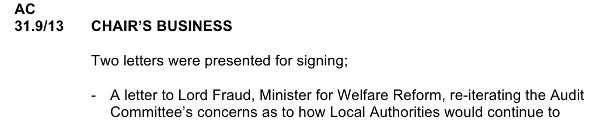
I’m not a regular reader of the minutes of meetings of Bristol City Council’s Audit Committee. However, there’s an absolute corker of a typographical error on page 3 of the draft minutes of its 24th September 2013 meeting (PDF).
Will anyone down at the Counts Louse (as real Bristolians call or) or City Hall (as the Mayor has renamed it) be eagle-eyed enough to notice?
Under no circumstances Lord Fraud should not be confused with Lord Freud, a Conservative peer who only pretends to be a Parliamentary Under-Secretary at the Department for Work and Pensions with responsibility for welfare reform. 😉
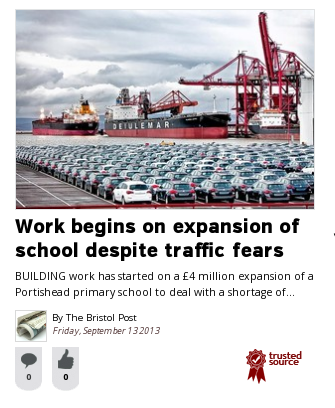
As any journalist knows, an appropriate picture can add interest to what would otherwise be a dull story. However, what a quay full of cars has to do with a report on school expansion in Portishead, only the Bristol Post knows.
Evidently, the above image is so good, the Post decided to use it a second time for a completely unrelated report into Frenchay Hospital.
Both screenshots were taken from the Bristol Post website at about 7.00 a.m. on Friday. However, the ‘featured image’ might have changed by the time you read the articles. 🙂
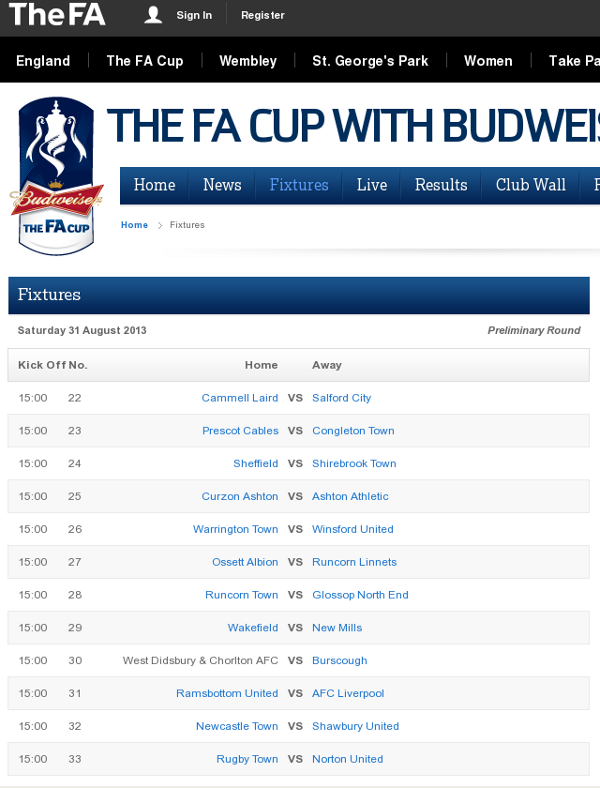
This weekend marks the start of the competition for the FA Cup, the most prestigious trophy in English football, with the start of the preliminary round, when all the amateur teams in the local leagues around the country have their chance of a cup run for glory, i.e. it’s the round where all the Davids battle it out for a chance to challenge Goliath.
By way of an example, Market Drayton Town, the team from the town of my birth, has a home tie today against Kidsgrove Athletic, which kicks off at 3 pm.
However, if – as many people do – you relied on the BBC as a source of sports news, you’d be completely unaware of the existence of the FA Cup preliminary round, as proven by the following screenshot taken today at the same time as the above FA screenshot.
That’s right! According to Auntie, there are no FA Cup fixtures for the next 7 days.
The BBC likes to base its reputation on its reliable and accurate coverage of news and events.
Is this reputation undeserved? Answers in the comments below please.
I’ve seen this fruit van a few times on Cumberland Road in recent weeks. At the foot of the offside door is a message to the light-fingered with a penchant for bananas.
Can other primates and other assorted fruit fans read?
Yesterday I returned from my annual meet-up in Shropshire with my sister Hilary. Dubbed the ‘sibling saunter’, it’s an opportunity we take each year to meet in Shropshire, the county of our birth, and go walking without the encumbrance of children, partners, etc.
This year we went down into the Clun area in the south-west of Shropshire and the first day’s walk took us into Wales. Following an excellent route map (PDF) prepared by the Clwyd-Powys Archaeological Trust, we visited the prehistoric burial cairns on Corndon Hill (513 m above sea level) before making to the Miner’s Arms in Priestweston for a pint and finishing off at the Mitchell’s Fold stone circle. Legend has it that one of the stones in the circle is a petrified witch, punished by locals for seeing off a magic cow that provided them with unending supplies of milk.
There’s a very convenient bench next to the trig point on the top of Corndon Hill and it’s perfect for a breather and a refreshment stop.
The porous, unclear nature of the border between England and Wales is well evidenced around this area by places with English names in Wales and Welsh ones in England. The border itself has moved around too. For instance, Montgomery – the site of one of the Marcher castles and now firmly part of Wales – is included in the Shropshire county returns of the Domesday Book.
Although our Corndon Hill walk was only 6 miles in length, we both agreed on its strenuous nature for fifty-somethings, albeit fairly fit ones.
As the first evening of our annual saunter set in, we were still undecided as to the next day’s walking route. Eventually we decided on a loop of some 10 miles in length comprising a section of the Shropshire Way to Hergan and its junction with the Offa’s Dyke Path, which here is well preserved and follows the line of the Dyke itself, down to Newcastle on Clun and then back to our base at the youth hostel in Clun.
Offa’s Dyke is a massive linear earthwork, roughly followed by some of current border between England and Wales. In places, it is up to 19.8 m wide – including its flanking ditch – and 2.4 m high, with the ditch always on the Welsh side. In the 8th century it formed some kind of delineation between the Saxon kingdom of Mercia and the Welsh. Offa himself was King of Mercia from 757 to 796.
So we set out from the grounds of Clun Castle following the Shropshire Way along the valley of the River Clun. The route is well waymarked and the Shropshire Way’s buzzard logo is well displayed on all signposts. After a couple of miles we climbed over the Cefns to Hengarn and Offa’s Dyke.
My sister, the great navigator, at the junction of Offa’s Dyke (on the left) and the Shropshire Way (on the right)
The section of the Shropshire Way over which we’d walked was shared with Wild Eadric’s Way, named after Eadric the Wild, a Saxon thegn (or thane. Ed.) who was lord of Clun and refused to swear fealty to the usurping William the Bastard of Normandy. The factual life of Eadric has since become interspersed with folklore, as shown in this article.
But back to Offa’s Dyke. The section we were walking is amongst the best preserved that remains. Furthermore, whilst descending to Newcastle on Clun, we passed the halfway point between the path’s 2 end points – Chepstow and Prestatyn. It was most fortunate we were walking on a Wednesday as there’s a community café open in Newcastle’s community centre on Wednesdays between 10.30 am and 4.30 pm; the refreshments were excellent! I recommend the ginger and lemon cake.
Once back in Clun it was time for a well-earned pint in the Sun Inn before retiring back to the youth hostel. If you’re thinking of staying in the area and have fond memories of ‘old skool’ hostelling, you’ll love Clun YH. It’s a beautifully restored water mill with plenty of the mill machinery on view. Furthermore, it’s one of those hostels where people talk to one another. Before drawing to a close, I’d like to thank Sue the volunteer warden on duty during our stay for her helpfulness and very cheery disposition. We both hope the bedding inventory didn’t do your head in! 🙂
We’re taking the sibling saunter back to the Clun and Bishops Castle area next year to explore inter alia the Iron Age hill fort of Bury Ditches.
Update: 24/08/13: About the time this post was published yesterday, the Shropshire Star reported that a section of Offa’s Dyke in Wales has been destroyed by bulldozer. Police and Cadw, the Welsh heritage organisation, are continuing to investigate how the earthwork alongside the A5 north of Chirk, came to be flattened in this blatant act of vandalism. Jim Saunders of the Offa’s Dyke Association is reported to have said: “The ditch could be dug out but the dyke has been destroyed now it will never be the same again.”