Nearly 80 years ago, Conservative leader Stanley Baldwin laid into the press on 17th March 1931 accusing them of wanting “power without responsibility – the prerogative of the harlot throughout the ages“.
When it comes to harlotry combined with lack of responsibility, it’s hard to emulate the Express.
For years these purveyors of xenophobia have actively campaigned for the country to leave the European Union, telling all manner of lies in the process.
Since achieving that aim the xenophobia has not abated in the slightest; and neither have the lies.
Yesterday the Daily Brexit – as it is otherwise known – reported (if it can indeed be called that. Ed.) on the the progress post-Brexit UK-US trade deal; or rather the lack of any progress.
However, anyone expecting a rational, balanced account would have been sorely disappointed.
The only con is the poor quality of Express reporting
‘It’s a CON!’ Britons react with fury after Biden puts brakes on post-Brexit trade deal‘ screamed the headline.
What? All Britons? Hardly.
In total, five Britons were quoted, all of them Express readers, hardly a scientifically selected cross-section of British society.
There is no input to the piece from the alleged government, not even a nudge or wink from the usual unidentified Whitehall source.
Not that such a minor detail matters to the bigots in the Express’ editorial office, who just wanted another opportunity to rant at these beastly foreigners and whose readers were more than happy to assist, especially as a trade deal with the USA was a major objective of Johnson’s Vote Leave government and, if achieved, would represent a major face-saver for a hardline administration whose tanking of the economy by its extremely poor deal with the EU has so far been masked by the damage done by coronavirus.
Furthermore, the piece is an opportunity for the Express to put the boot in on Katherine Tai, President Biden’s nomination for United States Trade Representative, both of whose parents were born in China, so enabling yet more causal bigotry from the Express.
Finally, it’s been a matter of general fact even before his election as president that Joe Biden does not regard the clinching of a trade deal with a post-Brexit United Kingdom as a high priority. Whereas previous US presidents have tended to use the UK as a bridge when dealing with the EU, a UK outside the EU is of less utility to Washington, since Biden has already bypassed the UK and has already been talking directly to Brussels.
If there has been a con, it’s been all the lies and British exceptionalism nonsense that the Express – exercising its power irresponsibly – has published for years.
How many of us pay that much attention to road signs when out and about on our daily business on foot as pedestrians?
I mean really pay attention, not just to the instruction being given or the advice being offered by the road sign itself, but the actual words used.
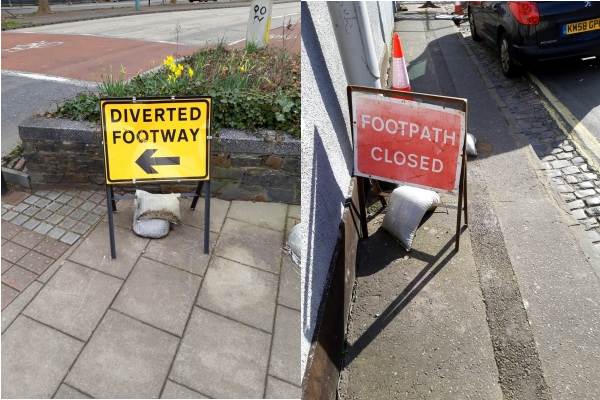
Take the two examples below, both taken during this past week on the streets of Bristol. Both are on a part of the highway used by pedestrians and generally referred to by the general public as the pavement (on which more anon. Ed.). But which – if any – is the correct term? Are footways and footpaths the same?
To answer the second question first, no; they are not the same.
If there’s one thing many decades of being a linguist has taught me, it is that terminology is important – the correct word used in the right context.
One generally has be a legislator, highway engineer or transport campaigner to know the difference between a footway and a footpath.
Fortunately, it is clearly defined in legislation, in this case the Highways Act 1980, which provides the following definitions:
“footpath” means a highway over which the public have a right of way on foot only, not being a footway; “footway” means a way comprised in a highway which also comprises a carriageway, being a way over which the public have a right of way on foot only.
In addition, Cheshire East Council provides the following information on its webpage entitled “What Are Public Rights of Way?“
You should be careful to distinguish between ‘public footpaths’ and ‘footways’. Pavements beside public roads are not public footpaths – it is better to refer to them as footways or simply pavements. Footways are not recorded on the Definitive Map as Public Rights of Way. A footway is really a part of the main highway which has been set apart for pedestrians.
Nevertheless, a caveat needs to be added to the clause where Cheshire East Council advises that “it is better to refer to them as footways or simply pavements“.
The caveat is that there’s a world of difference between what “pavement” denotes to ordinary mortals and professionals such as civil and highway engineers: for the former it’s the footway; for the latter more specialised use, Britannica gives the following definition:
Pavement, in civil engineering, durable surfacing of a road, airstrip, or similar area. The primary function of a pavement is to transmit loads to the sub-base and underlying soil.
Who would have thought two words on two such simple temporary road signs deployed for road works could be such a terminological minefield? 😉
The continuing ignorance of the hardline Tory MPs who spearheaded the UK’s departure from the European Union is a gift that just keeps on giving.
Not only do they not understand how the EU works (clue: it’s a rules-based organisation. Ed.), they also do not know how international trade works (clue: that’s also a rules-based system. Ed.).
When it comes to ignorance of the workings of international trade – and tariffs in particular – Shrewsbury and Atcham MP Daniel Kawczynski has previous form, ending up looking a lemon in respect of, er, lemons.
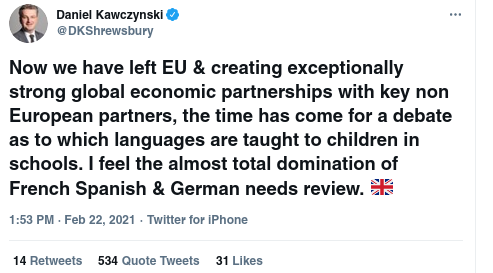
However, there appears to be no start to Daniel’s ignorance and no end to his vanity in wanting to draw attention to the same. On Monday 22nd February he posted the tweet below on his Twitter account.
Daniel no doubt believes that these languages are spoken solely in countries such as France, Spain and Germany in the hated EU.
Time to think again, Danny Boy! 😀
Let’s start with your last mentioned language shall we, Daniel (especially as it might be considered the easiest to dismiss.Ed.)?
German is, of course, spoken in Germany. However, it’s also the official language in Austria as well as being one of Belgium’s four official languages. In Italy’s province of Alto Adige (also known as the Südtirol. Ed.), 62% of the population are German speakers. Outside the EU, German is also one of Switzerland’s four official languages. German is a recognised minority language in the Czech Republic, Hungary, Poland, Romania, Russia and Slovakia. Beyond Europe there are still 25,000-30,000 native German speakers in Namibia, despite it ceasing to be a German colony over a century ago: some 12,000 persons whose first language is German currently live in South Africa. Turning to South America, there are an estimated 1 million German speakers, with German-speaking minorities in almost every Latin American country including Argentina, Belize, Bolivia, Brazil, Chile, Colombia, Costa Rica, Dominican Republic, Ecuador, Guatemala, Mexico, Nicaragua, Paraguay, Peru, Uruguay, and Venezuela. In North America, there are also German-speaking minorities in both the USA and Canada.
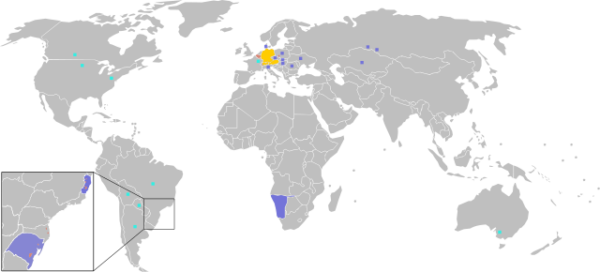
The map below illustrates where German is spoken around the world.
The German-speaking world. Image courtesy of Wikimedia Commons.
How does Daniel fare with French?
Equally badly is the answer.
Besides the EU countries of France, Belgium and Luxembourg, French is also spoken within Europe in Monaco and parts of Italy. Throughout the world there are estimated to be some 274 million French speakers, of whom some 77 million are native speakers. Within the EU alone, French is the third most widely spoken language (after English and German), being spoken by 19.71% of the population and is the second most-widely taught language after English. It’s an official language not only in France, but Belgium, Luxembourg, Monaco and Switzerland. It is also widely spoken in Italy’s Aosta valley region.
However, it is in Africa – and particularly former French colonies and territories – that the majority of the world’s French speakers live. According to a 2018 estimate from the Organisation Internationale de la Francophonie, an estimated 141 million African people spread across 34 countries and territories can speak French as either a first or a second language. This estimate does not include those inhabitants of non-Francophone African countries who have learned French as a foreign language.
Looking at the Americas, French is the second most common language in Canada, after English, and both are official languages at the federal level. It is the sole official language in the Canada’s Quebec province. In the USA, French is the fourth most-spoken language in the United States after English, Spanish, and Chinese, when all forms of French are considered, according to the United States Census Bureau.
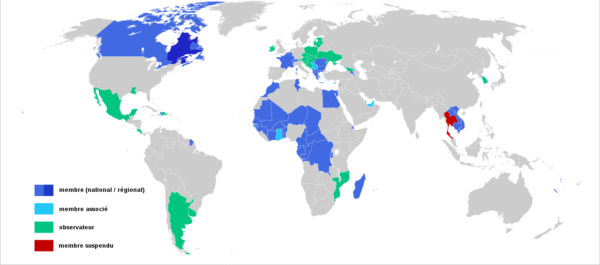
The following map shows membership of the Organisation internationale de la Francophonie, the international organisation representing countries and regions where French is either a lingua franca or customary language.
Membership of the Organisation internationale de la Francophonie. Image courtesy of Wikimedia Commons
So far that’s two own goals Daniel’s scored on the worldwide importance of 2 of the major foreign languages taught in British schools.
How does he fare with his third target – Spanish?
In short, not any better.
Today Spanish has 500 million native speakers, mainly in Spain and the Americas and is the world’s second-most spoken native language after Mandarin Chinese and the world’s fourth-most spoken language overall after English, Mandarin Chinese, and Hindi. Overall there are estimated to be 586 million speakers of Spanish in the world. As befits its large number of speakers, Spanish is one of the six official languages of the United Nations and it is also used as an official language by the European Union, the Organization of American States, the Union of South American Nations, the Community of Latin American and Caribbean States, the African Union and many other international organisations, as well as being one of the world’s most widely taught foreign languages.
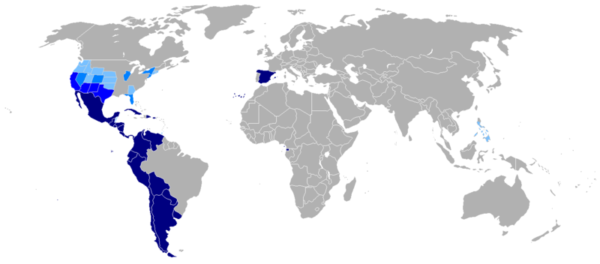
Below is a map showing where in the world Spanish is spoken.
Map of the Hispanophone world. Image courtesy of Wikimedia Commons
So how’s Daniel done?
In brief, not very well.
If Mr Kawczynski had been a footballer instead of a member of Parliament, he would have gone down in the match report as having scored three goals for the opposing side, also know as own goals (Kawczynski 3, og).
Finally, it’s worth pointing out that Daniel has been appointed the UK’s trade envoy to Mongolia. If his tweet was an attempt to increase the teaching Mongolian as a foreign language in British schools, it was, to say the least, extremely clumsy.
In the 18th, 19th and early 20th centuries, Welsh children who used their native tongue in schools were subject to a particular form of punishment and humiliation – the Welsh Not.
The Welsh Not (also Welsh Knot, Welsh Note, Welsh Stick, Welsh Lead or Cwstom) was an item used in Welsh schools in the 18th, 19th and 20th centuries to stigmatise and punish children using the Welsh language, according to Wikipedia.
Typically “The Not” was a piece of wood, a ruler or a stick, often inscribed with “WN“. On any schoolday, it was given to be worn round the neck to the first pupil to be heard speaking Welsh. When another child was heard using Welsh, “The Not” was passed to the new offender: and on it went. Pupils were encouraged to inform on their classmates. The pupil in possession of “The Not” at the end of the lesson, school day or week – depending on the school – received additional punishment besides the initial shaming and humiliation.
In recent times the Welsh Not seems to have transformed from being a physical object to a mental one, but one that is nevertheless still used to stigmatise speakers of one of the country’s oldest languages – one that was already old when Old English (which some call Anglo-Saxon. Ed.) first became established as England’s common tongue.
The persistence of stigmatisation is just one matter covered in a Metro opinion piece by Lowri Llewelyn entitled Why the Welsh language deserves respect not ridicule.
Looking specifically at stigmatisation, Lowri, who learned Welsh as a child and grew up in a bilingual household, writes:
I can’t count how many times English folk have jeered about my ‘dead language’.
At least it wasn’t referred to as “gibberish“, Lowri!
To reinforce her point, she continues:
Fuelled by anti-Welsh sentiment from England, the Welsh even came to oppress and disrespect themselves.
She then goes on to point out how, as a teenager she would only speak English to friends and be dismissive of her native culture, before going on to point out how she has since changed her attitude and welcomes efforts to increase the presence of Welsh.
Lowri concludes by pointing out some of the encouraging signs of a renewed interest in Welsh.
For instance, in recent times Welsh has become the fastest growing language in the UK on the Duolingo language learning platform. One explanation might be a renewed interest in the cultures and history of the nations that make up Great Britain, given the severe restrictions on foreign travel imposed as a result of the coronavirus pandemic.
in my first job after graduation (translator and marketing analyst for Imperial Tobacco in Bedminster, Bristol), part of my employer’s house style I had to absorb was an avoidance of all and any ambiguity.
I well remember my chagrin at being admonished for it by my line manager, who had left school at 14 with no qualifications, started out as a messenger boy in the post room and worked his way up to senior middle management.
Collins Dictionary defines ambiguity as “the possibility of interpreting an expression in two or more distinct ways” and “vagueness or uncertainty of meaning“.
This is a lesson that the employees of the Bristol Post/BristolLive (also known by some locals as the Temple Way Ministry of Truth. Ed.) have yet learn, as shown by the latest example below.
Following hot on the heels of the sacking of its Director of Corporate Affairs for insulting the Welsh (posts passim), comes news that frozen food giant Iceland is reviewing approach’ to bilingual signage in its Welsh stores.
The company had previously been criticised for its lack of provision of Welsh and English signage in stores, even attracting protests, such as one in Rhyl in 2018 reported by The Grocer.
At that time, Iceland was not exactly amenable to bilingual signage in its Welsh stores and even went so far as to issue a statement asserting its monoglot stance: “We do not currently provide signage in any language other than English in any of our stores in any part of the UK or Ireland.“
However, the company, which is based in Glannau Dyfrdwy (English: Deeside), had now announced this is changing, stating:
“We are currently reviewing our approach to providing Welsh signage in stores across Wales and updating this wherever possible. All new stores and those which are refitted have Welsh signage installed as standard, and this is also in place across all of our The Food Warehouse stores across Wales.”
The move has received support from Aled Roberts, the Welsh Language Commissioner, who has issued the following statement:
Research conducted by The Welsh Language Commissioner shows that customers in Wales want to see, hear and use the Welsh language in supermarkets in Wales. We have worked with a number of large supermarkets to develop their Welsh language services, supermarkets such as Coop and Lidl have responded brilliantly to develop a bilingual service. We would like to applaud their approach in working with us. We have contacted Iceland to inspire them to use Welsh, and encourage them to use bilingual signs, and we hope that they will respond to our request.
Keith Hann, director of corporate affairs for frozen food retailer Iceland has been dismissed with immediate effect after he was found to have made disparaging remarks about both the Welsh language and Wales itself.
The supermarket, which has its corporate headquarters on Deeside (Welsh: Glannau Dyfrdwy) in North Wales, was forced to apologise on Wednesday after reports emerged of Hann describing Welsh as “gibberish”
It also stated that Hann’s remarks did not reflect the company’s views and added it was a proud Welsh company.
Many Welsh customers contacted Iceland on Twitter stating they would be boycotting the company’s stores as a result of Hann’s crass insensitivity.
In addition to calling Welsh gibberish, Hann wrote on his blog that the Welsh language sounded “like someone with bad catarrh clearing his throat”.
Furthermore, in a tweet which has since been deleted, Hann wrote that the “inhabitants of the UK’s Celtic fringe loathe all visitors“.
Going back to my schooldays over 5 decades ago, I recall being taught in English language classes that to rubber stamp means officially to approve a decision without giving the matter in question any proper scrutiny or thought.
Rubber stamping is indicative of lack of care, attention and is indicative of perfunctoriness.
Furthermore, the definition I was taught all those long years ago is confirmed by Collins Dictionary, which states:
When someone in authority rubber-stamps a decision, plan, or law, they agree to it without thinking about it much.
Nevertheless, there seems to be a general trend nowadays in the press to use this verb routinely for the approval of any decision, whether or not it is preceded by lengthy or indeed any debate at all.
It’s as if to rubber stamp has become synonymous with to approve, which is really isn’t.
One very guilty party in this respect is the Bristol Post, now rebranded as Bristol Live by its Reach plc masters, as per this example from 12th February, where we read:
The plan is due to be rubber stamped at a council meeting on Monday (February 15).
If there’s one thing I know about planning meetings (having attended them. Ed.), it’s that their decisions are never rubber stamped, as councillors serving on planning committees generally tend to consider all applications in the most minute detail. There’s no waving agenda items all through in a couple of minutes, so members can retreat early to the pub or somewhere else more interesting than a council meeting room.
I hope any passing member of the fourth estate will take note of – and act upon – the content of this little post.
The City of London Police have reported that Mirwais Patang, aged 27, of Hillingdon, London, who stole the identity of a legitimate court interpreter and falsely provided court interpreting services in 140 cases was sentenced to two years imprisonment, suspended for two years, at Southwark Crown Court on 12 February 2021.
Southwark Crown Court. Image courtesy of Wikimedia Commons
Patang must also complete 300 hours of unpaid work within 24 months. He had previously pleaded guilty to 2 counts of forgery and 2 counts of fraud on 27 August 2020, plus a further 6 counts of fraud, and one count each of conspiracy to commit fraud and forgery.
Patang first acted as an interpreter of Pashto and Dari in March 2012, using his own name and identity to register with Capita, the company contracted by the Ministry of Justice (MoJ) to provide court interpreting services between January 2012 and October 2016.
Patang doctored a community interpreting certificate to prove his qualification to Capita and subsequently worked on 88 cases between March 2012 and August 2016, earning £35,574.
In September 2014, Patang stole the identity of a more qualified court interpreter. By using this identity, he earned just over £30,000 working on 52 cases between September 2014 and July 2015.
His fraudulent activity was eventually uncovered when Capita alerted HM Courts and Tribunals Service (HMCTS) to discrepancies in timesheets Patang had submitted. This resulted in the City of London Police launching a fraud investigation.
Furthermore, evidence collected by the City of London Police showed Patang had paid his friend, Solimann David, also of Hillingdon, £1,400 to attend court on his behalf and provide translating services for eight weeks even though David also had no qualifications to act as an interpreter.
David, also aged 27, pleaded guilty to a single count of conspiracy to commit fraud. He was also sentenced at Southwark Crown Court on 12 February 2021 to six months imprisonment, suspended for one year. He must complete 100 hours of unpaid work within 24 months.
Detective Andy Cope, from the City of London Police’s fraud team, said:
“The blind greed shown by Patang, and the total disregard for the implications of his actions and what it might mean for the integrity of serious criminal trials, is truly appalling. By thinking of only his own financial gain, he has undermined confidence in the criminal justice system and put victims of crime through unfair stress and worry.”
February 14th is St Valentine’s Day, a day normally devoted in non-pandemic times to the enrichment of florists and restaurateurs, and generally associated with the pleasures of romance and love.
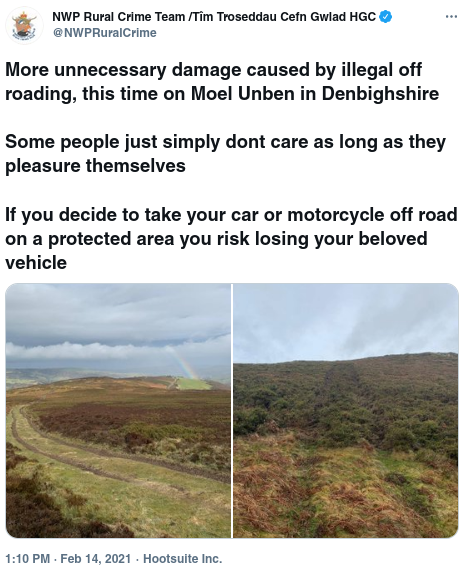
However, the North Wales Police Rural Crime Unit had matters of countryside damage on its mind that day, when it tweeted the following.
Pleasure themselves? Surely not!
Take a close look at the second paragraph of the tweet and Mr/Ms Plod clearly meant something completely different.
The person in charge of the force Twitter account clearly spent yesterday in a state of confusion between love and lust. 😀
I do hope they got their vocabulary sorted out by the time they came off shift and headed home to spend time with their significant other.

 Typically “The Not” was a piece of wood, a ruler or a stick, often inscribed with “WN“. On any schoolday, it was given to be worn round the neck to the first pupil to be heard speaking Welsh. When another child was heard using Welsh, “The Not” was passed to the new offender: and on it went. Pupils were encouraged to inform on their classmates. The pupil in possession of “The Not” at the end of the lesson, school day or week – depending on the school – received additional punishment besides the initial shaming and humiliation.
 Following hot on the heels of the sacking of its Director of Corporate Affairs for insulting the Welsh (
 Going back to my schooldays over 5 decades ago, I recall being taught in English language classes that to rubber stamp means officially to approve a decision without giving the matter in question any proper scrutiny or thought.