Language

  • The return of the spiv

    Grant ShappsOne consequence of the current media focus (which continues today, with the Mirror describing his tactics as “sleazy”. Ed.) on the business activities of Conservative Party Chairman Grant Shapps (right) has been a linguistic one.

    Many people have rediscovered a word which came to prominence during World War 2 – spiv.

    This word has often been used by those commenting on online articles on Shapps’ dubious business activities to describe the man himself.

    Oxford Dictionaries defines a spiv as:

    A man, typically a flashy dresser, who makes a living by disreputable dealings.

    During World War 2 those disreputable dealings usually meant that spivs circumvented the strict rationing regulations and/or could procure commodities or items that were hard to get.

    image of James Beck playing Pte Joe WalkerThe spiv was personified during my younger years by Private Joe Walker (left) in the TV comedy Dad’s Army. Walker was played by actor James Beck, who died suddenly at the age of 44 during production of the programme’s sixth series in 1973. In the series, Walker is a valuable asset to the platoon, due to his many “business” connections and his uncanny ability to conjure up almost anything that is rationed or no longer in the shops due to the war – and he will also have it in vast supply (for a price).

    Arthur English in character as a spivFor a generation older than mine, the spiv was perhaps characterised by comedians such as Arthur English (right), whose usual persona in the early days of his career was a stereotypical wartime “spiv”. As a consequence of this persona, Arthur English became known as “The Prince of the Wide Boys” (meaning in this context a man who lives by his wits, wheeling and dealing. Ed.). Wide boy is also a term that could possibly be applied to Shapps as an alternative to spiv.

    As regards the origins of spiv, there are several possibilities.

    Oxford dictionaries reckons it originates in the 1930s and is perhaps related to “spiffy“, meaning “smart in appearance”, which dates back to 19th century slang in this context.

    Another possibility is that it’s related to “spiff“, a bonus for salespeople (especially for drapers but later for car salesmen, etc.) for managing to sell excess or out of fashion stock. The seller might offer a discount, by splitting his commission with the customer. A seller of stolen goods could give this explanation for a bargain price.

    Yet another suggested origin is that it comes from the nickname of Henry “Spiv” Bagster, a small-time London crook in the early 1900s who was frequently arrested for illegal street trading and confidence tricks. National newspapers reported his court appearances in 1903-06.

    Furthermore, it has been speculated that it is VIPs backwards. In addition, further speculation has it that the word was also a police acronym for Suspected Persons and Itinerant Vagrants.

    Finally, there are also hints that it could have been borrowed from Romany. In that tongue, spiv is a word for sparrow, implying the person is a petty criminal rather than a serious “villain”.


  • Special opening offer

    Thanks to skimping on proof-reading, La Despensa Del Gourmet, a new Spanish delicatessen that’s recently opened in Prince Street, Bristol has a rather unusual offer at present, which sounds a bargain at £3.50!

    poster reads daily offer spanish sandwich with cock/water
    Picture courtesy of Bristol Bites

    Speculation has it that the proprietors are actually trying to offer a carbonated soft drink originally from America… However, that could be phallusy! 😉

    Hat tip: Bristol Bites.

  • Coracle!

    I’ve been in London for the weekend and one of the joys of visiting is a chance to see my niece Katherine.

    She’s currently in the middle of a project and is building a coracle in her flat in Bermondsey.

    coracle on living room floor
    Picture courtesy of Katherine Midgley

    Like other vessels covered by a membrane stretched over a frame, coracles are an ancient form of water craft. The use of coracles in Britain was noted by Julius Caesar on the occasion of his invasion of Britain in 55 BCE.

    The etymology of coracle is from the Welsh corwgl, which is in turn related to Irish curach, meaning a boat.

    Although an ancient form of craft, coracles have still found working uses up to the present day. For instance, for many years until 1979, Shrewsbury coracle maker Fred Davies achieved some notability amongst football fans; he would sit in his coracle during Shrewsbury Town FC home matches at their old riverside ground of Gay Meadow and retrieve stray balls from the River Severn. His coracle was last heard of in the National Football Museum.

    Coracles are difficult to manoeuvre as they are unstable due to their sitting “on” that water. In addition, coracles can easily be carried by currents and the wind. Nevertheless, let’s hope the maiden voyage is recorded for posterity.

  • After the book and film, the HTML colo(u)r chart

    There’s been a lot of interest in the media in recent days over the impending release of the film of E.L. James’ 2011 erotic novel Fifty Shades of Grey.

    Following hard on the heels of the media interest, comes the HTML colo(u)r* chart.

    HTML grey colours image

    If you need to pick colours for web pages, fonts and the like, the W3C has a handy picker.

    * In HTML American spellings – e.g. color, center – are used.

  • Another sign of spring

    Following on from last weekend’s catkins (posts passim), another sign of spring has just emerged: the croci (or crocuses) have burst into flower in the pocket park in Chaplin Road, Easton. On a bright, sunny day the flowers shine like beacons.

    crocus in flower

    Although not native to the British Isles, crocus sativus, the saffron crocus, has long been cultivated for the spice saffron.

    Indeed, such cultivation has given rise to some place names. For starters, there’s Saffron Walden in Essex, as well as Croydon in the sprawl of Greater London.

    As regards the latter, the theory accepted by most philologists is that the name Croydon derives originally from the Anglo-Saxon croh, meaning “crocus”, and denu, “valley”, indicating that it was a centre for the cultivation of saffron. It has been argued that this cultivation is likely to have taken place in the Roman period, when the saffron crocus would have been grown to supply the London market, most probably for medicinal purposes, and particularly for the treatment of granulation of the eyelids.

    The croci shown above are not saffron crocus, but are still a welcome sight. On a sunny day the air inside the flower cup of the crocus is said to be some degrees warmer than the surrounding air, making it a welcome place to visit for early pollinating insects.

  • Red card offence?

    Not being a regular reader of the sports pages, particularly not the football coverage, I’m indebted to Redvee once again for the screenshot below of an excerpt from yesterday’s Bristol Post report of the League One (that’s the Third Division in old money. Ed.) match between MK Dons and Bristol City FC.

    text of screenshot reads Both sides pressed hard for a winning goal in the closing stages and Alli came closest to breaking the deadlock when his fierce shit flew inches wide of the target.

    Isn’t defecating on the pitch a red card offence? 😉 Besides this, his excrement might have hit spectators behind the goal…

    The article has since been corrected.

  • Capita ordered to pay nearly £16,000 over interpreter failure

    image of scales of justiceCapita Translating & Interpreting has been ordered to pay costs of £16,000 by judge Sir James Munby, president of the family division, over its failure to provide interpreters seven times in the course of a single adoption case, The Guardian reports.
    The case in question was initiated in the family court in 2012. On six occasions at Dover Family Proceedings Court and Canterbury County Court, Capita T&I’s interpreters failed to appear or arrived too late, forcing the abandonment of hearings at which the Slovak-speaking parents were contesting the removal of their children. When the case was transferred to the High Court in London in May 2014 to be heard by Sir James, Capita T&I’s interpreters once again failed to appear. He was forced to adjourn the proceedings and ordered that HM Courts and Tribunal Service (HMCTS) should provide interpreters instead.

    In his judgement (PDF) Sir James states:

    There have been serial failures by Capita in this case against a background of wider systemic problems… [These were] not minor but extensive, and, at two different stages of the litigation, they had a profound effect on the conduct of the proceedings.

    Sir James ordered Capita to pay Kent County Council £15,927.36.

  • Sign of spring

    As we enter another month and a chill northerly wind drives temperatures down, it’s encouraging to know that signs of spring are appearing.

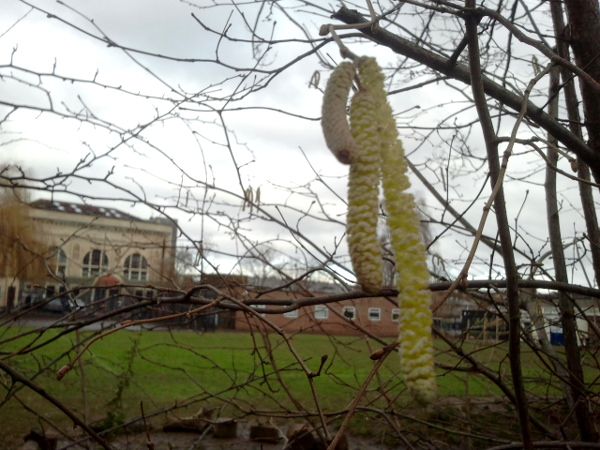
    Along with the appearance of snowdrops (posts passim), the swelling of hazel catkins is another early sign of an impending change of season.

    The photograph below was taken yesterday at the junction of Stapleton Road, Trinity Road and Lawford’s Gate in Easton.

    image of catkins

    According to Wikipedia:

    A catkin or ament is a slim, cylindrical flower cluster, with inconspicuous or no petals, usually wind-pollinated (anemophilous) but sometimes insect-pollinated (as in Salix). They contain many, usually unisexual flowers, arranged closely along a central stem which is often drooping.

    Hazel catkins are the male flowers of the plant.

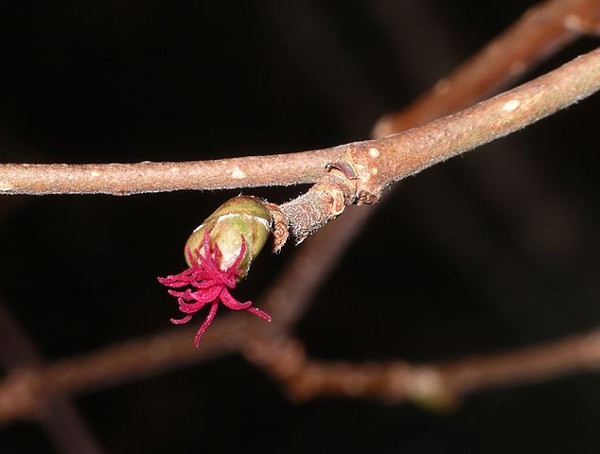
    The female flowers – as shown in the photo below – are much smaller and harder to spot.

    image of female hazel flower

    The change from winter to spring was admirably encapsulated by the final couplet of Percy Bysshe Shelley‘s 1819 Ode to the West Wind.

    The trumpet of a prophecy! O, wind,
    If Winter comes, can Spring be far behind?

Posts navigation