Media

  • Lookalikes – a politics & sci-fi double bill

    Prime Minister Theresa May has the inhuman touch, an inability to relate to people that has led some unkind people to refer to her as the “Maybot“. Indeed, the Financial Times (the sporting pink for the casino economy. Ed.) even came up with a definition for his noun last December, i.e.:

    A prime minister so lacking in human qualities that she soon requires a system reboot.

    Ouch!

    However, I wonder if our mainstream media have ever noticed the striking similarity between Theresa May and Twiki, the robot assistant of the eponymous hero of Buck Rogers in the 25th Century?

    Theresa May and Twiki

    Twiki was mainly voiced by the late, great Mel Blanc, who provided the voices for the likes of Bugs Bunny, Daffy Duck, Porky Pig, Tweety Bird, Sylvester the Cat, Yosemite Sam, Foghorn Leghorn, Marvin the Martian, Pepé Le Pew, Speedy Gonzales, Wile E. Coyote, Road Runner, the Tasmanian Devil and many of the other characters from the Looney Tunes and Merrie Melodies cartoons stables. If, in addition to these vocal talents, he could be brought back from the grave to speak well and lie badly, the Maybot might sound less like an automaton.

    We of a certain vintage remember our reading included following Dan Dare’s adventures in space against his arch-enemy, The Mekon, who with his shaven pate, does a remarkable impression of Sajid Javid, the current Home Secretary, who has recently been ushered into 2 Marsham Street, London SW1 with his dustpan and new broom to clear up the mess the Home Office has created in recent years in relation to the so-called “Windrush generation“.

    The British Home Secretary and The Mekon

    Incidentally, Javid is not the first Conservative Cabinet Minister to be compared to The Mekon. One of his partisan predecessors, the late Angus Maude, who was Paymaster General in the government of Margaret Thatcher from 1979 to 1981, was nicknamed The Mekon.

  • Royal birth – a comment from the past

    Yesterday a woman whose duty it is to produce occupants of the British throne gave birth to her third child and the right-leaning part of the British press has gone into overdrive churning out sycophantic drivel to mark the occasion, with several producing supplements.

    While all this pap is being fawned over by the more gullible members of the public, there are no doubt civil servants, government ministers, local government officers and others in the establishment busy using a good day to bury bad news.

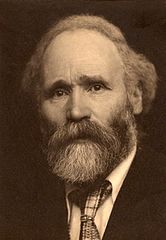
    Jame Keir Hardie photographed in 1905In June 1894 a previous royal birth occurred, prompting as it did then – and still does – the House of Commons to debate an address of congratulation to the monarch, in this case Queen Victoria. However, on the day the birth occurred there had been a terrible mine explo­sion at Pontypridd and 251 working class men and boys had lost their lives. The Government gave no sign of expressing any sympathy for the stricken town and the mourning relatives, and socialist MP James Keir Hardie sought to repair the omission by adding to the congratulation to the Queen an assurance of sympathy with the sufferers from the disaster.

    His motion was out of order, but he had the right to speak and he declared in a House tumultuous with anger that the tragedy in South Wales demanded far more of the attention of the House than the birth of any baby.

    Perhaps the most famous part of Hardie’s performance in the House of Commons that day is quoted below.

    “From his childhood onwards this boy will be surrounded by sycophants and flatterers by the score – [cries of “Oh!,oh!] – and will be taught to believe himself as of a superior creation [cries of “Oh,oh!]. A line will be drawn between him and the people whom he is to be called upon some day to reign over. …and the end of it all will be that the country will be called upon to pay the bill. [Cries of Divide!]”

    The royal grandson to whom Keir Hardie was referring grew up to be an unimpressive and irresponsible man with extreme right wing sympathies, notoriously visiting Hitler in 1937. In January 1936 he became Edward VIII. In December 1936 he abdicated before his coronation over his relationship with the American divorcee Wallis Simpson and during the Second World War was kept well away from Messrs Hitler and Mussolini by being appointed governor of the Bahamas in 1940.

  • Local rag now employing greengrocers*

    Changes are taking place at the increasingly downmarket Local World group of regional newspaper titles owned by Trinity Mirror.

    These changes are also being implemented at the Bristol Post, the city’s newspaper of (warped) record, whose online version now masquerades under the misleading title of BristolLive, as any signs of sentience have yet to be medically confirmed.

    As circulation has declined, so have standards to the point where it appears that greengrocers (or should that be greengrocer’s? Ed.) are cheaper to employ than what passes nowadays for journalists – or even journalist’s. This desperate move is amply illustrated by the screenshot below for the latest story lifted from scanning social media.

    headline reads Bristol's s**t cycling infrastructure now has it's own Twitter account

    In the meantime, locals can expect more news from Homophone Corner (that’s a site to be seen. Ed. 😉 ) and hard-hitting stories of the “Hartcliffe man stubs toe on Bristol Bridge” variety and barely concealed advertisements masquerading as restaurant reviews, mostly for places whose obituaries subsequently describe them as “popular” when they inevitably close down less than a year later.

    * Or should that be greengrocer’s? 😉

  • English translation required?

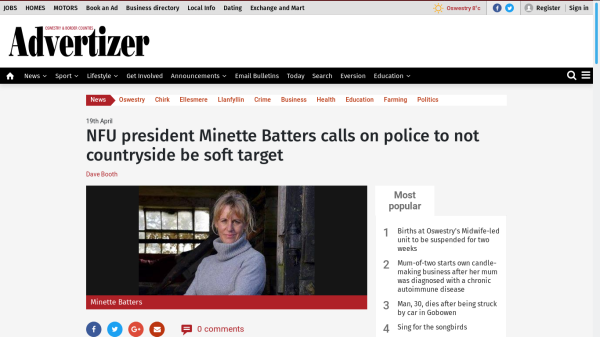
    Although it’s not one of his regular local media reads, your ‘umble scribe might just start visiting the Oswestry and Border Counties Advertizer website more to keep up to date with dynamic, one could even say groundbreaking, developments in use of the English language, if the headline of the report shown below is in any way typical of modern journalism.

    headline reads NFU president Minette Batters calls on police to not countryside be soft target

    The same piece, by the same author, also appears in yesterday’s Whitchurch Herald, where similar sub-editing skills are in evidence.

  • A bridge renaming too far

    Today I’ve written to my MP, Thangam Debbonaire, about Whitehall’s plans to rename the Second Severn Crossing and lumber it with the uninspiring and sycophantic moniker of the Prince of Wales Bridge.

    Second Severn Crossing
    Second Severn Crossing seen from Severn Beach. Picture courtesy of Wikimedia Commons.

    This move went down really badly in Wales, particularly in view of the total lack of public consultation and many tens of thousands of people have signed a petition objecting to the move, as reported by Wales Online.

    Besides the renaming being described variously as “pathetic“, “insulting” and “patronising” (and there is more than a hint of (neo-)colonialism about it. Ed.), many Welsh residents would like any change of name to be made in honour of someone who has actually done something for Wales, rather than sit around for decades waiting for his mum to die before he can take on her job.

    It now looks to be turning out to be equally unpopular in the West Country as the comments on this Bristol Post report seem to suggest.

    My email to Thangam is transcribed below.

    May I draw your attention to the following piece on the Post’s website: https://www.bristolpost.co.uk/news/bristol-news/backlash-grows-30000-sign-petition-1436994

    It’s not just the Welsh that object to it being renamed after Charles Windsor with no public consultation. I, one of your constituents and a long-term republican, also signed the petition. There are enough structures sycophantically named after the royals in any event.

    Perhaps you would like to join your Welsh colleagues in campaigning against this arbitrary change dreamed up in Whitehall and now being imposed insensitively upon the Westminster Village’s colony over the Severn! 🙂

    Regards, etc.

    Finally, it’s worth mentioning that most locals either side of the Severn estuary will still continue to refer to it as the Second Severn Crossing, no matter what the sycophants in London SW1 ultimately decide what to name it.

  • French seaweed farmers to sue Hanna-Barbera for breach of copyright?

    In Brittany collecting seaweed off the beaches and out at sea for use as fertiliser on fields has a long tradition.

    In the early 1960s, the job of collecting seaweed was given a major mechanical boost with the invention of the scoubidou, a corkscrew-like tool that is used for the commercial harvesting of seaweed, consisting of an iron hook attached to a hydraulic arm. Its invention is credited to Yves Colin and it is largely used for gathering oarweed.

    A scoubidou can be seen in action below.

    A scoubidou in action off the coast of Brittany
    A scoubidou in action off the coast of Brittany

    Scooby-Doo the cartoon dogLet’s fast forward to the USA in 1969. At animation company Hanna-Barbera, a character in the shape of a male Great Dane called Scooby-Doo has just been invented and becomes the eponymous hero of an animation series featuring amateur detectives.

    The franchise proved very successful with the cartoon series being shown all around the world, culminating in a feature length film in 2002.

    News has now emerged that Breton seaweed harvesters, also known as goémoniers, might now be considering suing the animation company for copyright infringement.

    Breton seaweed harvesters’ spokesperson Avril Fouelle has commented: “It’s only right that we seek recompense. If it hadn’t been for those darn kids in Hollywood stealing our terminology for financial gain, Brittany’s géomoniers would today be living more comfortably than they do.”

  • Trinity Mirror local “news” – readers respond

    Ever since the takeover of the Local World newspaper titles by Trinity Mirror in October 2015, several Local World titles seem to or actually have given up on reporting serious local news preferring to give preference to what are essentially advertorials (e.g. restaurant reviews) and trivia instead of the hard work of investigating corruption and wrongdoing in the local corridors of power and/or amongst the
    city’s so-called great and good.

    This certainly seems to ring true if one examines the Bristol Post, the city’s newspaper of warped record.

    Today’s most spectacular piece of trivia from the Temple Way Ministry of Truth concerns an encounter with an unpleasant object in the men’s toilets of McDonalds, not a caterer likely to feature in the aforementioned restaurant reviews (McDonald’s restaurants is a well-known modern oxymoron. Ed.).

    When allowed to comment, Post readers are not shy in expressing their views, as shown by the exchange below on the offending article.

    comments read 1 This is not news and 2 The Post isn't a newspaper

    As alluded to above, most of the Post’s alleged online news content can accurately be described as “clickbait“, which is defined by Wikipedia as “web content whose main goal is to entice users to click on a link to go to a certain webpage or video. Clickbait headlines typically aim to exploit the “curiosity gap,” providing just enough information to make readers curious, but not enough to satisfy their curiosity without clicking through to the linked content“.

  • It’s Pi Day

    Listening to Radio 3 this morning, presenter Petroc Trelawny announced that today is Pi Day, an annual celebration of the mathematical constant π (pi). Following the US date format style (MMDDYY), Pi Day is celebrated 14th March, since 3, 1, and 4 are the first three significant digits of π. Pi has to date been calculated to over one trillion digits beyond its decimal point.

    A Pi pie. Image courtesy of Wikimedia Commons
    A Pi pie. Image courtesy of Wikimedia Commons

    The earliest known official or large-scale celebration of Pi Day was organised by by physicist Larry Shaw in 1988 at the San Francisco Exploratorium, where he worked, at which fruit pies were consumed.

    Besides maths and the sciences, Pi also turns up in the arts. In literature for example, in Terry Pratchett’s fictional Discworld city of Ankh-Morpork, Unseen University is a school of wizardry staffed by a faculty mostly composed of indolent and inept old wizards whose main function is not teaching, but eating big dinners. The University’s unofficial motto is “η β π”, or “Eta Beta Pi” (Eat A Better Pie).

    Still in world of literature, Life of Pi is a fantasy novel by Yann Martel, which was adapted into a 2012 film of the same name directed directed by Ang Lee.

    Finally, Kate Bush’s 2005 album Aerial features the track Pi.

    Happy Pi Day! I shall be celebrating by eating a pastry product. 😀

  • Driverless vehicles – a nationwide danger?

    Every day in the UK people are being seriously injured or even killed by vehicles which apparently have minds of their own or are not under the control of a human being.

    If you need confirmation of this fact, just open any local newspaper or visit any local news website.

    Police Accident road sign

    Yesterday’s Bristol Post carries such a story of a fatal collision in Burnham-on-Sea in Somerset.

    Bearing the headline “Pensioner driving a mobility scooter dies after being hit by truck in Burnham-on-Sea“, this is a tragic tale, whose first sentence reads:

    An 80-year-old man has died after being hit by a pickup truck while driving his mobility scooter in Burnham-on-Sea.

    Further details are then provided by a police officer who confirms the absence of human intervention the other party involved in the incident. The officer is quoted as saying the following:

    At about 11.50am, a Nissan Navara was travelling along Oxford Street and, having turned into Adam Street, was in collision with the man who was on his mobility scooter.

    Nowhere in the article – short though it is – is there any mention of the Nissan Navara having a driver.

    This phenomenon of vehicles without drivers but with a mind of their own is not confined to the West Country either.

    A quick glance at the Express and Star website reveals that yesterday in the Bewdley and Stourbridge area, another crash occurred in which at least one of the vehicles was driverless.

    The crash involved a black Ford Ka and a black Ford Fiesta.

    The driver of the Ford Ka, an 18-year-old woman, sustained serious head injuries.

    Why is such a peculiar style of wording used for press reports of road traffic collisions? Are the highways and byways of the country really full of driverless, out of control vehicles with a sadistic or psychopathic streak?

    Probably not.

    The likely explanation for this curious style of reporting is that the majority of road traffic incidents ending in collision and injury will involve either insurance liability or criminal liability or both. The wording used carefully avoids attributing any blame.

    Furthermore, these collisions are often referred to as “accidents“. The last thing the majority of road traffic incidents are is accidental since the majority of them involve either driver error, as shown by the graph below.

    Dept of Transport graph showing causes of collisions 2005 to 2014
    Source: Department of Transport

    So, are the country’s roads full of metal boxes intent on causing harm to humans? Unlikely, but they are full of frail, fallible humans in charge of potential killers.

  • This year’s first celandines

    Spotted on Stapleton Road this morning.

    celandines spotted on Stapleton Road on 5th March 2018

    Actually, the plant’s full name is the lesser celandine (Ficaria verna).

    According to the Woodland Trust, lesser celandines may be found along damp woodland paths and tracks, as well as stream banks and in ditches. They also grow well in the shade of hedgerows, in meadows and in gardens: they usually start to flower between January and April each year.

    As one of the first flowers to appear after winter, they provide an important nectar source for early pollinating insects, including some bee species.

    In earlier times, the plant had medicinal and nutritional uses: lesser celandine was once believed to be a remedy for haemorrhoids and was known as ‘pilewort’. It is also high in vitamin C and was used to prevent scurvy.

    Furthermore, the lesser celandine has its place in literature too. William Wordsworth (1770-1850) composed three poems to the plant between 1802 and 1807, of which one – To the Small Celandine – is reproduced below.

    PANSIES, lilies, kingcups, daisies,
    Let them live upon their praises;
    Long as there’s a sun that sets,
    Primroses will have their glory;
    Long as there are violets,
    They will have a place in story:
    There’s a flower that shall be mine,
    ‘Tis the little Celandine.

    Eyes of some men travel far
    For the finding of a star;
    Up and down the heavens they go,
    Men that keep a mighty rout!
    I’m as great as they, I trow,
    Since the day I found thee out,
    Little Flower!–I’ll make a stir,
    Like a sage astronomer.

    Modest, yet withal an Elf
    Bold, and lavish of thyself;
    Since we needs must first have met
    I have seen thee, high and low,
    Thirty years or more, and yet
    ‘Twas a face I did not know;
    Thou hast now, go where I may,
    Fifty greetings in a day.

    Ere a leaf is on a bush,
    In the time before the thrush
    Has a thought about her nest,
    Thou wilt come with half a call,
    Spreading out thy glossy breast
    Like a careless Prodigal;
    Telling tales about the sun,
    When we’ve little warmth, or none.

    Poets, vain men in their mood!
    Travel with the multitude:
    Never heed them; I aver
    That they all are wanton wooers;
    But the thrifty cottager,
    Who stirs little out of doors,
    Joys to spy thee near her home;
    Spring is coming, Thou art come!

    Comfort have thou of thy merit,
    Kindly, unassuming Spirit!
    Careless of thy neighbourhood,
    Thou dost show thy pleasant face
    On the moor, and in the wood,
    In the lane;–there’s not a place,
    Howsoever mean it be,
    But ’tis good enough for thee.

    Ill befall the yellow flowers,
    Children of the flaring hours!
    Buttercups, that will be seen,
    Whether we will see or no;
    Others, too, of lofty mien;
    They have done as worldlings do,
    Taken praise that should be thine,
    Little, humble Celandine!

    Prophet of delight and mirth,
    Ill-requited upon earth;
    Herald of a mighty band,
    Of a joyous train ensuing,
    Serving at my heart’s command,
    Tasks that are no tasks renewing,
    I will sing, as doth behove,
    Hymns in praise of what I love!

    Incidentally, back in 2011, the Daily Mirror christened Stapleton Road “Britain’s worst street” where “murder, rape, shootings, drug-pushing, prostitution, knifings and violent robbery are commonplace“.

    As a local resident for over 40 years, I didn’t agree then and nowadays still don’t agree with or recognise the Mirror’s sensationalist description. Surely somewhere that dangerous wouldn’t be home to such gentle and uplifting life-forms as the lesser celandine, which have inspired such souls as one of the great English Romantic poets?

Posts navigation