Media

  • Nice one!

    News site www.thebusinesswomanmedia.com has got the emphasis just right here on its report on a wedding that’s causing the media to get excited and distract attention from all the nasty things going on in the world like Ebola in West Africa or the continuing madness in the Middle East (news passim).

    screenshot of headline stating internationally acclaimed barrister Amal Alamuddin marries an actor

    However, it could have added the word(s) ‘ageing’ and/or ‘greying’ in front of ‘actor’. 😉

  • Happy Easton

    As a part of inner city Bristol, Easton tends to get into the papers for all the wrong reasons, such as fly-tipping (posts passim).

    However, it’s a vibrant area where I’ve lived for nearly 4 decades and so it can’t be all that bad, as is shown by the fact that community campaigners Happy Easton have produced their own video version of the record-breaking Pharrell Williams hit “Happy” to show a more positive side of Easton.

    The video was filmed at 18 sites around the area including Easton Community Centre, Trinity Community Arts, the soon to be shut Trinity Police Station and various local shops and takeaways.

    Are the dancing cops and PCSOs as embarrassing as your relatives at a wedding? Answers in the comments below! 🙂

  • Project Fear revs up

    The No campaign against Scottish independence has since the outset been playing on people’s uncertainties about the fate of an independent Scotland to such an extent that supporters of independence have dubbed it Project Fear.

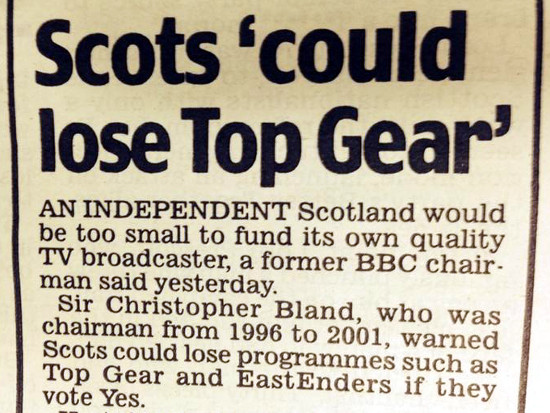
    In recent times, some of these have included some strange arguments, such as the one illustrated below.

    headline reading Scots could lose Top Gear

    That’s right! Project Fear has now put the idea in the minds of Caledonian petrolheads that they could lose the likes of Clarkson & Co.

    I can think of nothing more that would make me vote yes were I a Scot and was eligible to partake in the referendum.

  • Bristol’s Bitcoin machine handles £38K per month

    bitcoin logoThe Bristol Post is not renowned locally for its in-depth coverage of technology, let alone such exotic areas as crytocurrencies, but today proved an exception as it reported on the fortunes of Bristol’s only Bitcoin cash machine, which is located in Superfoods in St Stephen’s Street (review here) in the centre.
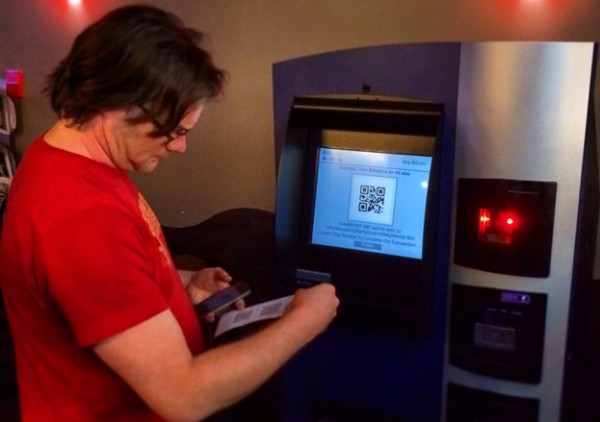
    a Bitcoin ATM similar to the one in Bristol

    SatoshiPoint, the machine’s owners have hailed it a success after the machine processed 250 transactions and the equivalent of £38,000 in Bitcoins in the month of August alone.

    SatoshiPoint’s Hassan Khoshtaghaza said: “Bristol is doing very well, in fact better than our London ATMs because there are now six of them in London so the use gets spread out. We are getting users from as far as Cardiff and Bath coming to use the machine in Bristol and our volume is increasing each month on buy and sell transactions.”

    The company recently installed a Bitcoin machine in Brighton and further cities under consideration are Cardiff, Manchester and Edinburgh, plus Newcastle Airport, according to Khoshtaghaza.

    SatoshiPoint’s Bitcoin machines accept £10 and £20 notes, but not debit or credit cards and users can buy anything from £10 to £1,500 worth of Bitcoins a day, at the live price plus 7% commission.

    Originally posted on Bristol Wireless.

  • I write for Bristol 24/7 (again)

    On Thursday last week, Bristol 247 published the item below penned by your ‘umble scribe in the wake of the Jennifer Lawrence nude pictures scandal under the title “Staying safe online: How not to become the next Jennifer Lawrence“.

    In recent days actress Jennifer Lawrence, best known for her role in 2012’s The Hunger Games, and other celebrities had their private pictures leaked online when their Apple iCloud account passwords were hacked and their intimate snaps snaffled.

    However, it is unlikely that any blame can be attached to Apple for the security break. It’s far more likely to be the users’ lack of care in setting up their user names and passwords as the images were stolen by an unknown person using specialist software.

    As regards passwords, hackers have 2 main methods for harvesting them – the dictionary attack and the brute force attack.

    A dictionary attack is a technique for defeating an authentication mechanism by trying to determine its decryption key or passphrase by trying hundreds or sometimes millions of likely possibilities, such as words in a dictionary. Dictionary attacks succeed because many people tend to choose simple passwords which are short (7 characters or fewer), such as single words found in dictionaries or simple, easily predicted variations on words, such as appending a digit. However, dictionary attacks are easy to defeat. Adding a single random character in the middle can make dictionary attacks untenable.

    A brute force attack consists of systematically checking all possible keys or passwords until the correct one is found. Due to the number of possible combinations of letters, numbers, and symbols, a brute force attack can take a long time to complete.

    Both dictionary and brute force attacks can be automated, speeding up the process considerably. For instance, it can take under a minute to crack a password with a dictionary attack if the password is weak and insecure.

    If you don’t want to end up in the same embarrassing predicament as Jennifer and her fellow victims, there are a few simple steps you can take.

    Cloud computing may be all the rage at present, but the simplest security measure you could take to safeguard your data would be not to use the cloud at all. In my professional work as a linguist, all my jobs involve confidential or private information, so I wouldn’t use cloud storage for the simple reason of that information being subject to the security – or lack of it – implemented by a third party.

    However, if you do use cloud storage, then don’t use it to store sensitive and/or privileged information, such as pictures displaying your rude bits or any other confidential stuff you wouldn’t want anyone else to see or access.

    There are a few more simple steps mainly involving passwords that you can take to improve your security:

    • Don’t use a simple password! According to password management company SplashData, the top three passwords of 2013 were “123456”, “password” and “12345678”;
    • Use a strong password. This is a password that’s alphanumeric, comprising both letters and numbers;
    • For additional security, use punctuation in your passwords too. Including punctuation in a mixed case alphanumeric password generally creates a more secure password, which would be exponentially harder to discover using either a dictionary or brute force password discovery method;
    • Use a long password. Most password crackers have no problem working out passwords up to 15 characters in length;
    • Don’t use the same password for all logins. I know this can be tedious and inconvenient, but it is worth it! If you have difficulty remembering passwords, note the details of your various accounts and the related passwords in a spreadsheet, but do remember to use yet another password to safeguard the spreadsheet itself! Alternatively, use password management software (such as KeePass) instead of a spreadsheet;
    • As with passwords, try using a non-obvious user name for logins.

    Devising secure passwords is not something everyone can do, but there’s help available here too. Symantec provides a Secure Password Generator, which will generate passwords between 8 and 64 characters in length and allows the use of lower and upper case characters, numbers and punctuation.

  • Bristol invents the bup

    Bristol likes to regard itself as a place of innovation.

    Bearing this inventive spirit in mind, contractors working in Old Market Street for Bristol City Council have invented a new public conveyance vehicle – the bup.

    image of bus stop featuring words Bup Stop

    A spokesperson for Bristol City Council said: “We take the misspelling of road marking very seriously and will soon be appointing an expensive CONsultant to advise us of the best possible solution.” (That quotation was made up, wasn’t it? Ed.)

    Hat tip: Bristol Post.

    Update 27/08/14: the orthographical gaffe was corrected yesterday, according to the Bristol Post.

  • West Country confusion

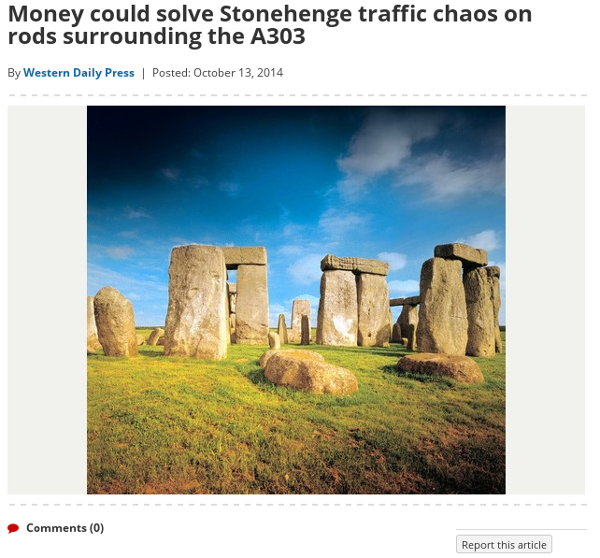
    The Western Daily Press is a stablemate of the Bristol Post and seems to share many of the latter’s afflictions – the same ugly Brutalist building on Bristol’s Temple Way, poor English, dodgy photo captions and the like.

    It was therefore no surprise to encounter a prime example of confused reporting this morning, as illustrated by the screenshot below.

    screensot of garbled article from Western Daily Press

    If one examines the article to which the news page above relates, three disparate elements seem to have been combined by reporter Geoff Bennett (who also writes for the Bristol Post. Ed.) and his associates, i.e.:

    • a headline referring to widespread outbreaks of salmonella food poisoning in hospitals in England;
    • a cuddly kittens picture and apposite caption; and
    • a report on the court case of the alleged groping barber (who was cleared by the court. Ed.) which gave rise to Friday’s sexist Bristol Post front page (posts passim).

    There is nothing like good, unambiguous reporting of the news – and the Western Daily Press is capable of nothing like it!

  • Bristol Post Balls – bad punning and sexism

    Regular readers will be aware that the Bristol Post is not renowned for the quality of its journalism.

    However, the dreadful pun and sexism of today’s front page of the dead tree edition marked a new low in the paper’s already woeful standards.

    image of Bristol Post front page with sexist pun

    Bad puns are annoying in headlines at the best of times and sexism is tolerated far less than when the fifty-something males in charge of producing Bristol’s daily work of fiction first started out in what was then called journalism.

    There has been a steady stream of criticism of the Bristol Post on Twitter throughout the day.

    However, the paper has not sought to respond to any of its critics, presumably because the person in charge of the Twitter account has yet to notice the ‘reply’ button.

    In addition, some of Bristol’s Twitterati have also been alerting the national media to The Post’s disgraceful front page seeking to trivialise a sexual assault.

    With front pages like the one above, is it any surprise that the Post’s circulation figures (as measured by ABC) are falling by nearly 11% per year? Not to me it isn’t!

    Update 18/08/14: Bristol 24-7 is reporting today that Bristol City councillor Naomi Rylatt has written to the Press Complaints Commission (PCC) over the above front page headline, describing it as a “disgusting attempt at humour“.

Posts navigation