Media

  • Telegraph on prolonged peace mission

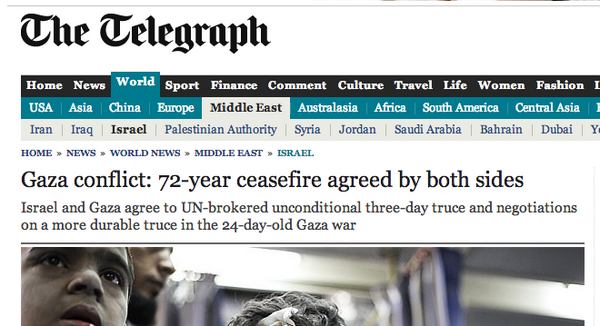
    A typographical error in a headline on the Telegraph’s website envisaged a long lull in the present conflict between the Palestinians in Gaza and the state Israel which has now been raging for more than 3 weeks.

    headline stating 72-year ceasefire agreed by both sides

    The error has since been corrected to read Gaza conflict: 72-hour ceasefire agreed by both sides.

  • Cricket explained

    The second Test series between England and India is currently taking place in Southampton (it’ll be day 3 today. Ed.) and my radio is tuned to the epic poem that is the BBC’s Test Match Special from 10.25 until the close of play each day, with the likes of Aggers, Blowers, Tuffers and Geoffrey Boycott (posts passim) filling the air with their wise words and wit.

    Cricket is a complex game that can take a long time to understand fully and I’m still occasionally baffled by the commentators. For the uninitiated, the many different laws and the strange names for positions on the field can seem overwhelming. For instance, which other game has a position on the field called ‘cow corner’*?.

    Below is a simple explanation for the uninitiated, which I originally heard at school decades ago as a brief summary of the game for foreigners.

    You have two sides, one out in the field and one in. Each man that’s in the side that’s in goes out, and when he’s out he comes in and the next man goes in until he’s out. When they are all out, the side that’s out comes in and the side that’s been in goes out and tries to get those coming in, out. Sometimes you get men still in and not out. When a man goes out to go in, the men who are out try to get him out, and when he is out he goes in and the next man in goes out and goes in. There are two men called umpires who stay out all the time and they decide when the men who are in are out. When both sides have been in and all the men have been out, and both sides have been out twice after all the men have been in, including those who are not out, that is the end of the game.

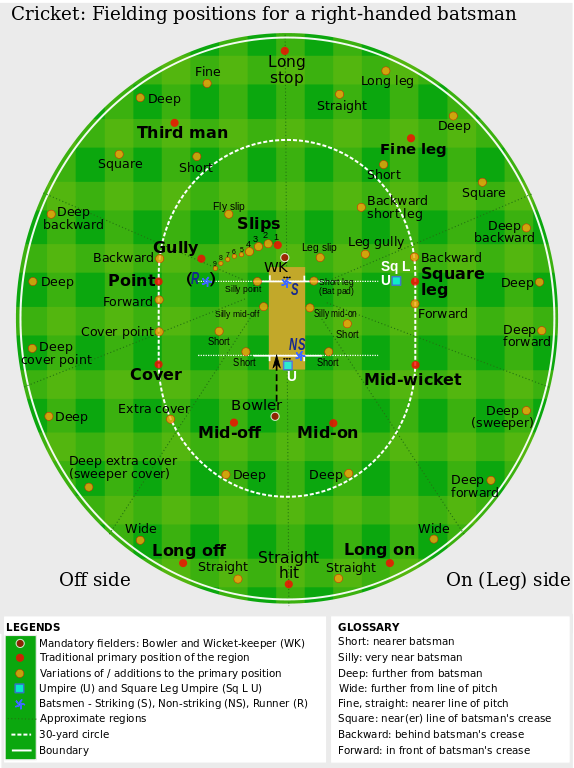
    For those who need help with fielding positions, Wikimedia Commons has helpfully provided the following graphic.

    image of cricket fielding positions

    Note that the fielding positions would be reversed for a left-handed batsman.

    * Cow corner = the area of the field (roughly) between deep mid-wicket and wide long-on. So called because few ‘legitimate’ shots are aimed to this part of the field, so fielders are rarely placed there – leading to the concept that cows could happily graze in that area.

  • Swansea news exclusive

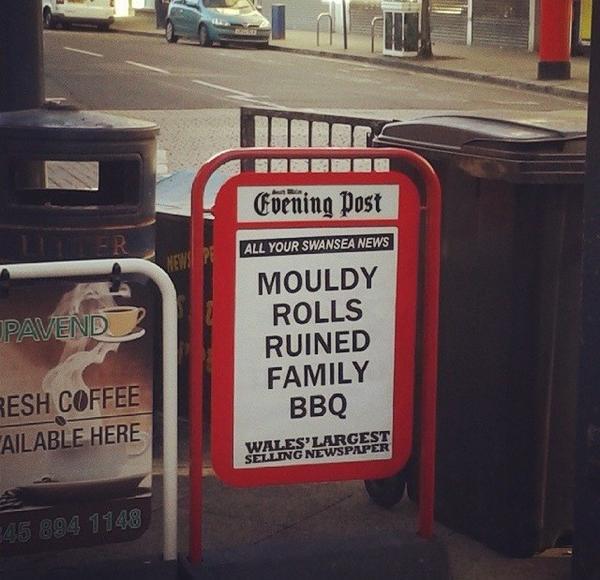
    Over in Swansea, Bristol Post owners Local World have a local news title – the South Wales Evening Post, which describes itself as “Wales’ largest selling newspaper“.

    As such, one would have thought that such a boast was based upon hard-hitting stories and investigative journalism.

    However, this is not so.

    Just like its Bristol counterpart, the South Wales Evening Post also has an approach to what constitutes news and headlines which could be described as parochial, i.e. narrow in outlook or scope.

    image of advert for paper with headline mouldy rolls ruined family bbq

    Hat tip: Marjory Smith

  • The Department of Dirty: coming soon to UK government?

    The Open Rights Group has launched the Department of Dirty website to draw attention to the filtering (also known as censorship. Ed.) of internet content by UK ISPs, particularly mobile providers.

    To find out if you can access the Dirty Internet via your mobile, phone your provider’s Department of Dirty customer services. Your mobile phone normally has internet filtering enabled by default.

    • 02 – 0800 977 7337
    • EE – 0844 381 6301
    • Vodafone – 08700 700 191 or 191
    • Three – 0333 300 3333 or 3333
    • Giffgaff Access adult content
  • Companies House to make all of its digital data available for free

    Yesterday, while David Cameron was rearranging the deckchairs on his governmental re-enactment of the SS Titanic, one significant piece of news (apart from the DRIP Bill. Ed.) seems to have escaped the personality-obsessed British media.

    open data stickersThe news was the Department for Business, Innovation and Skills announced that Companies House is to make all of its digital data available free of charge. It has hitherto charged users for anything but the most basic company information on its website.

    This will make the UK the first country to establish a truly open register of business information.

    As a result, it will be easier for members of the public and businesses to research and scrutinise the activities and ownership of companies and their directors. Last year (2013/14), users searching the Companies House website spent £8.7 million accessing company information on the register.

    The release of company information as open data will also provide opportunities for entrepreneurs to come up with innovative ways of using the information.

    This change will come into effect from the second quarter of 2015 (April – June).

  • Ministerial photo opportunity

    Last Friday, the Bedfordshire News website published a story of a visit by Defence Minister and Tory MP for Ludlow Philip Dunne to the hangars at Cardington, one of the major British sites historically involved in the development of airships.

    From the screenshot below, the visit provided a photo opportunity.

    screenshot featuring group looking like it's been excreted from giant bottom

    The ministerial party looks like it’s been excreted from or is about to be crushed by a giant bottom. Don’t ministers and their civil service minders ever check behind them before smiling for the camera?

  • Caption chaos

    Being sloppy is one thing at which the Bristol Post consistently excels and the situation only looks to get worse following the announcement by David Montgomery of Local World – the owners of the Bristol Post – on the future direction of its titles and the role of journalists.

    Today’s most glaring howler features photographs with the wrong captions in this article, as illustrated below.

    incorrectly captioned photo from Bristol Post

    That’s the first locomotive I’ve seen with blonde hair! 😉

    The chaos continues with subsequent photographs in the series too.

    incorrectly captioned photo from Bristol Post

    How anyone can confuse a girl with a locomotive is anyone’s guess.

    Is the Post employing visually-impaired journalists?

    We should be told.

  • Almost 1 in 5 sites blocked by UK nanny filters

    ORG logoThe Open Rights Group’s Blocked Project has revealed that nearly 20% of websites are blocked by web filters implemented by UK ISPs.

    Those affected involve Porsche broker’s website and a political blogger/mum hoping to read an article about post pregnancy care, yet they still get blocked by filters ostensibly designed to protect young people from adult content (which apparently includes talking about alcohol, smoking, anorexia and hate speech. Ed.), indicating that ISPs are acting as censors and arbiters of what is acceptable content for their subscribers.

    The extent of excessive blocking has been revealed by the Open Rights Group’s Blocked project, which is documenting the impact of filters. Web users can use a free checking tool where they can instantly check to see if a website has been blocked by filters. So far, the Open Rights Group has tested over 100,000 sites and found that over 19,000 are blocked by one ISP or another.

    One of the blocked sites is the political blog, Guido Fawkes. It’s being blocked by ISP TalkTalk, which puts the latter on a par with the not exactly democratic government of the People’s Republic of China.

    ISPs have also been criticised for the lack of information about how to get sites unblocked. Mum-of-one Marielle, said she was “humiliated” when she visited a shop run by mobile operator Three to find out how she could enable access to an article about post-partum care on her phone: “The manager told me that I couldn’t access filtered articles without entering a 4 digit PIN every time I wanted to read a filtered article because I had a PAYG plan” Marielle submitted a report to Three saying that the article had been incorrectly blocked, but didn’t get a response.

    Other sites that have been incorrectly blocked by filters include:

    www.sherights.com – this feminist rights blog was blocked by TalkTalk in April 2014. Its Editor-in-Chief says that as advertising revenue is generated by the number of site visitors and that being blocked, “directly impacts our bottom line. But, more than that, we are concerned with the message that blocking our site sends: that pro-woman, pro-equality, pro-human rights subject matter is somehow offensive, inappropriate or otherwise problematic.”

    www.philipraby.co.uk – Philip Raby, who sells and services Porsches, only found out that his website was blocked by O2 when one of his customers told him. Philip says that it’s difficult to measure the financial impact of being blocked but, “we must have lost some business and, of course, it doesn’t look great telling people the site is not suitable for under 18s!”

    Jim Killock, Executive Director of the Open Rights Group stated: “Through the Blocked project we wanted to find out about the impact of web filters. Already, our reports are showing that almost 1 in 5 websites tested are blocked, and that the problem of overblocking seems much bigger than we thought. Different ISPs are blocking different sites and the result is that many people, from businesses to bloggers, are being affected because people can’t access their websites.”

    The original impetus for the introduction of filters came from Claire Perry, the Conservative MP for Devizes, a vociferous campaigner for protecting children from adult material. However, she should have been careful what she wished for, as her own website (which features many references to pr0n. Ed.) has also fallen victim to the ISPs’ filters.

  • Bristol Post: England invests £168 in roads

    Road works traffic signAccording to yesterday’s online edition of the Bristol Post, the Department of Transport is to invest the princely sum of £168 – the largest amount it has spent on tarmac for four decades – in England’s road network.

    Of this total, the amount earmarked for local authorities in the Bristol area swells magically to more than £2 mn., according to a this piece by an unidentified Post hack.

    The second paragraph of the report reads as follows:

    The handout from a £168 funding pot which will see more than £3 million potholes filled is part of what is being billed as “the biggest investment in roads since the 1970s”.

    For those who prefer their information unmangled by the illiterates of the local media, the original Department of Transport press release is available here.

Posts navigation