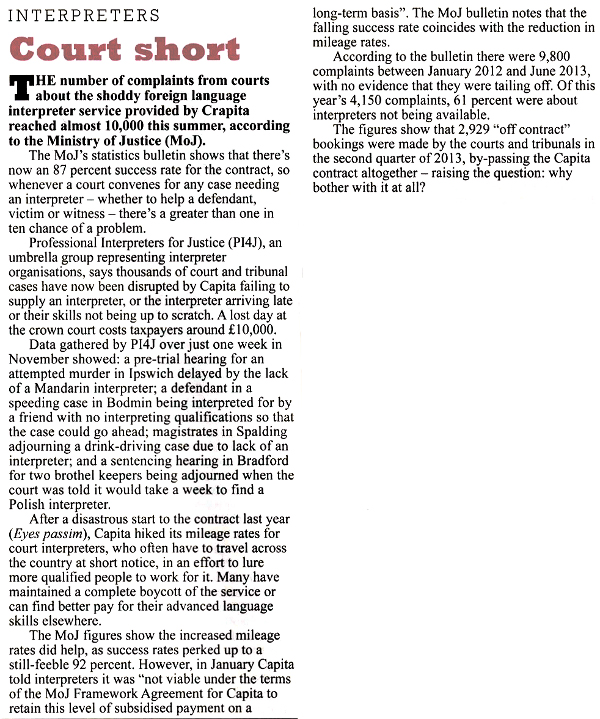
Describing it as “the shoddy foreign language interpreter service provided by Crapita“, The Eye’s piece notes there’s a greater than one in ten chance of trouble when a court makes a booking for an interpreter via the MoJ’s contract with Capita, with the piece reaching the conclusion why bother with the contract at all?
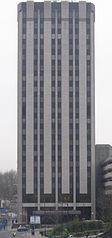
Castlemead was completed in 1981. The building has a roof height of 80 metres (262 feet) and consists of 18 floors. Written by an unidentified journalist, the Bristol Post article confidently describes it in its first paragraph as “Bristol’s tallest building”.
But is it?
No.
Most definitely not.
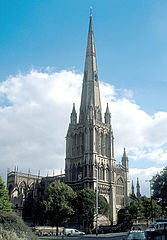
Bristol’s actual tallest buildingAs this blog has pointed out before (posts passim), that accolade is held by a much older building – St Mary Redcliffe, parts of which date to the 12th century.
The spire of St Mary Redcliffe, is 89 metres (292 feet) high. Its height makes it the third tallest English church spire in England. The spire itself was struck by lightning in 1446 and truncated (something which can be clearly seen in the illustration of the church on Millerd’s 17th century plan of Bristol. Ed.), in which condition it remained for some 400 years before being rebuilt to its present height in 1872.
So, Bristol Post hacks, think carefully – and do the all-important background research and fact checking – before in future describing any modern edifice as Bristol’s tallest. 🙂
Horses and cattle are both ungulates, i.e. both use the tips of their toes to support their whole body weight whilst moving. Both cows and horses have hooves.
A horse is an odd-toed ungulate with a long hairy mane and tale, whilst a cow is an even-toed ungulate. They’re easy to identify, unless you’re a city-based employee of the Bristol Post.
Yesterday the Post published a tragic story of more than 100 horses having to be put down after being rescued from appalling conditions in Bridgend in the Vale of Glamorgan.
However, the picture used to illustrate the report features animals that look more bovine than equine, as revealed by the screenshot below.
Frisians or Dobbins?
Just because both beef and horsemeat taste equally good on the plate doesn’t means they are interchangeable in the field, Bristol Post. Try saddling up a cow and entering a steeplechase! 🙂
I knew having children was expensive, but never realised cots – those small-sized beds for babies – could cost so much until I read this article in today’s Bristol Post about an expensive night out which sadly ended up in that local Palais de Justice also known as Bristol Crown Court.
Bristol Crown Court
Apparently, the night out resulted in a huge bill for bedding, according to the relevant sentence in the article.
The court was told Collins had to stump up £8,500 towards legal cots.
Today the Bristol Post has been occupied with faggots. It all started when Facebook, that bastion of free speech, banned the use of the word faggot as offensive. Apparently they’ve never heard of this traditional item of English cuisine over the pond, where faggot is a term of abuse for homosexuals.
As a result, Mr Brain’s – a producer of culinary products resembling faggots that started life in the Bristol area – has started a campaign to fight against Facebook’s ban, which is duly being reported by the Post.
In addition, the Post also informed its readers what faggots are. Any similarity between the Post’s article and the introduction to Wikipedia’s faggots article is presumably purely coincidental.
However, the Post hasn’t finished with faggots yet; it also tells its by now slavering readers how to make faggots. After having stated that faggots are made from pork, the Post drops a real clanger on this report, illustrating it with a photograph of a butcher (so far, so good. Ed.) posing with a joint of beef (D’oh! Ed.), as evidenced by the screenshot below.
Earlier this year I blogged about the Home Office’s so-called racist van (posts passim). Yesterday along with most of the national media the BBC reported that the Home Office had admitted that just 11 illegal immigrants had left the UK as a result of its ill-advised campaign.
Although the Home Office’s efforts were ill-advised and less than successful, its use of mobile billboards has inspired their use by others like the Tripe Marketing Board, as the picture below – allegedly from Lancashire – shows.
There are annual events that pepper the year providing easy copy for the media. One of these is Bonfire/Guy Fawkes Night on 5th November.
As 5th November is less than a week away, most media outlets are publicising local fireworks events. Here’s today’s offering of that ilk from the Bristol Post.
As usual a screenshot has been taken, just in case authors Rachel Gardner and Alex Cawthron realise they’ve posted a half-finished article. Additional black marks to Rachel and Alex too for a lower case start to the headline.
The UK’s dreadful, destructive coalition government has done something right – for a change.
As part of the forthcoming Local Audit and Accountability Bill, which will be debated by MPs in the House of Commons on Monday, new rights will be granted to the press and citizens to film and report council meetings, the Department for Communities and Local Government (DCLG) has announced.
In 2012 the government changed secondary legislation to open up councils’ executive meetings to the press and public. However, this did not apply to councils’ committee meetings or full council, nor to parish councils. Eric Pickles, the Secretary of State for Communities and Local Government, asked councils to open up their committee meetings, but many councils are still not complying. Many councils, particularly in Yorkshire and Lincolnshire are still keeping democracy behind closed doors. Some councils had even banned local residents from recording, blogging and tweeting at council meetings. Ministers believe these councils are clinging to outdated analogue ideals in a digital age.
Mr Pickles said: “An independent local press and robust public scrutiny is essential for a healthy local democracy. We have given councils more power, but local people need to be able to hold their councils to account. I want to do more to help the new cadre of hyper-local journalists and bloggers.
“I asked for councils to open their doors, but some have slammed theirs shut, calling in the police to arrest bloggers and clinging to old-fashioned standing orders.
“This new right will be the key to helping bloggers and tweeters as well as journalists to unlocking the mysteries of local government and making it more transparent for all. My department is standing up for press freedom.”
Here in Bristol, the council is well ahead of Mr. Pickles. Meetings have been webcast for years and members of the public and elected councillors freely tweet proceedings from the Counts Louse.
Today’s Independent puts the christening of George Windsor into perspective: one sentence at the foot of page 27 of its dead tree version.
However, the paper’s customary lack of deference is completely ruined by the paper’s online version which features both a photo gallery and a comment piece. 🙁
A screenshot has been omitted in the interests of taste. 🙂