-
-
A salutary lesson in social media for business
A message to all businesses: if you sack a member of staff, you should consider changing your Twitter password, particularly if that person had access to the account.
The Plough, a pub in Great Haseley, Oxfordshire, didn’t… and at the time of posting it has nearly 1,700 followers.
You can enjoy the results in the screenshot below.

Update 12 noon, 16/12/13: According to Buzzfeed, Jim Knight, the chef in question, created the Twitter account with the permission of his now former employers. Furthermore, he has also now been offered a new job, in which I wish him well. 🙂
Hat tip: Eugene Byrne
-
Felix Road Adventure Playground – latest
I live not very far away from Felix Road Adventure Playground, which for four decades has provided opportunities for play for inner city children in Easton.

Felix Rd Adventure Playground As regular readers will be aware, the playground has been under threat of closure ever since Bristol City Council made a mess of outsourcing play facilities around the city.
In response to this calamitous cock-up, local Easton residents organised a petition to save Felix Road (posts passim).
According to the Save Felix Road Twitter account, a debate on the playground will be held at a full meeting of Bristol City Council on 17th December as the petition has gained more than the required number of signatures to trigger a discussion in the council chamber.
I’ll await developments with interest as it’s not right that children in one of the most deprived parts of the city suffer when Bristol City Council cocks things up.
-
Bristol City Council – the developer’s friend
My attention was drawn today to a curious article on the Local Government Association website from Bristol City Council.
To me it’s reminiscent of a livestock dealer crowing about the fine qualities of the beast he’s trying to sell or perhaps even a prostitute buttering up a prospective client.
There are some fine examples of jargon too.
However, this article gives me cause for concern on three counts.
Firstly, I’m paying the wages of the council’s planning wonks directly through my council tax (and indirectly through your national taxes, a portion of which gets returned to local authorities by way of government grant. Ed.), but it seems like they’re not working for the benefit of the city’s residents, but the planners seem rather concerned with working for the benefit of property developers.
This leads on to my second concern: those chummy quarterly chats with the Bristol Property Agents Association (BPAA), a cosy club whose membership is drawn from primarily from local residential and commercial property agents, as well as commercial property lawyers, developers, architects, planners, building and quantity surveyors.
Finally, there’s the offer to renegotiate Section 106 agreements. These are planning obligations under Section 106 of the Town and Country Planning Act 1990 (as amended) and are a mechanism which make a development proposal acceptable in planning terms, that would not otherwise be acceptable. They are focused on site specific mitigation of the impact of development. S.106 agreements are often referred to as ‘developer contributions’ along with highway contributions and the Community Infrastructure Levy.
For a cash-strapped council, I would have thought that its priority should be squeezing as much from developers under S.106 as it can.
Evidently not.
The example of Finzels [sic] Reach given in the article is interesting. After being granted planning permission, the developers renegotiated their S.106 obligations and still went into administration last year. Perhaps their scheme was so poorly planned and financed, it should not have been given planning permission in the first place.
The article – dated 8th October 2013 – is reproduced in full below.
Bristol City Council: open for business on Section 106 agreements
Bristol City Council has an ‘open for business’ policy in relation to bringing forward development and investment in the city. Last year the Council received just over 3,000 planning applications, saying ‘yes’ to over 80 per cent of these (89 per cent of major schemes).
The council meets representatives of the Bristol Property Agents Association (BPAA) on a quarterly basis in order to discuss live issues, including delivery of development. The West of England Planning Toolkit and the Bristol Planning Protocol were jointly produced with representatives from the development sector.
Bristol has a good record of housing delivery. Its adopted Core Strategy target is for a minimum of 26,400 dwellings to be delivered between 2006 and 2026, and in the six years since 2006 over 12,700 (approximately 48 per cent) of these dwellings have been constructed. In addition, there are around 7,000 residential units currently with planning consent in the city – a significant proportion of which are yet to be commenced. In order to ensure this much needed development is brought forward, Bristol proactively seeks requests from developers to renegotiate Section 106 agreements on schemes that have become unviable since planning consent was granted. Requests are considered by the planning committee in a process that includes an open book appraisal of viability by the developer.
Outcome and impact
This approach is proving successful. Examples include Finzels Reach (a £200 million mixed-use development site in central Bristol), which is a high quality regeneration scheme on a strategically important site.
Within this context, Bristol negotiated a revised Section 106 package that met some, although not all, of the demands put forward by the developer. The revised position incentivised the developer to deliver the development to their timescale by reducing the Section 106 package by around a third (£4.5 million) if various triggers were reached.
Contact
Kate Hartas
Media and PR officer
Telephone: 0117 922 2649Since I drew attention to the article, I’ve received the tweet shown below from Bristol City Council.

On the basis of that tweet, I have a couple of questions for Bristol City Council’s press office.
1. If Bristol City Council describes a press release bearing this month’s date as ‘ancient’, what counts as modern?
2. If that press release was released in error as you seem to be implying, is any quality control exercised by your officers before material is released for publication?
Answers will be accepted in the comments below.
Update 23/10/13: The following message has been received this morning from Bristol City Council.
Hi Steve
I’ve tried to leave a comment on your blog but get a message saying we’re blocked, probably because our work computers are behind a proxy.
In answer to your questions though, the press release you’re referring to was sent out in Sept 2012, hence our description of it as ‘pretty ancient’. The website it was published on is not in our control but that of the LGA, which recently did technical amendments to the page (not the release) which updated the automatic date shown on their site. After your tweet we drew this to their attention and asked them to remove it as it was old news and could be confusing given the apparent date. The original press release was not an error, it was sent deliberately in Sept 2012. What we can’t control is who posts it where and for how long after.
I hope this clears it up for you.
Kind regards
TimTim Borrett
Service Manager, Media
Bristol City CouncilThanks Tim. That helps explain the ancient nature of the press release (which you might like to know the LGA’s webmaster still hasn’t taken down. Ed.), but not the matter of why the council’s planning department seems to be working more in the interests of property developers and not for the people of Bristol who pay their wages.
-
France’s Elysée Palace makes modest contribution to open data
Le Monde Informatique reports that the website of the Elysée Palace, the official residence of the French president is taking a step towards open data. In a tweet on 16th September, it announced it was opening up its data in a new open data section of its website.

At present this open data section consists essentially of the diary of President François Hollande which has been appearing since last December at the top of the site’s home page in the form of a timeline. The data in this timeline are offered in two formats: XML and JSON.
The Elysée is also releasing the origin of visits made to its website during the previous week in JSON format. Some 41% of its visitors originate from Google, 30% reach the site directly, 8% are referred by Twitter and 4% by the Elysée’s Facebook page. There are also daily statistics for the site’s servers (energy consumption, load) and visits displayed in graphical form: number of visitors, number of pages viewed per hour and the source of visits.
Since the announcement of the the French government’s open data portal data.gouv.fr in February 2011, several public sector organisations, publicly-owned companies (e.g. SNCF and RATP) and local and regional authorities have opened up some of their data.
-
Know Your Place now better
Know Your Place, Bristol City Council‘s historical mapping service that allows you to explore the city through historic maps, images and linked information, has been featured before on this blog before (posts passim).
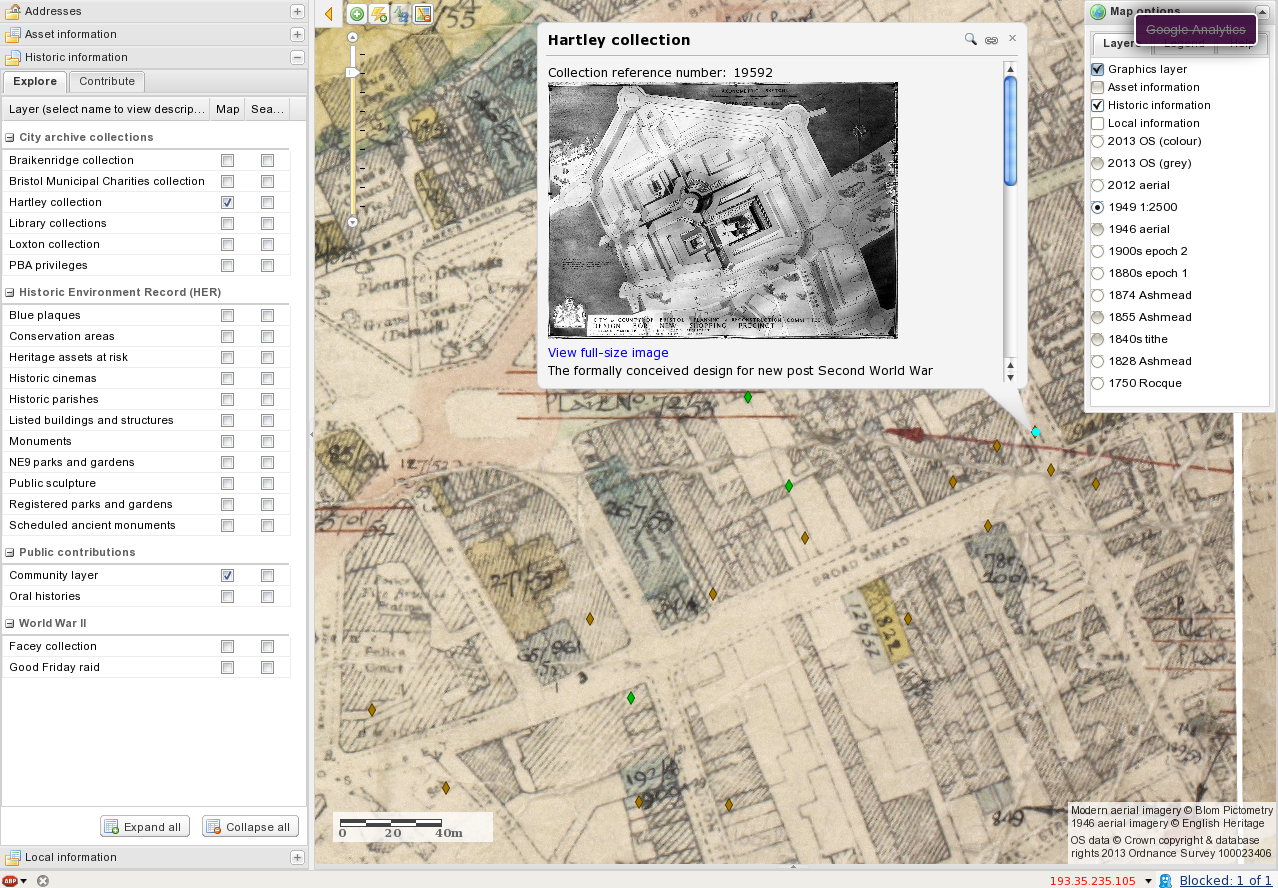
Earlier today Pete Insole, archaeologist for Bristol City Council, announced via Twitter that Know Your Place has now been augmented by the addition to the Hartley Collection layer of original architects’ drawings for the reconstruction of Bristol after World War 2.
Bristol was the fifth most heavily bombed British city of World War 2. The presence of the city docks and the Bristol Aeroplane Company made it a target for bombing by the Luftwaffe whose pilots were able to trace a course up the River Avon from Avonmouth into the heart of the city using reflected moonlight on the waters.
A screenshot featuring the new one of the new additions – one of the drawings for what ultimately became Broadmead shopping centre – is shown below.

Now improved – Know Your Place. Click on the image for the full version -
Made redundant? No, I was ‘catalyzed’
For decades, managers have been trying to come up with anodyne terms for dismissing people and making them redundant.
Some of the more common ones are: give someone their notice, get rid of, discharge, terminate; lay off; sack, give someone the sack, fire, boot out, give someone the boot, give someone their marching orders, show someone the door, can, pink-slip; cashier.
Following this trend, bosses at Bristol City Council have now come up with another, ‘to catalyze’, as evidenced by a mole down the Counts Louse (since renamed ‘City Hall’ by Mayor Red Trousers (posts passim). Ed.) who tweeted the following yesterday.

I’m sure all employees of the council are reassured that the management has their best interests at heart by not wanting to hurt their feelings as they’re unceremoniously handed their P45s and shown the door.
-
Running normally?
Have you ever wondered why your train is running late?
The National Rail Enquiries Twitter feed is very useful for providing answers, as per the typical tweet below.
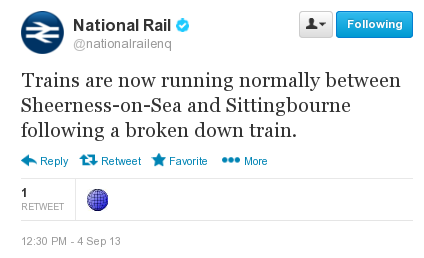
I can hear those of you with an acute sense of English already asking whether “running normally” on the UK rail network usually involves “following a broken down train” (because that’s what travelling by rail normally feels like? Ed.). 😉
-
Court interpreting: a barrister tweets
The courts and tribunals interpreting contract being implemented by Capita Translation & Interpreting continues its disastrous course if one listens to anyone except Ministry of Justice civil servants or ministers (posts passim).
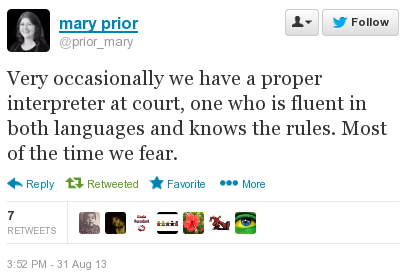
Below is a tweet from yesterday posted by London-based barrister Mary Prior.
No further comment is necessary.
-
Capita: feast or famine
So far this blog has recorded a dearth of Capita T&I interpreters for the jobs they’re supposed to be doing in the country’s courts (posts passim).
Now just for a change we’re pleased to report a surfeit, as shown in this tweet (screenshot below).
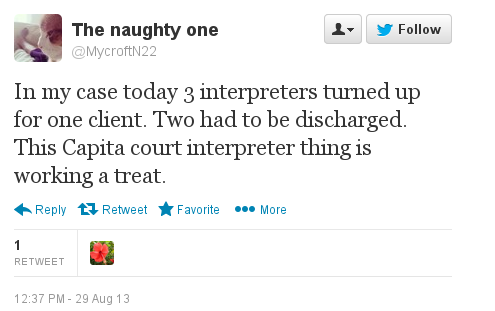
Are Capita T&I interpreters like buses – one waits for ages and then 3 turn up at once? Or do Capita’s finest believe in safety in numbers? Is any comment on this amazing development forthcoming from Helen Grant MP, the Minister for Victims and the Courts?
I think we should be told.