Linux

  • Crowdfunding for Tails

    Tails logoTails is a live Linux operating system (based on Debian. Ed.), that can be booted on almost any computer from a DVD, USB stick or SD card. Tails aims at preserving its users’ privacy and anonymity, as well as helping them to:

    • use the Internet anonymously and circumvent censorship; all connections to the internet are forced to go through the Tor network;
    • leave no trace on the computer being used without your requesting it;
    • use state-of-the-art cryptographic tools to encrypt your files, emails and instant messaging.

    A crowdfunding campaign to support encryption tools for journalists has been launched by The Freedom of the Press Foundation; this campaign will last for two months and is collecting funds for Tails, Tor, the encrypted mobile communication tools RedPhone and TextSecure, plus the LEAP encrypted email platform.

  • Recommended: Scribus

    In the immediate aftermath of my mother’s recent death, I offered to prepare the order of service for her funeral. I felt this was one small service I could perform for her, as well as presenting me with an ideal opportunity to re-acquaint myself with Scribus, the free and open source desktop publishing (DTP) package.

    screenshot of Scribus
    My mother’s order of service being edited in Scribus. Click on image for full-sized version

    When it comes to operating systems, Scribus will run on Linux, other Unix-like operating systems, Mac OS X, Haiku, Microsoft Windows, OS/2 and eComStation; and that’s pretty impressive for a start.

    Scribus is designed for layout, typesetting and preparing files for professional quality image setting equipment. It can also create animated and interactive PDF presentations and forms. Example of its use include writing small newspapers, brochures, newsletters, posters and books.

    Scribus supports most major bitmap formats, including TIFF, JPEG and Adobe Photoshop. Vector drawings can either be imported or directly opened for editing. The long list of supported formats includes Encapsulated PostScript, SVG, Adobe Illustrator, and Xfig. Professional type/image setting features include CMYK colors and ICC color management. It has a built-in scripting engine using Python.

    Text can be imported from OpenDocument (ODF) text documents, such as those produced by LibreOffice Writer, Microsoft Word, PDB (Palm OS) and HTML formats, although some limitations apply. OpenDocument text (.odt) files can typically be imported along with their paragraph styles, which are then created in Scribus. HTML tags which modify text, such as bold or italic will also be handled pretty well.

    Scribus is available in more than 24 languages and is released under the GNU General Public Licence (GPL).

  • Canonical forks Gnome Control Centre*

    Ubuntu logoRobert Ancell of Canonical, the company behind the popular Ubuntu Linux distribution, has announced on the Ubuntu desktop mailing list that Canonical is forking the Gnome Control Centre.

    Robert’s email is reproduced in full below.

    Hi all,

    Ubuntu makes use of a heavily patched gnome-control-center (61 patches) and we will in future move to the new Ubuntu System Settings [1] once we achieve convergence. We are already running an old version of gnome-control-center (3.6) and the value for Ubuntu in upgrading this is low since it would take a lot of work to update our changes. Running an old version until convergence blocks those who do use GNOME (i.e. Ubuntu GNOME).

    For these reasons it has been discussed that we should fork gnome-control-center 3.6 for Unity into unity-control-center [2].

    To be very clear, this is a fork with a limited lifespan. We don’t expect to make significant changes to it outside of stability and security fixes.

    This change affects a number of packages, and I have attempted to find and fix all the side-effects (See bug 1257505 [3]). The proposed changes are in a PPA [4].

    Please test this PPA and post any problems in the bug report. I’d like to land this change into the archive if there are no reasons to block it.

    I also have a fork of gnome-settings-daemon for the same reasons which I am running successfully, I will do a similar call for testing when we have landed the control center changes.

    Thanks,
    –Robert

    [1] https://launchpad.net/ubuntu-system-settings
    [2] https://launchpad.net/ubuntu-control-center
    [3] https://bugs.launchpad.net/ubuntu/+source/gnome-control-center/+bug/1257505
    [4] https://launchpad.net/~ubuntu-desktop/+archive/unity-control-center

    * = Spelling in title and author’s text localised to EN-GB! 🙂

  • An open source framework for the “internet of things”

    Today’s Le Monde Informatique reports that the AllSeen Alliance, an umbrella group for major consumer electronics manufacturers, is working on an open source framework with which it will be possible to connect almost anything to the internet.

    Household electrical goods, cars and computers could soon communicate with each other thanks to an open source framework developed by the AllSeen Alliance with the support of the Linux Foundation. This group of major consumer electronics manufacturers includes Cisco, D-Link, Haier, LG Electronics, Qualcomm, Panasonic and Sharp. According to the Linux Foundation, “the framework, originally developed by Qualcomm under the name of the AllJoyn Project, will enable different systems to see each other, to connect and to interact transparently, irrespective of their manufacturer or the operating system they use”. Members of the alliance will contribute to the framework by providing engineering resources and software resources to enable developers, manufacturers and suppliers to provide interoperable services and devices. “Qualcomm has contributed to the AllJoyn code under the aegis of the AllSeen Alliance. This will hold the copyright, offering the project a broader reach,” said Jim Zemlin, Executive Director of the Linux Foundation. “The open source community can also contribute to this code,” he added.
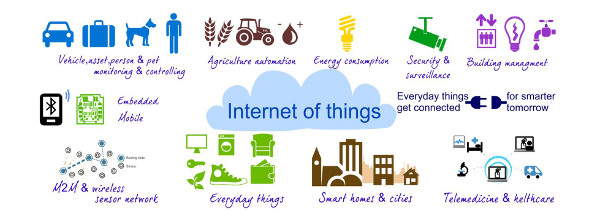
    internet of things graphic

    The framework runs on Linux, Android, iOS, Windows and other OS variants involved. “Developers can download the code already and find details of APIs using the reference source allseenalliance.org and start working,” the Foundation announced. “Once APIs comprising an interoperability layer are supplied to the open source community, it will be possible to graft all sorts of services onto them,” Zemlin stated in an email. For example, the framework could enable users to play music easily because there are various wireless loudspeakers nearby. “Today this would be difficult because the majority of consumers have audio systems from different manufacturers, they store their music on various media and use different cloud storage services,” Zemlin explained. “This framework will therefore enable easy playing of music on compatible loudspeakers near these sources,” he added. “Engineers are already at work writing this code and implementing it in existing products. We are expecting several announcements of this type at the next CES (7th -10th January 2014), ” he stated.

    A truly universal framework

    The framework could also be used to enable a domestic electrical system to turn of a home’s heating system when the house is empty and thus contribute to reducing household energy bills. “Such a system could be adapted to different scenarios; for example, to put household equipment on standby when its occupants are out and turn them on gradually before their return,” Zemlin declared. “The same system could enable the family car to be detected when it’s a mile away, switch on the lights and start up the heating or even open the garage door automatically when the car is approaching,” he added. “All these communications could work with existing transmission technologies – wifi, Bluetooth – and future ones, such as those based on radio waves,” Zemlin also stated.

    The AllSeen Alliance is the Linux Foundation’s 11th collaborative project. “As companies create more products integrating this code, the developer community devoting time to extending and improving this code will grow, just like what happened with other projects based on Linux or OpenStack,” Zemlin stated.

  • Polish school finds Ubuntu PCs “faster and cheaper”

    Ubuntu logoJoinup, the EU’s public sector open source news site, reports that the Zolnierzy Sybiru high school in the Polish city of Lubawka has converted 11 of its PCs to run Ubuntu Linux.

    The 11 machines are shared by 55 pupils and the conversion took place at the instigation of one of the school’s teachers.

    The switch has made the PCs run faster and there have been savings on Windows and other proprietary software licences too, according to FWiOO, the Polish foundation for Free and Open Source Software.

    The 11 PCs in question were bought in 2005 with funds from the Ministry of Education and previously ran Windows XP. In September the PCs were converted Ubuntu Linux.

    In September a brief report (Polish) summarising the high school’s switch to Ubuntu Linux was published.

    The pupils store their data in a free cloud solution offered by Canonical, the firm behind Ubuntu Linux.

    “By using Ubuntu, these computers run faster and more reliably”, FWiOO notes.

  • LibreOffice 4.1.3 released

    the LibreOffice logoThe Document Foundation (TDF) blog announced earlier today that LibreOffice 4.1.3 has been released for Linux, Mac OS X and Windows. This is the third minor release of the LibreOffice 4.1 family, which features a large number of improved interoperability features for proprietary and legacy file formats.

    According to TDF, the new release is another step forward in the process of improving the overall quality and stability of LibreOffice 4.1. Nevertheless, for enterprise adoptions, The Document Foundation suggests the use of LibreOffice 4.0.6, which is supported by certified professionals.

    The release of LibreOffice 4.1.3 is taking place just one day before the LibreOffice HackFest in Freiburg, Germany, where the community will gather at the ArTik to get started on EasyHacks under the mentoring of experienced LibreOffice developers such as Thorsten Behrens, Eilidh McAdam, Bjoern Michaelsen, Markus Mohrhard, Eike Rathke and Michael Stahl.

    LibreOffice 4.1.3 is available for immediate download. Change logs are available at the following links: https://wiki.documentfoundation.org/Releases/4.1.3/RC1 (fixed in 4.1.3.1) and https://wiki.documentfoundation.org/Releases/4.1.3/RC2 (fixed in 4.1.3.2).

  • Jamaica adopts GNU Health

    GNU Health logoJamaica is to become the first country in the world to adopt GNU Health, the free and open source health and hospital administration system nationwide, Joinup reports, following the signing of an agreement between the Jamaican Ministry of Health (MoH) and GNU Solidario, a NGO supplying free software for health and education.

    This will be a herculean task, demanding cross-sectoral integrations from all the regions of this country. To initiate the implementation, programmers, system administrators, physicians, nurses and health records staff, as well as other public officials gathered to participate in several meetings, workshops and focus groups. The MoH Health Informatics team itself had representatives from both the national and the regional levels, as well as health records, clinical, IT and management personnel.

    After an intense week, the initial guidelines for the project were designed in order to complete the first stage by the end of this year.

    GNU Health provides the following functionality:

    • Health Information System (Demographics, Epidemiology);
    • Hospital Information System;
    • Electronic Medical Records.

    In addition, GNU Health has won the Best Project of Social Benefit award from the Free Software Foundation, amongst other international awards.

  • Embedded Linux on a growth curve

    Tux - the Linux kernel mascot
    Tux – the Linux kernel mascot
    Embedded Linux developers got together in Edinburgh on 24th and 25th October 2013 for the Embedded Linux Conference Europe in conjunction with LinuxCon Europe, German technology news website Heise reports. Sony’s Tim Bird, Chair of the Linux Foundation’s Consumer Electronics working group, presented a wild ride through the achievements of recent years. Linus Torvalds‘ old joke that Linux would one day achieve world domination has become surprisingly serious.

    According to kernel developer Wolfram Sang, problems are causing the overloading of the maintainers who can hardly keep up any more with the incorporation of patches in the kernel. Basic devices were also a topic: the microcontrollers from ARM’s Cortex-M series (which are used for applications such as smart metering, human interface devices, automotive and industrial control systems, white goods, consumer products and medical instrumentation. Ed.) have no memory management unit (MMU), which requires appreciable differences in development. As a consequence uClinux uses its own format for binaries for devices without a MMU.

Posts navigation