Open Source

  • Freeze date and Freeze Policy for Debian Jessie announced

    Debian logoThe next version (8.0) of Debian GNU/Linux, codenamed Jessie, will be released in the first half of 2015. Debian’s developers have now announced the freeze date and freeze policy for Debian Jessie. An extract of the announcement (entitled “Bits from the Release Team (Jessie freeze info)”) is reproduced below.

    We are happy to announce that we will freeze Jessie at 23:59 UTC on the 5th of November 2014. To avoid any confusion around exactly how we will freeze, we have prepared a draft of the Jessie Freeze Policy in advance

    FREEZE POLICY

    Notable changes to the policy include:

    • Well-defined stages in the freeze policy at certain dates.
      • After 3 months of freeze, we will no longer allow remove packages to re-enter testing
      • We only accept fixes for important bugs in the first month.
      • etc.
    • Proactive automated removals 3 months into the freeze.
      • Note that bug-free packages will be removed if they (build-)depend on a RC-buggy, non-key package.
      • Also note the interval of 7 days between each removal run.
    • Inclusion of “do” and “don’t” guidelines for uploads and unblock bugs.
    • Currently, we are undecided whether to maintain “carte blanche” freeze exceptions at the start of the freeze. For now, exceptions are *not* included in the freeze policy (i.e. do *not* rely on them). This means that changes have to migrate to testing *before* the freeze date if they are to be included in the release.
      • *If* such exceptions are added, they will *not* apply for packages where migration would change the “upstream” version.
      • Native packages are at a disadvantage here, since all uploads of native packages are considered a new “upstream” version.
      • It should go without saying, but “urgency” abuse is not an acceptable way of getting your latest changes into the release.
      • It should also go without saying that embedding a new upstream release in a patch just to get a such “carte blanche” exception is also considered abuse.

      As noted we are dealing with a draft, so there may be changes to the actual freeze policy. Should we change the policy in a substantial way, this will be included in subsequent “bits”.

  • GNU Make 4 released

    GNU head imageThe GNU Project has announced the release of version 4 of GNU Make, the software’s latest stable version.

    Make is a utility that automatically builds executable programs and libraries from source code by reading files called makefiles which specify how to derive the target program.

    This latest version provides support for Guile integration as an embedded scripting language for makefiles, as well as other new features and many bug fixes and performance improvements. There are also some backward-incompatibilities.

    Potential users are advised to read the NEWS file that comes with the GNU make distribution for complete details on changes visible to the user.

    Make can be downloaded from http://ftp.gnu.org/gnu/make/.

  • Linux for Astronomers

    Distro Astro is a Linux distribution based on Ubuntu/Linux Mint which aims to cover the requirements of astronomers and astronomy enthusiasts.

    The project has announced the release of version 1.0.2 of its distribution, codenamed Ceres.

    Distro Astro has features for almost all astronomy uses — from observatories, planetariums – and for all users from professional researchers to astro-photographers and amateur enthusiasts; and that’s why it’s called Linux for Astronomers. The project’s website has a full review of Distro Astro’s features.

    Distro Astro’s ISO (size: 1.9 GB) can be downloaded from South Common Observatory in East Sussex.

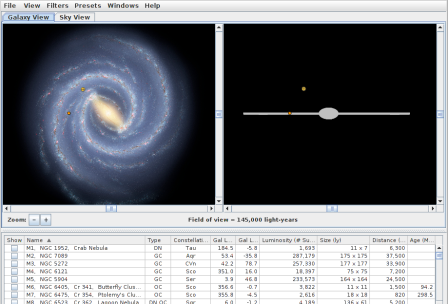
    screenshot of program running on Distro Astro

  • Italy’s Macerata province halfway through LibreOffice migration

    the LibreOffice logoJoinup, the EU’s public sector open source news site, reports that Italy’s Macerata province is halfway its migration to the free and open source LibreOffice suite as a replacement for Microsoft Office. LibreOffice is currently used on 230 of its 450 workstations. The migration is expected to be completed in December next year.

    The same article also reports that Windows is being replaced by Linux as the workstation operating system used for non-specialised tasks on the provincial government’s PCs.

    These moves are expected to save the provincial authority some €150,000 in 2014. For Italy as a whole, the Asca news agency states the LibreOffice 2013 Conference in Milan was told that migrating the public sector to LibreOffice could save the public purse €300-500 mn.

  • Happy 30th, GNU!

    Today is the 30th birthday of the GNU Project, which instigated the whole move towards free and open source software and the wealth of GNU/Linux distributions and software currently available.

    GNU’s initial aim, as outlined by Richard Stallman, was to develop a Unix-like operating system, but one which contained no proprietary Unix code.

    GNU 30th anniversary logo

    Stallman’s original announcement is reproduced below.

    Free Unix!

    Starting this Thanksgiving I am going to write a complete Unix-compatible software system called GNU (for Gnu’s Not Unix), and give it away free(1) to everyone who can use it. Contributions of time, money, programs and equipment are greatly needed.

    To begin with, GNU will be a kernel plus all the utilities needed to write and run C programs: editor, shell, C compiler, linker, assembler, and a few other things. After this we will add a text formatter, a YACC, an Empire game, a spreadsheet, and hundreds of other things. We hope to supply, eventually, everything useful that normally comes with a Unix system, and anything else useful, including on-line and hardcopy documentation.

    GNU will be able to run Unix programs, but will not be identical to Unix. We will make all improvements that are convenient, based on our experience with other operating systems. In particular, we plan to have longer filenames, file version numbers, a crashproof file system, filename completion perhaps, terminal-independent display support, and eventually a Lisp-based window system through which several Lisp programs and ordinary Unix programs can share a screen. Both C and Lisp will be available as system programming languages. We will have network software based on MIT’s chaosnet protocol, far superior to UUCP. We may also have something compatible with UUCP.

    Who Am I?

    I am Richard Stallman, inventor of the original much-imitated EMACS editor, now at the Artificial Intelligence Lab at MIT. I have worked extensively on compilers, editors, debuggers, command interpreters, the Incompatible Timesharing System and the Lisp Machine operating system. I pioneered terminal-independent display support in ITS. In addition I have implemented one crashproof file system and two window systems for Lisp machines.

    Why I Must Write GNU

    I consider that the golden rule requires that if I like a program I must share it with other people who like it. I cannot in good conscience sign a non-disclosure agreement or a software license agreement.

    So that I can continue to use computers without violating my principles, I have decided to put together a sufficient body of free software so that I will be able to get along without any software that is not free.

    How You Can Contribute

    I am asking computer manufacturers for donations of machines and money. I’m asking individuals for donations of programs and work.

    One computer manufacturer has already offered to provide a machine. But we could use more. One consequence you can expect if you donate machines is that GNU will run on them at an early date. The machine had better be able to operate in a residential area, and not require sophisticated cooling or power.

    Individual programmers can contribute by writing a compatible duplicate of some Unix utility and giving it to me. For most projects, such part-time distributed work would be very hard to coordinate; the independently-written parts would not work together. But for the particular task of replacing Unix, this problem is absent. Most interface specifications are fixed by Unix compatibility. If each contribution works with the rest of Unix, it will probably work with the rest of GNU.

    If I get donations of money, I may be able to hire a few people full or part time. The salary won’t be high, but I’m looking for people for whom knowing they are helping humanity is as important as money. I view this as a way of enabling dedicated people to devote their full energies to working on GNU by sparing them the need to make a living in another way.

    For more information, contact me.

    Arpanet mail:
    RMS@MIT-MC.ARPA

    Usenet:
    …!mit-eddie!RMS@OZ
    …!mit-vax!RMS@OZ

    US Snail:
    Richard Stallman
    166 Prospect St
    Cambridge, MA 02139

  • GNOME 3.10 released

    Yesterday the GNOME project announced the release of GNOME 3.10, the latest version this popular desktop for GNU/Linux.

    This latest release in the GNOME 3 series includes many new features, applications and bug fixes, as well as enhancements and updates to many existing applications.

    Introducing the release, Allan Day of the GNOME Design Team said, ‟GNOME 3.10 is a significant upgrade for our users and developers will benefit from new features in the application development platform. Our contributors did an incredible job and have created a really exciting release.“

    Highlights for GNOME 3.10 include:

    • Experimental Wayland support;
    • A reworked system status area, which gives a more focused overview of your system;
    • Three new applications (which are technology previews): Maps, Music and Software;
    • Three new additions to the core set of GNOME applications: Notes, Photos and Weather;
    • ‟Software“, which provides an easy way to browse and install applications;
    • New geo-location features, such as automatic time zones and world clocks;
    • The ability to set a custom image on the lock screen;
    • High-resolution display support.

    GNOME 3.10 screenshot

    For developers, there are new GTK widgets, a geo-location framework that will allow location-aware applications and the ability to define composite widgets using XML.

    As stated above, GNOME 3.10 also introduces initial Wayland support. This represents a major technological step forward for GNOME and will enable the project to fully adopt the next generation display and input technology in the future.

    Full details of the changes in the new 3.10 version of GNOME are set out in the release notes.

  • Bristol Wireless to provide tech training in November

    This November Bristol Wireless is offering a week of training days in its lab at Windmill Hill City Farm, Bedminster, Bristol.

    One topic will be covered each day of the week of the 25-29 November and there are four places available for each topic.

    The course topic for each day is:

    • Monday 25th November: Hosting web services
    • Tuesday 26th November: Linux Vserver virtualisation environment
    • Wednesday 27th November: SQL database programming
    • Thursday 28th November: System administration
    • Friday 29th November: Administration using Puppet automation software

    Tuition will start each day at 10 am and end at 5 pm.

    The tutors for the week will be Bristol Wireless’ Ben Green and Julien Weston. Ben has well over 10 years’ experience as a systems administrator, whilst Julien has been an accomplished database engineer for a couple of decades.

    Bristol Wireless uses Debian GNU/Linux as its preferred operating system and the courses will be taught on Debian, although participants are welcome to bring their own laptops and preferred operating systems to the courses.

    Participants must have some experience of Linux systems, including at least some command line skills and should expect a fast pace of learning. Each participant will be given a virtual server to experiment with on the day with the required tools set up for the topic at hand.

    Cost will be £200 per day, which doesn’t include food or accommodation, although the on-site city farm café will be open and there are plenty of other eateries in the area.

    For more information please contact Ben Green at Bristol Wireless at training2013@bristolwireless.net or on 0117 325 0067.

    Reposted from Bristol Wireless.

  • Is there a backdoor in Linux?

    image of Linus Torvalds
    Linus Torvalds ponders answering another awkward question
    At this year’s LinuxCon held in New Orleans, Linus Torvalds and fellow kernel developers were asked whether they’d been approached by US security services to put a backdoor in Linux, thus compromising the operating system’s security, The Register reports.

    Linus responded to the question by saying no whilst at the same time nodding his head, thus indicating that he had been approached. He then resumed by completely denying any approach had been made. This was followed by another developer saying that such things couldn’t be discussed. Linus’ reaction is reminiscent of the reserve Marissa Mayer, CEO of Yahoo, on the NSA‘s Prism programme because any mention of it could be “treason”.

    Rumours of backdoors and other forms of hidden access routes in operating systems such as Microsoft Windows and security protection products have been in circulation for years. These rumours have been given a fresh lease of life following the recent revelations by NSA whistleblower Edward Snowden.

    Linus’ and the other developers answers have not exactly cleared the air as to whether Linux is as secure an operating system as its users are likely to believe. As The Register article points out:

    Worried netizens have become far more paranoid about the possibility of backdoors in the technology they use and this paranoia extends to both closed-source and open-source software.

    However, it is pointed out by The Register that security service agents who are rebuffed by developers then tend to leave them alone.

    Finally, there’s one point to consider: in open source anyone with the requisite skill is free to examine the code, modify and adapt it. On that principle, wouldn’t it therefore be more difficult to hide vulnerabilities and backdoors in open source products than closed, proprietary software?

  • LibreOffice improves support for OOXML

    the LibreOffice logoAccording to Heise, Suse and Lanedo have completed a project to improve the interoperability of the free and open source LibreOffice productivity suite with OOXML, the format used by Microsoft Office files. The requirements were jointly defined by several bodies, including Munich City Council, the Swiss Federal Court and the French Ministry of Culture and Communication and the project received total funding of €160,000.

    The improvements have been incorporated into LibreOffice versions 3.6, 4.0 and 4.1. The code is licensed under the LGPL and MPL 1.1 3, but may also be used under the Apache 2 licence, so it can also be incorporated into Apache OpenOffice.

  • Orca screen reader improves Braille functions

    Orca logoOrca, the screen reader for the GNOME desktop used on Linux machines, is now at the Beta 2 stage for its forthcoming 3.10 release. According to Softpedia, the 3.10 Beta 2 release fixes the broken text attribute presentation for Gecko, the new sliders are now present in GNOME Shell, partially-implemented value interfaces with range of 0 to 1 are now handled and a workaround has been added for Delete and Backspace text changed events.

    Moreover, Braille functions are now performed only when Braille is enabled and object:active-descendant-changed has been added to events that may be part of an “event flood”.

    Finally the Polish and Slovenian translations have been updated in Orca 3.10 Beta 2.

    See the fairly basic change log for all changes since the last release.

Posts navigation