English usage

  • Bristol pavement parking petition

    p>Bristol Green Party is currently collecting signatures for a petition seeking to ban pavement parking within the city. It’s a major problem, particularly in those parts of the city where streets are narrow and footways (aka pavements. Ed.) are even narrower.

    Pavement parking makes it hard to walk safely, especially for those with disabilities, those pushing prams and buggies and those with low vision. People in wheelchairs or on mobility scooters are also badly affected. On top of this, the city is supposed to be promoting what’s called active travel, i.e. walking and cycling, as opposed to the use of tinned 3-piece suites, particularly those powered by fossil fuels.

    Pavement parking on Bannerman RoadPavement parking on Bannerman Road

    The text of the petition is as follows.

    To: Bristol City Council
    From: [Your Name]

    Weโ€™re calling on Bristol City Council to take action on pavement parking in Bristol by:
    1. Using its existing powers to ban pavement parking in Bristol now, where it can and where itโ€™s needed; and
    2. Calling on the Government to strengthen councilsโ€™ powers to ban pavement parking where bans are needed.

    Sign the petition.

  • Robust systems?

    generic smartphone image
    Not safe in Troy hands
    Today the Mail on Sunday broke the news that the phone of one Mary Elizabeth Truss was hacked while she was Foreign Secretary before embarking on her disastrous seven weeks as the shortest serving prime minister of the English Empire (which some still call the United Kingdom. Ed.). The general consensus is that the Russians were the culprits and they were able to obtain private messages between Truss and foreign officials, including some about the Ukraine war.

    The security breach was discovered when Truss was campaigning for the Tory Party leadership in the summer, but was apparently hushed up on the orders of Truss’ predecessor, the equally useless disgraced alleged former party-time PM, one Alexander Boris de Pfeffel Johnson, who has since returned to his old habits of doing no work for his long-suffering constituents in Uxbridge & South Ruislip.

    It is also claimed that private conversations between Truss and her equally useless (and rapidly dismissed, serving less time in office than his boss. Ed.) Chancer of the Exchequer Kamikwasi Kwarteng criticising Johnson were also amongst the information acquired by the hackers, leaving the Britannia Unhinged duo at risk of being blackmailed. One has to wonder how much kompromat the Kremlin has on Truss, Kwarteng and other present and former members of the alleged government.

    Whilst all this is highly amusing to those of us on the left of the political spectrum, one disturbing aspect is the tone of the typical official .denial that a breach has occurred. According to The Guardian, a government spokesperson is reported as having stated the following:

    The government has robust systems in place to protect against cyber threats. That includes regular security briefings for ministers, and advice on protecting their personal data and mitigating cyber threats.

    Robust is another of those weasel words and stock phrases trotted out by officialdom when its shortcomings have been exposed.

    The adjective has two dictionary definitions, depending upon whether people/animals or objects/systems are involved:

    (of a person or animal) strong and healthy: and
    (of an object or system) strong and unlikely to break or fail.

    The only comment your ‘umble scribe can make on that is that the security breach would not have occurred had the government’s systems been robust enough, besides adding that if security is a major concern, Suella ‘Leaky Sue’ Braverman would not have been re-appointed as Home Secretary by this month’s Prime Minister only 6 days after she had been sacked by Ms Truss for a major security breach by using a personal – not official – email account to send privileged government information to a right-wing Tory MP and accidentally copying the message to another MPโ€™s aide, who alerted Number 10.

  • Shropshire Star exclusive: Clun migrates 50 km

    Clun in the far south-west of Shropshire is quite a sleepy place with romantic castle ruins, some fine real ale pubs, a wonderful youth hostel in a former water mill and the Offa’s Dyke Path within staggering distance.

    It is a world away from Telford, the largest urban area within the ceremonial county with a population of 185,600.

    Nevertheless, Friday’s Shropshire Star reported that due to dodgy website tagging and editing, Clun has moved 50km (that’s 30 miles in old money. Ed.) and has now been absorbed into the unitary authority of Telford & Wrekin, as shown by the following screenshot.

    Screenshot of Shropshire Star article placing Clun within Telford

    The reaction of the good burghers of Clun to the news of the town’s eastward migration has not yet been reported. ๐Ÿ˜€

    However, the fact that the article’s tagging bears no relationship to the copy hints that the tags are edited by a different person to the one writing the actual report.

  • Red menace in SW1

    Your ‘umble scribe recalls a phrase from his Cold War childhood – the Red Menace. This was a term used at that time to describe the Soviet Union or an “international communist conspiracy”; an alternative was the Red Scare. By the time of the Cold War, the Russian revolution and establishment of the Soviet Union caused widespread concern among the political elites of the major powers for many decades.

    However, Larry the Downing Street cat (aka Chief Mouser to the Cabinet Office. Ed.) has been dealing with a red menace of his own in the shape of Reynard the Fox.

    Any connection of Larry’s interloper with Keir Starmer’s Labour Party should be dismissed. The fox’s colouration far too dubious to be allowed into his nominally red party. ๐Ÿ˜€

  • Family matters

    There are some writers whose importance does not diminish with their demise. Take, for example, the ancient Athenian playwright Aristophanes; his plays are still being staged nearly two and half millennia after his death; then there’s that genius in understanding human emotions and the human condition, William Shakespeare.

    George Orwell press card photoTo these giants of literature, your ‘umble scribe would add the name of George Orwell. Even though he died in 1950, his works still seem startlingly relevant to life in the 21st century and its politics in particular. The major annual prize for political writing in the English Empire (which some still call the United Kingdom. Ed.) is named after him.

    Nineteen Eighty-Four (in words, not numerals. Ed.), which was written in 1948 and published in 1949, was intended as a warning against authoritarianism and oppression. However, successive twenty-first century governments seem to have used it as a manual for the implementation of mass surveillance of the population and the removal of their right to privacy, particularly as regards the use of information technology (via e.g. the Regulation of Investigatory Powers Act 2000); and all in the name of so-called security.

    What has been exercising your correspondent this morning is a particular passage from The Lion and the Unicorn: Socialism and the English Genius. This was an essay written in 1941 during World War 2 relating to the state of the English, as opposed to the British. In particular, it highlights the outdated English class system as a major impediment in the mid-20th century, as exemplified below.

    England is not the jewelled isle of Shakespeare’s much-quoted message, nor is it the inferno depicted by Dr Goebbels. More than either it resembles a family, a rather stuffy Victorian family, with not many black sheep in it but with all its cupboards bursting with skeletons. It has rich relations who have to be kow-towed to and poor relations who are horribly sat upon, and there is a deep conspiracy of silence about the source of the family income. It is a family in which the young are generally thwarted and most of the power is in the hands of irresponsible uncles and bedridden aunts. Still, it is a family. It has its private language and its common memories, and at the approach of an enemy it closes its ranks. A family with the wrong members in control โ€“ that, perhaps, is as near as one can come to describing England in a phrase.

    Looking at the cupboards bursting with skeletons, one only has to look at the colonial oppressors and crooks that our Victorian forebears sought to elevate to figures of admiration, such as Robert ‘Lord Vulture’ Clive, who used his position in the East India Comp;any for personal enrichment and the likes of Waterloo hero Thomas Picton, formerly a sadistic and cruel governor of Trinidad. Both Clive and Picton have featured in the recent statue wars where the right wing, including government ministers, sought to deny the brutality of empire and its legacy. Sorry, but introducing the system of common law and the game of cricket are not adequate compensation for centuries of plunder, expropriation, conquest, repression and genocide.

    Looking at the deep conspiracy of silence about the source of the family income, there has yet to be any official acknowledgement that the family income from the late 16th century onwards was based upon piracy and then increasingly upon slavery, for which some former British Caribbean colonies are clamouring increasingly for reparations.

    Elizabeth Mary Truss, alleged Prime Minister of the English EmpireFinally, let’s come to that family with the wrong members in control. They don’t come more wrong than the current occupant of Number 10 Downing Street, one Elizabeth Mary Truss.

    Truss is clearly an admirer – and blatant imitator – of her Tory predecessor Margaret Thatcher, who did so much to destroy the British economy and society in the 1980s. However, what really grates with many people is the manner in which Truss was elevated to the premiership, i.e. elected to the leadership of her party by its 160,000 strong membership which is mainly elderly, white, male and racist (occasionally referred to as a ‘selectorate‘. Ed.), and thus hardly representative of the country.

    If England truly is akin to a family, it is one that is deeply dysfunctional.

  • Welsh ‘tumbleweeds’ threat

    To paraphrase Jane Austen, it is a truth universally acknowledged that Tories are averse to taxation and using said the monies thus raised to fund public services for the benefit of all.

    Today’s Nation Cymru reports that Wales will become a land of โ€˜betting shops, tanning salons and tumbleweeds [sic]โ€™ if a proposed visitor levy (aka a tourism tax. Ed.) currently being consulted upon by the Welsh government in a hysterical outburst from one Andrew RT Davies, alleged leader of the Conservative group in the Senedd.

    Writing in yesterday’s Daily Brexit (which some still call the Express. Ed.), Davies laid into the traditional class enemy, stating ‘Labour sit, like a lead foot, pressed down on the windpipe of Welsh business‘, adding that the proposed visitor levy would risk ‘livelihoods in our communities‘ as one in seven Welsh jobs is reliant on tourism. Davies is voicing the severe criticism of the proposed tourism levy from business organisations the length and breadth of Wales. Davies himself wrote that if the levy were introduced, ‘Wales would be nothing but betting shops, tanning salons and tumbleweeds‘.

    Tumbleweed in bloom in the Mojave desert
    Coming to Wales soon? Tumbleweed in bloom in the Mojave desert.
    Image courtesy of Wikimedia Commons.

    Many countries – and the constituent local public authorities of nation states – around the world already apply a tourism levy. After all, why should local taxpayers pick up the tab for the pressures tourists put on the public purse in popular visitor destinations?

    Speaking from experience, on his last visit to the Greek island of Crete, your ‘umble scribe noticed a distinct lack of betting shops, tanning salons and – most importantly – tumbleweeds despite paying a 5% tourism levy everywhere he stayed overnight. ๐Ÿ˜€

  • Reach Welsh titles’ exclusives: Hurricane Ian drops rain on Wales

    At the time of writing, Hurricane Ian, the ninth named hurricane of this year’s Atlantic hurricane season, is off the coast of North and South Carolina on the eastern seaboard of the United States. Any remnant of said hurricane, downgraded to a tropical storm by the time it starts crossing the Atlantic, is not expected to dump any of its remaining rain on the shores of Great Britain for many days yet.

    The exact location of Hurricane Ian comes courtesy of the USA’s National Hurricane Center, as shown below.

    Image from National Hurricane Center showing current location of Hurricane Ian

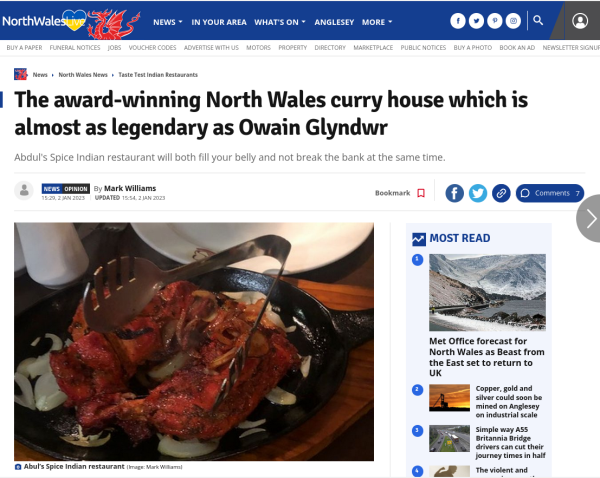
    However, this has not stopped both Wales Online and the Daily Post (aka North Wales Live. Ed.), the 2 Reach plc regional news titles covering North and South Wales respectively, from coming up with similar misleading stories (fairy tales surely? Ed.) on today’s pages of their respective ‘news‘ websites. The Daily Post story can be seen here and the Wales Online story here. Note also the use of ‘amid‘ in the Wales Online headline (posts passim).

    Headline reads Hurricane Ian LIVE updates as US storm fall out hits North Wales with gale-force winds and downpours
    Which hurricane, Daily Post?
    Headline reads Live updates as rain and wind set to hit Wales amid expected Hurricane Ian fallout
    Same question to you, Wales Online.

    If the fourth estate cannot even get the names and locations of extreme weather events correct, what else should they not be trusted about?

  • Fossil fuel mined with weasel words

    Q: when is a land reclamation scheme not a land reclamation scheme?

    A: When it’s actually an open-cast coal mine covering four square kilometres of south Wales.

    Which transports us Merthyr Tydfil and its inappropriately-named Ffos-y-fran Land Reclamation Scheme, which Wikipedia describes as a ‘major opencast coaling operation‘ to the town’s north-east.

    A general view of the Ffos-y-fran open-cast mine
    Ffos-y-fran: open-cast coal mine or proper land reclamation scheme? Image courtesy of Wikimedia Commons.

    The scheme’s operators have this week filed an application to keep mining coal there for a further nine months until June 2023, according to Wales Online, with landscaping of the site completed by December 2024.

    As revealed by the Wales Online article, the main aim of the scheme is the mining of 10 million tonnes of coal.

    In your ‘umble scribe’s opinion, this is not reclamation in either of its definitions, i.e.:

    • the activity of getting useful materials from waste (unless the land itself is regarded as waste. Ed.); or
    • the activity of making land that is under water or is in poor condition suitable for farming or building.

    It is the pure and simple plundering of highly polluting fossil fuels for profit at a time when a climate crisis is occurring due to the past profligacy of homo sapiens – a misnomer if ever there was one – with fossil fuels, to which there is still no end in sight, especially under the less than benign apology for a government of one Mary Elizabeth Truss, which seems committed to continue fossil fuel extraction and shale gas in particular.

Posts navigation