English usage

  • The tannery ghost?

    Wellington Road in St Judes runs along the west bank of the River Frome (aka the Danny in east Bristol. Ed.) offering views of the industrial buildings on the far bank.

    View of J. Scadding & Son's timber yard featuring brick remains of former tannery on the site
    The ghost of building past in the timber yard

    In front of the more modern timber sheds erected by current site occupants J. Scadding & Son, are some older structures of brick and stone, which appear to be nineteenth century industrial buildings. In the 19th century the banks of the Frome were densely crowded with industrial buildings, particularly for processes that required ready access to an abundant supply of water, such as brewers and tanners.

    A quick search through the vintage maps on Bristol City Council’s excellent Know Your Place website reveals that Scadding’s current site was occupied by the Earlsmead Tannery in the late 19th century, whilst Scadding’s website reveals the company only moved to the site in the mid-1950s..

    Late 19th century Earlsmead Tannery
    Site of Scadding’s timber yard in the late 19th century.

    Could those standing walls be Earlsmead Tannery’s remains?

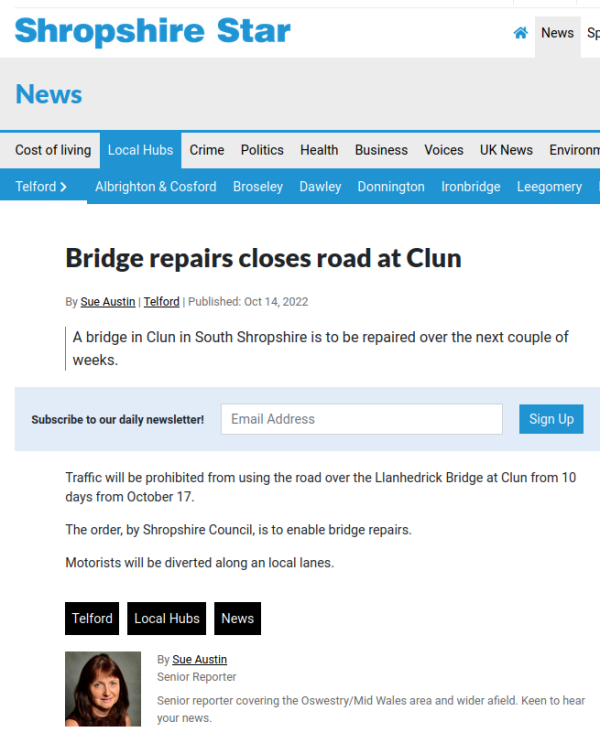
  • Shropshire Star journalist gives up after enigmatic byline

    The screenshot below is the full extent of an article* which has appeared this morning on on the Shropshire Star website.

    Headline reads Aldi seeks go-ahead for signs at new Shrewsbury store
    You’ve got the headline, what more do you want?

    Given the modern journalistic tendency of trying squeeze the whole story into the headline, perhaps there was no need to write much more than a tokenistic byline, concerning which your ‘umble scribe would be most grateful if any readers knowing what the gfgfgfg byline signifies could offer their thoughts in the comments below. Thanks! 😀

    * = The article has since been removed.

  • Surveillance for corporate profit

    Automatic Number Plate Recognition (ANPR) surveillance seems to be on the rise since your ‘umble scribe first reported on its use by B&NES for access control to the council’s rubbish tips recycling centres some years ago.

    It’s now being used by parking management companies to catch drivers who overstay their welcome in private car parks, as shown by the example below spotted in central Bristol today outside the snappily named Double Tree by Hilton hotel on Redcliffe Way.

    Sign warning of use of ANPR to control car park use
    Somebody’s watching you…
    The hotel car park in question is ‘managed’ by Smart Parking, whose website boasts the company is ‘Reinventing the Parking Experience’. The manner in which Smart Parking is ‘reinventing’ parking (minus the experience. Ed.) can best be described by your correspondent as ‘Orwellian‘.

    The adjective Orwellian is no exaggeration if one peruses the company’s marketing brochure to glean how ANPR is used. It states:

    Smart Parking’s automatic number plate recognition (ANPR) / license plate recognition (LPR) parking system is a simple, efficient and cost-effective way of off-street car park management.
    Cameras placed at entry and exit points take a timed photo of the number plate of each vehicle entering and exiting the premises. Customers then simply pay and walk, using their license place as identification. We can also configure sites to have validated parking which can include permit only, staff only, free limited time parking and definable grace periods, to name a few.
    As with our other solutions, SmartANPR/LPR work with the SmartCloud platform to deliver occupancy, stay rates and enforcement efficiency reporting for car park management and future planning.

    Note the American English usage of license.

    Of course, for any users who outstay their welcome, the company wants to make a profit with its penalty charges (note to any passing journalists, despite your constantly referring to these charges in your copy as ‘fines‘, they are in fact invoices; only the judicial authorities can impose fines. 😀 Ed.) and so needs to obtain details of the vehicle’s keeper from the DVLA. The DVLA is more than willing to divulge this information for a fee, as confirmed by the answer to a Freedom of Information Act request from 2012.

    The law allows the DVLA to disclose vehicle keeper information to those who can demonstrate a reasonable cause for requiring it. Reasonable cause is not defined in legislation but the Government’s policy is that it should relate to the vehicle or its use, following incidents where there may be liability on the part of the driver.

    The DVLA also charges a fee for the disclosure of this information, as the response further clarifies:

    The fees levied by the DVLA for Fee Paying Enquiries are set to recover the costs of processing requests and ensure that the cost is borne by the requester and not passed onto the taxpayer.

    Even so, the agency has fallen foul of the Information Commissioner’s Office for “not using the correct lawful basis to disclose vehicle keeper information“, as The Guardian reported a few months ago.

    Your correspondent feels an urge to submit another FoI request for the DVLA to enquire about the amount of money received by the agency for this service, but has more than a suspicion such a request would be refused on the grounds of commercial confidentiality.

  • Enforcement notices – a tale of two cities

    Staying in Glasgow for a few days for my niece’s wedding, your correspondent cannot help comparing and contrasting the differences between how Glasgow and Bristol City Councils set about tackling the public nuisance and environmental crime of fly-tipping, particularly as regards the use of public notices for enforcement and dissuasion.

    Exhibit A: the public notices used by Bristol City Council.

    BCC A5 no fly-tipping sign

    This is an A5-sized sign with no redeeming graces, which threatens the maximum possible fine under law of ÂŁ50,000 (no mention of the alter#native maximum penalty of 6 months’ imprisonment or a combination of the two. Ed.). Should anyone feel public -spirited enough to fancy reporting any fly-tipping, the public is directed to the council’s main switchboard number, with no mention of the very convenient option of reporting fly-tipping online.

    Exhibit B: a public notice used by Glasgow City Council, as seen in Holmlea Road.

    A4 sized no fly-tipping sign from Glasgow City Council

    The initial difference is the size of the notice: at least A4 instead of A5, i.e. twice the size. There’s no mention of any maximum penalty, but residents are encouraged to report Dumb Dumpers via a 24-hour 0845 number. 0845 telephone numbers are “business rate numbers” (otherwise known as “non-geographical premium rate phone numbers“, for which the charge for mobile telephones and landlines is “up to 7p and your phone company’s access charge“. The UKPhoneIfo website warns that “charges for dialling 0845 numbers can be significantly higher – up to 41p per minute” when calling from a mobile number and that “when an 0845 number is called, the call recipient receives a small share of the call cost.” This number is a Scotland-wide number for reporting fly-tipping (there’s also a pan-Scottish Dumb Dumpers reporting website too, Ed.), in addition to which Glasgow City Council website also offers online reporting of fly-tipping and other environmental crimes.

    Two more differences to Bristol are apparent: the locations of the council rubbish tips (civic amenity sites) are given in a further attempt to change anti-social behaviour, whilst finally residents are reminded that the state of the neighbourhood is their responsibility, as well as that of the council.

    There are lessons that Bristol City Council could learn from Glasgow, as long as it ditches the not invented here attitude that seems to pervade the corridors of the Counts Louse.

    One final note: even though the city is still being tidied up following the end of the recent Scottish bin collectors’ strike, your correspondent’s overall impression is that the streets of Glasgow are not as filthy as those of Bristol. Whether this is due to belittling and disparaging those who despoil the urban area as Dumb Dumpers has yet to be proven empirically, but is another tactic BCC could try, if so inclined.

  • More poor Reach plc quality control

    Genius (or should that be genious? Ed.) headline writing from today’s Daily Post, alias North Wales Live.

    Is the entire editorial team asleep at their desks?

    Headline reads Ingenius mum shares 57p meals and cooking tips with her 572k followers

    Such a glaring spelling mistake and the obvious lack of quality control remind your ‘umble scribe of a Mark Twain quotation regarding a still extant US newspaper, i.e.

    I think the Cincinnati Enquirer must be edited by children.
  • Bristol Post/Live exclusive: music venue moonlights as property developer

    As a linguist, your ‘umble scribe has, during his working life, always used language as a precision tool. Were using le mot juste can mean the difference between a one-off job or repeat business is confined to linguists is unusual or not, is a matter for conjecture, There are certain other professions where the use of the right vocabulary is vital, particularly in the law and in the field of intellectual property (e.g. trade marks, patents).

    It often does not apply in the world of journalism, where a columnist may be taking a deliberately ambiguous angle.

    This accuracy of language definitely does not apply to the titles of the Reach plc stable of local news titles, including Bristol’s (news)paper of warped record, the Bristol (Evening) Post and the accompanying Bristol Live website.

    As a prime example of this is contained in Thursday’s piece about the redevelopment of Trinity police station.

    Headline reads Trinity Road police station to be redeveloped into 104 flats by music venue

    The headline implies that the as-yet unnamed music venue itself will be building the housing, not some developer who has just realised that, due to the proximity of entertainment, the building bill will now be augmented by the addition of acoustic insulation.

    The police station to be demolished and redeveloped just happens to be over the road from the Trinity Centre, with which your correspondent has a long association (posts passim).

    What is obvious from perusing the article is that the person(s) writing the headline is/are different from the one who write the article. This seems to be standard practice.

    Furthermore, it is also evident that the headline writers do not carefully read what reporters have written, as shown by the latest version of how the story is presented on the paper’s website, with the soon-to-be former cop shop itself transformed a new music venue.

    Headline reads police station to become new music venue

    Sacking all those sub-editors a few years ago to save some money has really paid off in terms of the quality of your ‘journalism’, hasn’t it, Reach plc?

  • Local trees decide it’s autumn

    According to the Woodland Trust, “Horse chestnuts, with their mahogany-bright conkers, are the very essence of autumn.

    Here in inner city BS5, the local horse chestnut trees in the centre of Lawrence Hill roundabout and on Lawrence Hill itself have decided that autumn has come already, judging by their dry and brown falling leaves and general frowzy appearance.

    Horse chestnuts in autumn colours on Lawrence Hill roundabout
    Horse chestnuts in autumn colours on Lawrence Hill roundabout
    Ayutumnal horse chestnuts on Lawrence Hill
    Ditto about a hundred metres from the roundabout

    The horse chestnut is native to the Pindus Mountains mixed forests and Balkan mixed forests of south east Europe; it was first introduced to the UK from those areas then under the administration of the Ottoman Turks in the late 16th century, being widely planted in parks, gardens, streets and on village greens.

    The tree gets its English name of horse chestnut from the scars the leaves leave on the twig when they fall, which resembles an inverted horse shoe with nail holes.

    Besides the children’s game of conkers, conkers are also used horse medicines, as additives in shampoos and as a starch substitute. Chemicals extracted from conkers can be used to treat strains and bruises.

    Just like the local hawthorns are an indicator of the approach of spring for your ‘umble scribe (posts passim), the these horse chestnuts fulfil a similar role for the approach of autumn. Below is a Woodland Trust video of the life of a horse chestnut throughout the year.

  • Welsh language payment machine baffles monoglots

    ,

    Bilingual Welsh/English pay and display signRhyl on the North Wales coast attracts many non-Welsh-speaking visitors to its golden sands (your ‘umble scribe was once a regular visitor there as a child since our Sunday school outings all went there. Ed.) and views of the Liverpool Bay wind farms. However, its council-run car parks have pay and display machines set to Welsh as the default language; and this has been frustrating those who cannot read, speak or understand even basic instructions in Welsh, as yesterday’s Nation Cymru reports.

    According to the article, “Queues developed as non-Welsh speakers struggled to work out how to pay for their parking at Rhyl’s central underground car park near the promenade, which is administered by Denbighshire County Council.

    Furthermore, the council’s machinery also seemed to have difficulty recognising bank debit cards.

    A local with basic Welsh fluency described the experience of one monoglot: “The man stormed off when the machine repeatedly failed to accept his bank card. ‘Why are the instructions only in Welsh. Not many people in Rhyl speak Welsh’.”

    A spokesperson for the local authority defended the default Welsh language option, stating:

    We would like to remind people that there are two other machines available in the Rhyl Central car park and people can use the pay-by-phone smartphone app with location code 804281 as an alternative way of paying.
    Our pay and display machines default to Welsh, but there is a large grey “language button” that people can press to change the language. This is explained on the machines.

    Perhaps grey is not a suitable colour for the language button; perhaps the council need to change this to red and white in the style of the English flag or red, white and blue in the style of the Bloody Butcher’s Apron (which some still call the Union Jack or Union flag. Ed.). 😀

    Update 15/08/22: Monday’s Nation Cymru has yet another story on the inability of users to operate a second parking machine ‘in bloody Welsh’, this time from the other end of the country, Caswell Bay, on the Gower peninsula near Swansea.

Posts navigation