There was a great clanger in a tweet this morning from Bristol’s Western Daily Press, the sister publication of the Bristol Post (and joint occupier with it of Bristol’s Temple Way Ministry of Truth. Ed.) and likewise subject to many of the latter’s failings with the English language.
Here’s an image of the tweet in question.
The morals of this tale are clear: if you run a tawdry TV talent show orthography is as dangerous as shut-eye if housebreakers are around; if you run the social media account of a mediocre regional paper, learn to proof-read before posting online*! 🙂
* The spelling error in the tweet originally appeared in the article itself, but has since been corrected.
A Christmas Market is taking place at St Werburghs Community Centre this coming Friday, 4th December from 5.00 to 8.00 pm.
The Christmas Market is yet another very popular community-led event hosted by St Werburghs Community Centre.
Join us on Friday for a festive feast of all things creative and buy original arts and crafts from the best local artists and makers. There are always plenty of wonderful stalls booked filled with personal, handmade and unique gifts for your family and friends.
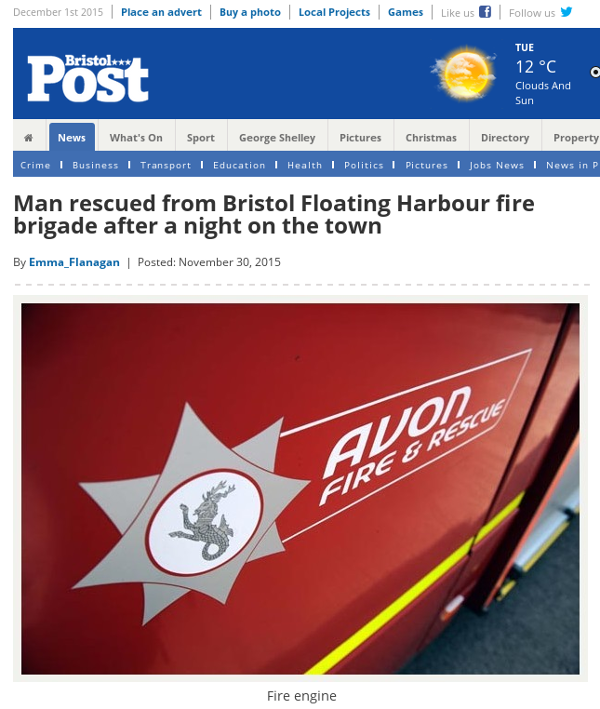
There seem to be times when confusion is rife in the Bristol Post’s headquarters on Temple Way. This was exemplified yesterday by the headline in this report, of which a screenshot follows, just in case Post hacks realise a mistake has been made.
In spite of the headline, Post reporter Emma Flanagan fails to explain in her article why anyone would need rescuing from the fire brigade after a night out.
Furthermore, there is no explanation either for the logic behind Bristol’s City Docks having their own fire brigade.
Perhaps kind readers could help her out and provide plausible reasons in the comments below. 🙂
Yesterday, feeling frustrated with Bristol City Council’s ineptitude at tackling fly-tipping and litter in the city’s Easton and Lawrence Hill wards, despite 18 months’ vigorous campaigning by local residents and ward councillors, I decided to take advantage of Twitter’s poll facility.
The results of the poll are shown below.
That’s right! 90% of respondents believe Hell will freeze over before the local authority gets a grip on fly-tipping.
If anyone spots Satan shopping for ice skates in Broadmead, the Galleries, Cabot Circus, Cribb’s Causeway or any other retail centre in the Bristol area, please provide details using the comments form below. 🙂
At times like this, I’m reminded of the words spoken earlier this year on a Ramadan open day by one of the imams at Al Baseera mosque in St Judes, Bristol said: “a terrorist is someone without religion; he’s just a criminal”.
Hardly a day goes by when the hacks at the Bristol Post exhibit the poor quality of written English so prevalent in the media nowadays; and today is no exception.
Writing about a closure of the A4174 Avon Ring Road and clearly out of his usual field of politics, reporter Ian Onions drops a real clanger which would doubtless have been picked up if the paper still employed proper, old-fashioned, omniscient sub-editors.
Having a shelf life – that’s another first for a bridge!
Shelf life is the length of time that a commodity may be stored without becoming unfit for use, consumption, or sale. In other words, it might refer to whether a commodity should no longer be on a pantry shelf (unfit for use), or just no longer on a supermarket shelf (unfit for sale, but not yet unfit for use). It applies to cosmetics, foods, medical devices, explosives, beverages, pharmaceutical drugs, chemicals, and many other perishable items. In some regions, an advisory best before, mandatory use by, or freshness date is required on packaged perishable foods.
No sign of a bridge in that list of products, unless it’s covered by “perishable items“. 🙂
The term for which Mr Onions was grasping was clearly “service life“, whose definition is once again supplied succinctly by Wikipedia.
A product’s service life is its expected lifetime, or the acceptable period of use in service. It is the time that any manufactured item can be expected to be ‘serviceable’ or supported by its manufacturer.
However, since the reports headline tried to create uncertainty about the length of any road, I reckon the Post’s objective was more concerned with whipping up emotions amongst its predominantly car-obsessed readership than with accuracy in use of the written word.
If one only read the Bristol Post, there’d be no way that residents in the wider city would have any inkling that three polluting standby electricity generating stations were currently awaiting planning permission in the European Capital of Greenwash.
Fortunately, this dreadful development has been picked up by Bristol 24/7: and here’s the unsurprising bit; they are all in the more deprived parts of the city.
It is believed these power plants will form part of the Short Term Operating Reserve (Stor) network of reserve power banks which provide additional generating capacity to feed into the National Grid at peak times.
Firstly, a planning application (ref. 15/02310/F) has been submitted on behalf of Plutus Energy for a 48 unit diesel generating plant and 2 diesel storage tanks with a capacity of 22,000 litres for 6 Feeder Road, Bristol and Avonbank, Feeder Road, Bristol, (both in the deprived Lawrence Hill ward. Ed.) close to St Philips Marsh School.
Forty-eight diesel generators will doubtless chuck out a fair old quantity of particulates, which is a component of air pollution implicated in human cancer,heart and lung damage, and mental functioning.
The applicants have not conducted an environmental impact assessment for the site since its small size (0.5 ha) is below the threshold for such a requirement. Nevertheless, local ward councillors believe such an assessment should be carried out due to the size and impact of the proposed development.
In addition, some skulduggery is evident in the noise impact assessment that has been carried out. Edward Road was chosen for the noise impact, significantly further away from the site than St Philips Marsh School. Again, local councillors think this study should be reviewed and amended to include the impact on the school and the nearby Severn Vineyard Church.
A diesel generating plant somewhere in Africa
Despite the fact that inner city Bristol already has dreadful air quality, this is not the only dirty diesel generating plant planned for the city.
An application (ref. 15/04297/F) for another such facility has been submitted for Romney Avenue in Lockleaze, another of the city’s not so prosperous areas. Once again the applicants are Plutus Energy, who want to put 32 generators on this site close to a major housing estate and obviously care very little indeed for Bristol’s air quality.
Finally, yet another application (ref. 15/04420/F) has been filed by UK Power Reserve for 10 diesel or gas generators for in in New Gatton Road in St Werburgh’s, with ten 12-metre high exhaust flues.
Below is a short video on the St Werburgh’s scheme made by local residents.
It’s quite scandalous that UK Power Reserve and Plutus Energy are even considering putting polluting power stations in or next to residential areas. On account of the need for extra domestic heating and lighting, these back-up power stations are most likely to be used on cold, foggy winter days when something called a temperature inversion occurs; this causes cold air to sink, trapping the warm air in a bubble enveloping the city, thus enabling urban pollution to build up to dangerous levels, perfect for increasing the incidence of respiratory ailments. The fact that both companies have cut corners in the form of environmental and noise impact assessments shouldn’t be forgotten.
These dangerous unwelcome schemes should be thrown out by councillors.
Finally, a language note. Over in the United States of America, this dumping of dirty, polluting and generally unwelcome facilities on poor, deprived communities has a name – environmental racism. In Wikipedia, environmental racism is defined as follows:
Environmental racism is placement of low-income or minority communities in proximity of environmentally hazardous or degraded environments, such as toxic waste, pollution and urban decay.
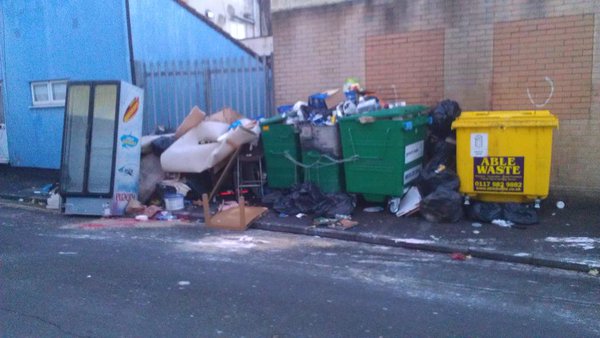
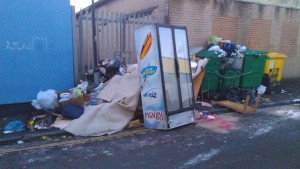
I am indebted to my friend Julien Weston for the images below of yesterday’s fly-tipping on Jane Street, a notorious fly-tipping hotspot just off Church Road in the Redfield area of Bristol (posts passim).
After 18 months of the Tidy BS5 campaign (both formally with UP Our Street and informally with residents acting on their own initiative. Ed.) to tackle litter and fly-tipping in Bristol’s Easton and Lawrence Hill wards, the cleanliness of the city’s streets doesn’t seem to be getting any better. Indeed it seems to be getting worse.
Furthermore, statistics released by central government recently reveal that Bristol is the filthiest of the West Country local authorities when it comes to fly-tipping. Fly-tipping reported to the four unitary authorities that comprise the former Avon County Council area during the 2014-15 financial year are as follows:
B&NES – 530;
South Gloucestershire – 1,359;
North Somerset – 2,343;
Bristol – 9,709.
Jane Street and the rest of Easton and Lawrence Hill wards are part of the Ashley, Easton & Lawrence Hill Neighbourhood Partnership. According to the city council’s website the Neighbourhood Partnership (NP) has the following purpose:
The Neighbourhood Partnership (NP) is about residents working with the Council to influence decisions. Its aim is to use local knowledge to make better decisions about what needs doing. It also has a small budget to spend on local improvements.
At the last NP meeting on Monday, 5th October 2015, the report of the Neighbourhood Partnership Co-ordinator promised the following change in the Area Action Plan in respect of Lawrence Hill/Church Road corridor where Jane Street is situated:
Increase responses to the ongoing problems of fly-tipping in Lawrence Hill, mainly Jane Street, Morton Street, Thomas Street, Ducie Road Car Park and Lawrence Hill.
The evidence of one’s eyes reveals that if there has been any increase in the local authority’s response, it must be starting from a very low, if not to say, almost non-existent base.
The fact that Bristol City Council allows this level of filth during its year as European Green Capital – and is seemingly helpless or hapless in tackling it – is an eloquent indictment of its treatment of its less prosperous wards like Lawrence Hill and Easton.
According to the European Green Capital website, the justification behind the establishment of the European Green Capital award is that:
Urban areas concentrate most of the environmental challenges facing our society but also bring together commitment and innovation to resolve them. The European Green Capital Award has been conceived to promote and reward these efforts.
If Bristol is prepared continually to tolerate the “environmental challenge” of high levels of persistent fly-tipping in its less prosperous districts, as well as lacking the commitment and innovation to resolve them, then I believe the city was awarded the European Green Capital accolade on false pretences.
Litter and fly-tipping are not only unpleasant to look at and live with day after day, they’re a hazard to health – both physical and mental.
Come on Bristol City Council, get your finger out and let’s not just have a tidy BS5, but a tidy city generally! Let’s see if you’re really prepared to deal with this serious level of environmental crime or are just going to carry on making placatory noises to angry residents who despair at your inability and inaction.
Footnote: my opinion of Bristol City Council’s ability and motivation to get to grips with environmental crime in Lawrence Hill and Easton has not been improved by the fact that I have reported 16 instances of fly-tipping – matching my highest daily count to date – to the local authority today. Help lighten my load by reporting fly-tipping too!
Most active citizens become active after frowning and tut-tutting about problems in their communities, but there’s only so much scowling and muttering that can be done: action ultimately needs to be taken; and that starts with a smile. These East Bristol residents tell you how.
Up Our Street has also produced an active citizenship toolkit. To get one please give them a ring on 0117 954 2834.




 Hardly a day goes by when the hacks at the Bristol Post exhibit the poor quality of written English so prevalent in the media nowadays; and today is no exception.