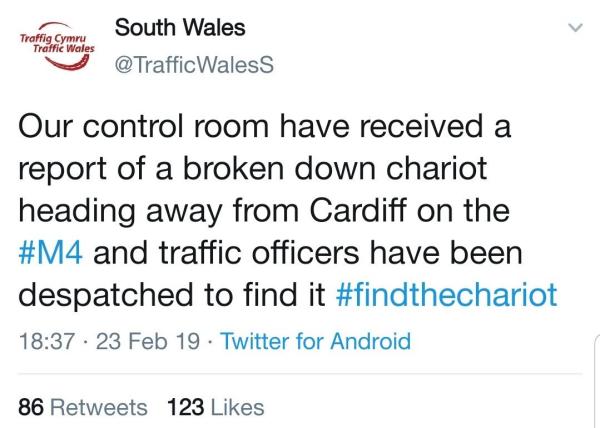
After Wales’ 21-13 decisive victory in yesterday’s Six Nations rugby fixture in Cardiff, Traffig Cymru, the Welsh Government’s traffic information service, couldn’t resist having a bit of fun on Twitter at the expense of the England squad and English rugby fans.
Swing low…
I wonder if the chariot had been rescued by a band of angels before Mr Plod had a chance to find it… 😀
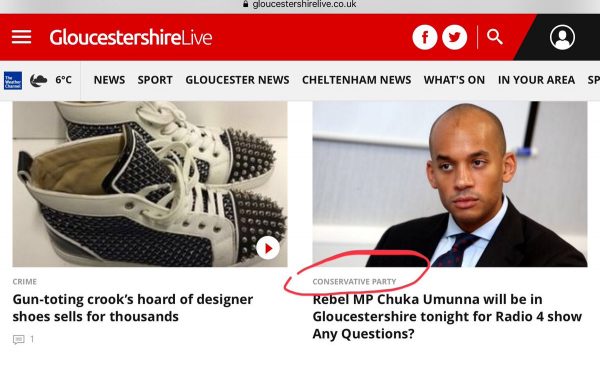
Gloucestershire Live is a sister title of the Bristol Post/Bristol Live and as such provides a similar mediocre quality of journalism to its victims readers.
My Gloucestershire friends have this morning confirmed via social media that as far as the governance of the county is concerned, politics inevitably equals the Conservatives and the Blue Team dominate what is effectively a de facto one-party state.
A spot of conning anyone?Recent delvings into the history of Market Drayton’s court leet (posts passim) have taught me of the duties of the officers of that ancient manorial court; and the more researching I’ve done, the more has come to light.
The duties of one officer in particular caught my attention: the ale-conner.
Further news of that officer’s duties at Drayton’s Dirty Fair comes from a surprising source – the 30th December 1911 edition of The Corrector. This was a newspaper that used to be published in the 19th and early 20th century in Sag Harbor on Long Island in New York State.
At the bottom of page 3, in E.J. Edwards’ New News of Yesterday column, the following piece entitled Tasting The Drinks appears:
An old custom has just been observed at Market Drayton, where the annual fair, called “the Dirty Fair,” has been opened by the Court Leet. A proclamation, it is reported, was read by the “Ale-Canner,” who warned “all rogues. vagabonds, cut-purses, and idle men immediately to depart from this fair.”
“Ale-Canner” has a jovial smack about it, but we are afraid it is a misprint for “Ale-Conner,” an ancient and honorable officer, both of manors and corporations, His duty was to taste the new brew of every “brewer and brewster, cook. and pie-baker.” and if it were unfit to drink the whole was confiscated and given to the poor.
It should be added that in the middle ages “unfit to drink” usually meant weak and watery. The chemist was not abroad in those benighted days, so there was no risk of arsenical by-products being present in the pottle-pot.
Besides testing beer and the measures in which it was sold, the ale-conner also ensured the goodness and wholesomeness of bread, plus the measures in which it too was sold.
If this report is to be believed, it was therefore the ale-conner’s duty to declare the Dirty Fair open in times gone by, in addition to his public health duties in the days before the various improvements in ensuring the health of the public brought about by our 19th century forebears.
Conner is an interesting noun as regards its origins. Nowadays we are all familiar with the noun con, which is short for confidence trick. However, thinking there is any connection between the two would be erroneous. There’s also a conning tower on a submarine, but its origins have more to do with conning in the sense of navigating a vessel.
To find the conner’s origins one has to go back to many hundreds of years. According to Merriam Webster, its origins are indeed in Middle English, as would befit an office established in a medieval court. In Middle English, the noun was cunnere, meaning an examiner or tempter, which was derived from the Middle English verb cunnian, to examine, which itself originates from the Old English verb cunnan, meaning to be able.
Finally, ale-conner was sometimes also rendered as aleconner or even ale-kenner.
Following on from my post on the markets and fairs of Market Drayton (posts passim), my home town, the following comment was left on the site by Andrew Allen long after comments on the post itself were closed.
Andrew also grew up in Market Drayton somewhat later than myself and my siblings and his words are reproduced below.
I was born and brought up in MD and for some reason I just had a flashback of the Court Leet which I recall being re-enacted when I was a child in the late 1970s.
It was great to read your notes about the Court. We have a photo at home (my mother’s) of a load of gentlemen standing outside the Corbet in their finery, I guess around 1900… it has my grandfather in the shot… I now think that must have been the Court Leet.
Anyway, thanks for your notes.
Courts Leet were a very old institution. According to Wikipedia, “The court leet was a historical court baron (a manorial court) of England and Wales and Ireland that exercised the “view of frankpledge” and its attendant police jurisdiction“.
My original source for information of Market Drayton’s Court Leet – Peter Hampson Ditchfield’s 1896 book, Old English Customs Extant at the Present Time: an account of local observances – states the following:
At Market Drayton there are several fairs held by right of ancient charter. One great one, called the “Dirty Fair,” is held about six weeks before Christmas, and another is called the “Gorby Market,” at which farm-servants are hired. These are proclaimed according to ancient usage by the ringing of the church-bell, and the court-leet procession marches through the town, headed by the host of the “Corbet Arms”, representing the lord of the manor, dressed in red and black robes, and the rest of the court carrying silver-headed staves and pikes, one of which is mounted by a large elephant and castle. At the court several officers are appointed, such as the ale-conner, scavengers, and others. The old standard measures, made of beautiful bell-metal, are produced, and a shrew’s bridle, and then there is a dinner and a torchlight procession.
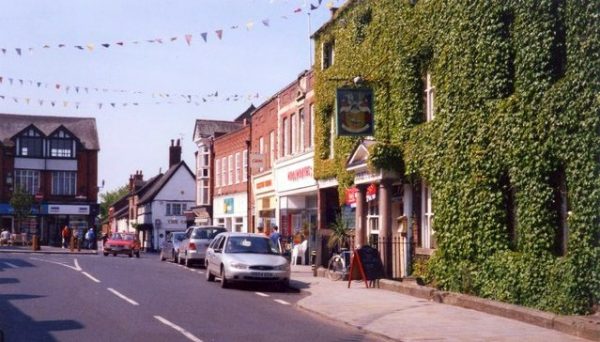
High Street Market Drayton with the Corbet Arms Hotel on the right. Image courtesy of Wikimedia Commons.
Only two officers of the court are mentioned by Ditchfield – the ale-conner and scavengers. The ale-conner’s duties were to ensure the quality of ale and to check that true measures are used. The duties of scavengers were to ensure standards of hygiene within the lanes and privies and to try and prevent the spread of infectious disease.
The ceremony Andrew remembers seeing as a youngster in the late 70s was a one-off re-enactment in 1977 for the Queen’s Silver Jubilee. The Shropshire Star sent a photographer to record the event. The paper’s record of the celebrations, including the court leet re-enactment is still available online. As regards photographs of the original court leet, the Shropshire Archives collection contains 3 photographs of the court leet, all dating from the first decade of the twentieth century. According to the National Archives, the Shropshire Archives also contain a printed menu from 1936 for the Market Drayton Tradesmen’s Association dinner held at the Corbet Arms Hotel after Drayton Manor Court Leet broadcast. So it seems the court leet may have survived in some form until the mid-1930s.
Many thanks to Andrew for getting in touch and sharing his memories.
If anyone has further knowledge of which other officers constituted the Court Leet, please use the comments below or the contact form.
The right-wing Telegraph newspaper has enjoyed a long and close relationship with the Conservative Party. So close indeed that it is often referred to as the Torygraph.
This close relationship means that developments within the Tory Party are frequently reported first in the Telegraph.
It is therefore no surprise that the latest developments on the state of the UK’s Brexit negotiations popped into my Twitter feed this morning with the following Telegraph headline and abstract.
Yes, that’s why the negotiations have been so disastrous. They’ve been handled by ducks, or more specifically a Eurasian teal, a male specimen of which is shown below.
A top international negotiator according to the Telegraph. Photograph courtesy of Wikimedia Commons.
How a duck or ducks actually managed to deal with the question of the Irish backstop remains a mystery and is probably why the Tory right wing is so obsessed with it. And quite what a revamped negotiating teal is, one could indulge in conjecture. Was it taken to some backstreet ornithologist and given the plumage of, say, an Arctic skua, together with a bit of beak remodelling?
If there’s one thing that can be said about language, it’s that it’s dynamic. Blink for a second and you might miss the coining of a neologism or an old turn of phrase becoming obsolete.
The latter in particular can have amusing consequences, especially if re-used by someone possibly too young to appreciate the original connotations of the word or phrase.
One such most likely occurred today in a Bristol Post piece about free travel in the Bristol area on Unibus services.
The item’s second paragraph reads as follows:
Passengers will able to hop on the Unibus U2 service, from Monday February 18 until Friday, February 22 without spending a penny.
To someone of my age (rapidly approaching where I qualify for a pass for free bus travel. Ed.), the phrase has connotations other than obtaining buckshee travel.
If someone says that they are going to spend a penny, they mean that they are going to go to the toilet. [British, old-fashioned, politeness]
The origins of the phrase stretch back to the Victorian era and refer to the use of coin-operated locks on public toilets in the UK. Such locks were first used in a public toilet outside London’s Royal Exchange in the 1850s.
The phrase “to spend a penny” has now largely died out and been forgotten, except by those with greying hair, due to changes to public toilets themselves (many of which have been closed by austerity-hit local authorities. Ed.) and changes in the charges to use a toilet. Last time I looked while on my travels, the toilets at Manchester Victoria railway station cost an exorbitant 20p, i.e. 4 shillings or 48 times the original cost of one penny.
Via Twitter, the following image arrived in my timeline this morning. It’s a below the piece comment, ostensibly from someone called DAZ21, from the mobile version of the Daily Mail website.
As you can see, at the top of the comment DAZ21 would like us all to think he’s from the fair English county town of Northampton.
However, there are a couple of problems with locating dear ole DAZ21 there if one examines the text of the comment closely; and the vowels in particular.
Look first near the bottom of the comment. Is that a letter “a” with diaresis (ä), I see before me?
The letter “a” with diaresis is quite common in German (as in Käse – cheese. Ed.), but not in English.
However, there’s a real clincher in the text that shows DAZ21 is more likely to hail from Novosibirsk than Northampton: and once again it’s a vowel that gives the game away, namely the “i” with diaresis “ï“).
According to Wikipedia, “Yi (Ї ї; italics: Її) is a letter appearing the Cyrillic script, as used by Russian, amongst other languages.
In English this is a very uncommon character and is used when ⟨i⟩ follows another vowel and indicates hiatus (diaeresis) in the pronunciation of such a word.
There have been questions about the reliability of the the Daily Mail for decades. Last year it was banned as a source by Wikipedia due to its “reputation for poor fact checking and sensationalism“.
One wonders how much further that reputation has slumped if its below the piece comments are now full of bots or actual Russians pretending to be Brits posting provocative and/or misleading content.
By the way, Novosibirsk is Russia’s third most populous city after Moscow and St Petersburg.
The BBC has long boasted of the quality of its English.
However, its reputation fort linguistic excellence has started to look very tarnished in recent years. One particular area of concern is the BBC’s failure to use the correct terminology when referring to those who work with languages (posts passim).
Since I first wrote about this seven years ago, very little seems to have changed, as shown today by a news story posted today by a reporter with BBC Newcastle concerning the quality of language services provided to the police and courts by ITL North East Ltd. of Gateshead.
It starts off on the wrong foot, with the headline proclaiming: “Translators were ‘not qualified’ for police interview work“.
Translators don’t do interview work, said my mind, unless they’re working from transcripts!
The first paragraph, however, manages to get the terminology correct:
Unqualified police interpreters have cost the public thousands of pounds by causing court delays and in one instance the collapse of a case, the BBC has learned*.
The error in the headline in repeated further down the piece, as follows:
In addition to Northumbria Police, it provided translators for interviews with the Durham and Cleveland forces.
As regards the quality of the interpreters provided the piece details several cases where unqualified interpreters had caused trials to collapse and unnecessary expenditure to be incurred. For instance, one so-called interpreter couldn’t explain the police caution in full to a suspect.
In another instance, an “interpreter” who had just been in the country for 3 months before being recruited. She freely admitted not being able to understand everything a police officer said in an interview with a suspect.
Since the evidence of poor quality work came to light, Northumbria Police requested a full audit of the qualifications held by all interpreters registered with ITL North East Ltd.
The BBC should follow Northumbria Police’s example and audit the liguistic abilities of their reporters.
For those reporters who still don’t understand the difference between translators and interprwters, I would refer them once again to my handy illustrated guide from 2013 (posts passim).
* = As regards the phrase “the BBC has learnt…”, it has been pointed on social media out that this story was first broken the satirical magazine Private Eye over a year ago. Do keep up Auntie!
One thing is certain about life in Bristol: it’s quite unlike living anywhere else and can sometimes be well beyond the borders of the surreal.
This feeling is enhanced by reading the Bristol Post, city’s newspaper of (warped) record.
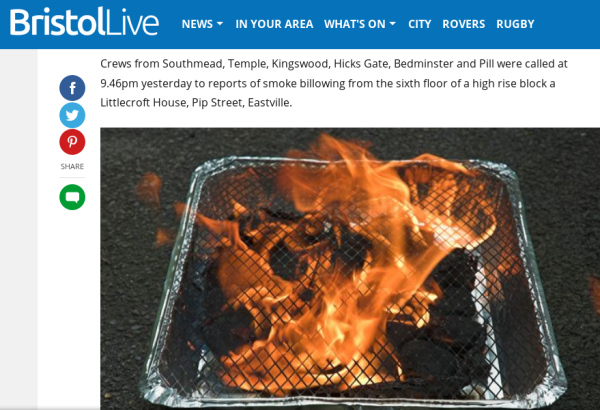
Just skimming casually through the Post website, readers may easily miss some real exclusives, such as this fire brigade incident reported yesterday by Heather Pickstock, who is alleged to be the paper’s North Somerset reporter.
As shown in the screenshot above, Ms Pickstock informs readers as follows in this fine piece of creative writing:
Crews from Southmead, Temple, Kingswood, Hicks Gate, Bedminster and Pill were called at 9.46pm yesterday to reports of smoke billowing from the sixth floor of a high rise block a Littlecroft House, Pip Street, Eastville.
There’s just one thing wrong with the above sentence: it’s completely incorrect; there’s no Pip Street in Eastville and no high rise block called Littlecroft House either.
A research technique known to ordinary mortals, but not to Ms Pickstock, affectionately known as “5 minutes’ Googling” reveals there’s a a council tower block called Little Cross House in Phipps Street, Southville, a good four miles across the city from Eastville.
The Bristol area can breathe a sigh of relief that Ms Pickstock does not work as a call handler on the 999 emergency switchboard. 😉



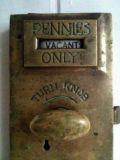 The origins of the phrase stretch back to the Victorian era and refer to the use of coin-operated locks on public toilets in the UK. Such locks were first used in a public toilet outside London’s Royal Exchange in the 1850s.