English usage

  • Introducing the Stockholm

    In the world of metrology there are standardised and internationally-recognised units of measurement such as the metre for linear distance, gram for weight and litre for liquid measurement.

    In everyday life there are also informal units of measurement used by people to give or gain an idea of the magnitude of a particular phenomenon.

    In terms of surface area, for instance, there’s the football pitch. Imperial Tobacco, my employers many years ago, used to like to boast that the cigarette production hall at W.D. & H.O. Wills’ factory in Hartcliffe, Bristol, (once the largest cigarette factory in Europe. Ed.) had an unobstructed floor area, i.e. free of the pillars supporting the roof structure, equivalent to three football pitches. Another common measurement for surface area is the Wales, particularly for larger items than football pitches.

    Also in common use for informal metrics are the double-decker bus and cricket pitch, both for linear distance.

    This plethora of informal measurements has now been joined by a newcomer, the Stockholm, courtesy of the Bristol Post, the city’s newspaper of warped record.

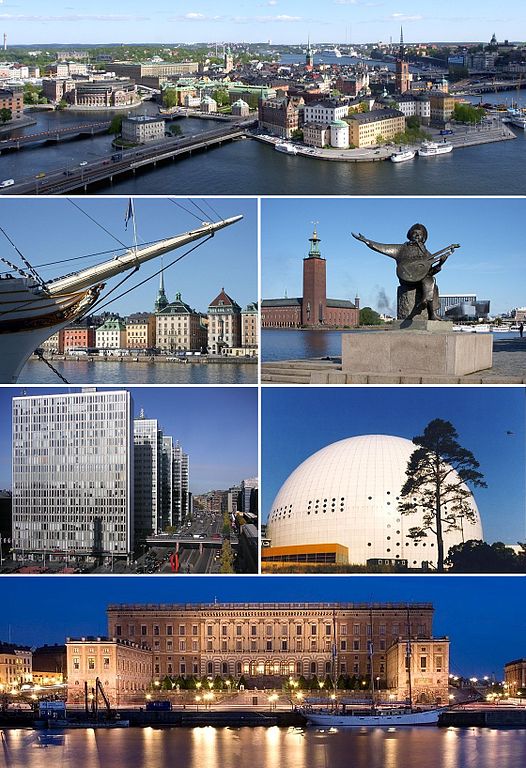
    Stockholm city views
    Stockholm: once just the capital city of Sweden, now a unit of measurement. Image courtesy of Wikimedia Commons.

    Reporting yesterday on the shameful fact that Bristol, in spite of its huge housing crisis, now has 5,785 empty homes in the city, the Post then goes on to introduce Sweden’s capital as a new unit of measurement specifically for vacant homes, stating:

    Nationally, there are now just short of a million (980,565) properties deemed uninhabited – about the same amount as the entire housing stock of Stockholm.

    There you have it.

    Finally, a word of caution, under no circumstances should the Stockholm as a measurement of empty homes ever be compared with so-called Stockholm syndrome, a psychological condition in which hostages develop a psychological alliance with their captors as a survival strategy during captivity.

    If readers do happen to come across any further undocumented units of measurement, please alert your ‘umble scribe via the comments below.

  • Littered with innuendo

    Yesterday’s Bristol Post reported on the first month of operation of what it’s dubbed the “litter police”, the private contractors brought in by Bristol City Council to take enforcement action on such environmental crimes as dropping cigarette ends, littering, failing to clear up the mess of one’s dog, tagging and spitting.

    They’ve had a busy first month, issuing 1,368 fixed penalty notices with a total value of nearly £70,000.

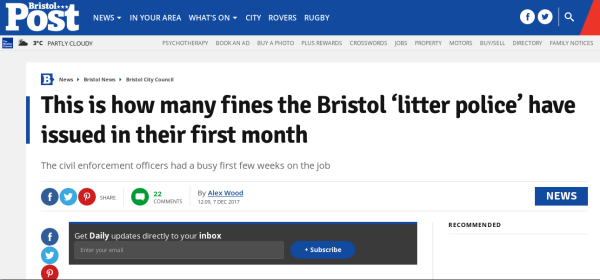
    Whilst this long overdue enhanced enforcement against the untidy is welcome (as a founder of Tidy BS5 I wholeheartedly support their engagement by BCC. Ed.), it’s not the numbers that interest me, but the Post’s choice of language, particularly at the top of the article, which is reproduced below.

    sub-heading under headline reads the civil enforcement officers had a busy first few weeks on the job

    Look between the headline and the byline and you’ll see the following sentence: “The civil enforcement officers had a busy first few weeks on the job“.

    All you Brits can stop sniggering.

    Now!

    On the job” in the sense of something related to work is, to the best of my knowledge, an import from American English that has in recent decades started appearing increasingly in British corporate jargon. During my youth over 4 decades ago, the phrase had only one meaning and that had salacious connotations.

    Collins Dictionary gives the following definitions for the phrase in British English:

    • actively engaged in one’s employment;
    • (taboo) engaged in sexual intercourse.

    As regards the first definition, this could cover tuition given during employment (e.g. on the job training): no further explanation is required for the second.

  • “Brexity”

    Today’s Times has discovered a new word being used by younger people in the UK, i.e. “Brexity“.

    It turns up in a comment piece by Janice Turner admonishing those outward-looking folk who voted to remain in the EU in that disastrous referendum for continuing to criticise the isolationist Little Englanders who voted to undo 4 decades of European integration and dragging a partly reluctant UK into a more modern era.

    Ms Turner’s piece gives a couple of examples of the usage of “Brexity“. For instance, concerning places: “It was this horrible Brexity little town“; and food: “He ate this disgusting Brexity pasty“.

    According to Ms Turner, it denotes something low-grade, provincial, unsophisticated; enjoyed or frequented by the old, the white working class.

    Brexit Monstrosity float in Manchester
    Brexit Monstrosity float in Manchester. Image by Robert Mandel courtesy of Wikimedia Commons.

    Commenting on a reference to the Times comment piece, Twitter user Fish in a hat has pointed out the following:

    I understand it is now coined freely in youth slang to mean trashy & tawdry. The young have a good eye, but are cruel. OTOH it is their future that is being trashed & were denied a vote. They have the right to complain. I am sure they will rejoin as soon as they are old enough to.

    Quite. Those under 18 have even greater grounds for being upset as they were denied a vote in the referendum, unlike the 2014 Scottish independence referendum when all Scots over 16 years of age were given a say.

    Getting rather old and coming from white working class stock, your correspondent hopes his readers won’t find him and his attitudes too Brexity. 😀

  • Sexy shellfish?

    Many press organisations have sacked sub-editors and dispensed with proofreading in recent years as a means of saving money.

    Alabama’s Times Daily in the USA seems to have been part of this movement, as is apparent from the following photo of its front page today on the unfolding story of former Alabama state judge and Republican politician Roy Moore‘s past sexual indiscretions.

    Headline reads party divided over sex clams

    If one were dining out, what would be the right wine to accompany sex clams? 😉

    Hat tip: Dr Ray Schestowitz.

  • Fork handles

    Last weekend once again saw your ‘umble scribe and his friend André helping out (posts passim) with the 2 major elements – bonfire and fireworks respectively – of the Trinity Centre‘s Bonfire Night event, which was recast this year as a “Festival of Light“.

    While setting up, André showed me one of the fireworks he would be setting off. It’s shown in the picture below.

    Label on firework reads Fork Handles

    As he remarked at the time, it’s good to know firework manufacturers have a sense of humour, let alone one that harks back to a classic of British TV comedy dating from 1976 originally written by one Gerald Wiley.

    Once again, my thanks to the good folks at Trinity for a great event.

  • Modern oxymoron in East Bristol

    Spotted on Devon House in Whitehall Road, Bristol, this morning.

    Sign in photo reads Supported Independence, Devon House

    This fine old building, which has a Georgian core, is currently being refurbished for some sort of supported or sheltered housing scheme.

    However, whoever thought up the “Supported Independence” text on the sign doesn’t really understand English and probably couldn’t even begin to say what constitutes an oxymoron, i.e. an epigrammatic effect, by which contradictory terms are used in conjunction. .

    Dictionary.com defines independence as follows (NB: emphasis added):

    1. Also, independency. the state or quality of being independent.

    2. freedom from the control, influence, support, aid, or the like, of others.

    I rest my case.

  • No Welsh please, we’re Great Western Railway

    Earlier this week Wales Online reported that train company Great Western Railway will not have Welsh language announcements or signs on its new class 800 fleet that will be providing services on the Great Western route from South Wales to London Paddington.

    800 Class locomotive in GWR livery
    Class 800 locomotive in GWR livery. Photo courtesy of Wikimedia Commons

    The lack of Welsh language announcements or signs on board was first spotted by Cardiff City Labour councillor and Welsh learner Phil Bale, who raised the matter with Great Western Railway via social media.

    GWR responded to Cllr. Bale as follows:

    I’m afraid we have no plans to have bilingual signage and on-board announcements on these services.

    Diolch yn fawr, GWR!

    The decision was justified by GWR remarking that the trains serve both England and Wales they aren’t a dedicated South Wales Fleet. However, as a patronising nod in the direction of Wales having a distinct language, GWR did point out that it had leaflets available in Welsh, but passengers would have to ask for them first (presumably in English. Ed.).

    In response to GWR’s monoglot policy, Councillor Bales remarked: “For me it shows that Great Western are stuck in the dark ages. We have a Welsh Government target of one million Welsh speakers and there are international transport operators who manage to provide their services in different languages all across Europe.”

    As the trains do serve both countries, one would have thought that providing bilingual announcements and signs would have been a common courtesy to those who speak Welsh; and as for Councillor Bales’ remark about running services in other countries, your correspondent doesn’t believe the travelling public overseas would tolerate the incompetence and sheer bloody-mindedness of GWR.

    GWR’s attitude contrasts sharply with that of fellow train company, Arriva Trains Wales, which also runs services between Wales and England (e.g. from Cardiff Central to Manchester Piccadilly. Ed.). Arriva provides both signs and announcements in both Welsh and English, as well as bilingual ticket machines and timetables, even at English stations.

    Plaid Cymru described GWR’s attitude as “disrespectful“, whilst a Cymdeithas yr Iaith (Welsh Language Society) spokesman said: “Ensuring bilingual signage and announcements on trains in Wales is a matter of basic respect for the Welsh language – there is no excuse not to. The fact GWR have said they don’t intend even to ensure these simple things, and that they’ve missed easy opportunities to do so, shows that they are not a suitable organisation to provide a train service in Wales.

    “The Welsh Government should publish strong language standards in the transport sector so that the Welsh Language Commissioner can force companies like GWR to respect the language.”

    According to the South Wales Argus, a Welsh Language Commission spokesman said: “Great Western’s alleged lack of investment in the Welsh language is a cause for concern.

    “In 2016 the Commissioner submitted a report to the Welsh Government recommending that Welsh language standards should be placed on train companies. The Commissioner continues to work with train companies and others to develop the use of the Welsh language on a voluntary basis, and discusses public concerns with them.”

  • Welsh paperwork rejected by bank in Wales

    Santander logoYesterday’s Wales Online reports that Santander refused to deal with paperwork submitted by a customer… because it was written in Welsh.

    This is in spite of the fact that the bank has a clearly stated Welsh language policy which states:

    We want all of our Welsh speaking customers to feel comfortable using Welsh language in their day to day banking with us and we encourage its use wherever possible. It’s why we support a number of Welsh language initiatives, allowing customers to use Welsh language in conversations with our Welsh speaking colleagues in branch, on our cash machines in Wales and when writing to us.

    This policy was clearly not known to some manager somewhere in England as the bank declined to process membership forms after they were handed in at the bank’s branch in Aberystwyth.

    After their submission in Aberystwyth, the paperwork clearly landed on the desk of a bank official who clearly didn’t speak the language of Hywel Dda, as the forms were subsequently returned to the branch in question with a note which stated: “Please return these documents to your account holder. Unfortunately Santander can only accept these documents written in English.”

    Unfortunately, the paperwork in question was submitted to Santander’s Aberystwyth branch by Cymdeithas yr Iaith Gymraeg (aka the Welsh Language Society).

    Cymdeithas yr Iaith Gymraeg’s rights spokesperson Manon Elin, commented as follows:

    This is another example of a private company refusing to provide a Welsh language service because they’re not required to do so, and that’s completely unacceptable. We must have a language law which ensures that banks have to respect basic rights to use the Welsh language. Unfortunately, the Welsh Government’s plans for new legislation make it less likely that banks will have to comply.

    The vast majority of people have to bank, but there is no means of banking online in Welsh, and we have to fight for other basic services in Welsh.

    The society has also raised the matter with Minister Government Alun Davies challenging him to change the bank’s policy. In a recent white paper, the Minister refused to commit to extending Welsh language rights to the banking sector because of the ‘present economic certainty‘.

    In response to this incident, the bank has commented as follows:

    Santander accepts documentation that we receive in Welsh in line with our Welsh language policy.

    We understand our customers who live in Wales may have various documentation and forms that will be written in Welsh.

    If our policy has not been followed then we apologise for any unintentional upset this matter may have caused. The matter will be reviewed to ensure this does not happen again.

    For your ‘umble scribe the final sentence from Santander can be translated into plain English as: “Oops! We’ve been caught out!” 🙂

  • That Florence speech… in foreign

    It’s a well-known fact that when the Brits go abroad and want to converse with Johnny Foreigner, the most convenient is (for Brits of course) to speak English very s-l-o-w-l-y and very LOUDLY; there’s no need to go through all that tedious process of learning how to have intercourse with the locals in the vernacular.

    Mrs Theresa May, a woman who does very poor Prime Minister impressions, went to Florence in Italy on Thursday to make a speech (posts passim). However, it is unlikely that non-Brits understood it as it was delivered sotto voce.

    As my working life as a linguist has been devoted to improving international understanding, I felt it was my duty to help the EU negotiators understand what Mrs May said and have therefore translated her Florence speech into foreign, as per the screenshot of her opening paragraphs below.

    screenshot of start of May's  Florence speech, converted into upper case in LibreOffice

    To convert May’s speech into foreign was simplicity itself. Indeed it was so simple I don’t know why Theresa’s staff at 10 Downing Street didn’t bother to do it themselves.

    The first stage was to copy the transcript of May’s speech from the government’s website, open a new document in the excellent free and open source LibreOffice productivity suite (other, usually proprietary, office suites are available. Ed.), paste the content from the operating system’s clipboard, then hit Ctrl+A to select all the text, followed by going to the Format menu and selecting Text -> UPPER CASE.

    Job done! I now had a copy of Mrs May’s Florence speech in easily intelligible foreign and one perfect for online use as it is also 100% shouty. 😉

    Your ‘umble scribe’s version in foreign is available to download (PDF) should readers also wish to promote international understanding. 😀

Posts navigation