Bristol

  • #tidyBS5 in the Bristol Post

    This blog has previously highlighted the problem of fly-tipping in the Easton and Lawrence Hill areas of Bristol (posts passim).

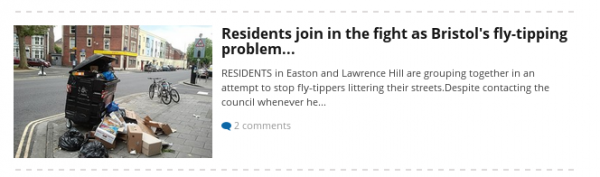
    The move to get more people involved in reporting and combating this menace that blights the inner city took another step forward two days ago when it was featured in the Bristol Post, as shown by the following screenshot.

    Bristol Post article image

    I was contacted by the Post’s Sophie Prideaux and we exchanged emails that went on to form the basis of the article and, as I’m feeling charitable, I’ll even forgive her for changing my surname from plural to singular halfway through the piece. πŸ™‚

    Sophie also contacted my local councillor, Marg Hickman, who’s been a great support from the outset.

    Another purpose of the article was to publicise the #tidyBS5 hashtag, which is being used to highlight the scourge of fly-tipping in the BS5 postal area on social media, such as Twitter.

    As regards Marg’s involvement, the Post states:

    Mrs Hickman, a Labour councillor for Lawrence Hill ward, is urging residents to get behind #tidyBS5, saying it’s an “important initiative to improve the quality of life of residents living in BS5”.

    Read the Post’s report.

  • #tidyBS5 gains momentum

    After the last Easton & Lawrence Hill Neighbourhood Forum meeting where I talked about fly-tipping in my area of Bristol (posts passim), it was suggested to me that I devise a hashtag for use on Twitter and elsewhere to help highlight the problem. My answer was #tidyBS5.

    The hashtag and its use have now been given another boost by publicity in the fortnightly Easton & Lawrence Hill Neighbourhood Management email bulletin.

    image from newsletter featuring tidybs5

    There’s also a meeting with councillors and officers on fly-tipping and rubbish in just over a week’s time to which I’ve also been invited. Let’s hope it ends in some proper enforcement and action to make scenes like the one below a thing of the past.

    image of Stapleton Rd fly-tipping

  • Provided? No, neglected!

    Bristol City Council is a local authority that will seemingly stop at nothing to waste public money blowing its own trumpet.

    On the way back from the shops, this pointless sign by the flats on Easton Road caught my attention.

    sign in overgrown gardens stating provided by caretaking services

    The sign’s wording should be amended in my opinion to read “Neglected by Caretaking Services“.

    Council budgets all around the country are under pressure. In view of these financial constraints, here’s a suggestion for Bristol City Council: stop wasting money on pointless, self-aggrandising signage and you might find funds in the corporation coffers to cut the grass! πŸ™‚

  • Gone!

    As I walked down Midland Road in Bristol’s St Philips area this morning, all that remained of the Ebenezer Chapel (posts passim), East Bristol’s first Primitive Methodist place of worship, was a pile of rubble.

    site of now demolished Ebenezer Chapel

    Built in 1849, the Ebenezer Chapel had been a landmark in East Bristol for 165 years.

    Years of neglect by its owners and one week in the hands of demolition contractors have now ensured it is no more. πŸ™

  • Goodbye Ebenezer

    Despite the best efforts of campaigners (posts passim), east Bristol is losing another part of its dwindling number of buildings of historical interest as the former Ebenezer Chapel in Midland Road in the city’s St Philips area is currently being demolished by its owners, no doubt to make way for yet more soulless ‘apartments’ of zero architectural merit (like much of Bristol’s post-war architecture. Ed.).

    The building itself has had a chequered history: it opened as a Primitive Methodist chapel in 1849. Henry Overton Wills II, from the local tobacco dynasty, laid its foundation stone. It closed as a Methodist chapel in 1938 but reopened as a Christadelphian hall in 1958 after WW2 bomb damage had been repaired. It was converted into business premises in the 1980s.

    Ebenezer Chapel demolition

    I feel that the demolition has been aided and abetted by a gutless local authority which could have stepped in and refused the demolition order. Bristol City Council justified its actions by giving two reasons:

    • the building is not listed; and
    • the building is not in a conservation area.

    The fact that the Ebenezer Chapel was neither listed nor included in the nearby Old Market Conservation Area is indicative of the abject failings of Bristol City Council as a local authority.

    The chapel was the first Primitive Methodist chapel built in Bristol. Surely it deserved listing solely for that single reason?

    Furthermore, unlike the more conventional Gothic style employed for chapel buildings at the time, the Ebenezer Chapel was designed with decorative round arched windows in a very rare bold Romanesque style. This should have been yet another reason for listing.

    Regarding the chapel, Kathy Clark, conservation officer at the Victorian Society has said: “Ebenezer Chapel, or at least its distinctive front wall, should be reused and extended for a new use, whilst preserving a worthy piece of Bristol’s heritage. We urge Bristol Council to work for retention of the chapel.”

    There’ll be no chance of that now that half the front wall has been demolished! πŸ™

    So, I’ll bid a sad farewell to the Ebenezer, as no doubt will the thousands of people that pass it every day, but I will end with a question to Bristol City Council: when will the historical and architectural heritage of east Bristol – traditionally a poorer and less prosperous part of the city – be given equal treatment with its counterpart in Bristol’s better-off districts?

    Perhaps the city council would like to answer that question using the comment form below.

  • Talking rubbish

    One perennial problem in the Easton district of Bristol where I live is fly-tipping, the illegal dumping of waste.

    trade and other waste dumped by communal bin for household waste in Stapleton Road, Easton
    Disgraceful! Trade & other waste dumped by communal bin for household waste in Stapleton Road, Easton

    Some areas – such as Stapleton Road (see above picture) – have persistent problems and last night I gave a short presentation at the latest Easton & Lawrence Hill Neighbourhood Forum meeting to try and encourage other residents and those who work in the area to get involved and make Easton a tidier place.

    I’m pleased to say I received whole-hearted support from local councillor Marg Hickman, who is equally concerned about the amount of litter on the streets (are fly-tipping and littering related; does one attract the other? Ed.).

    Flytipping can be reported online using the council’s dedicated report form. Some people use Twitter to do so too, whilst for those with a smartphone various third party applications are available, such as My Council.

    If anyone does draw attention to fly-tipping or litter on Twitter, you might like to add the hashtag #tidybs5. If you live elsewhere in Bristol you might like to adapt the #tidybs* hashtag, replacing the asterisk with the first figure of your postcode.

    Yesterday I did learn prior to the Neighbourhood Forum meeting that persistence pays off: via an email from the city council I learnt that several traders on Stapleton Road are or have been served with fixed penalty notices for fly-tipping by enforcement officers. It’s a start, but I get the impression that fly-tipping will be as hard to eradicate as a Hammer horror film vampire.

    Bristol will be European Green Capital in 2015. Unless it sorts out fly-tipping and other environmental problems in Easton and the city’s other less prosperous areas (like the plague of flies, dust and other industrial pollution in Avonmouth. Ed.), the accolade should be amended to read European Greenwash Capital.

  • Bristol open data initiative launched

    open data stickersBristol City Council is working with the Future Cities Catapult and the Connected Digital Economy Catapult on a new open data initiative that will help Bristolians improve their city with the help of local authority data.

    The partners are working together to release Bristol civic data sets such as traffic management and land use databases to citizens. The collaboration will support developers to use the data to create new products and services to improve how the city of Bristol works, making it easier to get around, reduce waste, save energy or improve the city’s air quality.

    Once the data sets are made available online in late summer, citizens and businesses will be invited to explore around one hundred data sets, supported by a series of Catapult-run events and competitions. Bristolians will be supported in testing, prototyping and commercialising their ideas.

    Following a successful initial data release, the Catapults and the Council will then create a schedule to release further useful city data sets in consultation with the developer community. The programme’s outcomes will be shared with local authorities, developers and organisations in other UK cities to spread the benefits to the citizens of other cities.

    This post originally appeared on Bristol Wireless.

  • Caption chaos

    Being sloppy is one thing at which the Bristol Post consistently excels and the situation only looks to get worse following the announcement by David Montgomery of Local World – the owners of the Bristol Post – on the future direction of its titles and the role of journalists.

    Today’s most glaring howler features photographs with the wrong captions in this article, as illustrated below.

    incorrectly captioned photo from Bristol Post

    That’s the first locomotive I’ve seen with blonde hair! πŸ˜‰

    The chaos continues with subsequent photographs in the series too.

    incorrectly captioned photo from Bristol Post

    How anyone can confuse a girl with a locomotive is anyone’s guess.

    Is the Post employing visually-impaired journalists?

    We should be told.

  • Use Your Head

    Integrate Bristol is a local charity formed to help with the integration of young people and children who hail from other countries and cultures.

    In addition, Integrate Bristol campaigns against all forms of violence and abuse against women and girls and promote gender equality; it aims to raise awareness of and promote education around these issues through its creative projects.

    One of the forms of abuse Integrate Bristol campaigns against is the practice of female genital mutilation (FGM). Although strictly illegal in the UK, FGM still continues and laws set in place to protect children do not adequately ensure the protection of girls from practising cultures.

    The most recent creative project organised by Integrate Bristol is the #useyourhead video. #useyourhead is the title of the song that launches the next part the campaign by Fahma Mohammed and the young people of Integrate Bristol against FGM. This had its premiΓ¨re on Thursday 26th June at Bristol’s Counts Louse (otherwise known as City Hall by some. Ed.).

    The video was filmed in many locations around Bristol and features some well-known Bristol personalities, such as the gentlemen from my local kebab shop. Also making it through to the final edit are a couple of dubious dance moves from a pair of Bristol’s minor political irritations, but don’t let that put you off enjoying the video. πŸ™‚

    If readers have any concerns regarding FGM, they can call the free 24-hour helpline on 0800 028 3550.

    For more information about the work of Integrate Bristol, see http://integratebristol.org.uk/about/.

    Update 04/07/2014: from @MsMottram on Twitter, news arrives that the video is now featured on the Cosmopolitan website, where it’s described as “our tune of the summer so far“.

  • Art up the Feeder

    In recent years, Bristol has hosted two very successful public arts trails.

    Wow! Gorillas was a project sponsored by Bristol Zoo Gardens in 2011 that displayed 61 decorated life-sized fibreglass gorilla sculptures on the city’s streets. It coincided with the zoo’s 175th anniversary. At the end of the event the sculptures were auctioned off, raising £427,300 for gorilla conservation work and for local Bristol charity Wallace and Gromit’s Grand Appeal.

    2013 saw Gromit Unleashed take to the streets of Bristol. This saw 1.18 million people visiting the Gromit Unleashed trail and associated exhibition over the 10 weeks of the event last summer. Church Road at Lawrence Hill was one of the sites chosen for a Gromit; it hosted one named Lodekka (posts passim) after the fondly remembered Bristol double-decker bus commonly in use when I first moved to the city in the 1970s.

    After these events, the places where any remaining sculptures can be seen on public display can be counted on the fingers of one hand. One gorilla can be seen in North Street, Bedminster and one Gromit adorns the bows of one of the Bristol Ferry Boat Co.’s ferries plying the city docks.

    However, there’s one place where both a gorilla and a Gromit can be seen together – Feeder Road alongside the Feeder Canal, historically an area associated with grime and industry, not art of public view.

    If you look up a couple of hundred yards beyond the traffic lights, you see them.

    sculpture of the roof of Manor Scrap

    Both were bought at the respective charity auctions by Manor Scrap. According to their website, Manor also acquired another gorilla, but this cannot be viewed from the road from what I could see.

    Chatting to Pete, the boss of Manor Scrap recently, I understand that the next sculpture trail to be organised in the city will be based on another Aardman animated character – Sean the Sheep.

    Will Shawn end up down the Feeder too?

Posts navigation