media

  • The Department of Dirty: coming soon to UK government?

    The Open Rights Group has launched the Department of Dirty website to draw attention to the filtering (also known as censorship. Ed.) of internet content by UK ISPs, particularly mobile providers.

    To find out if you can access the Dirty Internet via your mobile, phone your provider’s Department of Dirty customer services. Your mobile phone normally has internet filtering enabled by default.

    • 02 – 0800 977 7337
    • EE – 0844 381 6301
    • Vodafone – 08700 700 191 or 191
    • Three – 0333 300 3333 or 3333
    • Giffgaff Access adult content
  • #tidyBS5 in the Bristol Post

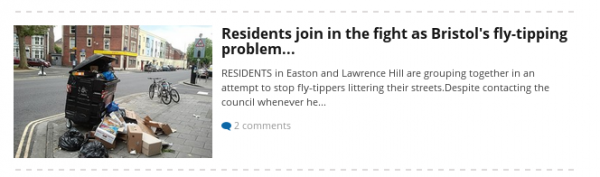
    This blog has previously highlighted the problem of fly-tipping in the Easton and Lawrence Hill areas of Bristol (posts passim).

    The move to get more people involved in reporting and combating this menace that blights the inner city took another step forward two days ago when it was featured in the Bristol Post, as shown by the following screenshot.

    Bristol Post article image

    I was contacted by the Post’s Sophie Prideaux and we exchanged emails that went on to form the basis of the article and, as I’m feeling charitable, I’ll even forgive her for changing my surname from plural to singular halfway through the piece. 🙂

    Sophie also contacted my local councillor, Marg Hickman, who’s been a great support from the outset.

    Another purpose of the article was to publicise the #tidyBS5 hashtag, which is being used to highlight the scourge of fly-tipping in the BS5 postal area on social media, such as Twitter.

    As regards Marg’s involvement, the Post states:

    Mrs Hickman, a Labour councillor for Lawrence Hill ward, is urging residents to get behind #tidyBS5, saying it’s an “important initiative to improve the quality of life of residents living in BS5”.

    Read the Post’s report.

  • Companies House to make all of its digital data available for free

    Yesterday, while David Cameron was rearranging the deckchairs on his governmental re-enactment of the SS Titanic, one significant piece of news (apart from the DRIP Bill. Ed.) seems to have escaped the personality-obsessed British media.

    open data stickersThe news was the Department for Business, Innovation and Skills announced that Companies House is to make all of its digital data available free of charge. It has hitherto charged users for anything but the most basic company information on its website.

    This will make the UK the first country to establish a truly open register of business information.

    As a result, it will be easier for members of the public and businesses to research and scrutinise the activities and ownership of companies and their directors. Last year (2013/14), users searching the Companies House website spent ÂŁ8.7 million accessing company information on the register.

    The release of company information as open data will also provide opportunities for entrepreneurs to come up with innovative ways of using the information.

    This change will come into effect from the second quarter of 2015 (April – June).

  • Ministerial photo opportunity

    Last Friday, the Bedfordshire News website published a story of a visit by Defence Minister and Tory MP for Ludlow Philip Dunne to the hangars at Cardington, one of the major British sites historically involved in the development of airships.

    From the screenshot below, the visit provided a photo opportunity.

    screenshot featuring group looking like it's been excreted from giant bottom

    The ministerial party looks like it’s been excreted from or is about to be crushed by a giant bottom. Don’t ministers and their civil service minders ever check behind them before smiling for the camera?

  • Caption chaos

    Being sloppy is one thing at which the Bristol Post consistently excels and the situation only looks to get worse following the announcement by David Montgomery of Local World – the owners of the Bristol Post – on the future direction of its titles and the role of journalists.

    Today’s most glaring howler features photographs with the wrong captions in this article, as illustrated below.

    incorrectly captioned photo from Bristol Post

    That’s the first locomotive I’ve seen with blonde hair! 😉

    The chaos continues with subsequent photographs in the series too.

    incorrectly captioned photo from Bristol Post

    How anyone can confuse a girl with a locomotive is anyone’s guess.

    Is the Post employing visually-impaired journalists?

    We should be told.

  • Almost 1 in 5 sites blocked by UK nanny filters

    ORG logoThe Open Rights Group’s Blocked Project has revealed that nearly 20% of websites are blocked by web filters implemented by UK ISPs.

    Those affected involve Porsche broker’s website and a political blogger/mum hoping to read an article about post pregnancy care, yet they still get blocked by filters ostensibly designed to protect young people from adult content (which apparently includes talking about alcohol, smoking, anorexia and hate speech. Ed.), indicating that ISPs are acting as censors and arbiters of what is acceptable content for their subscribers.

    The extent of excessive blocking has been revealed by the Open Rights Group’s Blocked project, which is documenting the impact of filters. Web users can use a free checking tool where they can instantly check to see if a website has been blocked by filters. So far, the Open Rights Group has tested over 100,000 sites and found that over 19,000 are blocked by one ISP or another.

    One of the blocked sites is the political blog, Guido Fawkes. It’s being blocked by ISP TalkTalk, which puts the latter on a par with the not exactly democratic government of the People’s Republic of China.

    ISPs have also been criticised for the lack of information about how to get sites unblocked. Mum-of-one Marielle, said she was “humiliated” when she visited a shop run by mobile operator Three to find out how she could enable access to an article about post-partum care on her phone: “The manager told me that I couldn’t access filtered articles without entering a 4 digit PIN every time I wanted to read a filtered article because I had a PAYG plan” Marielle submitted a report to Three saying that the article had been incorrectly blocked, but didn’t get a response.

    Other sites that have been incorrectly blocked by filters include:

    www.sherights.com – this feminist rights blog was blocked by TalkTalk in April 2014. Its Editor-in-Chief says that as advertising revenue is generated by the number of site visitors and that being blocked, “directly impacts our bottom line. But, more than that, we are concerned with the message that blocking our site sends: that pro-woman, pro-equality, pro-human rights subject matter is somehow offensive, inappropriate or otherwise problematic.”

    www.philipraby.co.uk – Philip Raby, who sells and services Porsches, only found out that his website was blocked by O2 when one of his customers told him. Philip says that it’s difficult to measure the financial impact of being blocked but, “we must have lost some business and, of course, it doesn’t look great telling people the site is not suitable for under 18s!”

    Jim Killock, Executive Director of the Open Rights Group stated: “Through the Blocked project we wanted to find out about the impact of web filters. Already, our reports are showing that almost 1 in 5 websites tested are blocked, and that the problem of overblocking seems much bigger than we thought. Different ISPs are blocking different sites and the result is that many people, from businesses to bloggers, are being affected because people can’t access their websites.”

    The original impetus for the introduction of filters came from Claire Perry, the Conservative MP for Devizes, a vociferous campaigner for protecting children from adult material. However, she should have been careful what she wished for, as her own website (which features many references to pr0n. Ed.) has also fallen victim to the ISPs’ filters.

  • Bristol Post: England invests £168 in roads

    Road works traffic signAccording to yesterday’s online edition of the Bristol Post, the Department of Transport is to invest the princely sum of £168 – the largest amount it has spent on tarmac for four decades – in England’s road network.

    Of this total, the amount earmarked for local authorities in the Bristol area swells magically to more than £2 mn., according to a this piece by an unidentified Post hack.

    The second paragraph of the report reads as follows:

    The handout from a £168 funding pot which will see more than £3 million potholes filled is part of what is being billed as “the biggest investment in roads since the 1970s”.

    For those who prefer their information unmangled by the illiterates of the local media, the original Department of Transport press release is available here.

  • Court adjournments continue due to interpreter absences

    A quick search of the local media reveals that every week courts all over England and Wales are having difficulty booking interpreters when they need them since Capita T&I gained the contract for providing them for the Ministry of Justice.

    On Tuesday The Bolton News reported that a suspected cannabis farmer had to have his court hearing adjourned because his Vietnamese interpreter did not attend.

    The defendant, Hiep Thai, was remanded in custody by Bolton Magistrates Court.

    Meanwhile in Swansea Crown Court, four Latvian defendants were unable to enter pleas in a case concerning an alleged kidnapping and assault in Carmarthen, according to the Carmarthen Journal on Wednesday.

    The defendants were unable to enter any pleas because the court had been unable to arrange for a Latvian interpreter to be present.

    Judge Peter Heywood ordered the 4 defendants to return to Swansea Crown Court on 5th September (will Crapita be able to arrange an interpreter at such short notice? Ed.) for their next hearing, when they will be asked to enter pleas. In addition, the court was informed that a Latvian, Polish and a Bulgarian interpreter would probably be required for the trial to take place.

    One defendant, Juris Udrins, remains on remand in Swansea Prison, whilst the other 3 – Aleksandrs Turcans, Armands Nikiferovs and Guntis Goldins were bailed.

  • Photo captions: out of focus

    There’s a certain art to captions for photographs used to illustrate news pieces; photographs provide additional interest to what could otherwise be a dull bit of prose.

    Today the Bristol Post features one story which seems to provide an element of unintentional comedy, as shown by the following pictures and their captions used in a slideshow in the piece in question.

    image of police car with wrong caption
    Foxtrot Oscar?
    image of dancers with police car caption
    Thank you for a lovely evening on the beat…

    The International Journalists Network has published guidance on writing photo captions. Its first paragraph states:

    Photo captions are often the first elements of a publication to be read. Writing photo captions is an essential part of the news photographer’s job. A photo caption should provide the reader basic information needed to understand a photograph and its relevance to the news. It should be written in a consistent, concise format that allows news organizations to move the photo to publication without delay.

    I’ll note quote the rest of the photo captions advice, but would recommend it be read – and acted upon – by the residents of Bristol’s Temple Way Ministry of Truth. 🙂

  • Juvenile errors

    Today’s online version of the Bristol Post carried a piece with a real howler of a typo in its headline, as shown by the following screenshot.

    screenshot of Post headline stating Bristol councillors' pay is BELOW the minimum age

    After reading the headline, I was uncertain as to whether our councillors are below the minimum age or ‘earn’ less than the minimum wage for their services.

    The typographical error in the headline has since been corrected.

    By equating the councillor’s allowance with a wage or salary, the Post is making yet another juvenile error. Elected members of the City Council receive allowances in recognition of the time, work and costs involved in allegedly representing the people of Bristol; a wage is defined by Collins English Dictionary as a “payment in return for work or services, esp[ecially] that made to workmen on a daily, hourly, weekly, or piece-work basis.”

    Furthermore, yesterday the Post lifted this story from The Guardian about probable nuclear targets in the UK in the 1970s and completely misinterpreted the map (PDF) produced by The Guardian to accompany the piece, which clearly shows Bristol as a probable nuclear target, one of 106 around the UK. Instead the Post confidently proclaimed in its story that “Bristol was not thought to be important enough to be a target for Soviet missiles, according to government papers made public yesterday”.

    Fellow local blogger Stockwood Pete commented this was “Horribly inaccurate reporting even by the Post’s low standards.”

    One has to wonder if quality control is beyond the abilities of the Bristol Post.

Posts navigation