There’s a certain art to captions for photographs used to illustrate news pieces; photographs provide additional interest to what could otherwise be a dull bit of prose.
Today the Bristol Post features one story which seems to provide an element of unintentional comedy, as shown by the following pictures and their captions used in a slideshow in the piece in question.
Foxtrot Oscar?Thank you for a lovely evening on the beat…
Photo captions are often the first elements of a publication to be read. Writing photo captions is an essential part of the news photographer’s job. A photo caption should provide the reader basic information needed to understand a photograph and its relevance to the news. It should be written in a consistent, concise format that allows news organizations to move the photo to publication without delay.
I’ll note quote the rest of the photo captions advice, but would recommend it be read – and acted upon – by the residents of Bristol’s Temple Way Ministry of Truth. 🙂
Today’s online version of the Bristol Post carried a piece with a real howler of a typo in its headline, as shown by the following screenshot.
After reading the headline, I was uncertain as to whether our councillors are below the minimum age or ‘earn’ less than the minimum wage for their services.
The typographical error in the headline has since been corrected.
By equating the councillor’s allowance with a wage or salary, the Post is making yet another juvenile error. Elected members of the City Council receive allowances in recognition of the time, work and costs involved in allegedly representing the people of Bristol; a wage is defined by Collins English Dictionary as a “payment in return for work or services, esp[ecially] that made to workmen on a daily, hourly, weekly, or piece-work basis.”
Furthermore, yesterday the Post lifted this story from The Guardian about probable nuclear targets in the UK in the 1970s and completely misinterpreted the map (PDF) produced by The Guardian to accompany the piece, which clearly shows Bristol as a probable nuclear target, one of 106 around the UK. Instead the Post confidently proclaimed in its story that “Bristol was not thought to be important enough to be a target for Soviet missiles, according to government papers made public yesterday”.
Fellow local blogger Stockwood Pete commented this was “Horribly inaccurate reporting even by the Post’s low standards.”
One has to wonder if quality control is beyond the abilities of the Bristol Post.
We’re an organisation that’s very much led by its users – both individuals and groups – and we hold a forum for users annually where we ask them what things should be going on at St Werburgh’s Community Centre, what could be improved and so on.
This year’s forum takes place on Tuesday next week from 3.30 pm and the customary invitation email has been circulated to users. It says:
Our Users Forum is an afternoon full of fun for everybody of all ages. It is a chance to see what goes on at the community centre, join in our free demonstration classes and talk to other users. It is also an opportunity to tell us what you love about us and what you’d like to see improved. We will have plenty of fun activities – including a Children’s Challenge activity with prizes, a bouncy castle, games, ‘Bear Grills’ BBQ and stalls. If you have never been, it is a great opportunity to have a look around the Centre and meet the staff, users and other visitors.
It will also be the last day at work for Centre Manager Goska Ong before she goes on maternity leave, so come along and wish her farewell.
This award of European Green Capital is allegedly bestowed in recognition of the important role that local authorities play in improving the environment and their high level of commitment to genuine progress.
However, is it deserved in the case of Bristol City Council?
I have my doubts.
Earlier today I discovered tree felling, thinning and scrub clearance had been going on within the last few days at Lawrence Hill roundabout.
This is the middle of the main bird nesting season in the British Isles.
As regards protecting breeding birds and mitigating harm during the breeding season, Natural England’s advice (PDF, p. 4) is as follows:
The main mitigation route to reduce the likelihood of harm to breeding birds is to undertake clearance or destruction of any vegetation or structure which may be used as a breeding site outside the bird breeding season when breeding birds are unlikely to be present (based upon habitat features) or where survey work has confirmed their absence. Avoidance of such features is best achieved through timing of work (see below) but may also be possible by temporarily preventing birds from using these features, before they start doing so. Examples include physical exclusion (preventing access to potential nest sites) or use of visual or audible deterrents. Such measures should only be undertaken following the advice of a suitably experienced ecologist, taking account of relevant legislation and welfare considerations.
The bird breeding season will be dependent upon weather conditions and will vary from year to year, but in general is the period between early March and late August.
Natural England is the government’s advisor on the natural environment, providing practical advice, grounded in science, on how best to safeguard England’s natural wealth for the benefit of everyone.
Furthermore, a quick search of the city council’s website for scrub clearance bird nesting season returns 29,400 hits, with the first page seeming to consist of the council pontificating that no such works should be undertaken when birds are on the nest.
However, it is clear from the pictures above that Bristol City Council’s clear modus operandi is “do as I say, not as I do“.
The English language has a term for such an attitude: hypocrisy.
There’s also a splendid fairly new English word specifically for a superficial or insincere display of concern for the environment shown by organisations: greenwash.
Next year, Bristolians can bet their city will be coated in greenwash, liberally applied with big brushes and rollers by the city council, given its apparent hypocrisy when it comes to nature conservation.
In particular, it redrew the map of the shire counties, some of which had been in existence in some form since medieval or Saxon times.
One of the Act’s results was the creation of the County of Avon, a non-metropolitan county, which survived from its creation on 1st April 1974 until its abolition on 31st March 1996, when it was succeeded by the present unitary authorities of Bristol, South Gloucestershire, Bath & North East Somerset.
Despite its abolition and its failure to engage popular support during its existence (it was widely derided at the time as a “cardboard county”. Ed.), Avon is proving harder to eradicate than a vampire. Its legacy can be found all over the West of England and the defunct county’s former administrative area.
In organisational terms, its name crops up in the following public and private bodies:
In addition to the above, there’s still an Avon Coroner’s district, the Forest of Avon community forest project and one can by an Avonrider ticket on local bus services.
Although it ceased to exist nearly two decades ago, many bodies still insist that Avon forms part of the postal address of places like Bristol in spite of the fact that the Royal Mail long since indicated that it was not necessary to include Avon as part of any address as Royal Mail itself had abandoned the use of postal counties in 1996.
The inspiration for this post came from a conversation this morning on Twitter.
Any further instances of the survival of Avon can be posted in the comments below.
Bristol City Council, those champions of preserving the city’s heritage of past centuries (as long as it fits in with their particular view of what constitutes heritage. Ed.), together with Redfield Educate Together (who’ll be running the school to be opened on the site) and the builders, PPP ‘experts’ Skanska, have submitted a planning application proposing the demolition of the old Victorian school buildings and the building of a box-like, bland, modern replacement.
The existing building has apparently been declared unsuitable by the city council’s Children and Young People’s Service, the trendy, modern moniker for what used to be the Local Education Authority.
A petition has been organised to try and avert its demolition and the information below comes from it.
The Victorian school currently occupying the site was designed in 1898 by the acclaimed local architect, Herbert J Jones, and it is a candidate for local listing. It is a local landmark in St. George, an area with a strong character and the building, in excellent condition, was used by the council until recently (isn’t it curious how the same building can be used and then regarded as unsuitable by the same body? Ed.).
The petitioners believe, as recommended by English Heritage advice on reusing Victorian schools, that the building should be saved and adapted for the new school. If not large enough, other school buildings are available, such as the other school in Avonvale Road in Barton Hill.
The advice from English Heritage is strong: “Where re-use for educational purposes has been ruled out, every effort should be made to find a new use. The aim should be to obtain the best return for the taxpayer consistent with government policies for protecting the historic environment.”
The replacement defeats Bristol City Council’s draft policy DM26 which states that, “Development should contribute positively to an area’s character and identity, creating or reinforcing local distinctiveness.”
The petition, which is addressed to Bristol City Council, concludes as follows:
We acknowledge the urgent and strong need for a new school in the area and we very much support the reuse of this building and the search for more suitable sites, and for a school which is truly inspiring for the future generations of Bristolians.
We believe you should reconsider your plan, looking for the advice of English Heritage’s experts independent from the proposal of a single developer.
One of the jewels of Bristol is Castle Park – a reasonably large green space in the middle of the city.
In times gone by this was partly the heart of the medieval city and contains the ruins of Bristol Castle. It also used to be the city’s main shopping area before World War 2. It lost that status when Broadmead (virtually unscathed by bombing) was developed as the city’s central shopping area. The construction of this bland, uninspiring mid-20th century retail development required the demolition of an area of Victorian, Georgian and Tudor buildings.
The west end of Castle Park, Bristol. Image courtesy of Wikimedia Commons
For most of the past week, Castle Park has been closed to the public for a private commercial event, causing great inconvenience to those who use it regularly, such as cyclists and pedestrians making their ways to and from work or the shops, as well as more casual users wanting a bit of respite in pleasant surroundings in their lunch breaks.
To try and prevent Bristol City Council from closing Castle Park in future for its pure commercial gain and allow citizens access to their parks at all times, a petition has now been started on the 38 Degrees website.
The petition reads as follows:
To Bristol City Council
Following the complete closure of Castle Park (Bristol UK) for the 3rd year running, we propose that public parks should never be fenced off in their entirety for commercial events.
Tens of thousands of people attending a music event can negatively affect local residents and will inevitably cause damage to this small park. Damage which takes time and money to repair, and that can ruin the enjoyment of the park for the general public for weeks to come.
A park should be available for general public use at all times and even more so during School or Bank Holidays.
We request that Bristol City Council only license commercial events to be held at more suitable venues and allow people access to public parks.
Keeping parks open and accessible at all times is important because parks and green spaces have been shown to improve the well-being of local people and attract visitors from further afield.
According to Bristol City Council’s Parks and Green Spaces Strategy, central Bristol Bristol is so lacking in green space that temporary park closures would further deplete Castle Park.
Finally, parks are a public service provided by the council on behalf of the people of Bristol; they should not be exploited to the latter’s detriment as a means of generating revenue.
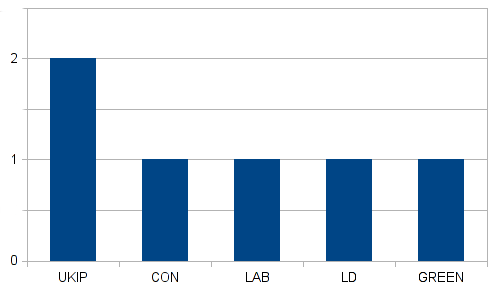
All election materials delivered to my home are recycled and those containing my personal detailed are shredded before recycling.
Each election I keep a tally of the number of communications received from each candidate or party, which has acquired the name of the shredder poll over the years.
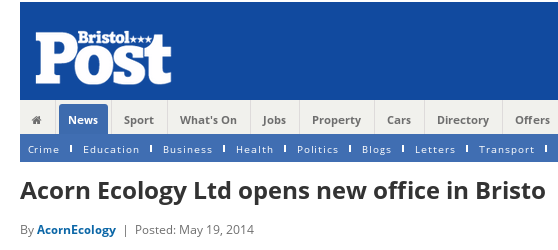
One of the features of the variety of English spoken in Bristol is the terminal ‘L’ – a final, intrusive ‘L’ on words ending in a vowel sound. As a consequence, Bristolians live in areals of the city and some of them do their shopping in Asdal.
This terminal L found its earliest expression in the city’s name itself, which has mutated from Brigstowe in Saxon times.
However, the terminal L is now under threat from poor writing and editing at the Bristol Post (or should that be Bristo Post? Ed.), as revealed in this blatant advertisement masquerading as news, complete with obligatory screenshot.
More of this poorly written junk can be expected in future as the Bristol Post – along with the rest of the Local World group to which it belongs – will be making increasing use of user-provided content, presumably to save on employing trained journalists.
The historic Ebenezer Chapel, the last remaining non-conformist chapel in the St Philips area of Bristol, is under threat of demolition from its owners, who seem very unconcerned about its value.
As a non-conformist building, it is very interesting architecturally too, looking more influenced by the Romanesque or Norman style (as it is otherwise known in England. Ed.) than the more usual Gothic Revival.
Ebenezer Chapel in its days as an architectural salvage emporium. Picture courtesy of John M (via Geograph)
However, a petition has been started to try and save (some of) it.
The text of the petition reads as follows:
Ebenezer Chapel, on Midland Road, is under imminent threat of demolition. The landowner wishes to destroy this important and beautiful reminder of the history of St Philips and Old Market, to replace it with a modern block of flats.
The chapel was built in 1849, the first Primitive Methodist chapel built in Bristol. Notwithstanding its beauty for local residents and the thousands of pedestrians and cyclists which pass it each day, it is the last-remaining architectural evidence of the education and spiritual support given to the first residents in the area, who settled in the early nineteenth century.
An attempt has been made to get the building listed by English Heritage, while it is a very strong candidate for the Local List. But because it is not listed and is outside of a conservation area, Bristol City Council says it is powerless to intervene and save this beautiful building.
We would like your support for this petition, which aims to show how many people would like this building saved and, at the very least, incorporated into any new development that takes place.
The more public support we receive, the more we can do to persuade the landowner and council to work to save this important historical landmark for future generations, and in so doing create a better development for all.
As well as signing the petition, please consider writing to your local councillor and local media to express your support for saving the chapel, and calling on them to do all they can in the future to protect the heritage of our great city.


 One of the Act’s results was the creation of the