English usage

  • Bristol opens Europe’s first speech lab for non-native English speakers

    Earlier this week Bristol University announced the opening in Bristol of Europe’s first speech laboratory designed to break down communication barriers faced by those who speak English as a second language.

    microphone and recording equipmentIn a linguistically diverse society, with many people speaking English as their second language, researchers at Bristol University are pioneering a new approach to help understand how factors such as accent influence communication.

    The speech lab, which is funded by the European Commission through a four-year €100,000 Marie Curie grant, uses state-of-the-art audio technology to capture and analyse second language speech samples and to train people to assess the speech in a purpose-built environment.

    The insights gained will then be used to train those who speak English as a second language and also to improve the teaching of English by targeting the elements of speech most likely to achieve successful communication.

    Dr. Talia Isaacs, Director of the Second Language Speech Lab, conducts research at the lab as part of a research programme with international collaborators to identify aspects of speech that are most important for engaging in effective communication when English is not the speaker’s primary language.

    general view of speech labShe said: “Reducing language barriers is a pressing social and educational challenge, especially in countries like the UK where the linguistic palette is very rich.

    “Improving oral communication skills for non-native English speakers will help with many aspects of everyday life – from success in the workplace and in education to improving social integration and accessing vital services.

    “Although accents are very noticeable to listeners and may lead to social stereotyping, someone who sounds different is not necessarily communicating ineffectively. In fact, a whole host of factors, such as pronunciation, grammar and vocabulary, contribute to the successful transmission of a message. So we often need to listen beyond the accent.

    “Research conducted at the lab will enable us to study the linguistic factors that contribute to breakdowns in communication in greater depth and identify ways to mitigate these.”

    By way of an example, future research could collect data from GP consultations, where either the doctor or the patient is speaking English as a second language. This could help to ensure such consultations are conducted with greater clarity.

    Furthermore, there could be instances where engineers from various countries are collaborating on a joint project and there’s a need to ensure that everyone fully understands each another and can communicate their findings effectively.

  • The British pub – undergoing gastration?

    I’m a great lover of no-frills, working-class pubs. They’re what I grew up with and frequented when I first started drinking. Indeed I still give them my custom and can often be found at the Little Russell in Barton Hill, Bristol (posts passim).

    One worrying development in recent years is the rise of the ‘gastropub‘.

    Eagle_Gastropub_Clerkenwell_2005
    The Eagle, Clerkenwell, London, reputed to be the first victim of gastration. Picture courtesy of Wikimedia Commons.
    The term gastropub is a portmanteau of gastronomy and pub, and originated in the United Kingdom in the late 20th century. The establishment itself is defined as ‘a bar and restaurant that serves high-end beer and food‘.

    My Bristol Wireless colleague Rich has devised the verb ‘to gastrate‘ to describe the phenomenon of converting boozers to gastropubs. I would define the verb as follows:

    gastrate (v.) – to ruin a perfectly good pub by converting it to sell small, overpriced portions of food.

    See also: gastration (n).

    The process of gastration is also being actively encouraged by the media, as shown in a piece last week on the Bristol Post website.

    Will traditional drinkers soon be struggling to find traditional boozers if this trend continues?

  • Overshare: Chambers word of the year

    speech bubble with speechLanguage is dynamic, constantly mutating and changing. One sign of this dynamism is the appearance of neologisms, i.e. newly coined word, or phrases or familiar words used in a new sense.

    There are plenty of neologisms in evidence in this year’s Chambers Dictionary annual search for its word of the year, many prompted by or associated with information technology.

    Chambers has this week announced that overshare is its word of the year for 2014, The Guardian reports.

    “Overshare” topped a shortlist compiled by the Chambers editorial board, which included “bashtag”, defined as “a hashtag used for critical or abusive comments”, and “digital native” – “a person who has learned to use computers as a child”.

    And the meaning of overshare? To reveal an inappropriate amount of detail about one’s personal life.

  • Stephen Williams MP caused by Al Qaeda – Post exclusive

    It’s not very often the Bristol Post manages to come up with an exclusive, but today’s online edition proved a winner on that score.

    The text below was concealed in a letter to Post from reader Stephen Farthing:

    THE news of 15-year-old girl Yusra Hussien leaving Bristol to become a supporter of IS, allegedly, is a worrying outcome and I echo what Stephen Williams said, that such an objective is not only foolish but profoundly unwise.

    In some ways, what Al Qaeda started in 2001 has produced many problems of his kind.

    Yes, you did read that correctly: “problems of his kind“, i.e. problems like him, if you prefer to paraphrase.

    image of Stephen Williams MPThe Post has exclusively revealed that Bristol West MP Stephen Williams is a problem that has been caused by Al Qaeda, an organisation never before known for its links to the UK’s Liberal Democratic Party, let alone elected members thereof.

    Perhaps Mr Williams would care to comment on his links to Al Qaeda below; or alternatively perhaps the Post could employ a little more care when publishing reader’s letters where a lost or missing consonant can give a phrase a whole new meaning.

  • School English: see me after class

    I do worry when schools display lack of proficiency in the English language. After all, they are establishments whose tasks include imparting formal training in the vernacular.

    In particular, they seem to have problems with the use of the apostrophe (posts passim), whether that entails its use as a possessive or as an indication of omission.

    The latest example from the nursery slopes of Mount Academia was found almost on my doorstep at St. Nicholas of Tolentine RC Primary School in Pennywell Road, Bristol, which seems to think that childrens is the plural of child.

    showing misused apostrophe on school notice

    Should anyone from the school happen to be reading this, the correct punctuation is children’s. In the words of several of my old teachers: you could do better; see me after class. πŸ™‚

  • What is open?

    Open Knowledge Foundation logoThe Open Knowledge Foundation is doing marvellous work in the fields of open data and open content.

    The Foundation has just published version 2 of its Open Definition. This definition is released under a Creative Commons Attribution licence and is reproduced verbatim below (complete with US spellings and punctuation throughout. Ed.).

    Open Definition

    Version 2.0

    The Open Definition makes precise the meaning of “open” with respect to knowledge, promoting a robust commons in which anyone may participate, and interoperability is maximized.

    Summary: Knowledge is open if anyone is free to access, use, modify, and share it β€” subject, at most, to measures that preserve provenance and openness.

    This essential meaning matches that of “open” with respect to software as in the Open Source Definition and is synonymous with “free” or “libre” as in the Definition of Free Cultural Works. The Open Definition was initially derived from the Open Source Definition, which in turn was derived from the Debian Free Software Guidelines.

    The term work will be used to denote the item or piece of knowledge being transferred.

    The term license refers to the legal conditions under which the work is made available. Where no license has been offered this should be interpreted as referring to default legal conditions governing use of the work (for example, copyright or public domain).

    1. Open Works

    An open work must satisfy the following requirements in its distribution:

    1.1 Open License

    The work must be available under an open license (as defined in Section 2). Any additional terms accompanying the work (such as a terms of use, or patents held by the licensor) must not contradict the terms of the license.

    1.2 Access

    The work shall be available as a whole and at no more than a reasonable one-time reproduction cost, preferably downloadable via the Internet without charge. Any additional information necessary for license compliance (such as names of contributors required for compliance with attribution requirements) must also accompany the work.

    1.3 Open Format

    The work must be provided in a convenient and modifiable form such that there are no unnecessary technological obstacles to the performance of the licensed rights. Specifically, data should be machine-readable, available in bulk, and provided in an open format (i.e., a format with a freely available published specification which places no restrictions, monetary or otherwise, upon its use) or, at the very least, can be processed with at least one free/libre/open-source software tool.

    2. Open Licenses

    A license is open if its terms satisfy the following conditions:

    2.1 Required Permissions

    The license must irrevocably permit (or allow) the following:

    2.1.1 Use

    The license must allow free use of the licensed work.

    2.1.2 Redistribution

    The license must allow redistribution of the licensed work, including sale, whether on its own or as part of a collection made from works from different sources.

    2.1.3 Modification

    The license must allow the creation of derivatives of the licensed work and allow the distribution of such derivatives under the same terms of the original licensed work.

    2.1.4 Separation

    The license must allow any part of the work to be freely used, distributed, or modified separately from any other part of the work or from any collection of works in which it was originally distributed. All parties who receive any distribution of any part of a work within the terms of the original license should have the same rights as those that are granted in conjunction with the original work.

    2.1.5 Compilation

    The license must allow the licensed work to be distributed along
    with other distinct works without placing restrictions on these other works.

    2.1.6 Non-discrimination

    The license must not discriminate against any person or group.

    2.1.7 Propagation

    The rights attached to the work must apply to all to whom it is redistributed without the need to agree to any additional legal terms.

    2.1.8 Application to Any Purpose

    The license must allow use, redistribution, modification, and compilation for any purpose. The license must not restrict anyone from making use of the work in a specific field of endeavor.

    2.1.9 No Charge

    The license must not impose any fee arrangement, royalty, or other compensation or monetary remuneration as part of its conditions.

    2.2 Acceptable Conditions

    The license shall not limit, make uncertain, or otherwise diminish the permissions
    required in Section 2.1 except by the following allowable conditions:

    2.2.1 Attribution

    The license may require distributions of the work to include attribution of contributors, rights holders, sponsors and creators as long as any such prescriptions are not onerous.

    2.2.2 Integrity

    The license may require that modified versions of a licensed work carry a different name or version number from the original work or otherwise indicate what changes have been made.

    2.2.3 Share-alike

    The license may require copies or derivatives of a licensed work to remain under a license the same as or similar to the original.

    2.2.4 Notice

    The license may require retention of copyright notices and identification of the license.

    2.2.5 Source

    The license may require modified works to be made available in a form preferred for further modification.

    2.2.6 Technical Restriction Prohibition

    The license may prohibit distribution of the work in a manner where technical measures impose restrictions on the exercise of otherwise allowed rights.

    Non-aggression

    The license may require modifiers to grant the public additional permissions (for example, patent licenses) as required for exercise of the rights allowed by the license. The license may also condition permissions on not aggressing against licensees with respect to exercising any allowed right (again, for example, patent litigation).

  • Greengrocer returns to Post

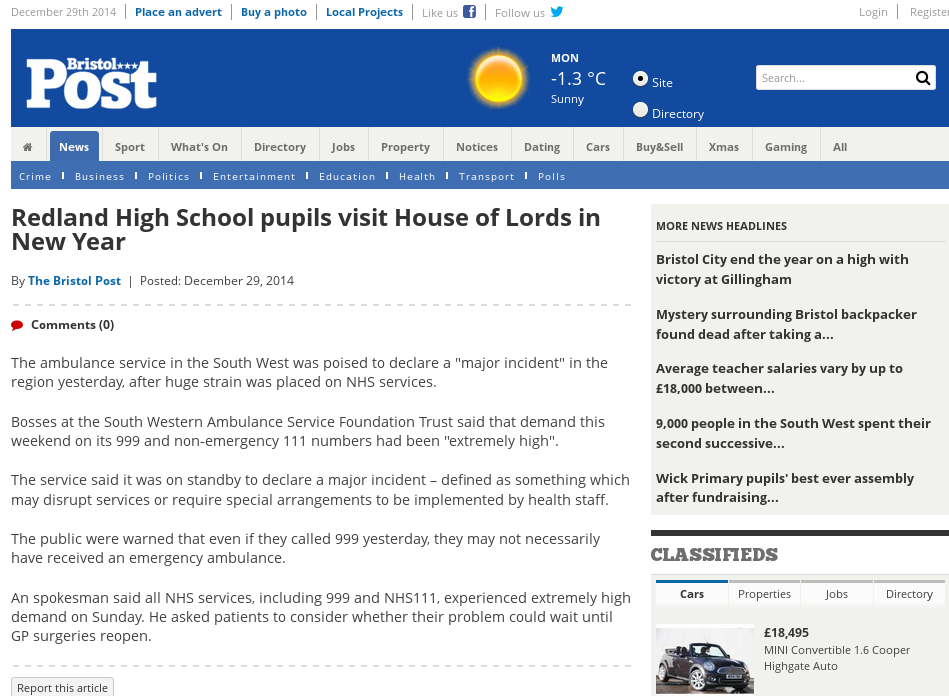
    Thursday’s Bristol Post saw the welcome return to journalism of a local greengrocer, with a report featuring a superfluous apostrophe in the headline.

    Bristol Post headline featuring greengrocer's apostrophe

    The writer from the fruit and vegetable trade has been rather quiet on Temple Way recently. This blog has not featured his or her work for nearly a year now (posts passim).

    One question that should be asked of Localworld, owners of the Bristol Post, is whether it was it such a great idea to get rid of sub-editors?

  • Nice one!

    News site www.thebusinesswomanmedia.com has got the emphasis just right here on its report on a wedding that’s causing the media to get excited and distract attention from all the nasty things going on in the world like Ebola in West Africa or the continuing madness in the Middle East (news passim).

    screenshot of headline stating internationally acclaimed barrister Amal Alamuddin marries an actor

    However, it could have added the word(s) ‘ageing’ and/or ‘greying’ in front of ‘actor’. πŸ˜‰

Posts navigation