media

  • Bristol Post Balls – verb conjugation

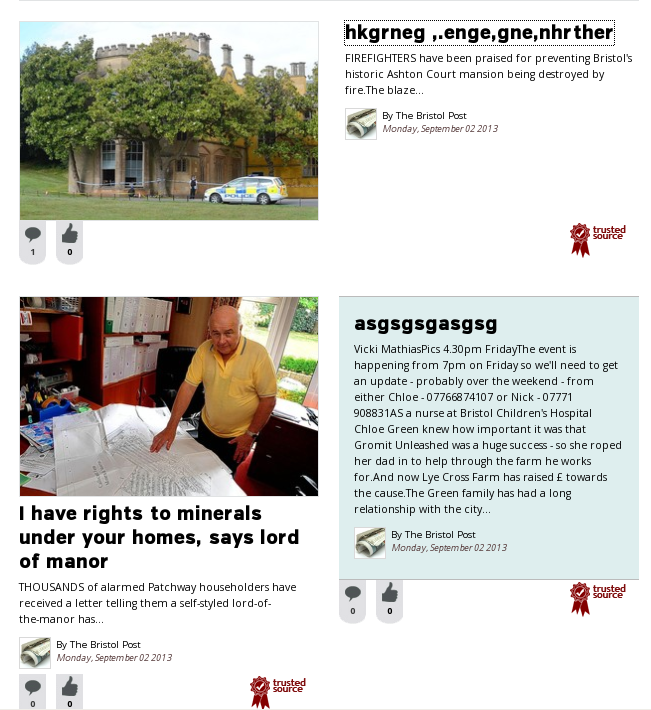
    The Bristol Post website carries an initial report today of a fire last night at Ashton Court, a 17th century mansion house in north Somerset owned by Bristol City Council.

    Allegedly penned by someone called DanielEvans1, the third paragraph of the piece reads as follows:

    A total of six Avon Fire and Rescue pumps and an aerial appliance were need to extinguish the fire in the early hours.

    An inability to conjugate the verb ‘to need’ correctly is evidently no barrier to employment as a journalist at the Temple Way Ministry of Truth. 😉

  • A letter to the Prime Minister

    The World Association of Newspapers and News Publishers (WAN/IFRA) has written the letter below to the British Prime Minister following the recent spurious detention of David Miranda, the partner of Guardian journalist Glenn Greenwald, at Heathrow airport under Schedule 7 of the Terrorism Act 2000.

    WAN-IFRA is the global organisation for the world’s newspapers and news publishers, with formal representative status at the United Nations, UNESCO and the Council of Europe. The organisation groups 18,000 publications, 15,000 online sites and over 3,000 companies in more than 120 countries.

    No doubt WAN/IFRA’s intervention will have absolutely no effect the surveillance of citizens by the British state revealed by Glenn Greenwald’s Guardian articles or the UK’s abuse of terrorism legislation.

    The Right Honourable David Cameron MP
    Prime Minister of Great Britain
    10 Downing Street
    London
    United Kingdom

    23 August 2013

    Dear Prime Minister,

    We are writing on behalf of the World Association of Newspapers and News Publishers (WAN-IFRA) and the World Editors Forum, which represent 18,000 publications, 15,000 online sites and over 3,000 companies in more than 120 countries, to express our deep concern at the actions of government officials that led to the destruction of computer hard drives at the offices of the Guardian newspaper on 20 July.

    According to reports, the decision to destroy the equipment was made by Guardian staff in response to the threat of legal action by the UK government. In attempting to exercise prior-restraint, the government’s aim was to prevent the publication of reports based on the leaked files supplied by National Security Agency (NSA) contractor and whistle-blower, Edward Snowden.

    That your government felt the need to threaten legal action in order to block reporting into issues of public interest is deeply regrettable. Furthermore, WAN-IFRA is extremely concerned that the government’s actions were an act of intimidation that could have a chilling effect on press freedom in the UK and beyond.

    WAN-IFRA fully supports the actions of Guardian editor-in-chief Alan Rusbridger, who explained on numerous occasions that copies of the information stored on the hard drives were held elsewhere under foreign jurisdictions, and that physically handing them over to UK government authorities or destroying them would be a symbolic gesture only.

    In a separate but not unrelated incident, WAN-IFRA is equally concerned over the manner of the detention at Heathrow airport under Schedule 7 of the UK Terrorism Act 2000 of David Miranda, the partner of Guardian journalist Glenn Greenwald who has been instrumental in breaking the story on the NSA files. Mr Miranda had his personal electronic items confiscated and was held for an unprecedented nine-hours without charges being brought against him.

    The apparent misuse of this particular element of anti-terror legislation places journalists, and those aiding journalistic work, under suspicion of being terrorists or having involvement in terrorist activities. This is an outrageous and deeply disturbing connection to make, and we seek assurances from you and your government that the necessary inquiries will be made to ensure any inference of association between journalism and terrorism is not part of official policy and is publicly condemned as categorically misleading.

    Added to these latest incidents, WAN-IFRA is disturbed by the perceived slide in press freedom witnessed in the UK over recent months. Serious questions remain regarding the future direction of independent press regulation. Reports also suggest that since Lord Justice Leveson’s inquiry into press behaviour as many as 59 journalists have been arrested under three separate police investigations. None have been convicted and many have spent months on police bail.

    As a result, the United Kingdom’s commitment to international standards of freedom of expression, as outlined in Article 19 of the International Covenant on Civil and Political Rights (ICCPR), of which Great Britain is a signatory, is under intense scrutiny both domestically and around the world.

    We respectfully call on you to reaffirm the United Kingdom’s commitment to a free and independent press and to realign the various government and police authorities behind this unequivocal message. We urge the UK government to respect the rights of journalists to protect their sources and to create the conditions necessary to ensure the press can continue its crucial role in maintaining free and fair societies, without government interference or intimidation.

    We look forward to hearing from you at your earliest convenience.

    Yours sincerely,

    Tomas Brunegård
    President
    World Association of Newspapers and News Publishers

    Erik Bjerager
    President
    World Editors Forum

  • Bristol Post Balls – the ghost train

    Yesterday’s Bristol Post featured a report on convicted murderer Paul Flint, who has absconded from Ford Open Prison in Sussex.

    Flint is believed to be in the Bristol area, the evidence for which is included in the following sentence:

    The latest reported sighting of Flint was on a train at Bristol Parkway station, heading towards Westbury-on-Trym, shortly after 6.20pm on Tuesday.

    There’s one major problem with that statement: no railway line runs between Bristol Parkway and Westbury-on-Trym. The closest any line runs to Westbury-on-Trym is the Henbury Loop line (posts passim), which has been closed to passenger traffic since 1964.

    Is there a chance that reporter Daniel Evans was confusing Westbury-on-Trym with Westbury in Wiltshire, which does have a functioning railway station – or does he live in a Bristol in a parallel universe where public transport provision is excellent? 😉

  • Bristol Post Balls – let it rain

    Certain parts of the country suffered from very heavy rain earlier this week. Where I was camping in the Black Mountains for the past week, we had some 3 inches of rain over the weekend.

    image of a row of umbrellas
    Image courtesy of Wikimedia Commons

    The Bristol area was also affected by the torrential downpour. Sit back and marvel at the mathematical genius of an anonymous Bristol Post reporter in this report posted in the online version on Sunday and bearing the headline “Met Office issues severe weather warning as Bristol poised for 12 hours of heavy rain“.

    The forecast is for heavy rain from 10pm tonight, stretching through until 10pm on Monday, before heavy rain showers persist until 7pm.

    Excluding the heavy showers, I make that at least 24 hours. How about you? 🙂

  • Bristol Post Balls 4 – a classic homophone

    Today’s cock-up by the Bristol Post, from a story entitled ‘Man on lilo rescued after drifting out to sea off Weston-super-Mare’, has gained Bristol’s newspaper of record a seat in homophone corner.

    For the benefit of passing Post journalists a homophone is “a word that is pronounced the same as another word but differs in meaning. The words may be spelled the same, such as rose (flower) and rose (past tense of “rise”), or differently, such as carat, caret, and carrot, or to, two, and too.”

    Now let’s see (or sea. Ed.) what landed the Post this particular accolade.

    screenshot of homophone from Bristol Post
    What did he drift out to see, Bristol Post?
  • Farewell to The H

    Today’s a sad day in the IT news world: The H is closing down. For the last few years it has been an excellent source of IT news in the fields of free and open source software, security and software development, or as it said in its own words: “The H brings you the in-depth coverage of the world of IT, communications, data security and the politics of technology.”

    Earlier today editor DJ Walker-Morgan (aka Codepope. Ed.) posted the message below on The H’s website.

    Although The H has produced many widely read stories, it has not been possible to effectively monetise that traffic to produce a working business model.

    Because of this, after four and a half years as The H and six years online, The H is, sadly, closing its doors. We thank all our readers for their deep interest and engagement. Work is taking place to create an archive to ensure that the content of the site will remain publicly accessible.

    Best regards

    DJ Walker-Morgan and the entire team at The H

    The H was produced in association with Heise Online, a major German IT news site and one I’d recommend.

    So farewell, The H and thanks for providing quality news for the last few years and best wishes for the future; you’ll be missed.

Posts navigation