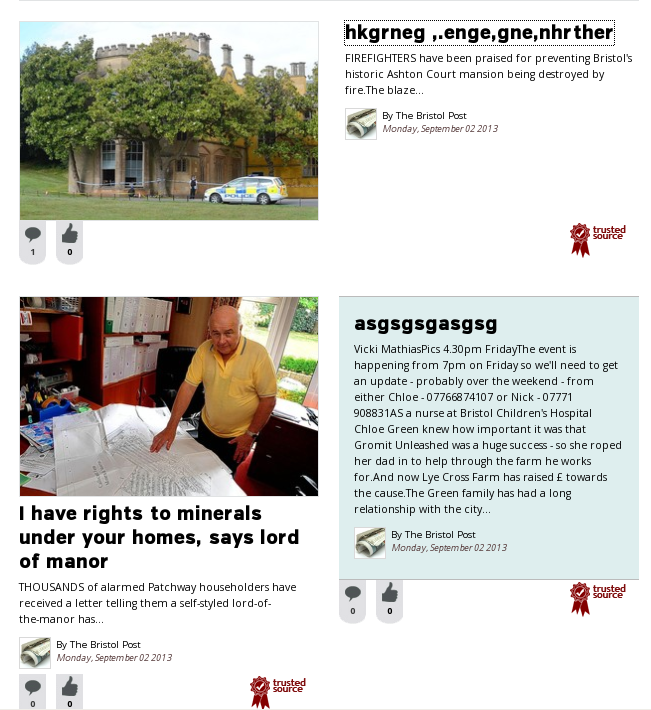
When I volunteered many years ago on producing Planet Easton – a community newspaper for my part of Bristol – one of the hardest tasks for the editorial team was devising headlines for articles.
However, one unnamed employee at The Argus in Brighton deserves a special mention for the example below, a fine example of the use of alliteration and homophones.
The container being loaded for shipping to TogoBristol’s University of the West of England (UWE) has announced that a shipment of refurbished computers and office furniture has just arrived in Togo after an eight week voyage. The recycled equipment was refurbished by UWE student volunteers.
Jo Earl, from UWE Volunteering, co-ordinated students from UWE’s Department of Computer Science & Creative Technologies to make the computers ready for use.
“Four volunteers worked as a team to assess the donated equipment, install operating systems and additional software. In total 84 PCs were shipped and the students worked really hard on a complex and time-consuming task,” said Jo.
“After refurbishing the computers, our next big task was shipping the PCs from Frenchay campus,” continued Jo, who worked with UWE facilities manager Richard Bird on packing and loading the computers, printers, desks and chairs into a shipping container.
The Bristol Post website is an online disaster that just keeps on giving, as in today’s example in the screenshot below where the unnamed hapless hack can’t tell the difference between looking for something and being debauched. 🙂
There’s one major problem with that statement: no railway line runs between Bristol Parkway and Westbury-on-Trym. The closest any line runs to Westbury-on-Trym is the Henbury Loop line (posts passim), which has been closed to passenger traffic since 1964.
Is there a chance that reporter Daniel Evans was confusing Westbury-on-Trym with Westbury in Wiltshire, which does have a functioning railway station – or does he live in a Bristol in a parallel universe where public transport provision is excellent? 😉
Certain parts of the country suffered from very heavy rain earlier this week. Where I was camping in the Black Mountains for the past week, we had some 3 inches of rain over the weekend.
Image courtesy of Wikimedia Commons
The Bristol area was also affected by the torrential downpour. Sit back and marvel at the mathematical genius of an anonymous Bristol Post reporter in this report posted in the online version on Sunday and bearing the headline “Met Office issues severe weather warning as Bristol poised for 12 hours of heavy rain“.
The forecast is for heavy rain from 10pm tonight, stretching through until 10pm on Monday, before heavy rain showers persist until 7pm.
Excluding the heavy showers, I make that at least 24 hours. How about you? 🙂
Yesterday I left the confines of Bristol and travelled down to the Bristol Channel coast.
While there I was there I made time to visit an area of salt marsh to forage for marsh samphire (also known as glasswort), which is currently in the midst of its short season, which consists of the months of July and August only.
Marsh samphire (Salicornia europaea)
Samphire can be eaten raw or cooked. In the latter instance, no salt needs to be added to the cooking water as the plant has an inherent high salt content. It has a fresh, salty taste, crisp texture and makes a great accompaniment to fish and shellfish dishes, eggs or such specialities as salt marsh lamb. As samphire gets older and larger, the core of the plant becomes more stringy and the succulent flesh has to be stripped off the stringy core.
Until the start of the 19th century, marsh samphire also had industrial uses: before the introduction of the LeBlanc process for the industrial production of soda ash, marsh samphire ashes were long used as a source of soda ash (mainly sodium carbonate) for making glass and soap.
As regards the origin of the noun samphire, it is believed to be a corruption of the French name herbe de Saint-Pierre, i.e. “St Peter’s herb”.
North Somerset Council – Bristol’s immediate neighbour to the south – has announced that free wi-fi will be available in almost every library across North Somerset from 1st August.
This will allow library users (not ‘customers’, as stated in your press release, North Somerset! Ed.) to bring their own laptops and other devices into their local library to use the internet.
Wi-fi will be available to everyone by simply visiting any library during opening hours. There will be no need to book and visitors will not need to be a library member to set up an account, although first time users will need to approach a member of the library staff to set up an account.
However, there’s library where this facility won’t be available – the mobile library.
Today’s cock-up by the Bristol Post, from a story entitled ‘Man on lilo rescued after drifting out to sea off Weston-super-Mare’, has gained Bristol’s newspaper of record a seat in homophone corner.
For the benefit of passing Post journalists a homophone is “a word that is pronounced the same as another word but differs in meaning. The words may be spelled the same, such as rose (flower) and rose (past tense of “rise”), or differently, such as carat, caret, and carrot, or to, two, and too.”
Now let’s see (or sea. Ed.) what landed the Post this particular accolade.
The second AshesTest match is currently underway at Lord’s in London between England and Australia.
Over the years I’ve become a fan of the live coverage provided by the Test Match Special team on Radio 4 LW; local Bristol community station BCfm interferes with the signal on Radio 4’s FM signal where I live.
Geoff BoycottAs a consequence, I’ve got to know and appreciate the consummate broadcasting skills of Aggers, Blowers and company, including Geoff Boycott, regarded by some as the ‘greatest living Yorkshireman’.
One of the joys of listening to the coverage is the banter between the team, especially the ribbing of Boycott and the interplay between him and Aggers in particular.
Now Geoffrey is not known for keeping his counsel to himself, being a man of strong opinions. Like all of us, he’s got little foibles in his speech and recurring phrases, affectionately known as ‘Boycottisms‘. These Boycottisms have been used to produce ‘Boycott bingo’ cards like the example below.