Eggs have long been associated with Easter since for Christians the Easter egg is a symbol of Christ’s empty tomb.
The custom of the Easter egg originated in the early Christian community of Mesopotamia, which stained eggs red in memory of the blood of Christ, shed at his crucifixion.
This practice still survives in Greece where hard-boiled eggs are dyed bright red to symbolise the spilt Blood of Christ and the promise of eternal life. They are also cracked together to celebrate the opening of the Tomb of Christ.
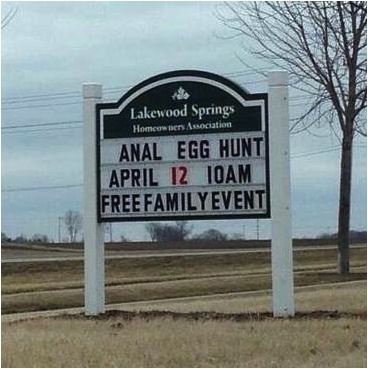
In more recent times since those of the early Christians of Mesopotamia egg hunts have become a fixture of the Easter events calendar.
However, here’s one event from recent years from Lakewood Springs in Illinois that sounded a little too intimate for comfort…
On 5th May elections will be held in England for local councils, local police and crime commissioners and in Bristol the elected Mayor.
As part of the election process, there’s a period before the announcement of the election and the final election results in which central – in the case of general elections – and local government is prevented from making announcements about any new or controversial government initiatives (such as modernisation initiatives or administrative and legislative changes) which could be seen to be advantageous to any candidates or parties in the forthcoming election.
This period has traditionally been called “purdah” after the practice in certain Muslim and Hindu societies of screening women from men or strangers, especially by means of a curtain. “Purdah” itself originates from Urdu and Persian “parda“, meaning a “veil” or “curtain“.
Earlier this month I attended the quarterly meeting of Bristol’s Ashley, Easton & Lawrence Hill Neighbourhood Partnership. At this meeting attendees were clearly told by the officer serving the partnership that “purdah” was no longer an acceptable term and that the time in question should be referred to as the “pre-election period“.
This occurred after “purdah” had already been used a few times by elected councillors and makes your correspondent wonder if colourless, unaccountable, unelected council officers (whose wages we pay. Ed.) should be allowed to dictate the vocabulary which is used in meetings.
I don’t think they should.
Do you agree or disagree with my conclusion? Please comment below.
Last Thursday I was in Shrewsbury, county town of the county of my birth. Shrewsbury is steeped in a wealth of medieval history, including plenty of ancient street names (mostly based upon the shops sited there – e.g. Butcher Rown, Fish Street, etc. Ed.), amongst them the intriguingly titled Grope Lane.
Grope Lane street signA look back down Grope Lane towards High Street
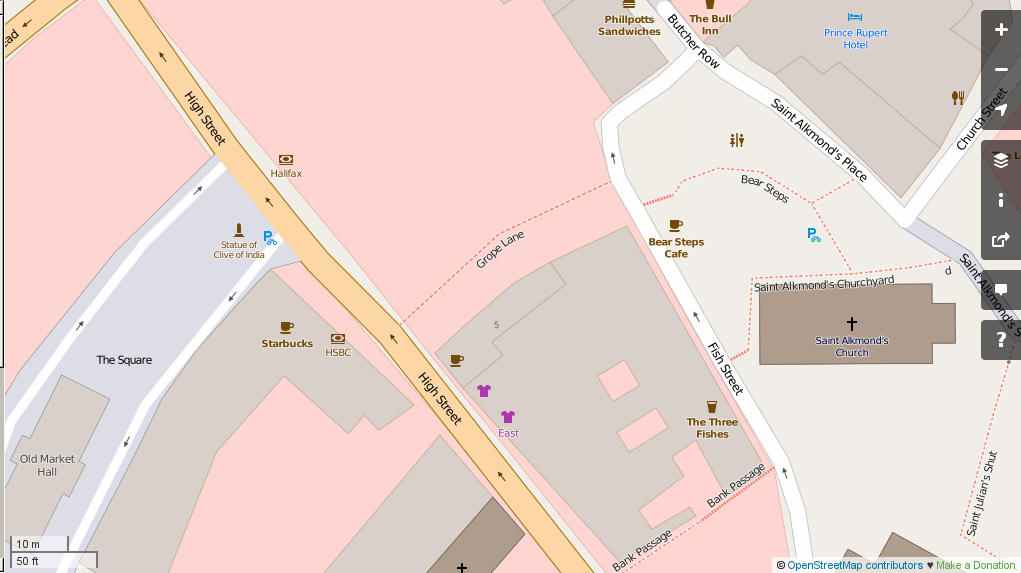
Grope Lane in Shrewsbury is a narrow alley connecting High Street and Fish Street in the heart of the old medieval town, as shown on the location map below.
Location of Grope Lane in Shrewsbury. Image courtesy of OpenStreetMap. Click on image for full-sized version
As with many towns in the Middle Ages, Shrewsbury’s Fish Street (and nearby Butcher Row. Ed.) are named after the trades that occupied them. However, Grope Lane is also reputed to be linked to trade – this time the pleasures of the flesh.
Wikipedia has an excellent page on this street name in its unsanitised version.
Gropec*nt Lane, says Wikipedia, was a street name found in English towns and cities during the Middle Ages, believed to be a reference to the prostitution centred on those areas… Gropec*nt, the earliest known use of which is in about 1230, appears to have been derived as a compound of the words grope and c*nt (our medieval forebears were less sensitive and more earthy in their use of language than their modern descendants, as anyone who had read Chaucer in the original Middle English can testify. Ed.). Streets with that name were often in the busiest parts of medieval towns and cities.
Towns and cities with active quays or ports often had an adjacent Grope(c*nt) Lane, as in the case of Bristol, although that street name recorded in the reign of Edward III (1312-1377), was subsequently changed to Hauliers Lane and has since been changed again (see below).
Although the name was once common throughout England, changes in attitude resulted in its replacement by more innocuous versions such as Grape Lane. A variation of Gropec*nt was last recorded as a street name in 1561.
In Shrewsbury a street called Grope Countelane existed as recently as 1561 and connected the town’s two principal marketplaces. At some unspecified date the street was renamed Grope Lane, which it has retained to the present day. In Thomas Phillips’ History and Antiquities of Shrewsbury (1799) the author is explicit in his understanding of the origin of the name as a place of “scandalous lewdness and venery”, but Archdeacon Hugh Owen’s Some account of the ancient and present state of Shrewsbury (1808) describes it as “called Grope, or the Dark Lane”. As a result of these differing accounts, some local tour guides attribute the name to “feeling one’s way along a dark and narrow thoroughfare”.
Other towns and cities in England also had their own local Grope(c*nt) Lane including the following:
London (several examples);
Bristol (now called Nelson Street);
York;
Newcastle upon Tyne;
Worcester;
Hereford;
Oxford (now Magpie Lane);
Norwich (now Opie Street);
Banbury (now Parsons Street);
Glastonbury (now St Benedicts Court); and
Wells (initially changed to Grove Lane, now Union Street).
Maris Dombovskis of Longton is charged with failing to provide a specimen of breath for analysis, driving without insurance and without a licence on January 19.
District Judge Jack McGarva adjourned the case until February 29 to arrange for an interpreter.
This was the second time last week that a court case at this court complex had to be adjourned for lack of an interpreter.
On Tuesday 23rd February magistrates adjourned the case of a Polish resident of Smallthorne charged with assault for 3 days to arrange for an interpreter, The Sentinel also reported.
Where Bristol has the Bristol Post, formerly the Bristol Evening Post, as its newspaper of record (warped. Ed.), the Potteries has The Sentinel, formerly the Evening Sentinel.
Both newspapers now belong to the Local World stable and share many common features: the content management system running their websites, difficulty in distinguishing editorial content from advertising, a cavalier attitude to the correct use of the English language and so on.
Yesterday’s Sentinel carried a report of a railway signal failure in the Stafford area.
The report was helpfully illustrated with a photograph as per the screenshot below.
The photograph is also helpfully captioned, as follows:
DELAYS: Rail services have been hit by signalling problems at Stafford.
It is evident for a number of reasons that the anonymous members of the Sentinel’s “Digital_team” who put together this report are no great users of the railway network.
Firstly, the photograph shows semaphore signals. These are not used at Stafford, which lies on the West Coast Main Line, where semaphore signals were removed and replaced with colour light signals many decades ago.
Secondly, the plate on the signal mast identifies the signals as part of the Severn Bridge Junction signal complex.
Thirdly, what is the Abbey Church of St Peter & St. Paul in Shrewsbury doing in the background, lurking behind the largest sempaphore signal box in the country? 😉
On Tuesday the Welsh Government website reported that legislation to improve the protection and management of Wales’ unique historic environment had been passed by the National Assembly for Wales.
Once the Bill is law, Wales will also become the first country in the UK to put historic environment records on a statutory footing – a measure that many groups having been calling for across the UK.
These records will allow advice on decisions by planning authorities and land managers to be based on sound information.
The records will also provide access to the new list of historic place names in Wales – another first for Wales.
Station sign at Llanfairpwllgwyngyllgogerychwyrndrobwllllantysiliogogogoch – Wales’ longest place name. Image courtesy of Wikimedia Commons
Reporting on the place names records, the BBC states that the scheme will see the names of fields, river pools, caves and even ruined cottages collected and used to develop a definitive digital map. Furthermore, the names themselves will also make their way onto a National Library of Wales database.
As a language, Welsh emerged in the 6th century from Common Brittonic, the common ancestor of Welsh, Breton, Cornish and the extinct language known as Cumbric, according to Wikipedia.
Shelf life is the length of time that a commodity may be stored without becoming unfit for use, consumption, or sale. In other words, it might refer to whether a commodity should no longer be on a pantry shelf (unfit for use), or just no longer on a supermarket shelf (unfit for sale, but not yet unfit for use).
As one of these four submarines is supposed to be at sea at all times, perhaps Mr Daly would care to explain to his readers, why the quartet is cluttering up the quartermaster’s stores instead. 😉
Alternatively, perhaps Patrick could learn the definition of the term “service life“. 🙂
Update 12/02/16: The piece has since been amended and the offending “shelf-life” replaced.
Since 1990 the spelling reform approved by the Académie Française has never really been pursued. “Oignon” without an “i“, the removal of some circumflex accents: at the start of the next academic year, teachers should finally implement this reform, TF1 reports. A total of 2,400 words are going to be changed; here are 10 examples.
The word “nénuphar” will henceforth be able to be written as “nénufar“. The spelling reform of 6th December 1990 that was approved by the Académie Française is finally going to be applied at the start of the next school year by the publishers of school textbooks and thus by teachers.
One of the new features is that circumflex accents are going to disappear gradually. The verb “s’entraîner” will therefore be able to be spelt with a simple “i” and thus minus the circumflex accent. This part of the reform should make learning spelling easier for children.
Special National Education Official Bulletin no. 11 of 26 Novembre 2015 gives a reminder that the spelling reform to be applied to the schooling of a child is that of 1990. Spelling and grammar textbooks will therefore carry the wording “New spelling” from the start of the next academic year.
Another brain-teaser
Only 45% of French people were proficient in the rules of spelling in 2015. What will happen when students have to learn to spell the same word in two different ways? Teachers are already reticent about this question.
The change in French spelling has not been accepted by the world of work and business for 26 years. The 2,400 words involved in this reform could therefore be regarded as errors by prospective employers although the 2 spellings will be accepted.
10 words which will change at the start of the school year
Oignon to ognon (onion) Nénuphar to nénufar (water lilly) S’entraîner to s’entrainer (to train oneself) Maîtresse to maitresse (mistress) Coût to cout (cost) Paraître to paraitre (to appear) Week-end to weekend Mille-pattes to millepattes (millipede) Porte-monnaie to portemonnaie (purse) Des après-midi to des après-midis (afternoons)
Online opposition
However, The Guardian reports that the changes to French spelling have not met with universal approval. There have been complaints that the Socialist government is dumbing down the language of Molière.
Polish is one of the most common foreign languages for which interpreters are required in UK courts, yet it seems that Capita Translation & Interpreting, which holds the contract for supplying interpreters in courts and tribunals, still seems to be experiencing difficulties in providing Polish interpreters, nearly four years after the incompetent outsourcing giant got its hands on the contract.
Yesterday’s Worcester News reports that a case against 3 Polish nationals accused of producing 105 cannabis plants in Worcester had to be adjourned yesterday.
Marcin Pobiegly, Lukasz Kloch and Andrzey Ratowski appeared before magistrates in Worcester on Friday concerning a cannabis grow in the city’s Vauxhall Street.
However, the case had to be adjourned due lack of court time as magistrates waited in vain for a Polish interpreter to arrive.
It will now be heard on Monday, always providing that a Capita interpreter bothers to turn up.
Update 02/02/16: An interpreter did turn up on Monday and that day’s Worcester News states that the case has now been referred to Crown Court.
A couple of days ago, the Tory Police & Crime Commissioner candidate for Gloucestershire, Will Windsor-Clive criticised the £100,000 or so the Gloucestershire constabulary spends annually on interpreters (posts passim) in an early campaign effort to deploy bigotry and xenophobia.
Today, the Western Daily Press reports that the current Police and Crime Commissioner, independent Martin Surl, has defended his force’s expenditure on linguists.
He is reported to have said the following:
Translators [sic] are highly qualified professionals who provide a fundamental service.
Victims must be protected and the law administered without fear or favour and effective communication is essential to the process of justice.
It is also a legal requirement that if a case comes to court, all sides must be understood and be able to understand the proceedings.
Well said, Mr Surl, although you need to see my handy illustrated guide to appreciate the difference between translators and interpreters. 🙂
 Earlier this month I attended the quarterly meeting of Bristol’s



 Since 1990 the spelling reform approved by the
  Polish is one of the most common foreign languages for which interpreters are required in UK courts, yet it seems that Capita Translation & Interpreting, which holds the contract for supplying interpreters in courts and tribunals, still seems to be experiencing difficulties in providing Polish interpreters, nearly four years after the incompetent outsourcing giant got its hands on the contract.
 A couple of days ago, the Tory Police & Crime Commissioner candidate for Gloucestershire, Will Windsor-Clive criticised the £100,000 or so the Gloucestershire constabulary spends annually on interpreters (