politics

  • A traditional seasonal monologue

    In deference to the time of year, here’s a monologue – Christmas Day in the Workhouse – penned by George R. Sims in 1879.

    It is Christmas Day in the Workhouse,
    And the cold bare walls are bright
    With garlands of green and holly,
    And the place is a pleasant sight:
    For with clear-washed hands and faces
    In a long and hungry line
    The paupers sit at the tables,
    For this is the hour they dine.

    And the guardians and their ladies,
    Although the wind is east,
    Have come in their furs and wrappers,
    To watch their charges feast:
    To smile and be condescending,
    Put puddings on pauper plates,
    To be hosts at the workhouse banquet
    They’ve paid for – with the rates.

    Oh, the paupers are meek and lowly
    With their ‘Thank’ee kindly, mum’s’;
    So long as they fill their stomachs
    What matters it whence it comes?
    But one of the old men mutters,
    And pushes his plate aside:
    ‘Great God!’ he cries; ‘but it chokes me!
    For this is the day she died.’

    The guardians gazed in horror
    The master’s face went white;
    ‘Did a pauper refuse his pudding?’
    ‘Could their ears believe aright?’
    Then the ladies clutched their husbands,
    Thinking the man might die
    Struck by a bolt, or something,
    By the outraged One on high.

    But the pauper sat for a moment,
    Then rose ‘mid a silence grim,
    For the others has ceased to chatter,
    And trembled every limb.
    He looked at the guardian’s ladies,
    Then. eyeing their lords, he said,
    ‘I eat not the food of villains
    Whose hands are foul and red:

    ‘Whose victims cry for vengeance
    From their dank, unhallowed graves.’
    ‘He’s drunk!’ said the workhouse master.
    ‘Or else he’s mad, and raves.’
    ‘Not drunk or mad,’ cried the pauper,
    ‘But only a hunted beast,
    Who, torn by the hounds and mangled,
    Declines the vulture’s feast.

    I care not a curse for the guardians,
    And I won’t be dragged away.
    Just let me have the fit out,
    It’s only Christmas Day
    That the black past comes to goad me,
    And prey my burning brain;
    I’ll tell you the rest in a whisper, –
    I swear I won’t shout again.

    ‘Keep your hands off me, curse you!
    Hear me right out to the end.
    You come here to see how the paupers
    The season of Christmas spend.
    You come here to watch us feeding,
    As they watch the captured beast.
    Hear why a penniless pauper
    Spits on your paltry feast.

    ‘Do you think I will take your bounty,
    And let you smile and think
    You’re doing a noble action
    With the parish’s meat and drink?
    Where is my wife, you traitors –
    The poor old wife you slew?
    Yes, by the God above us
    My Nance was killed by you!

    ‘Last winter my wife lay dying,
    Starved in a filthy den;
    I had never been to the parish, –
    I came to the parish then.
    I swallowed my pride in coming,
    For, ere the ruin came,
    I held up my head as a trader,
    And I bore a spotless name.

    ‘I came to the parish, craving
    Bread for a starving wife,
    Bread for a woman who’d loved me
    Through fifty years of my life;
    And what do you think they told me,
    Mocking my awful grief?
    That “the House” was open to us,
    But they wouldn’t give “out relief”.

    I slunk to the filthy alley –
    ‘Twas a cold, raw Christmas eve –
    And the bakers’ shops were open
    Tempting a man to thieve;
    But I clenched my fists together
    Holding my head awry,
    So I came home empty-handed,
    And mournfully told her why.

    Then I told her “the House” was open;
    She had heard of the ways of that,
    For her bloodless cheeks went crimson,
    And up in her rags she sat,
    Crying, “Bide the Christmas here, John,
    We’ve never had one apart;
    I think I can bear the hunger, –
    The other would break my heart.”

    ‘All through that ever I watched her,
    Holding her hand in mine,
    Praying the Lord, and weeping
    Till my lips were salt as brine.
    I asked her once if she hungered
    And as she answered “No,”
    The moon shone in at the window
    Set in a wreath of snow.

    ‘Then the room was bathed in glory,
    And I saw in my darling’s eyes
    The far-away look of wonder
    That comes when the spirit flies;
    And her lips were parched and parted,
    And her reason came and went,
    For she raved of her home in Devon,
    Where her happiest days were spent.

    ‘And the accents, long forgotten,
    Came back to the tongue once more,
    For she talked like the country lassie
    I woo’d by the Devon shore.
    Then she rose to her feet and trembled,
    And fell on the rags and moaned,
    And, “Give me a crust – I’m famished –
    For the love of God!” she groaned.

    I rushed from the room like a madman,
    And flew to the workhouse gate,
    Crying “Food for a dying woman!”
    And came the answer, “Too late.”
    They drove me away with curses;
    Then I fought with a dog in the street,
    And tore from the mongrel’s clutches
    A crust he was trying to eat.

    ‘Back, through the filthy by-lanes!
    Back, through the trampled slush!
    Up to the crazy garret,
    Wrapped in an awful hush.
    My heart sank down at the threshold,
    And I paused with a sudden thrill,
    For there in the silv’ry moonlight
    My Nancy lay, cold and still.

    ‘Up to the blackened ceiling
    The sunken eyes were cast –
    I knew on those lips all bloodless
    My name had been the last;
    She’d called for her absent husband –
    O God! had I but known! –
    Had called in vain and in anguish
    Had died in that den – alone.

    ‘Yes, there in a land of plenty
    Lay a loving woman dead,
    Cruelly starved and murdered
    For a loaf of parish bread.
    At yonder gate, last Christmas
    I craved for a human life.
    You, who would feast us paupers,
    What of my murdered wife!

    ‘There, get ye gone to your dinners;
    Don’t mind me in the least;
    Think of your happy paupers
    Eating your Christmas feast;
    And when you recount their blessings
    In your smug parochial way,
    Say what you did for me, too,
    Only last Christmas Day.’

    image of St James' Workhouse, London. Picture courtesy of Wikimedia Commons
    St James’ Workhouse, London. Picture courtesy of Wikimedia Commons

    Happy Christmas all.

  • Crapita – trebles all round!

    Good news! Capita, a name not unknown in these hallowed halls (posts passim) has been the major beneficiary of one of the Outsourcers of the Year for 2012 in Private Eye‘s Rotten Borough Awards 2012 for its wholesale takeover of £300 mn. worth of public services from the London Borough of Barnet for the next decade or so.

    image of article scanned from Private Eye
    A honourable mention for Crapita. You deserve it, folks.

    Well done, Crapita! You richly deserve the work, of course. As they say in true Private Eye style and as per the post title: “Trebles all round!”

    How can local council services in London possibly be ‘delivered’ from Sheffield, Carlisle and Belfast? Answers in the comments below, please.

    Hat tip: Broken Barnet

  • Bristol bus petition

    Upon moving to Bristol from Wolverhampton many decades ago, the most striking immediate difference I can recall was that Bristol’s bus fares were double those of Wolverhampton and the service provided by the Bristol Omnibus Company was far more unreliable than that of the West Midlands Passenger Transport Executive (WMPTE).

    Much has changed since those days: the Bristol Omnibus Company is now part of FirstGroup, whilst the WMPTE has been rebranded as Centro.

    What hasn’t changed over the decades is the exorbitant level of bus fares charged in Bristol and the unreliability of the bus service.

    image of a WorstBus vehicle
    Worst Bus: eye-watering fares, unreliable service.

    A Bristolian called Daniel Farr has now decided to challenge the high price and unreliable service provided by First Bus in Bristol by setting up a petition on the government’s e-petition site.

    The wording of the petition, with which I couldn’t disagree at all, reads as follows:

    The prices of First groups [sic] bus tickets in Bristol and the quality of their service do not match up. Their fares are the most expensive outside of London, but yet their buses are unreliable and often late. Local government does nothing to improve the service or lower the prices so we call on the government to force First to reduce their charges.

    Sign the petition.

    Finally, frustrated bus users in the city have also set up their own website – http://www.bristolbususers.co.uk/ – to campaign for better and cheaper bus services in the Bristol area.

  • A Shropshire republican writes

    As an exiled Salopian, the Shropshire Star forms part of my regular online reading.

    Imagine my surprise earlier when I discovered that there is a spark of republicanism in my home town of Market Drayton, as shown by the following letter from Draytonian Andrew Lovatt.

    While thousands of the Queen’s subjects are born into poverty, her third great-grandchild will be born into a position of high status and comfort.

    The royal inequality gap is in direct contradiction to everything that 21st century Britain claims to stand for.

    Keep up the good work, Andrew! You probably feel quite lonely. 🙂

  • “An object lesson in how not to contract out a public service”

    Today the House of Commons Public Accounts Committee published its report into the Ministry of Justice’s language service contract which provides interpreters for the courts in England and Wales.

    In August 2011, the Ministry signed a four year Framework Agreement for language services with Applied Language Solutions (ALS), under which all justice sector bodies could enter contracts with ALS. It expected the Framework Agreement to be worth up to £42 million a year. In October 2011, the Ministry signed a five year contract under the Framework Agreement which went live nationally on 30 January 2012. The Ministry expected the contract to cost £18 million a year. In December 2011, after the Ministry had signed its contract with ALS, ALS was acquired by Capita.

    However, not all has gone well with the contract, to say the least (posts passim). The Committee concluded that the Ministry was not an intelligent customer in procuring language services, despite the risks posed to the administration of justice and to the Ministry’s reputation.

    The Ministry failed to undertake proper due diligence on ALS’ winning bid. It failed to heed financial and other advice that ALS was too small and would struggle to meet the Ministry’s requirements in time. The Ministry also ignored strong opposition from the interpreter community. Interpreting is a specialised service. The procurement and later implementation might have been more effective had the strongly held views expressed by experienced interpreters and trade bodies during the Ministry’s consultation been given greater weight. The contract did not include a strong enough incentive for ALS to meet the requirements of the contract right from the start. ALS was acquired by Capita just before the contract started.

    When the contract went live, Capita-ALS only met 58% of bookings and there was a sharp rise in the number of ineffective trials due to problems with interpreters. Unnecessary costs were caused to the Ministry of Justice due to the postponing of proceedings and delays which resulted in individuals being held in custody for longer periods. The Ministry was unable to quantify the additional cost to them of the failure. However, Capita has only been fined £2,200 to date for failing to meet the terms of the contract (just why does the UK continue to reward failure? Ed.).

    Capita-ALS is now fulfilling more bookings, but it is still struggling to fulfil all and the Committee concerned that it may not be doing enough to recruit interpreters or to provide incentives to interpreters. The Ministry cannot be sure that all interpreters working under the contract have the required skills, experience and character, partly because it is not yet inspecting Capita-ALS as it has the right to do under the contract. Too many courts are having to find their own interpreters, meaning that the purpose of the policy, to provide one centralised system, has not been met.

    Speaking on the publication of the report, Committee Chair Margaret Hodge MP said: “This is an object lesson in how not to contract out a public service.”

  • I write for Bristol24/7

    Through my role as secretary of Bristol Wireless, I’ve been involved in the campaign against the Government’s proposed Communications Data Bill and today had the article below posted on local news website Bristol24/7.

    In June of this year, the Government published its draft Communications Data Bill, dubbed a Snoopers’ Charter by opponents. Under this Bill, internet service providers and mobile operators such as Virgin Media, BT and Vodafone would be obliged to log the internet, email, telephone and text message use and retain this data for 12 months.

    Furthermore, the draft Bill also seeks to demand communications data from such social media sites as Facebook and Twitter that are based overseas, as well as search engines like Google.

    As such, these powers are overly broad, infringe the citizen’s right to privacy and would divert crucial funds away from other areas of policing at a time when front-line policing is generally facing cuts of some 20%. The serious criminals, terrorists and paedophiles, who the Home Office says this Bill targets, would still be able to avoid detection by taking fairly simple measures. By taking such a broad brush approach, the population of the UK would be transformed from a nation of some 60million citizens to a population of some 60m criminal suspects.

    A Joint Committee of MPs and peers was set up to examine the draft Bill. On Tuesday, December 10, the Joint Committee report was published and delivered a damning verdict on the Home Office. It says the Home Office gave “fanciful and misleading” evidence for “sweeping” powers that go beyond what they “need or should”.

    Furthermore, the Joint Committee’s report also criticised the projected £1.8 bn. cost of implementing the Bill’s proposals, reckoning that this cost will probably be exceeded “by a considerable margin”. In view of central government’s past record on IT projects, the Committee’s assessment will more than likely prove true.

    There is no doubt that current laws to monitor communications are outdated and were not drafted for a digital age where there is more personal data being created than ever before. However, the Communications Data Bill is not the answer. It should not simply be redrafted with minor modifications and resubmitted to Parliament, as the Prime Minister and Home Secretary seem committed to doing, judging from their public statements since publication of the Joint Committee’s damning report.

    Even under the present arrangements, 600 public bodies have potential access to citizens’ data and 500,000 surveillance requests were made last year.

    The UK needs a full review of surveillance laws before any new laws – such as the Communications Data Bill – are drawn up. The review should consider how pervasive and personal data has become. It should also examine how to bring about proportionate and appropriate powers for the collection, storage and use of our data.

    The Home Office has shown itself to be unable to strike an appropriate balance between security and privacy and appears to be wholly ignorant of the technical issues involved with policing online crime, such as the use of encryption. It should take part in a review but must not be allowed to lead it.

    The Communications Data Bill is akin to using a sledgehammer to crack a nut and, if implemented would place the UK on a par with repressive regimes like Iran and China, which HM Government likes to criticise for their illiberal measures without being able to recognise their own hypocrisy.

    I would urge everyone with an interest in their own privacy and liberties as a citizen to lobby their MPs to kill this Bill and request a review of surveillance laws as outlined above.

  • Milestone meeting as Justice Minister engages interpreter groups

    Helen Grant MP, the Parliamentary Under-Secretary of State and Minister for Victims and the Courts, held positive discussions on 4th December with nine organisations who united as umbrella group Professional Interpreters for Justice and whose representatives were invited to talks.

    In the meeting Helen Grant MP said that the system needs the professional interpreters’ organisations and that if all can work effectively and positively together it will be good for the running of the justice system.

    Problems with the operation of the Ministry of Justice contract awarded to Applied Language Solutions (acquired by Capita at the end of 2011) prompted a critical National Audit Office (NAO) report earlier this year. In addition, there have more recently been two parliamentary inquiries by the Public Accounts Committee and Justice Select Committee respectively, who will publish their findings in coming weeks.

    Professional Interpreters for Justice has been invited to submit ideas on how the Ministry of Justice can carry out the recommendations of the NAO report, particularly with regard to commissioning an independent evaluation of the adequacy of the new contract’s quality standards for interpreting and translation and the incentives which might attract professionally qualified members of the interpreter organisations back to court work.

    In its report the NAO highlighted that as few as 300 (13%) of the 2,300 professionally qualified interpreters on the National Register of Public Service Interpreters (NRPSI) are still working in the court; this has caused problems with both supply and quality of interpreting in courts under the new contract.

    Keith Moffitt, Chair of the Chartered Institute of Linguists, representing Professional Interpreters for Justice, says: “There’s a real risk of the legal interpreting profession collapsing and we are encouraged that the Justice Minister wants to listen and properly engage the profession in the interests of delivering justice. Our members are principled individuals who feel their professional status has been watered down by the absence of quality in this private contract. We’ll be writing to the Minister with our proposals for working groups to tackle the issues”.

    The Justice Minister invited proposals from Professional Interpreters for Justice within 14 days.

  • Joint Parliamentary Committee rejects Snooper’s Charter

    The Joint Committee of MPs and Lords today published its report into the draft Communications Data Bill, otherwise dubbed the Snooper’s Charter. The Committee has spent six months scrutinising the proposals, receiving a substantial amount of oral and written evidence. The final report is available from the Joint Committee website.

    As rumoured yesterday (posts passim), the Joint Committee has given the draft Bill the thumbs down, stating that it pays “insufficient attention to the duty to respect the right to privacy, and goes much further than it need or should”.

    Furthermore, the committee report is extremely critical of the Home Office, calling their figures “fanciful and misleading”.

    In addition to these criticisms, the report reckons the overall cost to the taxpayer is likely to exceed the predicted £1.8 bn. “by a considerable margin”.

    Finally, both the Joint Committee and the Intelligence and Security Committee, which was also examined the draft Bill, were critical the lack of consultation by the Home Office. Indeed, some major ISPs and communications providers were not consulted at all and were only sent a copy of the draft Bill after its publication.

    In conclusion, both the Joint Committee and the Intelligence and Security Committee believe that the Home Office’s proposals need rethinking.

    According to BBC News, a spokesman for the prime minister said the PM accepted the criticism from MPs and peers of the draft Communications Data Bill and would re-write it.

    In view of the PM’s views, we are forced to ask the following question: what do you call an organisation that ignores the views of 2 parliamentary committees? Answer: Her Majesty’s Government. 🙂

  • Snooper’s Charter – rumours that Parliament is unimpressed

    IT news website The Register reports today that the joint parliamentary committee of members of the Commons and Lords scrutinising the government’s draft Communications Data Bill – also known as the Snooper’s Charter (posts passim) – will publish its report tomorrow (Tuesday, 11th December).

    It is believed that most of the committee’s members felt the Home Office had failed to make a convincing case for the scale of requested draconian powers required to monitor British citizens’ activities online. The message likely to come from the joint parliamentary committee will probably be to encourage the police and law enforcement agencies to devise a much simpler scheme that the public can trust, along the lines of “go back to the drawing board and come and talk to us when you have something fresh”.

    The cost of the scheme – some £1.8 bn. – will also come in for criticism from the committee at a time when police resources are being severely cut.

    NB: This is a revised version of a post originally published on the Bristol Wireless site.

  • A government of snollygosters

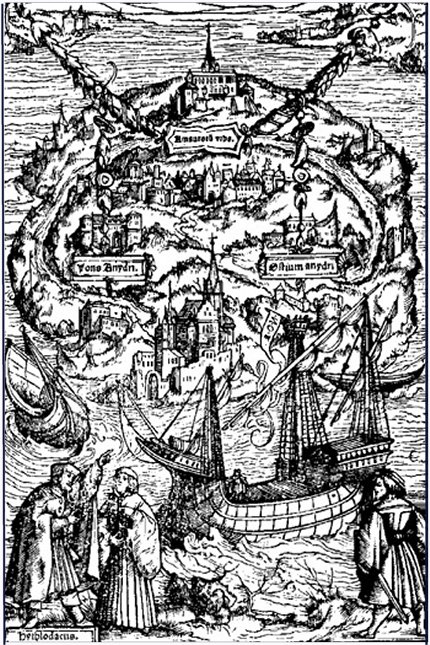
    I’ve just finished reading Utopia by Sir Thomas More (1478-1535).

    Utopia contrasts the contentious social life of European states with the perfectly orderly, reasonable social arrangements of Utopia and its environs (Tallstoria, Nolandia and Aircastle). In Utopia, with communal ownership of land, private property does not exist, men and women are educated alike and there is almost complete religious toleration.

    Woodcut by Ambrosius Holbein for the 1518 edition of Thomas More's Utopia
    Woodcut by Ambrosius Holbein for the 1518 edition of Thomas More’s Utopia. Picture courtesy of Wikimedia Commons

    One passage in the final chapter (entitled ‘Of the religions of the Utopians’) in particular struck a chord with me. It’s reproduced below.

    Therefore I must say that, as I hope for mercy, I can have no other notion of all the other governments that I see or know, than that they are a conspiracy of the rich, who, on pretence of managing the public, only pursue their private ends, and devise all the ways and arts they can find out; first, that they may, without danger, preserve all that they have so ill-acquired, and then, that they may engage the poor to toil and labour for them at as low rates as possible, and oppress them as much as they please; and if they can but prevail to get these contrivances established by the show of public authority, which is considered as the representative of the whole people, then they are accounted laws; yet these wicked men, after they have, by a most insatiable covetousness, divided that among themselves with which all the rest might have been well supplied, are far from that happiness that is enjoyed among the Utopians…

    Did Thomas More foresee the present UK government and its failed austerity policy? Hardly likely, but his words still have a ring of truth to them, which tells me that very little has changed in in general in governments since More’s time six centuries ago, apart from the introduction and gradual widening of the franchise to give the snollygosters an air of democratic respectability.

    In case you’re wondering, a snollygoster is a person, especially a politician, who is guided by personal advantage rather than by consistent, respectable principles. As a word, it originated in the fast-expanding USA of the nineteenth century.

    More’s Utopia is available for free in various formats from Project Gutenberg (posts passim).

Posts navigation