In Monty Python’s Life of Brian, Reg, the leader of the People’s Front of Judea (PFJ) asks: “All right, but apart from the sanitation, the medicine, education, wine, public order, irrigation, roads, a fresh water system and public health, what have the Romans ever done for us?“
Moving well north and west from Judea to England and asking the same question about the benefits of Roman rule for the locals, one unexpected legacy of oppression under the hob-nailed caliga may well be the north-south divide, but does that political, cultural and linguistic division, which has been a permanent fixture in your ‘umble scribe’s life, really date back over one and a half millennia? It is a recognised phenomenon that has even merited its own Wikipedia page.
Anyway, back to the Romans.
The Roman province of Britannia was in existence from the invasion of Claudius in 43 CE until with withdrawal of the legions in around 410 CE.
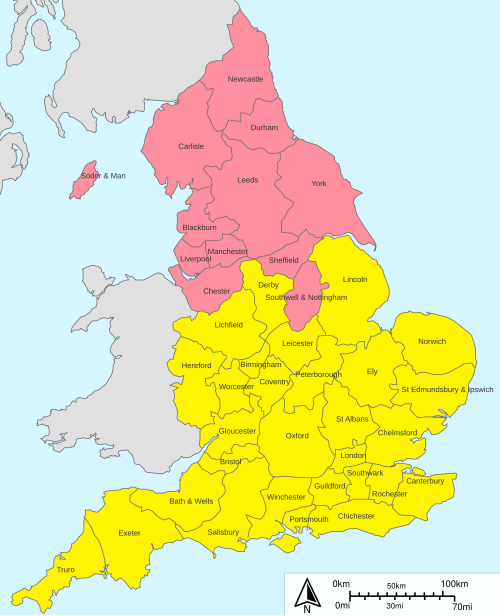
Some time, either in the late second century or early third century CE the province of Britannia was split into two, with Britannia Superior (Upper Britain) in the south governed from Londinium (London) and Britannia Inferior (Lower Britain) in the north governed from Eboracum (York). It is not known where the boundary between the two administrative regions was demarcated, with the boundary in the graphic below being purely conjectural.

Both Britannia Superior and Britannia Inferior were later sub-divided further. In 296, the emperor Diocletian undertook a major reorganisation of the empire. The newly named Diocese of Britannia was subdivided into four provinces, Britannia Prima and Maxima Caesariensis from Britannia Superior and Britannia Secunda (capital in Eboracum) and Flavia Caesariensis (capital in Lindum (Lincoln)) from Britannia Inferior.
When Catholic Christianity came to England, it followed a similar pattern to the fate of the Roman imperial province: firstly administration as a sole archbishopric from Canterbury, then the division of the country into two provinces, Canterbury and York, with the latter archbishopric being established 735, after being a bishopric from 626. This administrative ecclesiastical division has persisted to this day, with the Archbishop of York being regarded as the Church of England’s second most senior cleric.
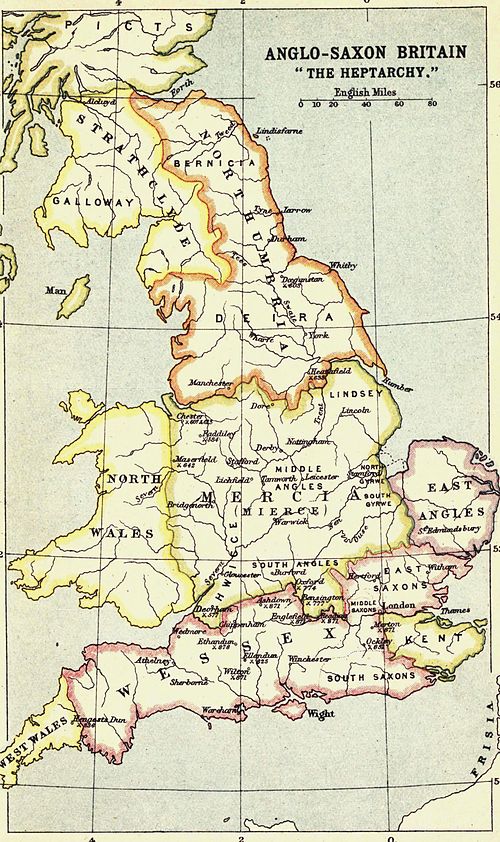
At about the same time that the early church was developing, so were England’s seven Saxon kingdoms (established by the descendants of incomers from continental Europe from the 5th century onwards, who intermarried with the locals and whose culture became the dominant one in what was later to become England. Ed.) – otherwise known as the Heptarchy. Of these, one of the largest was Northumbria, whose capital was likewise York and whose southern boundaries extended from the Mersey estuary in the west to the Humber estuary in the east.
However, other factors than ecclesiastical and administrative division need to be taken into account. These include the arrival and settlement of large parts of England with Norse speakers from the mid-ninth century onwards, ultimately resulting in the establishment of the Danelaw. The settlement of large numbers of Norse speakers also had a profound effect on the development of what became modern English, simplifying some of the more complicated syntax of Old English inherited from its Germanic roots, as well as enriching the language with such everyday nouns as egg and knife, plus adjectives like sly. Wikipedia has a list of English words of Norse origin, but your ‘umble scribe does not consider it complete as it has been reckoned that up to 3,000 modern English terms have their origins in Old Norse. But perhaps the most telling distinction is the difference in the origin of dialect words between the north and the south (e.g. the northern use of beck for a stream and in certain regions gan for go).
The north-south divide also played a role in that most famous year in English history – 1066, involving as it did a fraternal dispute between the two sons of Godwin of Wessex, namely Harold (who some, particularly William of Normandy believed had usurped the English crown which he believed had been promised to him. Ed.) and Tostig, earl of Northumberland. As earl of Northumberland, Tostig governed with difficulty. He was never popular with the Northumbrian ruling class, a mix of Danish invaders and Anglo-Saxon survivors of the last Norse invasion. Tostig was said to have been heavy-handed with those who resisted his rule, including murdering several members of leading Northumbrian families. On 3rd October 1065, the thegns of York and the rest of Yorkshire descended on York and occupied the city. They killed Tostig’s officials and supporters, then declared Tostig outlawed for his unlawful actions. Shortly after, Kind Edward the Confessor exiled Tostig at the behest of his brother Harold.
When Edward died and was succeeded by Harold, his rule was challenged by Tostig and Harald Hardrada of Norway, both of whom were killed at the Battle of Stamford Bridge on 25th September 1066. Hard on the heels of that encounter, Harold Godwinson himself lost the crown by being defeated by William (nicknamed both the Conqueror and the Bastard. Ed.) Duke of Normandy at Hastings on 14th October 1066.
The Norman takeover of England was not wholeheartedly welcomed everywhere and more particularly he William faced a series of rebellions and border skirmishes in Dover, Exeter, Hereford, Nottingham, Durham, York and Peterborough. However, the biggest revolt came in the northern part of England and is generally know to history as the Harrying of the North. In 1086, twenty years after William the Bastard’s invasion and the battle of Hastings, his great survey of the country known as the Domesday Book lists many areas as being waste, i.e. unproductive land yielding no tax revenue, so great had been his retribution for the revolt against his rule.
The fourteenth century is our next halt on this journey down the English north-south divide.
In 1381 there was a popular uprising now known to history as the Peasants’ Revolt (although plenty of people other than peasants were involved. Ed.) occurred. Although the main events occurred in the south-east of England, particularly Essex, Kent and London, revolts and public unrest occurred in other parts of England too; and the north did not escape.
Wikipedia records that:
In the town of Beverley, violence broke out between the richer mercantile elite and the poorer townspeople during May. By the end of the month the rebels had taken power and replaced the former town administration with their own. The rebels attempted to enlist the support of Alexander Neville, the Archbishop of York, and in June forced the former town government to agree to arbitration through Neville. Peace was restored in June 1382 but tensions continued to simmer for many years.
Hard on the heels of the events of 1381, 1395 was a pivotal year in English literary history with the appearance of Geoffrey Chaucer’s Canterbury Tales. Chaucer himself wrote (and probably spoke) in the East Midlands dialect which was prevalent in places such as London, Oxford and Cambridge, and was one of the most influential medieval English dialects in forming Modern English. However, he knew the Northern dialect too and it is spoken by the two northern clerks in the Reeve’s Tale.
The tale concerns Symkyn, a miller of Trumpington near Cambridge. He overcharged the steward of Soler Hall (which later became part of Trinity College), the college steward was too ill to face him. Two clerical students there, John and Aleyn, originally from Strother in north east England (a place now lost in the historical and geographical record. Ed.), are outraged at this theft and vow to beat the miller at his own game. The north-eastern accent of the two clerks is also the earliest surviving attempt in English literature to record a dialect from an area other than that of the main writer and is believed to be the first effort in English to extract comedy from imitating accents.
And that linguistic divide has existed since at least Chaucer’s time, with occasional low-level mutual disdain for the accents and dialects of north and south. One of my nieces – a Lancashire lass – did her degree in London. Whilst in London she was constantly told how northern she sounded; during visits back to the red rose county, the perceived loss of her accent and perceived adoption of southern speech were also remarked upon.
Over the centuries distinct differences other than linguistic have also grown up. Take food for instance. Bury has long been regarded by many as the traditional home of black pudding, whilst London will always be associated with jellied eels. Pie lovers generally associate decent pies with the north (see Hairy Bikers. Ed.). Turning to music, London has the Royal College of Music; Manchester is home to the Royal Northern College of Music. On the sports field the north has long been the home of rugby league (13 players per side) whilst rugby union (15 per side) has long predominated in the south. Plenty of other examples in other fields are also available.
 Before drawing to an end, it’s worth noting that where the north and south of England both begin and end is not fixed. If one is on the M1 down near London, the motorway signage clearly indicates that the North begins beyond Hatfield in Hertfordshire. In contrast, my Mancunian friend Steve defines the start of the North as anywhere north of a horizontal line at Knutsford Services on the M6 in line with the general rule that the further north one goes, the further north the south begins.
So, returning to and paraphrasing the PFJ’s Reg, apart from the sanitation, the medicine, education, wine, public order, irrigation, roads, a fresh water system and public health, did the Romans also give England its north-south divide? Have your say in the comments below.
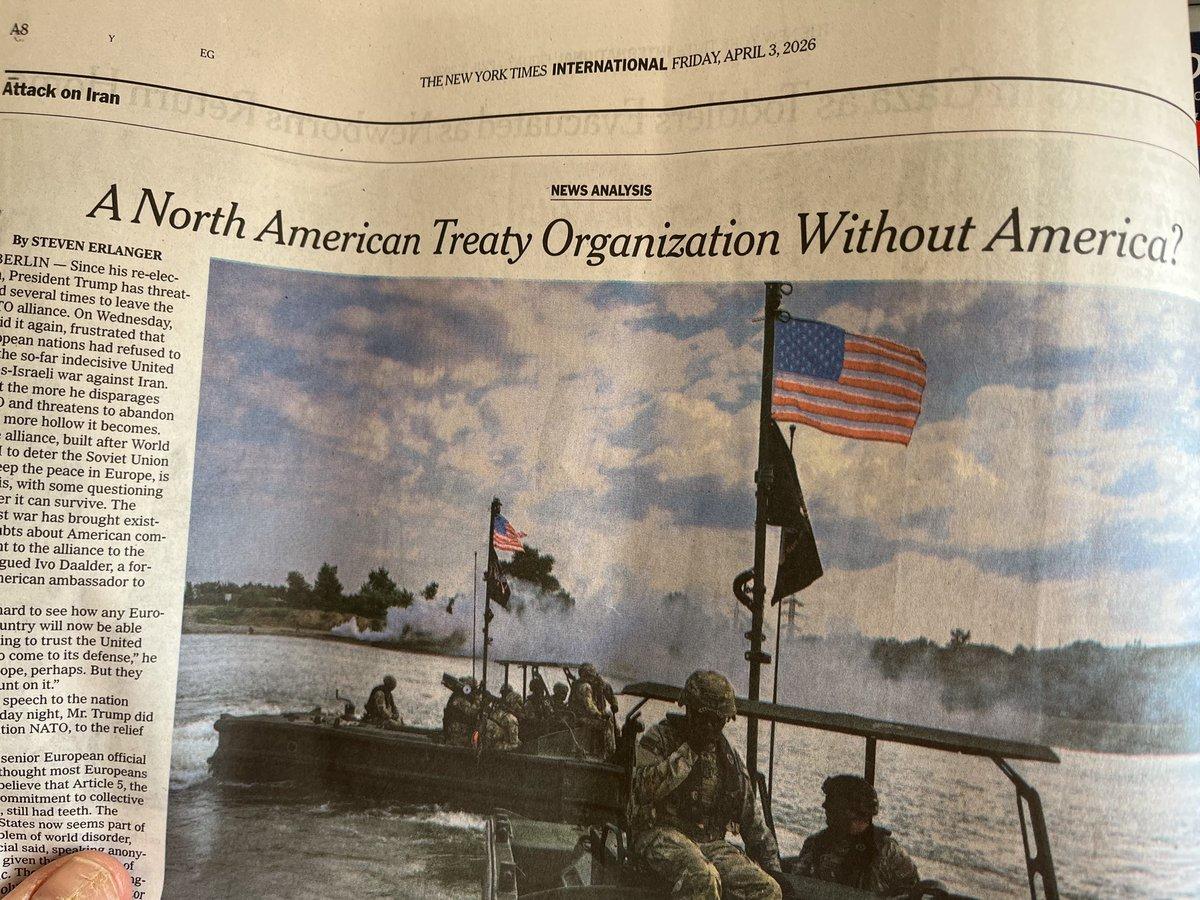
 Yes, you did read that correctly. With one flourish of fingers across the keyboard, the North Atlantic Treaty Organization has been transformed into the North American Treaty Organization by a New York Times ‘journalist’ seemingly unaware of a relatively common fact-checking tool commonly known to humanity as 5 minutes’ Googling*.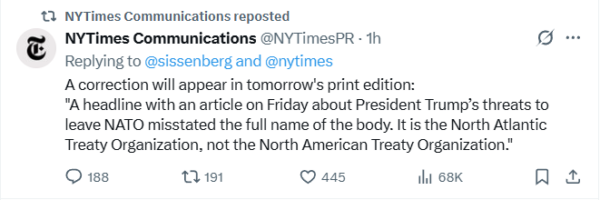





![Post reads over on threads someone just use [sic] ai;dr and we all need to adopt that right quick](http://xislblogs.xtreamlab.net/slwoods/wp-content/uploads//sites/23/2026/02/ai-dr.png)