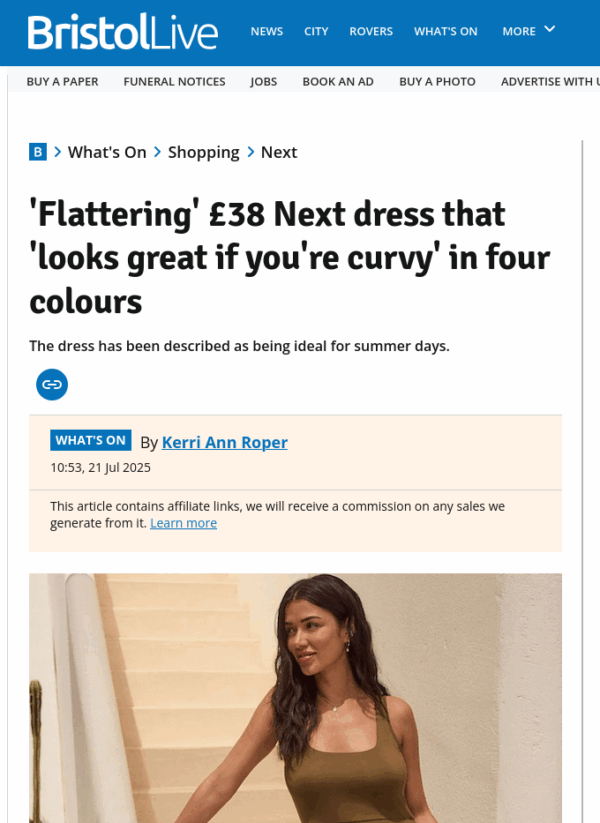
Some consumer clickbait from yesterday’s Bristol ‘Live’, a Reach plc local news title.
Articles for the same product also appeared in other Reach plc titles such as the Manchester Evening News and Birmingham ‘Live’, although their readers were not informed that curvaceousness comes in four colours, as were the good burghers of Bristol.
The reason for this is because the headline writers on those papers can recognise ambiguity, unlike those at the Temple Way Ministry of Truth.
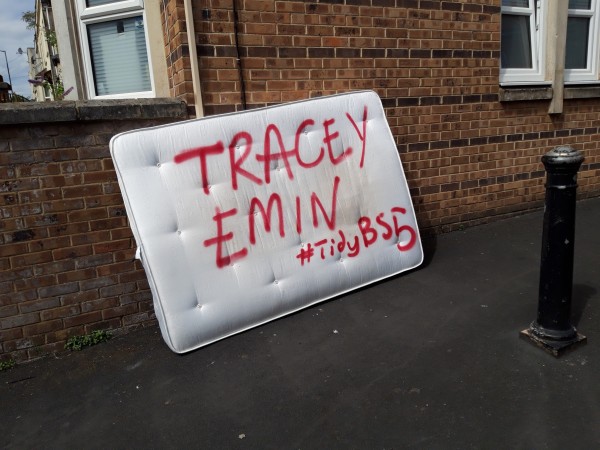
More years ago than he cares to remember, your ‘umble scribe was asked by one of his local ward councillors (now retired) to come up with a hashtag to publicise our fight against grime – litter, fly-tipping. fly-posting and other environmental crimes – in Bristol’s inner city wards of Easton and Lawrence Hill.
And so #TidyBS5 was born.
Well over a decade later, it’s very encouraging to see others using it, as per this mattress currently gracing St Mark’s Grove.
After Mandarin Chinese and Castilian Spanish, English is the third most spoken native language in the world today, as well as the world’s most widely learned second language, according to Wikipedia.
How it reached that position is a long and complicated story which has been reduced to a 22 minutes’ historical romp by the excellent Rob Words on YouTube.
Rob’s story of English from its earliest origins to the present day starts a long way from the shores of present-day England or even the eastern shores of the North Sea of what is now Frisia, northern Germany and Denmark where most of the origin stories for English start.
No, Rob starts in Asia around the shores and land between the Black Sea and Caspian Sea where it is believed the original ancestral language of English began, before moving both west and east to become the ancestors of the modern European languages and those of the Indian sub-continent based upon Sanskrit, the so-called Indo-European languages. For want of an actual name that has survived down the centuries, this ancestral language is referred to as Proto-Indo-European.
On the move westwards, the branch of Proto-Indo-European from which English developed is known as Proto-Germanic, which predated not just English and German, but also Dutch, Frisian and the Nordic/Scandinavian languages, Norwegian, Swedish and Danish.
The story of English on the island of Britain actually begins in the 5th century after the departure of the Romans and mercenaries from across the North Sea who eventually settled are involved.
The influences of subsequent invasions – such as the Vikings and William the Invader‘s wine-drinking, Francophone former Norse marauders are also noted, as are the roles of Shakespeare, Caxton‘s printing press (especially Chancery standard English. Ed.) are all covered as is the effect on English of England’s/Britain’s role in invasion, conquest and colonisation since the mid-sixteenth century.
Anyway, I hope you enjoy the video as much as me; and learn something too, which I definitely did.
The dictionary definition of ambiguity is “the fact of something having more than one possible meaning and therefore possibly causing confusion“.
Any sensible person would therefore believe that ambiguity has no place in a newspaper headline.
However, newspapers are not written nowadays by sensible people: or so it would seem.
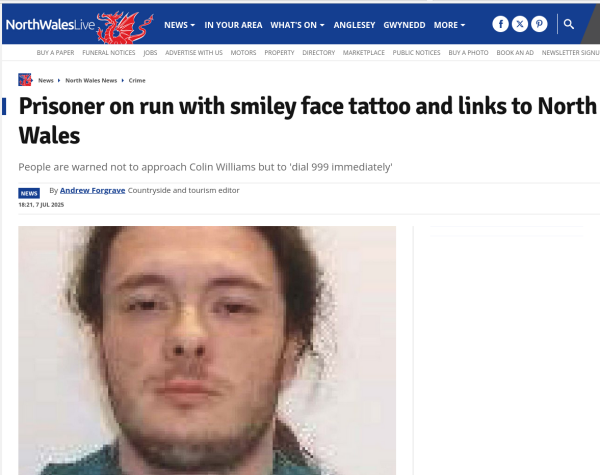
This is exacerbated by the modern media practice of trying to cram the entire story into the headline in a condensed form, as shown by the screenshot below of this piece from the Daily Post, a title in the Reach plc stable which serves the north of Cymru.
For the benefit of passing illiterate Reach ‘journalists’, an unambiguous version of the headline would read “Prisoner with smiley face tattoo and links to North Wales on run”.
It has since been rumoured that the smiley face tattoo has been recaptured by police. 😉
For those unaware of the actions of the racist US Immigration and Customs Enforcement agency under the less than benign presidency of the disgraced former 45th president and current disgraceful 47th president of the United States of America, insurrectionist, convicted felon, adjudicated sexual predator, business fraudster, congenital liar and golf cheat commonly known as Donald John Trump, the mock-up US road sign is on the right (naturally. Ed.).
The cruel actions of ICE are all part of The Felon’s chief mission to Make America Grate Again (or something like that. Ed.).
First Group has a virtual monopoly on public transport in Bristol via its buses and GWR Trains. However, its inability to run any service to timetable – no matter how important – has earned it the nickname of Worst Group.
First Bus was all over the local media at the start of June when it announced the opening of a new bus depot in the city’s Hengrove area for servicing its fleet of electric buses which will eventually total 74 vehicles.
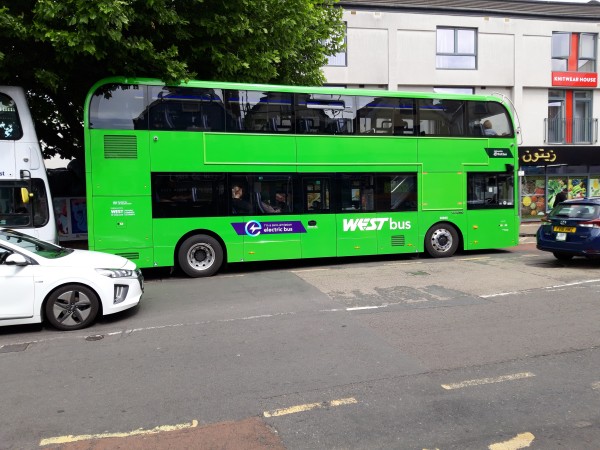
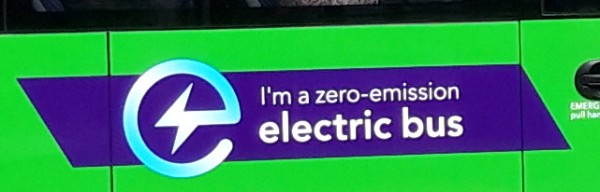
Your ‘umble scribe recently tried out one of the new double decker electric buses on the Number 24 route, which runs between Ashton and Southmead Hospital. On the whole the experience was very positive. The bus was clean, the ride silent and smooth. However, at this point a significant however enters the picture, namely that your correspondent was less than impressed by the greenwashing on the sides of the bus.
Greenwashing (a compound word modeled on “whitewash”), also called green sheen, is a form of advertising or marketing spin that deceptively uses green PR and green marketing to persuade the public that an organization’s products, goals, or policies are environmentally friendly. Companies that intentionally adopt greenwashing communication strategies often do so to distance themselves from their environmental lapses or those of their suppliers.[6] Firms engage in greenwashing for two primary reasons: to appear legitimate and to project an image of environmental responsibility to the public.
Whilst the engines of the new buses produce zero greenhouse gases or particulate emissions, that does not necessarily mean the vehicles are entirely free of emissions, especially when significant elements of the vehicle produce particulates due to wear and tear caused by their function. The two components involved are the brakes and tyres.
Until First acquires vehicles with zero tyre and brake wear, they should continue to be called out for being less than honest with the (travelling) public.
In a further perceived blow to Bristol’s allegedly long-suffering but volubly vocal motoring lobby, Bristol City Council has announced it is investigating alternative uses for two current car parks, according to Bristol247.
One of the two, near the SS Great Britain down the city docks and known as the Maritime Heritage Centre Car Park, is being investigated as a site for up to 150 flats. However, the fate of the other behind the Counts Louse (which some insist on calling City Hall. Ed.) is completely different; it’s due to be superseded by, er, jargon, i.e. special words or expressions used by a profession or group that are difficult for others to understand, in this instance something termed a last-mile micro-consolidation hub.
Thankfully a picture showing what this could look like has been provided by WSP, the city council’s chosen gibberish partners.
Yer tiz, as we say in Bristol.
Image courtesy of WSP
According to WSP, the gibberish “will provide a sustainable solution for freight deliveries, reducing reliance on traditional vans and supporting the city’s decarbonisation goals”.
Note how yet more jargon has to be used to explain the initial gobbledygook. If two loads of jargon are required to explain a fairly simple concept, perhaps the verbal diarrhoea merchants need to have a long sit down and a rethink. 😀
The BBC loves to boast about the quality of its journalism.
However, every now and again, it manages to publish an untruth so egregious and also stupid that one wonders how it gained a reputation for high class output in the first place.
To continue our story, we must travel to Nottinghamshire and the banks of the River Trent.
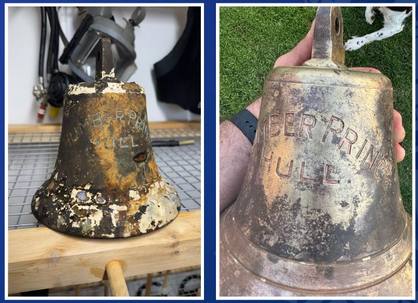
In April members of the police Underwater Search Team found a corroded ship’s bell during a routine training exercise and brought it ashore for a closer look, where the name Humber Prince emerged after the item was cleaned.
The bell was formerly attached to a vessel originally known as the Esso Nottingham, which was built in 1956 and subsequently re-registered as the Humber Prince in 1964 by Hull-based company by John H Whitaker Tankers, which used to ferry hydrocarbons on the river.
From the photos on the police press release, it is obvious that the bell is made of brass or bronze, not a ferrous metal such as iron or steel, which typically rusts as it corrodes.
Wikipedia’s page on the ship’s bell gives full details of the typical materials used.
The bell itself is usually made of brass or bronze, and normally has the ship’s name engraved or cast on it.
May I suggest that the BBC’s author writes out 100 times “Iron and steel rust. Other metals corrode!“
In recent times, QR codes have started to be exploited in phishing attacks, as reported and explained by The Daily Record. This has given rise to another neologism and such attacks are also known as ‘quishing’.
Denbighshire County Council and Conwy County Borough Council has urged residents to take care, as neither use QR codes as a payment method at council-run car parks.
Similarly, more than 20 fake QR code reports have been made regarding parking meters across the promenade in Llandudno.
For comprehensive advice on fake QR codes and how to avoid them, plus other scams visit Stop Scams UK.
NB: The QR code at the top of this post contains a QR code to one of the links used in the piece.




 In recent times,