Steve Woods

Written by a human.

  • Plastic peregrine

    peregrine falcon image
    Peregrine falcon
    Yesterday it was a joy to discover that the peregrine falcons which nested on the old generator house by St Philip’s Bridge were nesting there again (posts passim). Talking to a gentleman on the bridge who’d been watching them through binoculars, it would appear our urban peregrines are also adapting to our urban environment and are also learning to hunt after sunset using the city’s streetlighting.

    A couple of weeks ago, my attention was caught by peregrine calls when walking down Redcliff Street. They weren’t emanating from a falcon at all, but it’s taken your correspondent until now to track down their source. Looking up at the roof of the old, soon to be redeveloped Patterson’s building, I saw the sight below.

    fake peregrine

    Note the electric wire and turntable. It’s a plastic peregrine which looks very realistic to the local gull population. It rotates on its turntable, flaps its wings and also calls like a real falcon from time to time. It won’t fool me again.

    Update 09/04/15: Today I discovered the Redcliff Street plastic peregrine has a brother not far away in the city. He’s called Brian, lives on the roof of At-Bristol and has a Twitter account.

  • Non-English and non-Welsh speakers to be charged premium rate by DVLA

    In what appears to be a last-ditch swipe against foreigners, motorists who don’t speak either English or Welsh and want to use DVLA’s translation service will pick up the costs under changes announced on 25th March 2015 (the day before Parliament was prorogued. Ed.) by Transport Minister Baroness Kramer.

    telephone
    Picture courtesy of Holger Ellgaard and Wikimedia Commons
    The changes, which take effect from 29th April 2015, mean callers who request a translation service will now pay for the cost of the call. Currently, the cost of providing a translation service is covered by DVLA.

    Transport Minister Baroness Kramer said: “The vast majority of calls to DVLA are either free or charged at local rate. However, it is only right that the cost of using translation services is paid for by those who use them. The change will help encourage individuals who don’t speak English very well to learn the language and also help when accessing government services.”

    Under the changes, those who need a translation service will need to call the premium rate numbers, which will be publicised by DVLA closer to the implementation date of 29th April.

    The numbers will be available from 8am to 7pm Monday to Friday and from 8am to 2pm on Saturday. Calling these telephone numbers will cost £1.03 per minute from a landline and may cost considerably more from a mobile.

    All other public calls to DVLA contact centre are either free or charged at local rate.

    Hat tip: Yelena McCafferty.

  • Good Friday in Bristol 5

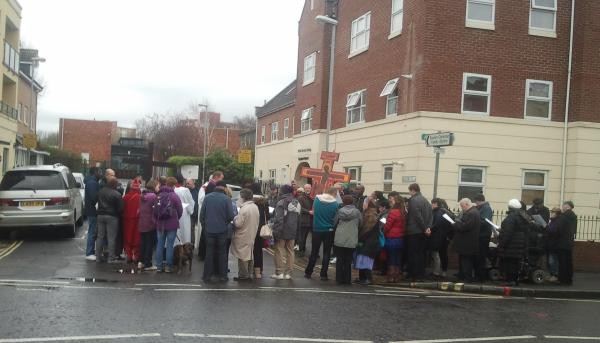
    When venturing out onto Stapleton Road earlier today, an unusual sight met my eyes – an open-air church service for Good Friday, the Christian holiday commemorating the crucifixion of Jesus Christ and his death at Calvary.

    Good Friday service on Stapleton Road

    Seeing the service in progress prompted me to look at the etymology of Good Friday. From whence does it originate.

    According to Wikipedia, the etymology of the term “good” in the context of Good Friday is disputed, with some sources claiming it is from the senses pious, holy of the word “good“, whilst others contend that it is a corruption of “God Friday“. The Oxford English Dictionary supports the first etymology, giving “of a day or season observed as holy by the church” as an archaic sense of good and providing examples of good tide meaning “Christmas” or “Shrove Tuesday” and Good Wednesday meaning the Wednesday in Holy Week.

    In German-speaking countries Good Friday is generally referred as Karfreitag (Kar from Old High German karabewail‘, ‘grieve‘, ‘mourn‘; Freitag for ‘Friday‘): Mourning Friday. The Kar prefix is an ancestor of the English word care in the sense of cares and woes; and thus mourning. The day is also known as Stiller Freitag (Silent Friday) and Hoher Freitag (High Friday, Holy Friday) in German-speaking countries.

  • Evolve OS changes name to Solus

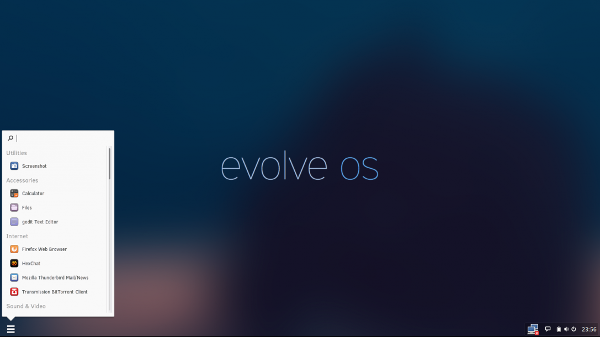
    This blog reported yesterday that the developers of the Evolve OS Linux desktop operating system had received a letter from lawyers acting for the UK’s Department for Business, Innovation & Skills informing them that BIS’ OS trade mark was being infringed and that the developers would have to pick a new name.

    Evolve OS screenshot

    Ikey Doherty of the development team has now posted the following statement on Google+:

    Thank you, everyone for helping us in the naming process! In that time, one name cropped up time and time again. A name we do own, and one indicative of our history and roots. Most importantly, the longevity, history and direct, traceable link of this name provides absolute and irrefutable evidence of prior art, and all rights to the name within this context. We have purchased solus-project.com and solus-project.net. Thus, Evolve OS will now be known (once again) as Solus. The full name for the operating system component of the project (i.e. the Linux distro) is Solus Operating System – the entirety of the project is the Solus Project.

  • Petition to end copyright rustling

    No Peanuts for Translators has posted a petition on Change.org to collect signatures for an end to copyright rustling – the deliberate deprivation of intellectual property rights for translators of literary works. Under copyright, literary translations are considered to be derivative works and their authors are entitled to royalties.

    sheriff with copyright rustler wanted poster

    The text of the petition reads as follows:

    Recent research shows that translators’ copyrights are “rustled” one third of the time in trade and commercial publishing—and eighty percent of the time in university-press publishing.

    Simply put, copyright rustling happens when a book publisher takes something from a translator that rightfully belongs to the translator alone: copyright to his or her work.

    Some of the biggest copyright rustlers in 2014 also happened to be some of the biggest publishers of translations in English—Europa Editions, Atlantyca, New Vessel Press, Gallic Books, Columbia University Press, Skyhorse Publishing, Yale University Press, Bloomsbury, Routledge, and others. (See Copyright “Rustling” in English-Language Translation: How Translators Keep (and Lose) Rights to Their Work—Data from Translations Published in 2014; http://tinyurl.com/lzpz2cm.)**

    Copyright rustling is not inevitable. It is not “standard industry practice.” It is not necessary for the translator-publisher relationship to function nor does it help publishers “afford” to publish translations.

    Let’s cut through the nonsense. Copyright rustling is a symptom of translators’ lack of negotiating power and of publishers’ willingness to exploit that weakness to their own advantage.

    No Peanuts! calls upon all publishers of translations in English:

    * Take copyright off the table. Negotiate fair terms with translators for licensing the use of their copyright, but recognize that the translation belongs to the translator who is allowing you to use it.

    * Take copyright off the table. Recognize translators’ legal and moral rights to their intellectual property.

    * Take copyright off the table. Stop coercing translators by making copyright transfer a take-it-or-leave-it condition of publishing contracts.

    Mutual respect always. Copyright rustling never!

    (Learn more about this issue on the No Peanuts! blog: https://nopeanuts.wordpress.com/resistance/stop-copyright-rustling.) Or write: nopeanuts.fortranslators@gmail.com.

    ———————-
    ** At the close of the campaign, a copy of the petition & signatures will be delivered to the following publishers. If you’d like to contact them directly in the meantime, their addresses are listed in Copyright Rustling: http://tinyurl.com/lzpz2cm. Atlantyca, Bloomsbury, Cambridge University Press, Cistercian Publications, Columbia University Press, Duke University Press, Europa Editions, Fordham University Press, Gallic Books, Glagoslav Publications, Hackett Publishing, HarperCollins, Harvard University Press, Ignatius Press, Karnac Books, New Vessel Press, Palgrave/McMillan, Princeton University Press, Routledge, Rowman & Littlefield, Skyhorse Publishing, Stanford University Press, SUNY Press, Syracuse University Press, University of Chicago Press.

    Sign the petition and help prevent fellow linguists being ripped off.

  • LibreOffice 4.4.2 released

    The Document Foundation has today announced the release of LibreOffice 4.4.2, the second minor release of the LibreOffice 4.4 “fresh” family, with over 50 fixes compared with LibreOffice 4.4.0 and 4.4.1.

    LibreOffice about window

    New features introduced by the LibreOffice 4.4 family are listed in the release notes.

    The Document Foundation suggests to deploy LibreOffice in enterprises and large organizations when backed by professional support by certified people, of whom the Foundation maintains a list.

    People interested in technical details about the release can see the changelogs for the bugs fixed in RC1 and bugs fixed in RC2 respectively.

    Download LibreOffice

    LibreOffice 4.4.2 is immediately available for download from http://www.libreoffice.org/download/.

    LibreOffice users, free software advocates and community members can support The Document Foundation with a donation. Money collected will be used to improve the project’s infrastructure and support marketing activities to increase the awareness of the project at both global and local levels.

    I’ve been using version 4.4.2 for a while now since I downloaded a pre-release development build (version 4.4.2.2) and have found it both stable and easy to use.

  • Evolve OS name change forced by trade mark dispute with UK government

    The Evolve OS desktop Linux distribution is being forced into a change of name due to potential trade mark problems with the UK government, Softpedia reports.

    Evolve OS screenshot

    The bone of contention is not the Evolve element, but OS, which is apparently a trade mark registered to registered to the Secretary of State for Business, Innovation and Skills, whose trade mark agents are a company called Field Fisher Waterhouse LLP.

    In its headline, Softpedia describes this trademark registration as “stupid“.

    Writing yesterday on Google+, the developers stated:

    This is not an April Fools post

    We will be required to change the name of the Evolve OS project, to avoid unnecessary legal action. All I will say right now is that the dispute is UK specific, and I have been informed that the relevant trademarks are held by the Secretary of State.

    The letter goes beyond asking for a withdrawal of trademark application and asks we stop using the “mark”.

    Clearly this is going to be an expensive and painful road in either direction, so we shall go with a rename.

    The developers have also asked for the help of the free and open source community to come up with a new name that would be free of trademark infringements.

    Reposted from Bristol Wireless.

  • Debian Jessie target release date announced

    Debian logoNiels Thykier of the Debian release team has announced the release date for the forthcoming version 8 of Debian, codenamed Jessie. Jessie should be ready on Saturday 25th April. The could only change, Thykier writes, if something really critical pops up or it is not possible to publish the release on time for technical reasons.

    There is still time until 18th April for final bug fixes; there should be no further changes to Debian in the final week before release. Managers of packages with bugs must therefore work speedily on getting them fixed. Until the release packages with critical bugs could still be removed from the distribution. Thykier writes that there are currently at least twelve release-critical bugs which could result in the removal of the packages concerned from Debian 8.

  • PI4J launches manifesto at election time

    PI4J logoProfessional Interpreters for Justice (PI4J) is an umbrella group an umbrella group representing over 2,000 interpreters on the National Register of Public Service Interpreters (NRPSI) and 300 British Sign Language (BSL) interpreters.

    It has been campaigning since the Ministry of Justice signed an agreement with ALS (later Capita Translation & Interpreting) for the provision of interpreting services for courts and tribunals on the basis that reliable communication provided by qualified professional interpreters and translators is an essential resource which ensures that justice and human rights are upheld for non-English speakers and deaf people. This is put at risk if standards are dropped and quality is sacrificed for profit.

    To highlight the threats to justice and human rights by cost-cutting on the provision of interpreters in the justice system and against the background of the forthcoming general election, PI4J has published a 7 point manifesto (PDF), as follows:

    • The use of qualified interpreters: Only qualified and experienced Public Service Interpreters to be
      used within the current MoJ Languages Services Framework Agreement and in any future arrangements.
    • Full consultation with the interpreting profession: Future arrangements cannot succeed without the
      support of professional interpreters.
    • Sustainable terms and conditions to be offered to interpreters: to ensure the success of any future
      arrangements and quality of service.
    • Independent auditing of quality and performance: Credible scrutiny of contract management and
      adherence to its provisions is essential, and should be part of the role of an independent Quality
      Assurance and Quality Management body.
    • Independent regulators: Regulation and the maintenance of registers should not be in the hands of
      private providers. In line with government guidance, since 1 April 2011 the NRPSI has been a fully
      independent regulator of the profession, paid for by the interpreters and run solely in the public
      interest. PI4J is of the view that the National Registers of Communication Professionals working with Deaf and Deaf Blind People (NRCPD) should also be independent.
    • Minimum levels of interpreter qualification: Interpreter training as well as language fluency with a minimum level of entry-level qualification must be required with skills maintained and developed
      through a programme of Continuing Professional Development (CPD). Provision should be put in place to encourage the supply of Rare Language interpreters.
    • Statutory protection of title: A working group must be set up to examine the feasibility of the
      introduction of statutory protection for the title of Public Service Interpreter.
Posts navigation