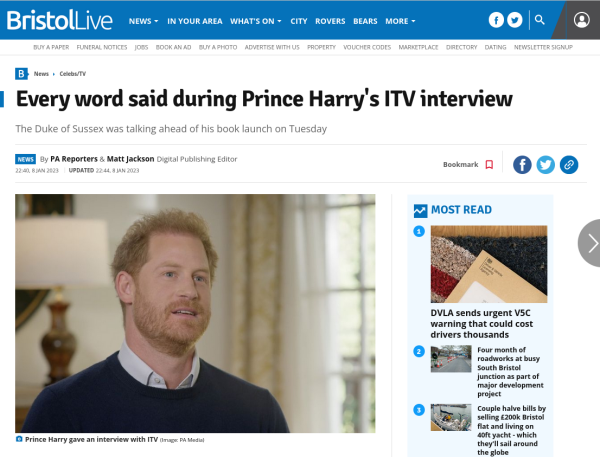
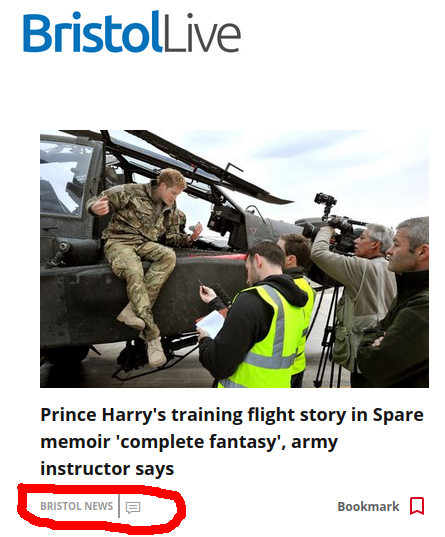
The Bristol (Evening) Post?Bristol Live website has a Bristol News menu item on its website. Today the home page revealed the item below had been added to that category.
Where to in Bristol did Mr. Henry Charles Albert David Mountbatten-Windsor do his flight training in Bristol?
At this point a number of significant howevers enter the narrative. Firstly, the army has no aviation training centre either in Bristol or its immediate environs, according to its website.
A second however could be levelled at the second part of the Reach publication’s classification of this item as News. It’s actually what could be classed as gossip, i.e. idle talk or rumour, especially about personal or private affairs of others, except that informant in question has gone running a national Sunday ‘news’ publication in the Reach plc stable.
Thirdly, for those whose who are really desperate to read this alleged news, it can be found here.
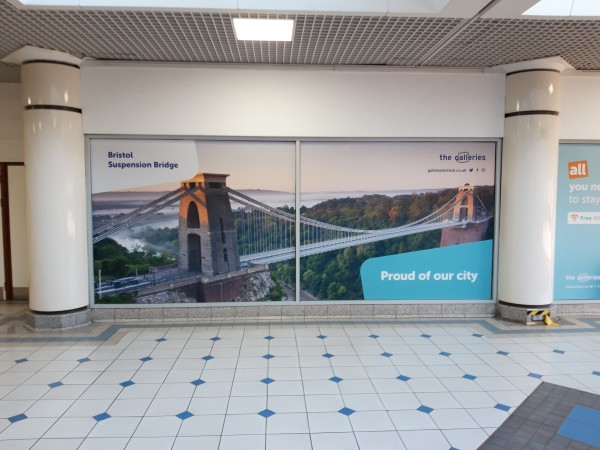
The Galleries shopping centre in Broadmead in Bristol opened in October 1991. Originally managed by managed by Capital & Regional and Aviva Investors, the complex is now in the hands of LaSalle Investment Management, whose registered office is in Chicago, IL in the United States.
However, this has not stopped them from trying to appear a local company: note the phrase “Proud of our city“
However, despite their pride in our city, LaSalle still manages to fail miserably as shown in the photograph below.
Last time I looked there was no Bristol Suspension Bridge. There are, however, a few suspension bridges around the city, but none of them is named after the city of their siting.
Somehow a photograph of the world-famous Clifton Suspension Bridge designed by Brunel but not opened until after his death has been used in error.
Ask any Bristolian its whereabouts and the answer is likely to be:”Bristle Suspension Bridge: where’s that to?”
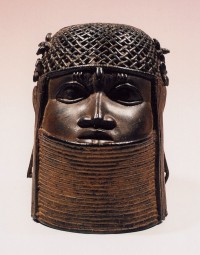
In 1897 British troops attacked, burned down and looted the palace of the Oba (king) of Benin in West Africa. The former Kingdom of Benin (1180–1897) is now part of present-day Nigeria.
Amongst the squaddies’ loot was a huge haul of bronze sculptures, many of which found their way into museums, galleries and onto the western art market.
One of these was acquired in Bristol City Museum & Art Gallery in 1935, where it is described as Object Number Ea7821.
Back in 2020 Prince Edun Akenzua of the Royal Court of Benin made a direct appeal to Bristol to return the looted artwork to Nigeria, as reported at the time by the Bristol Post.
Since then many fine words have been written by the city council about repatriation both on the museums website and the museums blog with the latter stating the following regarding the fate of the sculpture:
Although we have still not been able to make contact directly with Royal Court officials, we have been looking at the work of the British Museum and the Benin Dialogue Group and discussing options with the Legacy Restoration Trust. To be clear, we are not bound by the thoughts or decisions of any of these bodies, nor the UK government.
We have been gathering information about the best way to take on board the variety of thoughts and concerns of different groups in Nigeria. There has been a lack of consensus about the best place to hold objects that return to the country. The new, but yet to be built, Edo Museum of West African Art is one option that many do agree with.
Your ‘umble scribe also believes the city council’s museums service could have moved a little quicker and has today filed the following FoI request with the city council.
Dear Bristol City Council, This is a request for information under the Freedom of Information Act. The City Museum & Art Gallery contains in its collection a Benin bronze head (Object Number: Ea7821) looted by the Oba’s palace in 1897 and acquired by the museum in 1935. Some years ago, the local media reported that this object was to be repatriated to Nigeria. There have been no subsequent reports of its repatriation, so I am assuming this has still to happen.
Kindly provide an explanation for the delay in repatriating this object to where it belongs despite the city museums website (source: https://www.bristolmuseums.org.uk/collections/action-on-decolonisation/repatriation/) stating: “Bristol City Council acknowledges and recognises that the possession of historic Benin Bronzes is highly contentious and that there are calls for repatriation to Benin (Nigeria). As a consequence, Culture team staff are establishing contact with the interested parties in Nigeria and those who are currently negotiating with them across Europe as part of the Benin Dialogue Group and through the Legacy Restoration Trust in Nigeria”.
Yours etc.
In the past couple of months museums in the United States of America and Germany respectively have repatriated far more Benin bronzes than one bronze head, so come on Bristol, it’s time for you to exdigitate or if you can’t manage that, get your finger out! 😀
If it is possible to cut a word out, always cut it out.
Even though he was speaking specifically about the language of politics, Orwell’s words are also pertinent to other fields.
Although his works have been out of copyright for over two years, Orwell does not seem to be very popular reading amongst the hacks kludging together the Bristol (Evening) Post/Bristol Live, if one takes a look at the headline to this article which runs counter to the late great journalist’s advice.
Instead of adhering to Orwell’s advice and using the word transcript, the Temple Way Ministry of Truth headline writer has used four separate words and we’re back into the “What I did in my holidays” school of writing that should have been eliminated in primary school, not rewarded with public visibility and a decent salary. 🙁
Reach plc, owners of the Mirror and the Daily Brexit (which some still call the Express. Ed.), also control a large swathe of the local regional press across the English Empire (which some still call the United Kingdom. Ed.).
One of the accusations frequently levelled against Reach’s regional titles is that the news they carry has been dumbed down, particularly since the ousting of sub-editors who until some years ago provided a modicum of quality control over what was actually printed.
A further criticism often directed in Reach’s direction is a lack of investigative journalism, i.e. form of journalism in which reporters deeply investigate a single topic of interest, which may involve months or years researching and preparing a report.
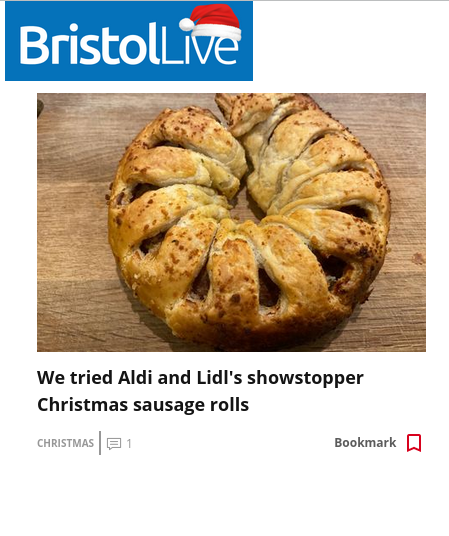
Your ‘umble scribe does not know if months or years of research have gone into preparing the flurry of seasonally inspired investigations that have appeared in various Reach title in the past week, but they do show the great sacrifice that has been made around the country by the waistlines of the reporters involved.
A small selection of this fearless sleuthing is shown below.
First up the Bristol (Evening) Post
The budget supermarkets Aldi and Lidl seem to have attracted particular attention, as per this poultry effort from The Daily Post/North Wales Live.
In the south of Cymru, Wales Online, formerly the Western Mail, has opted for a hyper-local approach, focussing its rapier-like skills on Cardiff’s independent retail catering sector. Note the whole story squeezed into the headline, thus saving the reader the bother of engaging with the piece, all apart from the verdict.
Finally in this brief excursion around some of the local titles in the Reach stable, we arrive at the Liverpool Echo, which goes in for a comparison of Marks & Spencer with our old friends Lidl. Note the glaring grammatical error in the headline, as well as the use of the first person singular in the verb conjugations.
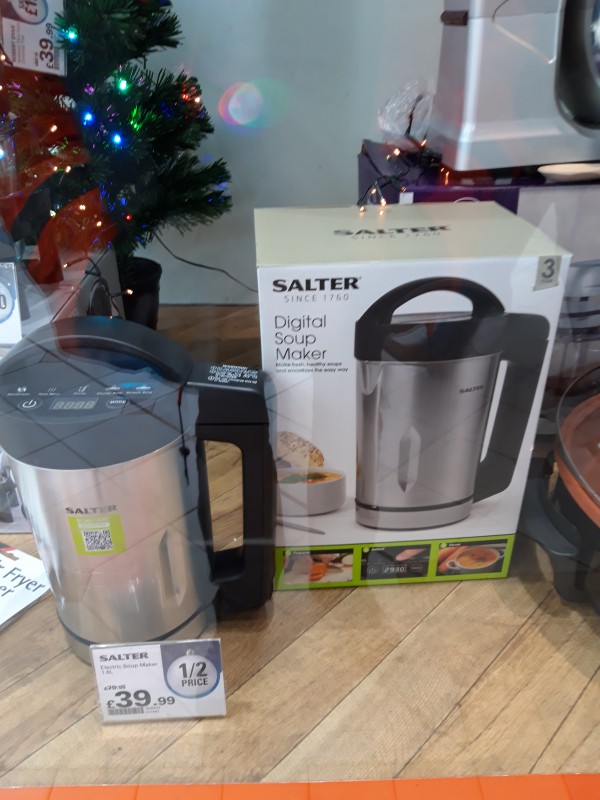
On a trip to town in recent days, your ‘umble scribe was intrigued by the digital soup spotted in a shop display window,
My initial thought was “What is digital soup?“
Is it made of fingers? Or are ones and zeroes involved? Is the digital a defiant gesture to all soup makers marketed before?
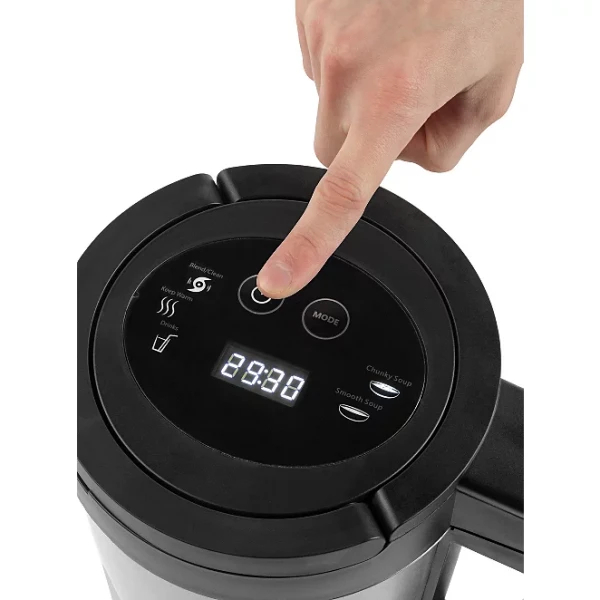
As it turns out, ones and zeroes are indeed involved and the digital part of the apparatus refers to the device’s digital control panel, as depicted below.
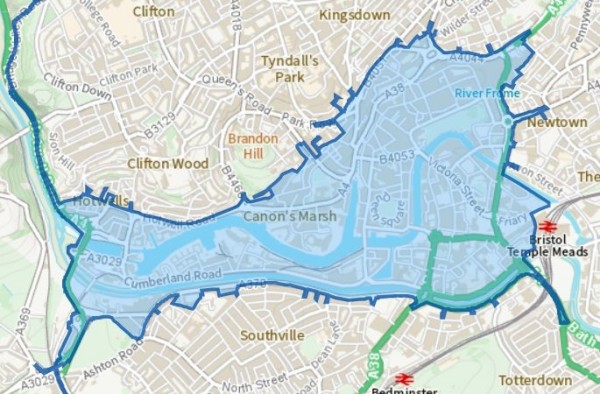
Bristol’s so-called Clean Air Zone, which has been long delayed and much contested, comes into force at the end of the month, with the usual doom-mongers predicting it will spell the death of the city centre and its shopping facilities in particular. Leaving aside those whose idea of transport policy involves sitting at the steering wheel of a mostly empty motorised three-piece suite, the scheme has caused some concern, particularly when coupled with the city’s dreadful public transport, exacerbated as it is at present due to a shortage of bus drivers.
A map of Bristol’s Slightly Less Polluted City Centre Air Zone is shown below.
Image courtesy of Bristol City Council
Some might consider it timid and unambitious, especially if the aim is to get people out of their cars and walking and cycling (so-called active travel. Ed.) or using public transport.
The argument is that the city vastly needs to improve facilities for cycling and walking* – providing far more dedicated infrastructure for both – as well as doing rather more in the way of enforcement against pavement parking (posts passim). As regards public transport, millions of pounds in public money have been poured into the city’s bus network over the years (e.g. Metrobus) with very sign of improvement and with the whole system now suffering from a driver shortage, the area’s bus network is even more unreliable than it has ever been. As for local rail services, Bristol’s are a disgrace compared with other major cities. It took decades of campaigning just to get a reasonably frequent service on the Severn Beach Line, whilst improvements to services to towns and cities surrounding local authorities have hardly improved at all. Then there’s the long-running saga of the reopening of the Bristol to Portishead railway line, where in over 2 decades progress can only be described as sub-tectonic, i.e. the earth’s tectonic plates, which shift by mere millimetres a year, are outstripping the bureaucrats. Meanwhile, the country is also failing to deal with a record cancellations of train services.
Could these be the real reasons why Bristol’s implementation of a congestion charging scheme looks so timid and unambitious?
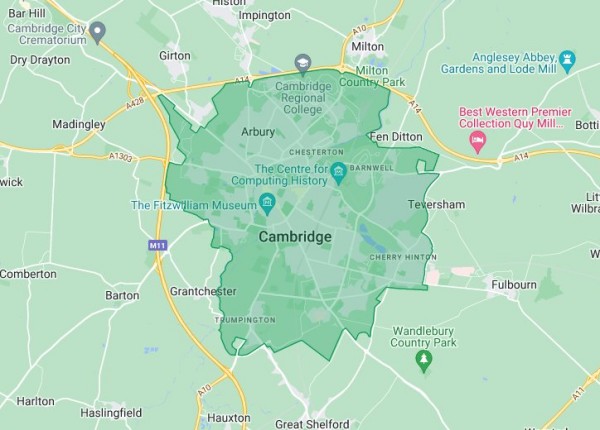
Looking around the country, Bristol’s congestion charging zone appears to be trifling, a mere inconvenience to the majority who can continue to drive without impunity, particularly when one looks at what is being proposed in Cambridge, for example, as shown below.
Cambridge’s congestion charging zone. Somewhere under the dark green shading is (most of) the city.
As can be seen, the Cambridge scheme covers most of the city’s built-up area, as well as some surrounding villages. It too has attracted criticism, with it being described as town versus gown and car versus bike, pitting the city’s ordinary residents against the dreamers in the spires of Academe.
Your ‘umble scribe just wonders what the reaction of Bristol would have been, had a Cambridge-style scheme been proposed for the city.
* = One of the biggest changes that the council could do to make walking a more practicable mode of transport would be to change the timings on pelican crossings so that the signals change to allow pedestrians to cross within seconds of the button being pressed. This was first suggested over 30 years ago by one of the city’s cycle campaigners, the late Chris Hutt of Cyclebag. The council is keeping it persistently out of sight, having filed it in its bureaucratic oubliette otherwise known as its extensive Not Invented Here filing system.
On a walk into town on Sunday in bright sunshine, you ‘umble scribe encountered a visitor to the River Frome in the inner city (where it’s also known at the Danny. Ed.) near the Peel Street bridge – a juvenile grey heron.
According to the RSPB, grey herons can be seen around any kind of water – garden ponds, lakes, rivers and even on estuaries.
The one pictured above was seen in close proximity to a stretch of the Danny frequented by a small shoal of roach, so perhaps it was after one (or more) of them.
In addition to fish, grey herons will also consume small birds such as ducklings, small mammals like voles and amphibians.
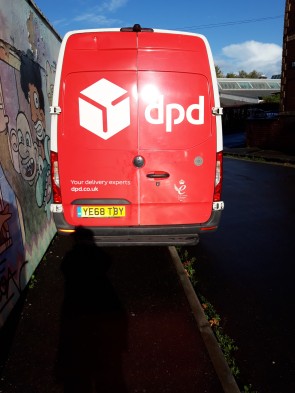
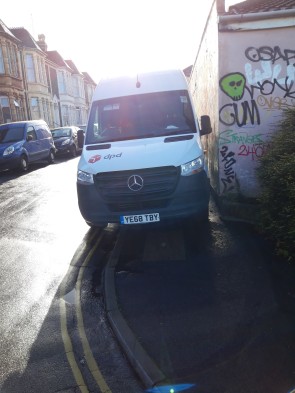
p>Bristol Green Party is currently collecting signatures for a petition seeking to ban pavement parking within the city. It’s a major problem, particularly in those parts of the city where streets are narrow and footways (aka pavements. Ed.) are even narrower.
Pavement parking makes it hard to walk safely, especially for those with disabilities, those pushing prams and buggies and those with low vision. People in wheelchairs or on mobility scooters are also badly affected. On top of this, the city is supposed to be promoting what’s called active travel, i.e. walking and cycling, as opposed to the use of tinned 3-piece suites, particularly those powered by fossil fuels.
The text of the petition is as follows.
To: Bristol City Council
From: [Your Name]
We’re calling on Bristol City Council to take action on pavement parking in Bristol by:
1. Using its existing powers to ban pavement parking in Bristol now, where it can and where it’s needed; and
2. Calling on the Government to strengthen councils’ powers to ban pavement parking where bans are needed.
Starting this Friday, Eastside Community Trust is organising a series of digital skills workshops for the over-55s from 12.30 to 2.30 pm as part of the Eastside Connect project.
Eastside Connect is a peer-to-peer project that works with people over the age of 55, who live in Easton or Lawrence Hill. The project strives to harness the skills and experience both lived and knowledge base to enable participants to share and discuss their desires for what older people want to see and do in the area they live, either individually or collectively. We have a variety of activities, all asked for by those who attend such as “Cuppa to Connect” a time for tea and a natter, “Come dine with us” – a community meal and more recently “East Mingle” at Trinity Arts creating a way to connect through dance, music and discussion.
The sessions are free and there’s the added lure of free refreshments, so if you’re free on Friday, an apprentice or fully qualified pensioner come along with your device – be it laptop, tablet or mobile phone – and problems and the delightful Gary and your ‘umble scribe will provide loads of useful advice and try to sort them out for you! 😀
 In 1897 British troops attacked, burned down and looted the palace of the Oba (king) of