Media

  • Cambridgeshire Police spends nothing on linguists

    When work restrictions on Bulgarian and Romanian migrants were relaxed at the start of the year, the usual xenophobic elements of the British media stoked fears that every criminal in eastern Europe would make a beeline for the UK and crime would soar.

    Emotive language was (ab)used, with the nation being told Bulgarians and Romanians would ‘flood’ into the country and dear old Blighty would be ‘swamped’ and similar such tosh.

    If crime had increased due to Bulgarian and Romanian migrants, this would have resulted in a massive rise in the criminal justice system’s use of linguists, as suspects and defendants are entitled to understand and follow the proceedings in their mother tongue.

    However, this surge in the use of East European linguists hasn’t actually happened.

    Indeed in response to Freedom of Information (FoI) Act queries, Cambridgeshire Police has revealed its spending on services for Bulgarian and Romanian linguists has actually declined, as revealed by the Cambridge News:

    Data has revealed the force spent just £9.10 on Bulgarian and £1,357.84 on Romanian translators in January last year when the restrictions were in place.

    But after they were lifted at the start of the year, the force spent zero pence on translators for the two languages.

    Read the full article.

    Hat tip: Katya Ford

  • Bristol Post Balls – the broken spellcheck

    One really has to admire the journalists at the Bristol Post, getting the news out to the public 6 days a week, sometimes in the face of extreme adversity.

    For instance, a Sunday morning is a bad time for the spellchecking software to have a dicky fit. After all, no IT support will be available until Monday.

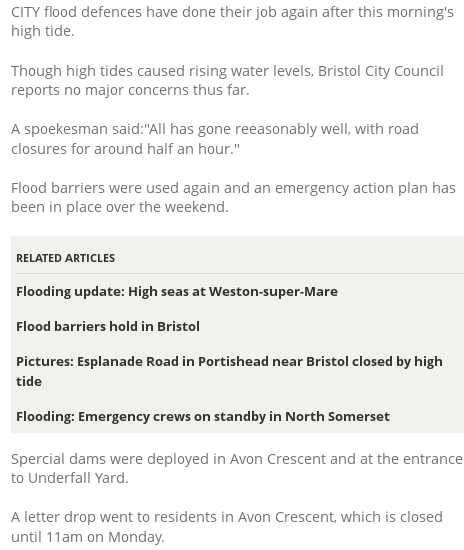
    Never mind, in the absence of a spellchecker, the Post’s Geoff Bennett ploughed valiantly on to produce this report, part of which is shown in the screenshot below.

    screenshot of Bristol Post article

    How long will it take before ‘spoekesman’, ‘reeasonably’ and ‘spercial’ are added to the Oxford English dictionary?

  • Bristol Post Balls – an American in Bristol

    There’s some bloke called Brendan Cole off something called Strictly Come Dancing on the television that’s currently got a show on at Bristol’s Hippodrome called ‘Licence to Thrill’, as shown by the publicity featured below.

    cole

    Earlier today the Bristol Post’s review of the show featured a translation of the show’s title into American English, no doubt in a bid to help transatlantic visitors to Bristol (alternatively, it could have been caused by letting an American intern loose in the news room or a keyboard/software configuration cock-up. Ed.), as shown by the following screenshot.

    Bristol Post headline with US spelling license

    The spelling of the headline has since been corrected.

    Y’all have a nice day! 🙂

  • Bristol Post Balls – headlining

    According to Collins English Dictionary, headline has the following definition as a noun:

    a phrase at the top of a newspaper or magazine article indicating the subject of the article, usually in larger and heavier type

    Here’s a headline from a piece in today’s Bristol Post (since corrected after being ridiculed by a sharp-eyed reader. Ed.).

    screenshot of Bristol Post article

    When it comes to how to use a headline, dictionaries unfortunately do not give guidance regarding their making sense. 🙂

  • Bristol Post Balls – irritable vowel syndrome

    If you either travel into or out of Bristol from the south or sail into or out of the city docks, you’ll be familiar with the Plimsoll Bridge, a swing bridge built over the Cumberland Basin in 1965.

    Plimsoll Bridge in action
    Bristol’s Plimsoll Bridge in action. Picture courtesy of Wikimedia Commons

    Unfortunately, there’s been some trouble with the bridge recently: during one recent rush hour swing some vital part broke and the bridge remained open – and closed to motor traffic – until the next day when it was cranked closed by hand.

    The various repairs that need to be carried out will require several weeks and vessels with high masts will therefore not be able to get into and out of the docks for that period.

    Yesterday the Bristol Post’s Michael Ribbeck reported on the latest stage of repairs.

    His first sentence reads as follows:

    A carriageway of a swing bridge in the centre of Bristol had to be closed overnight while repairs were carried out to lose joints.

    Poor Michael! Not only does he have trouble with his vowels, as with the old Stork margarine advertisement, he can’t tell verbs from adjectives! 🙂

  • Bristol Post Balls – Write ’em cowboy!

    Besides its use in the agricultural context, the term ‘cowboy‘ has long been in use informally to describe a person who is an irresponsible or unscrupulous operator, as in the phrase cowboy builder.

    Today’s Bristol Post carries a report where it’s uncertain as to who are the cowboys – the builders or the journalists who wrote the piece.

    The report in question covers repairs and refurbishment works currently underway at the former home of Thomas Chatterton (20th November 1752 – 24th August 1770), Bristol’s renowned 18th century poet and forger of alleged medieval literary works.

    With a sharp eye for inaccuracies, my attention was drawn to the following passage in paragraph 8:

    Lathe and plaster is being used on the walls and re-rendering on the outside is being carried out with limestone instead of modern materials so the original stonework can “breathe”.

    For anyone familiar with traditional building techniques, the 2 absolute howlers in there are immediately apparent.

    For anyone unfamiliar with traditional building techniques, such as passing Bristol Post journalists in search of enlightenment, here’s an illustrated guide showing where the authors went wrong.

    Here is a lathe: this one is for working metal; other types can be used for wood and other materials.

    image of metalworking lathe

    Here are some laths, minus their original plaster coating.

    image of laths minus plaster

    This is limestone – a whole pavement of it.

    image of limestone pavement at Malham Lings

    This is a house in St. Davids, Wales showing a traditional limewash finish, yellow ochre coloured in this case.

    image of house in St Davids

  • US Customs needs no reason to examine travellers’ electronic devices, Court confirms

    image of laptopIn a case brought by civil liberties campaigners, a Brooklyn court has ruled that US Customs officers do not need to suspect a crime to examine travellers’ computer equipment at borders, Le Monde Informatique reported yesterday.

    In the United States the border police may carry out checks of travellers’ portable computers and other mobile devices without having to justify suspicions that the content they wish to examine is connected with criminal action, an American federal judge concluded last week at the end of a case brought in 2010 by the American Civil Liberties Union (ACLU). The ACLU believed such behaviour infringed the US constitution. However, Judge Edward Korman of the Brooklyn District Court did not share this opinion and rejected the case. The ACLU is contemplating an appeal.

    The ACLU submitted the complaint on behalf of Pascal Abidor, a student with dual French and American nationality and two other associations, one which defends lawyers and the other press photographers. In 2010, Customs officers confiscated Mr. Abidor’s portable computer as he was entering the United States aboard a Montreal (Canada) to New York train as he was entering the USA. Mr. Abidor was studying the history of the Shi’ites in Lebanon and had downloaded photographs linked to the militant organisations Hamas and Hezbollah onto his computer. He was detained for several hours while his computer equipment was examined before being released with no further action being taken. He had disclosed his password and the officers searched through his private data, including messages he’d exchanged with his girlfriend. Some information was retained for the purpose of further inquiries after he had handed over his equipment.

    For lawyers and journalists whose work entails maintaining keeping the data they hold confidential, such investigations by customs form a real problem and the lawsuit aimed to highlight the violation that Abidor’s treatment represented. However, Judge Korman asserted that Customs already had special procedures for examining this content which required suspicions of crime. Furthermore, he stated that searches of this kind are rare at borders and are already made within the scope of these procedures. In summary he states in his ruling, published by the ACLU, that giving reasons would not be appropriate because it is highly unlikely that one of the members of the plaintiff organisations had been subject to an examination of their electronic equipment at borders since, according to the judge, there is little chance that such a search would take place without reasonable suspicion. In view of the figures submitted by US Customs and Border Protection, Judge Korman believes there is a less than one in a million chance that a computer carried by a foreign traveller entering the USA would be confiscated.

  • Bristol Post Balls – publish and be damned

    ‘Publish and be damned’ was the the reaction in 1824 of one Arthur Wellesley (1st May 1769 – 14th September 1852) when courtesan Harriette Wilson (whose clients included the then Prince of Wales, the Lord Chancellor and four future Prime Ministers. Ed.) threatened to publish her memoirs and his letters with the possibility of his reputation being damaged. Her decision to publish was based partly on the broken promises of her lovers to provide her with an income in her later years.

    However, for the Bristol Post publish and be damned would appear to be its normal modus operandi – at least as far as the online edition is concerned. The hacks down at the Temple Way Ministry of Truth are far too eager to hit the ‘publish’ button when their work is far from ready for publication, as evidenced by this morning’s screenshot of this post, which may have been rectified by the time you visit the site.

    screenshot from Bristol Post

    Harriette Wilson’s memoirs are still in print. How long can the Post last?

    Update, 9.00 am: the piece has been pulled and now returns a 404 error page. However, this does not mean it won’t rise again vampire-like from the crypt.

    Update, 10.20 am: It’s back!

Posts navigation