Open Source

  • Wikipedia community votes on MP4

    Wikimedia Commons logoContent on Wikipedia should not only be made available under a free licence, but also in free formats. As this is associated with limitations the Wikimedia multimedia team has launched a request for comment to integrate the H.264 MP4 codec, Heise reports.
    Such proprietary codecs have so far not been allowed in Wikipedia and its sister projects; even MP3 files are not allowed. Videos can only be uploaded in Ogg Theora format and the open WebM format developed by Google.

    In the opinion of the multimedia team, this limitation is significantly preventing the use of videos. Although the Chrome and Firefox browsers can play WebM, other browsers have still not implemented the format. It looks even worse as regards mobile devices: according to an analysis, two-thirds of mobile calls to Wikimedia servers originate from devices which cannot play the video formats made available on Wikipedia. Even the uploading of videos is made more difficult since contributors must first convert their videos before they can upload them. The result is that only 38,000 videos can be found on the Wikimedia Commons multimedia platform, whereas YouTube makes 6.5 million videos available in the education category.

    The proposal is not meeting with much approval in the community. On the first day of the discussion which started a month ago, must users spoke out against any support for MP4; however, supporters are not occupying too inferior a position. In particular, the secret licence agreements and any licensing payment due for commercial use of videos are being criticised. A compromise in which the Wikimedia Foundation will convert all uploaded MP4 videos into open formats is only supported by very few contributors.

    The multimedia team must now put more effort into convincing people if it wants to convert its plans into reality. Heise says the Wikimedia Foundation is adopting a neutral official position.

  • How to write user help

    A product’s user guide or help is an essential element of most items of software or consumer products today.

    Well-written help can save hours of confusion and frustration as new users get to grips with tools. It should be concisely written but cover all aspects of the use of the software or product.

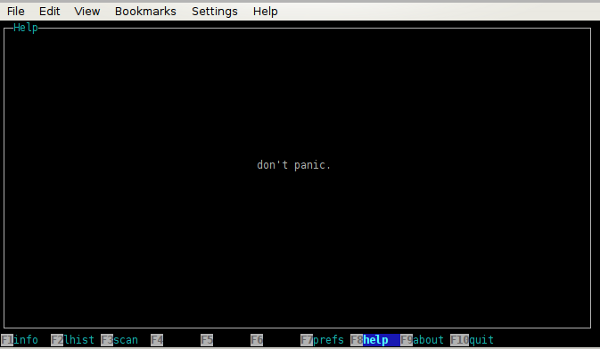
    The wavemon program for Linux is a monitor for wireless devices. It allows users to watch the signal and noise levels, packet statistics, device configuration and network parameters of their wireless network hardware.

    Here’s wavemon’s help file.

    screenshot of wavemon help file

    Concise isn’t it?

  • UK’s CESG finds Ubuntu most secure OS

    Ubuntu logoUbuntu 12.04 LTS proved to be the most secure product in a client operating system investigation by British security body Communications Electronics Security Group (CESG), which is part of GCHQ and provides assistance to government departments on their own communications security, according to a report today in Germany’s Linux-Magazin.

    The test field consisted of 11 desktop and mobile operating systems, including Windows 7 and 8, Windows RT, Android 4.2, Apple’s iOS 6 and Mac OS X 10.8, as well as Google Chrome OS 26. CESG investigated the security of the systems in various categories, e.g. VPN, hard drive encryption, secure boot, sandboxing, implementation of security policy and update policy.

    No system was able to meet all demands for use by the British authorities, but Ubuntu 12.04 LTS was shown to be the most secure system of those tested. Windows Phone 8 has the most critical vulnerabilities.

    Ubuntu supplier Canonical has summarised the results as it sees them in a PDF. The company is hoping to do even better with the forthcoming Ubuntu 14.0 LTS version of its operating system, particularly by supporting secure boot.

    More detailed information about the test is available on the CESG website, including CESG’s Ubuntu-specific report.

    First published by Bristol Wireless.

  • Italy puts free software first in public sector

    The Italian government has made free software the default choice for public sector organisations, the Free Software Foundation Europe (FSFE) reports. In a document (PDF, Italian) published last Wednesday, the Italian Digital Agency (Agenzia per l’Italia Digitale) issued rules saying that all the country’s government organisations must consider using free software before buying licences for proprietary programs.

    logo of Italian Digital Agency
    Logo of Italian Digital Agency

    The document, “Guidelines on comparative evaluation [of software]”, sets out a detailed method which public bodies must follow when deciding which software to use. They are required to look for suitable free software programs or choose software developed by the public sector. They may only consider procuring proprietary software no suitable programs of these types are available.

    “There is no excuse. All public administrations must opt for free software or re-use whenever possible”, says FSFE General Counsel Carlo Piana, who was part of the committee that advised on the guideline. “Now free software and re-use are the norm, proprietary software the exception. This is the most advanced affirmative action in Europe so far. I’m so proud that Italy leads the way, for once”.

    The document was authored by the Italian Digital Agency, which for the first time consulted representatives from the public sector, the free software community, and proprietary software makers.

    Importantly, the new rules come with a mechanism to ensure they are followed. Both public bodies and members of the public can ask the Italian Digital Agency to check if a given organisation is following the correct procedure. Administrative courts can annul decisions that contravene these rules and, in the event of negligence, individual public servants may be held personally liable.

  • EU also recommends ODF as a standard format

    ODF file iconAs an answer to a question from a Swedish politician the EU Commission has also confirmed ODF as a standard document format, Germany’s Linux Magazin writes. However, free software advocates are criticising the step as “not far-reaching enough”.

    image of Amelia Andersdotter MEP
    Amelia Andersdotter MEP
    At the end of November 2013 Amelia Andersdotter MEP, a member of the Swedish Pirate Party, submitted a written question to the EU Commission in which she dug deeper in two points into what was happening with file formats recommended by the EU. In 2011 Inter-Institutional Committee for Informatics had instructed all departments to support the OOXML standard developed and controlled by Microsoft. Andersdotter inquired what sense this still made when only one manufacturer is implementing the standard and how communication could take place with public sector organisations who are using other standards.

    The Commission’s answer was given a few days ago. According to a report on Joinup, the EU’s public sector open source news site, EU Commission Vice-president Maroš Šefčovič himself responded to the written question and mentioned OOXML and ODF as minimum requirements for document exchange. Šefčovič maintains that this ensures no vendor lock-in exists or can occur. In addition, public sector organisations should support other file formats in accordance with the best effort principle, i.e. if this is practically possible.

    Open source activists, such as the Open Forum Europe are describing the decision as overdue, but are criticising the EU for missing an opportunity for the EU to lead by example for not daring to stipulate ODF as a single open standard. Switzerland’s Open Systems Group welcomes this first step, Joinup states. Mathias Stürmer is even hoping that the Swiss government will follow suit, even though it is not within the EU; although it would definitely help to prompt other public sector organisations to make the change to ODF.

  • CodeCombat: an open source online game for learning how to programme

    The initiatives for encouraging young people to get into programming are multiplying, writes French news site Le Monde Informatique. With CodeCombat the work is both study and play.

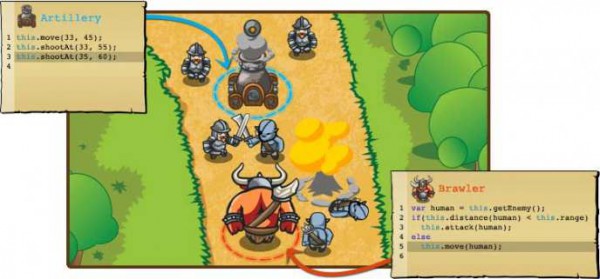
    Now released as open source, CodeCombat is a video game devoted to teaching programming. The platform is multi-player and uses CoffeeScript, a programming language that transcompiles to JavaScript. It’s possible to use JavaScript libraries even though CoffeeScript is very well documented.

    CodeCombat screenshot

    The basic idea is very simple: lines of code need writing for players to make progress in the game (see the image above) and to compete against other programmers/players. Volunteer participants create levels and characters which can be borrowed by other players.

    Developed by Nick Winter, an alumnus of Oberlin College in Ohio, CodeCombat is available in seven languages thanks to the efforts of willing participants in this collaborative development work.

    Reposted from Bristol Wireless.

  • 0 A.D. Alpha 15 “Osiris” released

    Just before the end of last month Wildfire Games announced the release of 0 A.D. Alpha 15 “Osiris”. 0 A.D. is a real time strategy game and the new release comes with additional functions. It’s available free of charge for Linux, Mac and Windows and is licensed under Version 2 of the GPL. The Alpha 15 release, which is playable, provides a multi-player lobby, in which players can meet and play each other, whilst a new playable civilisation can be added with the Ptolemaic Egyptians. However, only some of the latter’s buildings units and play functions can be tested; the civilisation itself shall only be made available in the next alpha version.

    A new play mode has been added to the game with so-called “Skirmish Maps”. Units now also gain a bonus if they come within reach of a certain building or special unit. Up top now temples regenerate the health of nearby units and most heroes also have such an “aura”. This function will be further refined and extended in future versions of the game.

    The user interface has also been improved so that players can now order their troops to defend other units or buildings. An audible signal or a chat message notifies when a player is being attacked, whilst flashing pixels on a miniature map show where the attack is taking place. Fighting units can be returned to the civilian work they were previously carrying out with a new “Back to work” button.

    In addition, there are new graphic elements, pieces of music and bug fixes, etc. in 0 A.D. Alpha 15 “Osiris”. The game is available for download from the project website.

    Finally, the project is seeking volunteer contributors in programming, art, sound, documentation and more. For details, log onto #0ad-dev on QuakeNet on IRC and meet the developers or register on the project’s forums and start participating!

    Previously published on the Bristol Wireless website.

  • Greens/EFA using Debian and encrypted email

    Debian logoJoinup reports that the European Parliament’s Greens/EFA Group has started trial use of laptops running a tailored version of the Debian GNU/Linux distribution and “is reaching out to the Free Software community”, in order to achieve trustworthy email encryption in moves to counter mass surveillance by companies and governments.

    In a press release, Greens/EFA co-president Rebecca Harms stated:

    “Thanks to Snowden we are beginning to understand the full scope of what it means to live in a digital environment polluted by pervasive surveillance. Commercial and governmental surveillance is undermining trust in our democratic institutions and corrupts the very fabric of democracy. This is now a global problem of such scale that each individual effort will fail, yet without taking small concrete steps from accepting where we are, no progress is possible. Therefore, the Greens/EFA is now reaching out to the Free Software community to join in a small project to use trustworthy email encryption in cooperation and dialogue with the European Parliament IT services.

    “As the Green Group in the European Parliament we want to make an effort to ensure that nobody but the intended recipient of an email can read it. Such emails need to be encrypted, travel over the internet, and then be decrypted on the receiving computer — and nowhere else. In this project, me and colleagues in the Greens/EFA will use a selection of Free Software from Debian and run it on computers dedicated for this purpose. We will start small scale with 10 regular consumer laptops. This is not special hardware running special software, but general computers running software available for everybody.”

    For secure email, a combination of the cryptographic software tools provided by GnuPG and the Icedove email client (a Debian-specific version of Mozilla Thunderbird) will be used as the European Parliament’s proprietary email solution cannot offer trustworthy encryption.

  • Enlightenment 0.18 released

    Just before Christmas the release of version 0.18 of the Enlightenment desktop environment for Linux was announced, according to Heise. Modules for controlling Bluetooth and music software are amongst the new features for the Enlightenment 0.18.0 (E18). It has been released as planned just one year after version 0.17.0 (E17), whose development took 12 years.

    In the new version the compositor which combines the application windows and desktop components into an overall picture is no longer optional, but firmly integrated into the desktop’s main components. Support for running Wayland, the potential successor X11 is also new, as is better interaction with systemd, the system management daemon designed exclusively for the Linux kernel API. The developers have also fixed several crashes and made considerable improvements to the file manager, according to the release notes.

    e18 desktop screenshot

    The developers are currently working on Enlightenment 0.19.0 (E19), which will be able to work as a Wayland Compositor. Details of these plans may be found on the E19 Release Manager blog, as well as in the video below.

Posts navigation