Tech

  • Joint effort to produce first 100% open source, enterprise-grade cloud office suite

    Kolab Systems, creators of Kolab, the leading open source groupware and collaboration framework, today announced a partnership with Collabora Productivity, the architects behind LibreOffice Online, the cloud-based office productivity suite.

    The first version of Kolab with integrated CloudSuite functionality is due to appear around the middle of 2016.

    Collabora’s CloudSuite web-based document product will be available as an integrated component in Kolab. The integration of CloudSuite into Kolab will allow users to work on documents simultaneously using a fully-featured online office suite from within the Kolab collaboration suite. Users will be able to create text documents, fill in spreadsheets and design presentations together, even when they are in different locations. Documents can later be saved in popular formats, including Open Document Format (ODF) and MS-compatible formats. The CloudSuite offering also comes with Collabora Office, a professional LibreOffice distribution, for offline use on the desktop.

    CloudSuite complements Kolab’s integrated editor, which is also gaining collaborative editing capabilities. Users will be able to collaborate in real-time composing emails, setting agendas for meetings or adding contacts to distribution lists before sharing their work with colleagues and clients.

    LibreOffice Online graphic

    “For too long, closed and insecure solutions have been the industry standard for office and groupware productivity,” said Kolab System’s CEO, Georg Greve. “With this partnership Collabora and Kolab are taking the lead, not only with bleeding edge technological innovation and an office stack with full, user-friendly and comprehensive collaborative features, but also with a product that respects users’ freedoms, protects their privacy, and guarantees their work will not be locked away in proprietary formats.”

    “Collabora Productivity is delighted to provide a key building block in Kolab’s comprehensive, new offering,” said Michael Meeks, General Manager at Collabora Productivity. “Kolab Systems have been a leading light in open source for many years and we look forward to supporting their ambitious growth plans in the enterprise sector and beyond.”

  • Is Cabot Circus employing Smurfs?

    The modern mobile phone is a sophisticated and very useful item: mine is a miniature marvel – a Linux-based computer that fits comfortably in the hand, plays music, acts as a radio, takes video and still images and also allows me to make telephone calls.

    Venturing into central Bristol, one notices that nearly everyone one passes has one and entering the Cabot Circus shopping centre – that latter day monument to retail therapy – is no exception to this general observation.

    Having noticed a couple of years ago that visitors to Cabot Circus have their progress around that Temple of Mammon tracked by means of their mobile phone signal (posts passim), it has been my practice ever since to turn my mobile phone off before entering; and I don’t turn it back on until I’m well clear.

    Cabot Circus mobile phone recharging cabinetIt’s bad enough being tracked from shop to shop, but there’s another threat to the privacy and security of mobile phones and their users in Cabot Circus… but you’ll only discover it if you happen to use the mobile phone charging points (shown left) kindly provided by the centre’s management.

    On the face of it, these charging points – 3 in number – are a boon to visitors. After all, who hasn’t been in a situation where one’s battery is running low. It does seem benevolent of the managers of Cabot Circus to provide half an hour’s gratis battery top-up, doesn’t it?

    Now, you remember me saying about turning my phone off before entering? Good! With my device switched well and truly OFF I have now placed my phone in the recharging facility whilst paying a call of nature. Upon return a few minutes later, I have in each instance retrieved by phone from the locker – and found it to be switched ON!

    Needless to say out of consideration for my security and privacy, I shall not be using one of these charging points again.

    As regards using the mobile phone charging points, the Cabot Circus website states the following:

    Because we want our visitors to have a stress free [sic] shopping experience within our centre, Cabot Circus has now installed three ChargeBox phone charging stations, ideal for when your battery goes flat at the most inconvenient times.

    Easy to use in three simple steps, connect your phone, lock, take the key and relax. The ChargeBox stations allow you to charge your phones for free and enjoy 30 minutes extra shopping time!

    The ChargeBox stations at Cabot Circus are located:

    – Level 1 outside Costa
    – Upper Ground at the Information Desk
    – Ground floor toilet lobby

    Curiously, there’s nothing in the above text that I can see about the points’ ability to turn on a mobile phone that’s been switched off.

    However, let’s be generous and assume that specific piece of information was omitted by mistake. 🙂

    When I charge my turned-off phone elsewhere, either by using a USB cable connected to a PC/laptop or the adapter that came with it, it definitely stays off. That being so, I began thinking how could the lovely folk at Cabot Circus generously providing me with free electricity be turning my phone back on when I’d left it firmly switched off.

    A quick internet search reveals no logical or plausible benign explanation as to why a switched-off phone is turned on by the charging station.

    The only tools of which your correspondent is aware for doing such things to a mobile phone is the Smurf suite of tools used by the British State’s snoopers at GCHQ, as revealed by NSA whistleblower Edward Snowden. In this suite of tools, one called “Dreamy Smurf” can allegedly turn a phone on or off, whilst another called “Nosey Smurf” can activate a phone’s microphone to use it for audio surveillance. “Tracker Smurf” is a geo-location tool that Snowden says offers a more accurate method of locating a phone and its carrier than using triangulation. Another Smurf can operate a smartphone’s camera, while “Paranoid Smurf” does its best to hide the activities of the other Smurfs.

    One therefore has to wonder whether that the operators of Cabot Circus, by turning visitors’ phones on, are infringing their privacy and presenting a security threat to their mobile devices.

    Care to come clean, Cabot Circus, on whether you’re employing Smurfs or using something analagous?

  • Happy 15th birthday, Wikipedia

    Wikipedia logoThis week, Wikipedia reaches its fifteenth birthday.
    These days the free online encyclopaedia is the world’s seventh most popular website and now includes more than 38 million articles in 289 languages, all maintained by an army of volunteer editors and contributors.

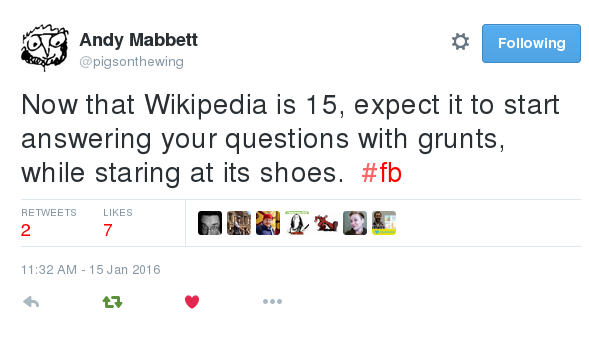
    Andy Mabbett, one of that army of editors and contributors, has been musing on Twitter as to how Wikipedia will react having reached this chronological milestone.

    tweet reads Now that Wikipedia is 15, expect it to start answering your questions with grunts, while staring at its shoes.

    Over the last 15 years, although the project was originally initiated by Anglophone geeks, Wikipedia has been working to increase the diversity of its content and contributors through outreach programmes such as edit-a-thons at universities and museums and by trying to appoint more women administrators. However, there is still plenty of work to be done in this field.

    The Wikipedia website and the open source Mediawiki software it runs on are managed by the Wikimedia Foundation charity, which is funded by donations, the vast majority of them from small donors.

    To mark Wikipedia’s 15th birthday the Foundation has created an endowment fund that it hopes will raise $100 mn. over the next 10 years.

    Happy birthday, Wikipedia – and may you enjoy many, many more.

    Reposted from Bristol Wireless.

  • Mail merge embedding in LibreOffice Writer

    Miklos Vajna of open source consultants Collabora has produced a short video showing the recent changes in mail merge in LibreOffice.

    If you ever used the mail merge wizard with a Calc data source, then you know how it worked in the past: you’ve got 3 files: the .odt mail template, the .ods data source and a .odb data source definition that defines how to access the .ods.

    The procedure has now been changed. As of LibreOffice 5.1, the .odb data source has been eliminated and the .ods data source is now embedded directly the .odt mail template.

  • Email encryption talk in Bristol

    As part of Alternative Bristol’s Breaking the Frame series of talks, an email encryption talk for beginners will be taking place at Hydra Books in Old Market Street, Bristol (map) from 7.30-9.30 p.m. on Friday 22nd January.

    public key encryption graphic
    How public key encryption works

    According to the organisers, an ordinary e-mail is like a postcard without an envelope: anybody who can put their hands on it can read it. Unlike a postcard an email is copied (rather than moved) to many different computers on its travels. All of these computers’ owners we can’t possibly trust and know. This makes them feel uncomfortable and is not necessary with simple email
    encryption.

    After this short (one hour!) workshop attendees will be able to email anyone else who makes it to the workshop without the email being intercepted by a third party.

    Certain organisations (e.g. journalists, unions, activists, etc.) have a responsibility to transmit sensitive messages securely and currently do not always do this. Don’t think what does this one email say about me? (or its recipient), think rather when examined en masse over time (most emails are stored indefinitely these days) what does this reveal about the way you live?

    It would save time if prospective attendees had Thunderbird set up and receiving your emails. If you have Ubuntu or another Linux distribution, it would help if you installed both Thunderbird and GPG before attending the talk. If you already use email encryption and want to help or share your key please come by too. No experience necessary, but if you have a laptop and USB stick please bring them with you.

    More details available via Facebook.

    Reposted from Bristol Wireless.

  • An Easter egg at Christmas

    Now that Christmas is just about out of the way for another year, the great speculation amongst Britain’s shoppers will be how soon into the New Year will Easter eggs appear on supermarket shelves. The customary 3 months as with all that Christmas tat? We’ll just have to wait and see.

    As a user of free and open source software, I’ve had an early – or late – Easter egg already courtesy of the VLC media player, as shown below.

    screenshot of VLC media player wearing its Christmas hat
    VLC media player wearing its Christmas hat

    Unless you’re familiar with the language of tech aficionados, the previous statement and accompanying screenshot are probably incomprehensible.

    In software an Easter egg is defined as “an intentional inside joke, hidden message, or feature in an interactive work such as a computer program, video game or DVD menu screen. The name has been said to evoke the idea of a traditional Easter egg hunt“.

    One of the first occurrences of what are now known as Easter eggs appeared in the Atari video game Adventure, having been planted there by computer game developer Warren Robinett. It wasn’t too fancy or interesting, just a hidden object planted in the game that led to a screen that said “Created by Warren Robinett.” The developer had buried this object within the game code as Atari didn’t credit its games developers at the time.

    Anyway, returning to the screenshot above, the Santa hat on the VLC program logo (the traffic cone in the middle of the window. Ed.) appears each year for the Christmas holiday period only; for the rest of the year, the logo is hatless.

    Besides VLC, some well-known and widely used applications have also contained Easter eggs. For instance, Easter eggs in the 1997 version of Microsoft Office include a hidden flight simulator in Microsoft Excel and a pinball game in Microsoft Word, whilst on all Microsoft Windows operating systems before XP, entering the text “volcano” in the 3D Text screen saver will display the names of all the volcanoes in the United States. Microsoft removed this Easter egg in XP but added others. Microsoft Excel 95 contained a hidden Doom-like action game called The Hall of Tortured Souls.

    Turning away from Microsoft, Apple is also not immune from Easter eggs. In 2012 an update to the Mac App Store for OS X Mountain Lion introduced an Easter egg in which apps, during the download process, were timestamped “January 24, 1984,” the date the original Macintosh went on sale. However, Easter eggs were not popular with Apple’s founder, the late Steve Jobs, who went through bouts of banning them.

    In addition to being sophisticated and/or laden with deep significance, some Easter eggs can be very simple and bereft of any meaning, merely reflecting the playful personality of their creators. Here’s a prime example from the GNU/Linux apt-get command line tool used for managing software packages. Typing the command apt-get moo results in something similar to the following screenshot.

    screenshot of apt-get moo command giving output of cow saying have you mooed today?
    The output of typing the command apt-get moo in the Linux terminal

    Anyway, I’m enjoying my festive Easter egg and I hope it’s not too late to wish all readers and visitors to this site the compliments of the season.

  • HTTP status code proposed to report legal obstacles

    IETF logoThe Internet Engineering Task Force (IETF) has as its mission “to make the internet work better by producing high quality, relevant technical documents that influence the way people design, use, and manage the Internet“.

    As part of this work, the IETF develops and promotes voluntary Internet standards, in particular the standards that comprise the Internet protocol suite (TCP/IP).

    These standards include HTTP status codes, which are derived from both IETF internet standards, IETF RFCs other specifications and some additional commonly used codes.

    The IETF’s HTTP Working Group has recently published a draft RFC proposing a new HTTP status code – status code 451 – for use when resource access is denied as a consequence of legal demands.

    The draft’s introduction gives the rationale for the proposal:

    This document specifies a Hypertext Transfer Protocol (HTTP) status code for use when a server operator has received a legal demand to deny access to a resource or to a set of resources which includes the requested resource.

    This status code can be used to provide transparency in circumstances where issues of law or public policy affect server operations. This transparency may be beneficial both to these operators and to end users.

    Getting into detail, the draft states that responses using this status code should include an explanation in the response body of the details of the legal demand, i.e. the party making it, the applicable legislation or regulation and the classes of person and resource to which it applies.

    The use of the 451 status code implies neither the existence nor non-existence of the resource named in the request. That is to say, it is possible that if the legal demands were removed, a request for the resource still might not succeed.

    The draft also gives an example of status code 451 in action.

    HTTP/1.1 451 Unavailable For Legal Reasons
    Link: <https://spqr.example.org/legislatione>; rel=”blocked-by”
    Content-Type: text/html

    <html>
    <head><title>Unavailable For Legal Reasons</title></head>
    <body>
    <h1>Unavailable For Legal Reasons</h1>
    <p>This request may not be serviced in the Roman Province
    of Judea due to the Lex Julia Majestatis, which disallows
    access to resources hosted on servers deemed to be
    operated by the People’s Front of Judea.</p>
    </body>
    </html>

    For those unfamiliar with the People’s Front of Judea, here’s some background information. 🙂

    One of the reasons behind the proposal is that existing status code 403 (Forbidden) was not really suitable for situations where legal demands mean access to resources is denied.

    Comments on the draft will be received until 13th May 2016.

    The numbering of the status code pays homage to science fiction author Ray Bradbury‘s 1953 dystopian novel, Fahrenheit 451.

    Reposted from Bristol Wireless.

  • LibreOffice 5.0.4 released for download

    The Document Foundation has announced the release of LibreOffice 5.0.4.

    This is the fourth point release of the LibreOffice 5.0 family and contains a large number of fixes compared with the previous releases.

    Based on feedback from journalists and end users, the LibreOffice 5.0 family is the most popular version of LibreOffice to date.

    LibreOffice 5

    Furthermore, LibreOffice 5.0.4 is suitable for commercial or large-scale deployments when backed by professional level 3 support from certified developers. When migrating to LibreOffice from proprietary office suites, organisations are advised to seek professional support from certified migration consultants.

    Finally, there are companies providing LibreOffice LTS versions which are intended for commercial deployments.

    Download LibreOffice

    LibreOffice 5.0.4 is available for immediate download.

    LibreOffice users, free software advocates and community members can support The Document Foundation with a donation.

    New project shop

    There’s another way LibreOffice users, free software advocates and community members can support the project. That’s by buying LibreOffice merchandise from the brand new project shop.

  • Collabora & ownCloud announce partnership & release CODE for LibreOffice Online developers

    Collabora, the architects of LibreOffice Online, have announced a the formation of a partnership and the release of CODE (Collabora Online Development Edition), a distribution of LibreOffice Online and ownCloud Server. The purpose of CODE is to give interested developers from any field an easy way to get early access to the very latest untested feature additions and updates to LibreOffice Online, in order to enable them to develop, test and contribute. ownCloud is the company behind ownCloud Server, the world’s most popular open source enterprise file synchronisation and share (EFSS) software. The partnership will deliver a combined commercial solution during 2016, based on an integration of Collabora CloudSuite – a trio of Online, Mobile and Desktop office productivity – with ownCloud Server.

    code screenshot

    “We’re delighted to partner with ownCloud to strengthen our go-to-market posture as we look forward to fulfilling the considerable market demand for an Open Source cloud document suite,” said Michael Meeks, Collabora Productivity’s General Manager. “This initial release of CODE is our first step in this exciting journey. By design, Collabora Online does not include essential cloud functionality such as identity management or storage. CODE gives a showcase of how filling this gap with a complementary integration with ownCloud gives a taste of the final deployment experience.”

    code screenshot

    “Collabora is a great open source contributor and a great partner for ownCloud to deliver a full LibreOffice Online experience integrated with ownCloud to the ownCloud Community. Developers and Users will be able to easily view and edit documents while storing them in ownCloud,” said Frank Karlitschek, ownCloud founder and project leader. “This integration proves the power of integration between leading Projects and allows full support for all major document, spreadsheet and presentation file formats.”

    CODE (Collabora Online Development Edition) allows prototype editing of richly formatted documents from a web browser. It has good support for key file formats , including text documents (docx, doc, odt, pdf, etc.), spreadsheets (xlsx, xls, ods, etc.) and presentations (pptx, ppt, odp, etc.). All files are processed in the cloud and rendered locally. This initial version allows basic editing. Collaborative and rich editing are planned. Interested developers can download CODE as an easily deployable virtual machine base image, bundled with ownCloud Server, and start contributing to both projects right away.

Posts navigation