Hundreds of locals have complained they are unable to get through to council services, such as the rent arrears department. To add insult to injury, when callers encounter difficulties, the recorded voice of a woman with a Geordie accent tells them: “I can’t understand that, could you please repeat it?”
Victoria Square, Birmingham, with the city council headquarters. Picture courtesy of Wikimedia Commons.
Indeed the system is so abysmal that each call is costing the city council – the UK’s largest local authority – the equivalent of £4.
Last year the council axed its call centre, which used to employ 55 people and contracted Capita IT Services (whose home page reads: “Capable. Our experts are able to create improved business performance with our customers”. Ed.) to supply the new, unusable system.
Could this be a sister company of Capita Translation and Interpreting, the outfit responsible for the court interpreting fiasco (posts passim)?
This maintenance release fixes some 90 bugs, including fixes for layout problems, overflowing margins, a regression in chart complex category placements and problems in importing and exporting ODF documents. Several problems that caused crashes when, for example, deleting the last cell in a table, importing tables from .docx files or following an incomplete print have likewise been corrected.
CodeWeavers, Inc., the developers of CrossOver, which enables users to run Windows software on Linux and Mac, is having a giveaway today, 31st October 2012.
For one day only, CodeWeavers is giving away CrossOver with 12 months’ free support and product upgrades.
If you’d like to take advantage of this offer, point your browser at http://flock.codeweavers.com/, register and download!
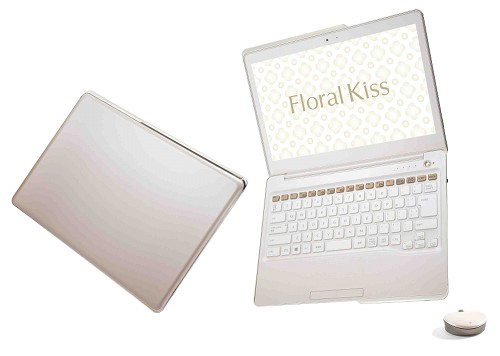
IT Donut has revealed that Fujitsu has announced a new range of computers, including a pink, sparkly one for women called Floral Kiss (although it’s also available in ‘elegant white’ and ‘luxury brown’).
Floral Kiss also seems to have no trackpad. Presumably Fujitsu thinks women are either too delicate or too stupid to use one.
While the IT Donut post states that Fujitsu will not be marketing Floral Kiss in the UK, I’m sure the patronising sexism of its marketing will not bypass any Brit of either sex with more than one working brain cell.
ComputerWeekly.com reports that safety specialist First Choice Facilities has been fined £18,000 by the Business Software Alliance (BSA) – the proprietary software industry’s licensing police – for unlicensed software following completion of an acquisition.
First Choice Facilities will now also have to pay an additional £81,000 to buy sufficient software licences to cover the unlicensed Adobe, Autodesk, Microsoft and Symantec products they used.
Of course, First Choice Facilities could have avoided all this hassle in the first place in 2 ways – 1 expensive and 1 cheap. The expensive way is the route down which they’ve gone; the cheap way would have been to have used only free and open source software.
In recent decades, computing has had a major influence on language. I’m indebted to my old friend Mr Wong for the following round robin that landed in my inbox and admirably illustrates how computing, computers and IT have pervaded everyday language.
Memory was something you lost with age.
An application was for employment.
A program(me) was a show on TV
A cursor was someone who swears a lot.
A keyboard was a piano.
A web was a spider’s home.
A virus was the flu.
A hard drive was a long trip down the motorway.
A mouse pad was a mouse lived.
There were others – something about a floppy – but I’ll spare your blushes with those! 😉
Those clever people at Anonymous claim to have compromised the security of the Greek Finance Ministry and have issued the following statement, the essence of which is reproduced below.
Greetings citizens of the world
Greetings citizens of Greece
We are anonymous.
The Greek government is prepared to testify to a vote in the Greek Parliament the new package of economic austerity measures of 13.5 billion euros which are expected to prolong the recession in Greece.
Under the austerity measures, pensioners have seen a 60 percent fall in their pensions – meaning their life savings are now less than half what they expected. Meanwhile, the government is considering more cuts, raising the retirement age and putting a cap on free healthcare provision of just €1,500 per person per year.
Greece used to have one of the lowest suicide rates in the EU but since 2010, the number of people taking their own lives has increased by 40 percent, with a large proportion from the older generation.
Sixty-eight percent of Greece’s population living below the at-risk-of poverty rate (ie, having an income below 60 percent of the national median) were spending over 40 percent of their income on rent or mortgage payments.
More than 439,000 underage children are living below poverty level in Greece due to the ongoing crisis, according to a UNICEF report released on Oct. 16 on the occasion of the World Feed Day 2012 and the International Day for the Eradication of Poverty.
The popularity of far right parties, including the neo-Nazi Golden Dawn, has risen in tandem.
Your goverment failed you.
Greek citizens, it’s time to revolt. Do it while you can.
Stick it to the Man.
You must resist. We stand by your side.
We gained full access to the Greek Ministry of Finance. Those funky IBM servers don’t look so safe now, do they… We have new guns in our arsenal. A sweet 0day SAP exploit is in our hands and oh boy we’re gonna sploit the hell out of it. Respectz to izl the dog for that perl candy.
The message concludes:
Citizens of Greece you are paying Banks and international hedge funds. They own your lives. Revolt before it’s too late. The austerity measures should not pass. We need to say no more.
Having spent my last few holidays on Crete (most enjoyable), I’ve been impressed by the stoicism with which ordinary Greeks have endured the last few years of austerity; they’ve been severely let down for years by their corrupt political class. Greek members of parliament have immunity from prosecution while in office. To save time at a later date, perhaps the parliament building at the end of Syntagma Square should be converted to a prison. 😉
The security breach also took place on the day after journalist Kostas Vaxevanis was arrested for leaking the “Lagarde List”, a document containing the names of 2,000 wealthy Greeks with Swiss bank accounts, who could possibly be evading tax and about whom the Greek authorities have done nothing for 2 years. Coincidence?
Last Friday saw the launch of Windows 8, the latest “best Windows ever” release from the Beast of Redmond.
However, the launch was not without its problems for MS, as reported by the Free Software Foundation (FSF). The FSF crashed the Windows 8 launch event in New York City. A cheerful GNU and her team handed out DVDs loaded with Trisquel GNU/Linux (a Linux distribution that meets the FSF’s very strict definition of free. Ed.), FSF stickers and information about the FSF’s new pledge, which asks Windows users to upgrade not to Windows 8, but to GNU/Linux.
The FSF crew at NYC Windows 8 launchHave a FSF sticker!
I must concur with the FSF’s conclusion: Windows 8 is a downgrade, not an upgrade since it compromises users’ freedom, security and privacy. Some of the ‘features’ of Windows 8 identified by the FSF that Microsoft won’t tell potential users about are:
Restricts freedom: Windows 8 is proprietary software. At its core, it’s designed to control you as a user. You can’t modify Windows 8 or see how it is built, meaning Microsoft can use its operating system to exploit users and benefit special interests.
Invades privacy: Windows 8 includes software that inspects the contents of your hard drive and Microsoft claims the right to do this without warning. These programs have misleading names like “Windows Genuine Advantage.”
Exposes personal data: Windows 8 has a contacts cache that experts fear may store sensitive personal data and make users vulnerable to identity theft.
In terms of world history, not a lot happens on remote Saint Helena. According to Wikipedia, St Helena “is one of the most isolated places in the world, located in the South Atlantic Ocean more than 2,000 kilometres (1,200 mi) from the nearest major landmass. The nearest port on the continent is Namibe in Southern Angola, the nearest international airport the Quatro de Fevereiro Airport of Angola’s capital Luanda.”
It has a population of 4,255 (2008 census) and a total area of 122 km2 (47 sq mi). Its chief role in history seems to have been as a place of exile for those Great Britain thought undesirable, ranging from Napoleon Bonaparte to 5,000 Boer War prisoners.
There’s one more interesting fact about St Helena: it has dreadful internet access. According to the Connect St Helena campaign website, the island’s current internet connection to the internet consists of a single 7.6 m diameter satellite dish installed in 1989; this provides the island’s only internet and international telephone connection. It uses a C band transponder on Intelsat 707 for a link to the UK with 10 MBit/s downstream and 3.6 MBit/s upstream through which all data and voice traffic is being routed. This satellite was launched in March 1996 and had a predicted lifetime of 11 years, which is already exceeded by five years now. The connection has a a total bandwidth of 10 MBit/s downstream, which is partly reserved for certain customers while the remaining capacity is shared by all other customers on the island resulting in very low effective bandwidth, often in the two-digit kbit/s range, roughly matching analogue modem speeds used in the late 1990s. Thus many internet applications like YouTube or Skype are hardly or not usable and the internet service on the island cannot be considered as “broadband” by any current definition.
Connect St Helena campaign logo
Not only is St Helena’s internet access slow by modern standards, it also prohibitively expensive. The most expensive access package costs £119.99 per month for a download speed of 384 KBit/s and 128 KBit/s upload. This package is capped to 3,300 MB/month data, with any excess charged at 9p/MB. By contrast the cheapest package costs £19.99/month for speeds of 128/64 KBit/s respectively and a 300 MB data transfer cap; exceeding the cap incurs a charge of 12p/MB (not very good is it? Ed.).
However, there is currently a once-in-a-liftime opportunity to change this. Plans exist for a super-fast transatlantic submarine optic fibre cable called South Atlantic Express (SAEx) between Brazil, Angola and South Africa. If this cable also made landfall at St Helena, the islanders could finally join the information society, which would improve standards of education and healthcare, as well as offering new economic prospects, as shown on the map below.
Proposed route of the SAEx cable and suggested change to connect St Helena
To enable the island to be connected to SAEx would require the British Government to stump up the cash. At Bristol Wireless we believe they should since we have always believed that access to information and knowledge via the internet is not a privilege, but a right. This is echoed in the closing paragraph of the Connect St Helena campaign website:
Please support us in bringing broadband internet to St Helena and improve life on this picturesque island. Being separated by a distance of 2,000 km from the next hospital, library and university, reliable broadband internet access would mitigate many problems resulting from St Helena’s isolation. There is probably no other place in the world that could profit so much from the merits of broadband telecommunications than St Helena.
The security breach resulted in the harvesting of details for some 2,000 accounts, including users’ names, email addresses, postal addresses and phone numbers.
Amongst the details leaked by the group were the login for the Administrator account and a link to McDonald’s Thailand Office Mail Login. The password of the administrator is in plain text. They are using a weak password; the password is ‘password’.
If all other multinational corporations took the same rigorous precautions as McDonald’s…