• Digital soup

    On a trip to town in recent days, your ‘umble scribe was intrigued by the digital soup spotted in a shop display window,

    Digital soup maker on display in shop window

    My initial thought was “What is digital soup?

    Is it made of fingers? Or are ones and zeroes involved? Is the digital a defiant gesture to all soup makers marketed before?

    As it turns out, ones and zeroes are indeed involved and the digital part of the apparatus refers to the device’s digital control panel, as depicted below.

    Soup maker digital control panel
  • Ball games signage ‘band’

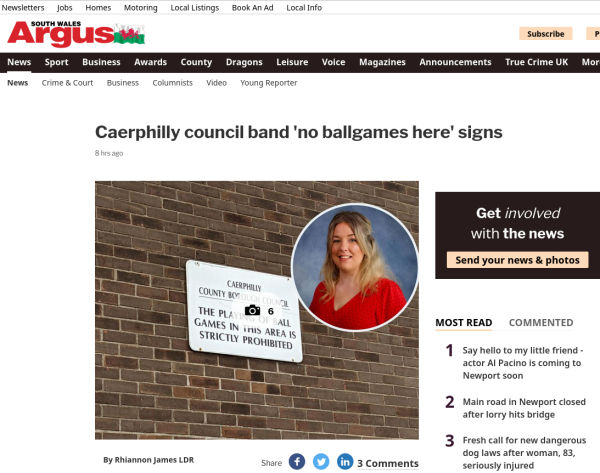
    Today’s South Wales Argus reports that Caerphilly County Borough Council in South Wales has been grappling with the matter of ballgames[sic], leading to them being “band

    Headline reads Caerphilly council band 'no ballgames here' signs

    After her compulsory period of exile in Homophone Corner, Local Democracy Reporter Rhiannon James (or the Argus’ headline writer, if different. Ed.) also ought to ask bosses for a keyboard with a working space bar and/or a functioning spellchecker. 😀

  • Defensive on donations

    Today’s Guardian reports that donations to the alleged natural party of government (©: the CONservative Party. Ed.) have declined by 40% in just 3 months (although in that quarter it still managed lay its paws on £3m.), according to the latest figures released by the Electoral Commission.

    By way of contrast, donations to the Labour Party have risen by almost 25%.

    Fifty pound note
    “Hello! Let me introduce you to the powerful and influential person holding me…”

    During this time the Tories have worked their way through 3 prime ministers – the disgraceful Alexander Boris de Pfeffel Johnson, one Elizabeth Mary Truss and now Goldman Sachs cheerleader Rishi Sunak – and two budgets, including a fiscal disaster from short-lived Chancer of the Excheqeur Kamikwasi Kwarteng.

    The Tory spokesperson quoted by The Guardian seems to be very much on the defensive, if your ‘umble scribe’s reading between the lines is accurate.

    The Conservative party only accepts donations from permissible sources, namely individuals registered on the UK’s electoral roll or UK registered companies. Donations are properly and transparently declared to the Electoral Commission, openly published by them and comply fully with the law.

    If as stated the Tories are only accepting donations from permissible sources, that represents a quick volte-face from six months ago when, as Open Democracy reported, it was still donations from Russian sources linked to the gangster regime of Vladimir Vladimirovich Putin.

  • A tale of two cities

    Bristol’s so-called Clean Air Zone, which has been long delayed and much contested, comes into force at the end of the month, with the usual doom-mongers predicting it will spell the death of the city centre and its shopping facilities in particular. Leaving aside those whose idea of transport policy involves sitting at the steering wheel of a mostly empty motorised three-piece suite, the scheme has caused some concern, particularly when coupled with the city’s dreadful public transport, exacerbated as it is at present due to a shortage of bus drivers.

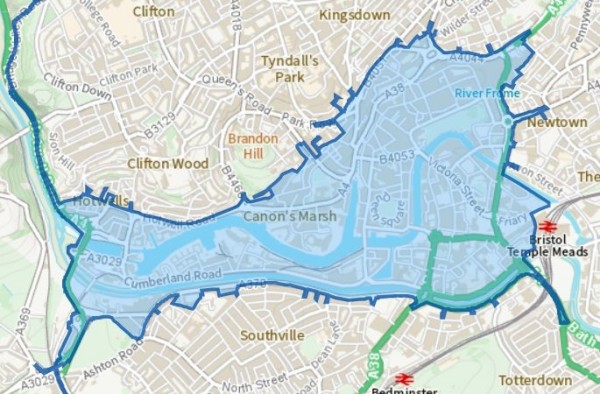
    A map of Bristol’s Slightly Less Polluted City Centre Air Zone is shown below.

    Bristol's central clean air zone
    Image courtesy of Bristol City Council

    Some might consider it timid and unambitious, especially if the aim is to get people out of their cars and walking and cycling (so-called active travel. Ed.) or using public transport.

    The argument is that the city vastly needs to improve facilities for cycling and walking* – providing far more dedicated infrastructure for both – as well as doing rather more in the way of enforcement against pavement parking (posts passim). As regards public transport, millions of pounds in public money have been poured into the city’s bus network over the years (e.g. Metrobus) with very sign of improvement and with the whole system now suffering from a driver shortage, the area’s bus network is even more unreliable than it has ever been. As for local rail services, Bristol’s are a disgrace compared with other major cities. It took decades of campaigning just to get a reasonably frequent service on the Severn Beach Line, whilst improvements to services to towns and cities surrounding local authorities have hardly improved at all. Then there’s the long-running saga of the reopening of the Bristol to Portishead railway line, where in over 2 decades progress can only be described as sub-tectonic, i.e. the earth’s tectonic plates, which shift by mere millimetres a year, are outstripping the bureaucrats. Meanwhile, the country is also failing to deal with a record cancellations of train services.

    Could these be the real reasons why Bristol’s implementation of a congestion charging scheme looks so timid and unambitious?

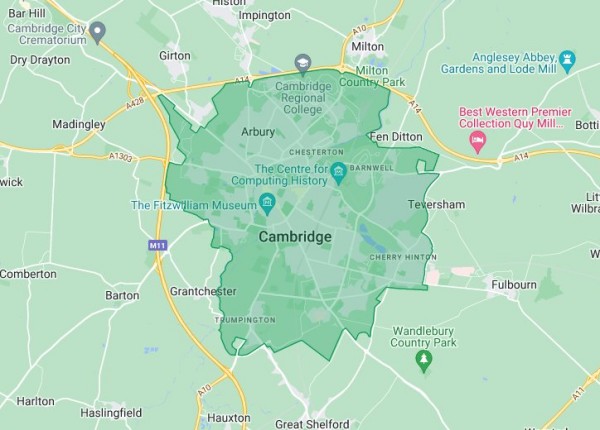
    Looking around the country, Bristol’s congestion charging zone appears to be trifling, a mere inconvenience to the majority who can continue to drive without impunity, particularly when one looks at what is being proposed in Cambridge, for example, as shown below.

    Map on Cambridge congestion charging zone covering most of the city's built-up area
    Cambridge’s congestion charging zone. Somewhere under the dark green shading is (most of) the city.

    As can be seen, the Cambridge scheme covers most of the city’s built-up area, as well as some surrounding villages. It too has attracted criticism, with it being described as town versus gown and car versus bike, pitting the city’s ordinary residents against the dreamers in the spires of Academe.

    Your ‘umble scribe just wonders what the reaction of Bristol would have been, had a Cambridge-style scheme been proposed for the city.

    * = One of the biggest changes that the council could do to make walking a more practicable mode of transport would be to change the timings on pelican crossings so that the signals change to allow pedestrians to cross within seconds of the button being pressed. This was first suggested over 30 years ago by one of the city’s cycle campaigners, the late Chris Hutt of Cyclebag. The council is keeping it persistently out of sight, having filed it in its bureaucratic oubliette otherwise known as its extensive Not Invented Here filing system.

  • Goodbye Snowdon. Hello Yr Wyddfa

    Snowdonia National Park Authority committee members have voted to use the Welsh names of Eryri (Snowdonia) and Yr Wyddfa (Snowdon) in both Welsh and English contexts Nation.Cymru reported on Wednesday.

    Yr Wyddfa (Snowdon) from Crib Goch, Parc Cenedlaethol Eryri National Park
    Yr Wyddfa (Snowdon) from Crib Goch,

    Image from Llywelyn200 courtesy of Wikimedia Commons

    The receipt of a five thousand signature calling on the authority to formalise the use of the Welsh names Eryri and Yr Wyddfa helped to prompt the latter to take decisive action. The petition was received after the authority had already established a commission to examine the use of place names.

    Cardiff University’s Dr Dylan Foster Evans was was asked to compile a series of principles for use as guidance when referring to geographical names in the Eryri / Snowdonia National Park.

    A start on using the Welsh names in an English context started some years ago when many of the park authority’s English versions of publications and digital media started using the names Eryri and Yr Wyddfa with the English names following in brackets.

    Naomi Jones, the Snowdonia National Park Authority’s Head of Cultural Heritage remarked:</p

    Many public bodies across Wales have moved to use both the Welsh and English names, or the Welsh name only, when referring to Yr Wyddfa and Eryri, as have many of the mainstream English-language press and filming companies.
    This is very encouraging and gives us confidence that this change in the authority’s approach will be accepted for the benefit of the Welsh language and as a mark of respect to our cultural heritage.

    Update 20/11/22: This news has not been universally welcomed east of Clawdd Offa/Offa’s Dyke. A typical reaction comes from monoglot, prejudiced Shropshire Star ‘readers‘. Take and look below the piece and cringe.

  • German Federal Ministry promotes open source

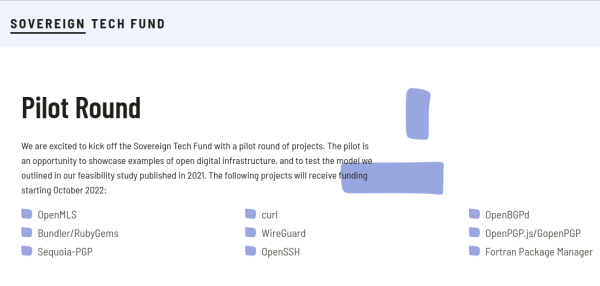
    Min. of Economic Affairs and Climate Action sponsorship logoThe German Federal Ministry for Economic Affairs and Climate Action’s Sovereign Tech Fund (STF) is promoting seven open source projects in a pilot round. The Fund shall therefore be increasing safety and data security on the internet, as well as digital sovereignty, according to German IT news site heise.

    A vulnerability in the Log4j open source Java library at the end of last year resulted in millions of potentially endangered systems. A discussion ensued about open source projects, which often represent crucial elements of the digital infrastructure.

    In the pilot round the Fund is supporting the OpenMLS library, which is used for end-to-end encryption, curl, the popular command line data transfer tool and an open implementation of the BGP internet routing protocol, which communicates between network segments and autonomous systems. The Ruby package manager RubyGems and Bundler, which facilitates the integration of Ruby packages in applications will also be supported, as will the WireGuard VPN software. In addition to this, the Fund is supporting GopenPGP, a modern OpenPGP implementation in Go, and OpenPGP.js, which can be executed in the browser. Furthermore, a projects is being promoted with OpenSSH, which is the standard for secure remote connections and is one of an administrator’s most important tools. STF pilot round projects as shown on STF website

    Software must adapt

    The STF characterises the projects as software belonging to digital base technologies and used extensively in business, the public sector and civil society. In a feasibility study (DE, PDF) the STF justifies the need to promote open basic technologies by the fact that although the importance and use of open source software is high, the projects nevertheless do not ‘adapt‘ accordingly and maintenance is often dependent upon committed individuals, thus increasing the risk of safety-critical vulnerabilities.

    In their coalition agreement, the SPD, the Greens and the FDP emphasise the importance of open source software for strengthening digital sovereignty.However, no funds were originally earmarked for the Sovereign Tech Fund in the federal government’s draft budget for 2022. In the end, coalition partners increased the funds provided so that the fund can now get started.

    The STF is promoting the above-mentioned projects until the end of the year with a total of €1 mn. Fiona Krakenbürger, the STF’s joint chief executive said: “This pilot round makes a small contribution to the sustainability of these important projects, which we hope to be able to expand in the years to come.” Projects worth funding will in future be determined in future by a committee of experts and an open application process. The STF intends to publish details of the application process in 2023.

  • French open source market still dynamic

    CNLL logoThe CNLL (France’s Free Software and Open Digital Enterprise Union), Numeum and Systematic Paris-Region commissioned MARKESS to carry out a study of the open source market in France and Europe (PDF), analysing the sector by identifying the main underlying trends since 2019 and anticipating future developments up to 2027.

    At the heart of the most dynamic digital sectors, free and open source software is continuing its progress which started more than 20 years ago and currently accounts for a market of nearly €6bn. in France.

    “Year after year, open source continues to grow, with a very encouraging outlook of almost 8% per year between 2022 and 2027. This strong growth shows the growing influence of open source on the digital economy in France and in Europe”, states Marc Palazon, chairman of Numeum.

    This progress is long-term. After having grown fortyfold in less than 20 years, the turnover of the open source sector in France must is still expected to grow faster than that of the overall software and digital services market over the next 5 years. France is also confirming its European leadership, along with Germany and the UK.

    For Philippe Montargès, chairman of Systematic Paris-Region’s Open Source Hub: “Open source is emerging as the quiet force of the digital sector. The growth of open source remains strong and has been for more than 20 years! France is reinforcing its European leadership with earnings of almost €6 bn. in 2022 and more than 60,000 direct jobs. These are two pieces of good news, especially since this lasting and positive dynamic is reflected in a strong increase in the penetration of free software into many innovative technologies and solutions (cybersecurity, cloud infrastructures, AI/Data, IoT, telecoms, SaaS, etc.) and extends widely throughout Europe.”

    The study therefore confirms the overall dynamism of free software in Europe. Open source is becoming more and more European by being structured around companies, communities and user organisations that make it the core of their development strategies. The main reasons for adopting open source are still costs savings and the strategic leverage effect, but also increasingly the ease of collaboration and skills development. The support of the European Commission, which has been announced since the publication of the last study in 2019, has gone hand in hand with the implementation of national policies in many member states and contributes to the dynamism of the open source sector.

    Furthermore, this growth is giving rise to a massive recruitment within the sector and the entire ecosystem which will have to train and recruit more than 26,000 new full-time equivalents (FTEs) between now and 2027, who will join and swell the ranks of the 64,000 employees currently developing and integrating open source solutions. The skills needed in free software are numerous and varied – developers, DevOps or marketing professionals, architects and consultants – as can be seen by browsing recruitment websites..

    Beyond training, a real industrial policy must be defined and implemented in France and Europe to take full advantage of the contribution of free software to innovation, technological independence and a more ethical and responsible digital sector.

    “Companies in the sector have long been calling for an industrial policy to make it an asset in a strategy to regain European digital sovereignty. Among the measures we expect: a proactive public sector purchasing policy; dedicated funding that takes economic models specific to free software into account; pro-competitive measures that limit the ability of dominants stakeholders to close down the market to the detriment of SMEs; more stringent open standards requirements and a dedicated training policy”, concludes CNLL Joint Chairman Stéfane Fermigier.


  • Brides to stay

    Judging by the home page of today’s Reach plc Daily Post/North Wales Live title, one could be led to believe that human trafficking and forced marriage are alive and well in Talybont north of Abermaw/Barmouth in Gwynedd.

    Headline reads Holiday park so popular people have offered brides to stay is named the best in Wales

    However, it is only when one reads the article that it is revealed that brown envelopes of cash have been proffered, not marriageable women.

    The front page has since been amended.

  • A good 404

    Those whose fingers get into a tangle will be familiar with the HTML 404 error code page, just one of a number of HHTP status codes, of which the 400 series deals with client errors.

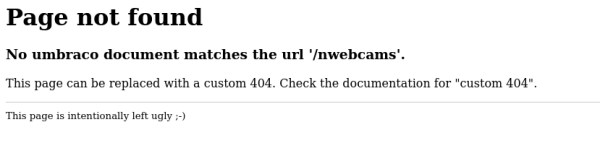
    A moment’s digital dyslexia this morning meant your ‘umble scribe was treated to Shropshire Council‘s 404 error page, as shown below.

    Shropshire's Council 404 page

    Umbraco is the open source content management system (CMS) used by the council to manage its website.

    Your correspondent particularly likes the final line: “This page is intentionally left ugly ;-)”.

    Computer scientist Brett Victor has an artistic 404 page, which pays homage to surrealist artist René Magritte.

    404 page of a pipe reading this is not a page

    However, my favourite 404 page of all time assumes the persona of Marvin the Paranoid Android from Douglas Adams’ Hithchiker’s Guide to the Galaxy. Although the original 404 page linked to from this post has now disappeared, Reddit has a full transcript of the text that used to appear on that page.

  • COP27 – a laugh from the past

    The world’s top greenwashing event COP27 is currently taking place in Sharm El-Sheikh in Egypt.

    To give an idea of the under-achievement of previous UN conferences on climate change, it’s worth pointing out that activist Greta Thunberg is boycotting the event, stating that it will be an opportunity for “greenwashing, lying and cheating“. Greta is famously critical of politicians as her “blah, blah, blah” speech showed.

    Anyway, in anticipation of a lack of any serious commitments and outcomes from the world’s political elite allegedly having a conferenceshores of the Red Sea, here’s a reminder from the past, in the shape of Ronnie Barker’s Ministry of Pollution sketch from the second season of The Two Ronnies, first aired in 1972.

Posts navigation