Bristol

  • Enforcement notices – a tale of two cities

    Staying in Glasgow for a few days for my niece’s wedding, your correspondent cannot help comparing and contrasting the differences between how Glasgow and Bristol City Councils set about tackling the public nuisance and environmental crime of fly-tipping, particularly as regards the use of public notices for enforcement and dissuasion.

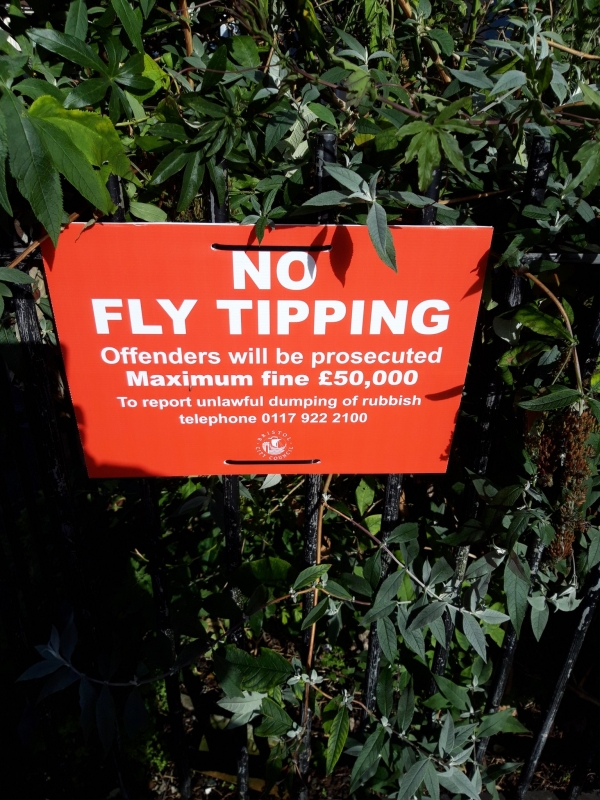
    Exhibit A: the public notices used by Bristol City Council.

    BCC A5 no fly-tipping sign

    This is an A5-sized sign with no redeeming graces, which threatens the maximum possible fine under law of £50,000 (no mention of the alter#native maximum penalty of 6 months’ imprisonment or a combination of the two. Ed.). Should anyone feel public -spirited enough to fancy reporting any fly-tipping, the public is directed to the council’s main switchboard number, with no mention of the very convenient option of reporting fly-tipping online.

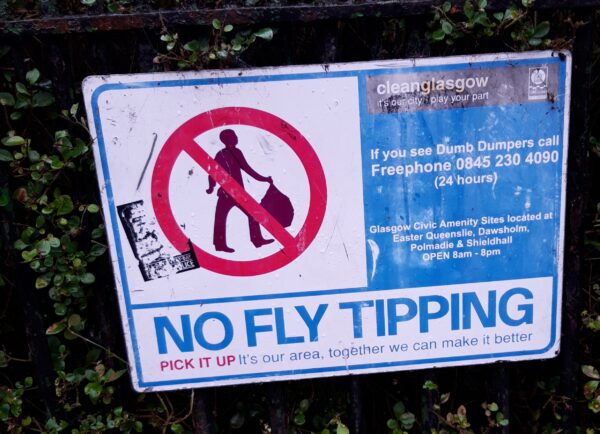
    Exhibit B: a public notice used by Glasgow City Council, as seen in Holmlea Road.

    A4 sized no fly-tipping sign from Glasgow City Council

    The initial difference is the size of the notice: at least A4 instead of A5, i.e. twice the size. There’s no mention of any maximum penalty, but residents are encouraged to report Dumb Dumpers via a 24-hour 0845 number. 0845 telephone numbers are “business rate numbers” (otherwise known as “non-geographical premium rate phone numbers“, for which the charge for mobile telephones and landlines is “up to 7p and your phone company’s access charge“. The UKPhoneIfo website warns that “charges for dialling 0845 numbers can be significantly higher – up to 41p per minute” when calling from a mobile number and that “when an 0845 number is called, the call recipient receives a small share of the call cost.” This number is a Scotland-wide number for reporting fly-tipping (there’s also a pan-Scottish Dumb Dumpers reporting website too, Ed.), in addition to which Glasgow City Council website also offers online reporting of fly-tipping and other environmental crimes.

    Two more differences to Bristol are apparent: the locations of the council rubbish tips (civic amenity sites) are given in a further attempt to change anti-social behaviour, whilst finally residents are reminded that the state of the neighbourhood is their responsibility, as well as that of the council.

    There are lessons that Bristol City Council could learn from Glasgow, as long as it ditches the not invented here attitude that seems to pervade the corridors of the Counts Louse.

    One final note: even though the city is still being tidied up following the end of the recent Scottish bin collectors’ strike, your correspondent’s overall impression is that the streets of Glasgow are not as filthy as those of Bristol. Whether this is due to belittling and disparaging those who despoil the urban area as Dumb Dumpers has yet to be proven empirically, but is another tactic BCC could try, if so inclined.

  • Gentrification reaches fly-tipping

    Like many other parts of the city, the Easton area of Bristol has been subject to an immense wave of gentrification in the last decade or so, with all the usual signs: rocketing house prices, overpriced bacon butties made with sourdough, etc.

    Indeed, local house prices have risen so dramatically within the city that an old college mate’s son and his partner couldn’t afford to buy anywhere in BS5 and eventually had to move to Cheltenham in order to find somewhere more affordable than Bristol’s inner city.

    Last year the Bristol Post/Live published its own guide on how to spot the signs of gentrification.

    It would be fair to say that gentrification has given rise to some local resentment on the streets, as shown below.

    Sticker with wording Refugees welcome. Londoners piss off!

    The signs of gentrification have even started showing in the types of items fly-tipped on local streets (in a sort of waste-related version of trickle-down economics. Last month your ‘umble scribe reported his first ever fly-tipped futon base and one of his other tasks today is to notify the council of this morning’s sighting of a fly-tipped golf bag on St Mark’s Road.

    Fly-tipped golf bag

    Fore!

  • Bristol Post/Live exclusive: music venue moonlights as property developer

    As a linguist, your ‘umble scribe has, during his working life, always used language as a precision tool. Were using le mot juste can mean the difference between a one-off job or repeat business is confined to linguists is unusual or not, is a matter for conjecture, There are certain other professions where the use of the right vocabulary is vital, particularly in the law and in the field of intellectual property (e.g. trade marks, patents).

    It often does not apply in the world of journalism, where a columnist may be taking a deliberately ambiguous angle.

    This accuracy of language definitely does not apply to the titles of the Reach plc stable of local news titles, including Bristol’s (news)paper of warped record, the Bristol (Evening) Post and the accompanying Bristol Live website.

    As a prime example of this is contained in Thursday’s piece about the redevelopment of Trinity police station.

    Headline reads Trinity Road police station to be redeveloped into 104 flats by music venue

    The headline implies that the as-yet unnamed music venue itself will be building the housing, not some developer who has just realised that, due to the proximity of entertainment, the building bill will now be augmented by the addition of acoustic insulation.

    The police station to be demolished and redeveloped just happens to be over the road from the Trinity Centre, with which your correspondent has a long association (posts passim).

    What is obvious from perusing the article is that the person(s) writing the headline is/are different from the one who write the article. This seems to be standard practice.

    Furthermore, it is also evident that the headline writers do not carefully read what reporters have written, as shown by the latest version of how the story is presented on the paper’s website, with the soon-to-be former cop shop itself transformed a new music venue.

    Headline reads police station to become new music venue

    Sacking all those sub-editors a few years ago to save some money has really paid off in terms of the quality of your ‘journalism’, hasn’t it, Reach plc?

  • BS5 bilingualism

    Bristol is a city in which, according to the 2011 census data, more than 90 languages are spoken: no surprise for the UK’s tenth most populous city.

    Given its proximity to Wales – a mere train ride or short drive away over one of the two bridges spanning the Môr Hafren (aka the Severn Sea. Ed.), there’s always been more than a bit of friendly rivalry between the city and county and South Wwales, with a topping of mutual parochial condescension reserved for near neighbours.

    Given the diverse nature of east Bristol’s population, it’s not unusual to see shop signs in languages other than English, but the Tenovus Cancer Care charity shop in St Mark’s Road (kindly note the apostrophe you prefer to ignore, Bristol City Council. Ed.), has achieved what to your ‘umble scribe’s recollection a first for BS5: a Welsh/English bilingual sign offering – on one side at least – a free health check. The reverse of that bilingual offer is in Welsh only.

    Bilingual free check-up sign
    Cymraeg /Sais
    Welsh tenovus signage
    Cymraeg yn unig

    This is not the time that Welsh signage has turned up in use to the east of Offa’s Dyke. Back in June a Welsh bilingual road works sign was observed doing splendid work in Coventry, as Wales Online reported.

  • Local trees decide it’s autumn

    According to the Woodland Trust, “Horse chestnuts, with their mahogany-bright conkers, are the very essence of autumn.

    Here in inner city BS5, the local horse chestnut trees in the centre of Lawrence Hill roundabout and on Lawrence Hill itself have decided that autumn has come already, judging by their dry and brown falling leaves and general frowzy appearance.

    Horse chestnuts in autumn colours on Lawrence Hill roundabout
    Horse chestnuts in autumn colours on Lawrence Hill roundabout
    Ayutumnal horse chestnuts on Lawrence Hill
    Ditto about a hundred metres from the roundabout

    The horse chestnut is native to the Pindus Mountains mixed forests and Balkan mixed forests of south east Europe; it was first introduced to the UK from those areas then under the administration of the Ottoman Turks in the late 16th century, being widely planted in parks, gardens, streets and on village greens.

    The tree gets its English name of horse chestnut from the scars the leaves leave on the twig when they fall, which resembles an inverted horse shoe with nail holes.

    Besides the children’s game of conkers, conkers are also used horse medicines, as additives in shampoos and as a starch substitute. Chemicals extracted from conkers can be used to treat strains and bruises.

    Just like the local hawthorns are an indicator of the approach of spring for your ‘umble scribe (posts passim), the these horse chestnuts fulfil a similar role for the approach of autumn. Below is a Woodland Trust video of the life of a horse chestnut throughout the year.

  • Peel Street meets the Globe

    A piece of artwork has appeared on the parched grass of Peel Street Green Space, which occupies the ground between Pennywell Road and Riverside Park on the far side of Peel Street Bridge over the Frome (aka the Danny in east Bristol. Ed.).

    Globe artwork at Peel Street

    Its arrival seems to have pre-empted the Bristol Post, which today wrote:

    A new public art trail reflecting on colonial histories and the impact of the slave trade is coming to Bristol.
    More than 100 artist-designed globe sculptures will appear in seven cities across the UK from Saturday and will be free to view by the public until October 31.

    The project, which is organised by The World Reimagined, aims to explore the UK’s relationship with the Transatlantic slave trade, its impact on society and how action can be taken to make racial justice a reality. The designs of the globes produced by the commissioned artists explore themes such as the culture of Africa before the slave trade and an ode to the Windrush generation.

    The World Reimagined has sited 103 unique Globes across the 10 trails in 7 host cities across the UK – Bristol, Birmingham, Leeds, Leicester, Liverpool, London and Swansea. All the trails will be connected to a digital platform that enables visitors to explore the collection and the history it reflects.

    The Peel Street globe is entitled Like The Sun and was created by Felix ‘FLX’ Braun, a Bristol-based a contemporary fine artist and muralist

    The site of the globe.
    © OpenStreetMap contributors

    The Bristol trail is handily shown on a map by The World Reimagined on which the globe installations are termed ‘Learning Globes‘.

    Bristol trail
    Click on image for full-sized map
  • BS5 bees

    Bees are found on every continent except Antarctica; and they’re crucial to life on this planet since they pollinate nearly 75% of the world’s plants, which in turn produce 90% of the food consumed by humanity. Without the aid of bees plant pollination would not occur so easily, plants would die and humans and many other species of life would die out.

    Generally one only notices bees in the inner city in ones and twos. However, bees establish new colonies by swarms consisting of a queen and legions of workers (her daughters). On Monday your ‘umble scribe spotted this swarm in Chaplin Road in Bristol’s inner city.

    Bee swarm on railings in Chaplin Road, Bristol
    Somewhere in the seething mass is the queen

    A neighbour informed me that a beekeeper was supposed to have turned up the previous evening to deal with them. S/he had evidently paid a visit by beer o’clock when your correspondent ventured forth for a pint.

    Note the two hive frames inside the box taped to the railings
    Note the two hive frames inside the box taped to the railings

    The bees have entered the box with the hive frames, presumably after the queen was first located and transferred to the box by the beekeeper.

    Bees have long been renowned for their industry. In Old English (aka Anglo-Saxon Ed.) the eponymous hero of Beowulf has beo (i.e. bee) as the first syllable of his name; when coupled with wulf (i.e wolf, predator), this implies Beowulf was a very busy and ultimately successful hunter. In medieval times, bees themselves were regarded as a potent symbol of chastity in Christianity, whilst in Islam, honey was believed to have spiritual and physical healing powers. These religious and cultural beliefs encouraged beekeeping on a vast scale among landowners and peasants alike.

    Coming up to the 18th century, the English poet, painter and printmaker William Blake wrote the following of bees in his “The Marriage of Heaven and Hell“:
    The busy bee has no time for sorrow.

    And finally on busy bees, from the 18th to the 20th century and the late Arthur Askey.

  • 1977 and all that

    1977 was allegedly a year for celebration as Elizabeth Mountbatten-Windsor had spent 25 years as unelected head of state of the English Empire (which some still call the United Kingdom. Ed.).

    At the time I was in the final year of my degree and well remember derelict buildings in the town centre being draped in bunting in preparation for a drive-by the queen.

    All the sycophancy at that time helped turn your ‘umble scribe into a lifelong republican, i.e. someone who would like to see this country abolish the monarchy and switch to having an elected – not hereditary – head of state. This is not to be confused with a right-wing US political party spelled with an upper case first letter.

    Come right up to date and Elizabeth Mountbatten-Windsor has now been minding the shop for 70 years, a record for the country. However, support for the monarchy is not as widespread or whole-hearted as it was in 1977 and in Scotland support for the monarchy is now down to 45%, as reported by The Guardian.

    However, that does not mean that republicans are having an easy ride for their beliefs, which they allegedly have a democratic right to express, as illustrated by the tweet below from the account of the Jeremy Vine show on Channel 5, a low point in daytime TV.

    Tweet reads As the country marks the Queen's 70 years on throne, should republicans perhaps keep their views to themselves this week? Celebrations are planned up and down the country. Do we really need anti-royalists spoiling the mood?

    I have no intention of being quiet. Indeed, yesterday I found the Stuff The Jubilee badge I bought in 1977 and am already wearing it with pride as per the encouragement from my ex-wife.

    Original 1977 Stuff The Jubilee badge Badge on hat

    Your correspondent won’t be the only one in east Bristol not celebrating this momentous non-event. News of three of our local pubs organising a F*ck the Jubilee punk festival has not gone down too well with some sections of the city’s populace.

    At a national level, Republic, the organisation campaigning for the abolition of the monarchy, has organised a petition to make Elizabeth the second the last monarch.

    And finally, now for something completely different…
  • More Bristol borkage

    Yesterday’s trip into Bristol’s Quarter of Mammon (aka the city’s central shopping district consisting of the dire post-war Broadmead centre, Galleries and Carboot Cabot Circus. Ed.) yielded another example of borked technology to add to the collection begun last week on my visit to the City Museum & Art Gallery (posts passim).

    Corporate graffiti, better known as advertising is all-pervasive and intrusive, but there’s no way I’d stand on my heads in the rain to read this bullshit. 😀

    advertisement displayed upside-down in Carboot Circdus
Posts navigation