open standards

  • Document Freedom Day: why open standards matter

    Document Freedom Day dove posterToday is Document Freedom Day, an annual international celebration of open formats and open standards and an opportunity to promote their use.

    The use of open standards is definitely gaining ground, particularly where it matters, such as in dealings with government bodies. This was amply illustrated last year by the UK Cabinet Office’s announcement of the adoption of open standards for collaborating on government documents.

    Why do open standards matter?

    Open standards are vital for interoperability and freedom of choice. They provide freedom from data lock-in and the accompanying vendor lock-in. This makes open standards essential for governments, companies, organisations and individual users of information technology.

    What is an open standard?

    An open standard refers to a format or protocol that is:

    • Subject to full public assessment and use without constraints in a manner equally available to all parties;
    • Without any components or extensions that have dependencies on formats or protocols that do not meet the definition of an open standard themselves;
    • Free from legal or technical clauses that limit its use by any party or in any business model;
    • Managed and further developed independently of any single supplier in a process open to the equal participation of competitors and third parties;
    • Available in multiple complete implementations by competing suppliers, or as a complete implementation equally available to all parties.

    How do open standards affect you?

    April, the French open source advocacy organisation, has produced a handy graphic in English to illustrate the difference between open and closed formats. Click on the image below for the full-sized version.

    April leaflet showing difference between open and closed formats

    Examples of open standards

    Many open standards are in wide use. Here are 3 examples:

    • Plain text (.txt);
    • HTML, the language of the web;
    • ODF, the default file format of free and open source office suites such as LibreOffice and OpenOffice. ODF can also be handled by Microsoft Office versions from Office 2007 onwards.

    Document Freedom Day is being promoted on social media by the use of the #DFD2015 hashtag.

  • TidyBS5 news

    A week ago yesterday, there was a meeting of the TidyBS5 task force with council officers and Councillor Marg Hickman at the offices of Up Our Street.

    It was a good opportunity for the officers to update community volunteers on what the council has done, is and will be doing.

    fly-tipping in Jane Street Redfield
    Jane Street in Redfield earlier today

    For Stapleton Road a deep clean is planned for this year; this will mean giving the footways a thoroughly good scrub and removing chewing gum from their surfaces. In addition, hanging baskets will be provided on approx. 30 lamp posts to help make the street a bit more colourful and attractive.

    The city council’s streetscene enforcement team has now moved into the area and has already had some success: 5 traders have been issued with £300 fixed penalty notices for abusing the communal bins intended for household waste only. In addition, some minor offenders have been fined smaller amounts.

    Turning to communal bins, task force members have been invited to assist in devising the communal bins consultation that the council is organising for the Stapleton Road corridor. Two task force members, Hannah and myself, informed officers that we were monitoring clearance times after fly-tipping had been reported. From my own monitoring since then, communal bins seem to be implicated in some 60% of sites notified to the council.

    After the update from the offices, it was pointed out to them that, while all this attention being lavished on the Stapleton Road area was appreciated, it should not detract from equally bad problems along the Lawrence Hill/Church Road corridor, home to the infamous Jane Street (see above).

    During my discussion on social media with BCC’s Chief Enterprise Architect Gavin Beckett about open standards (posts passim), he invited me to submit feedback on using the council website; this will be done from the aspect of reporting street cleaning matters, where the website still has a couple of interesting foibles.

    Up Our Street is organising a community litter pick on Saturday 28th March from 11 am to 1 pm. Volunteers are asked to assemble at Lawrence Hill roundabout (map). For more details, contact Lorena on 0117 954 2835.

    Big Clean publicity poster

    Finally, don’t forget to sign the TidyBS5 e-petition!

  • Bristol City Council & open standards – more

    BCC logoFollowing the post on Friday on Bristol City Council‘s response to my open standards FoI request (posts passim), more information has come to light.

    It was all sparked by a discussion on Twitter between myself and Alex, a leading member of the Bristol & Bath Linux Users’ Group (BBLUG).

    It all revolved around what was really meant by the phrase “not fully digital” in respect of PDF files.

    My speculation was that if text documents are scanned, these are usually converted to image-based PDFs with which the screen readers used by blind and visually impaired people can have problems.

    It turned out this was a good point, but not the real reason.

    The latter was supplied by Gavin Beckett, BCC’s Chief Enterprise Architect, who actually responded to my FoI request. It seems Gavin’s main reason for describing PDFs as “not fully digital” is that PDF is basically an attempt to make electronic files emulate paper. The move by the council away from PDF to HTML when responding to citizens is that more mobile devices (tablets and smartphones) are now being used by the public to communicate with the local authority and the latter wishes to provide the same – i.e. “fully digital” experience to all.

    Finally Gavin promised to follow up with his colleagues my gripe about using MS formats for responding to FOI requests. He conceded this was one example where PDF would be better.

  • Recommended LibreOffice extension: MultiFormatSave

    One of the great things about LibreOffice is the ability to customise and extend the software’s functionality by the use of extensions, for which there’s a dedicated website.

    If you use LibreOffice and need to save files in formats other than its native Open Document Formats (in my case, I work in Open Document format, but return work in MS Office formats and send out invoices as PDFs), then the MultiFormatSave extension is a really useful addition to your install since it can simultaneously save your file Open Document, MS Office and/or PDF formats as you choose.

    At the moment Open Document, MS Office 97 (.doc, .xls, etc.), MS Office 2007 XML (.docx, .xlsx, etc.) and PDF formats are supported.

    MultiFormatSave iconOnce installed via LibreOffice’s extension manager, MultiFormatSave adds a small icon – shown on the right – to the toolbars of your office suite’s component programs.
    Clicking on the icon will bring up the dialogue box shown below.

    MultiFormatSave dialogue box

    Saving in up to 3 formats at once is not only convenient, it can in my opinion help reduce one’s chances of falling victim to repetitive strain injury (RSI). 🙂

    More information on MultiFormatSave is available on the LibreOffice extensions site.

  • Response to open standards FoI request

    A response has been received today to my FoI request to Bristol City Council on open standards (posts passim).

    The reply was received in a record 10 working days and reads as follows:

    Bristol City Council has been a long-term supporter of open standards wherever possible. We have frequently voluntarily adopted national government policy on open standards and open source, recognising the benefits of this approach.

    We adopted StarOffice in 2005 and moved to the Open Document Format as our standard for office productivity files at the point it was incorporated in the StarOffice / OpenOffice.org products. We had to move to Microsoft Office in 2010 due to the lack of standards support in the local government applications market, partly due to the fact that national government policy was not mandated at local level and therefore did not have the desired effects on the document standards context. However we retained the ability to create, open and collaborate on ODF by implementing LibreOffice alongside Microsoft Office on all council PCs. Therefore we are already capable of using ODF to collaborate on government documents.

    In terms of publishing government documents to citizens, we have historically used PDF, but are now attempting to replace all information, advice and guidance, and application forms with fully digital services. Over time this will replace old PDF documents with HTML. If there are documents that meet a user need to download and read offline, we can produce PDF/A format from the open source PDF Creator software that is also available on every council PC.

    I’m very pleased to note that BCC has LibreOffice installed on every council machine. They kept that quiet! Perhaps they’ll use it to send me replies to my FoI requests in future instead of the propensity to use MS Office formats. But just to make sure, I’ll include a plea for a reply in an open format in all my future requests. 🙂

    Read the original FoI request and response on WhatDoTheyKnow.

  • LibreOffice 4.4.1 – a vast improvement

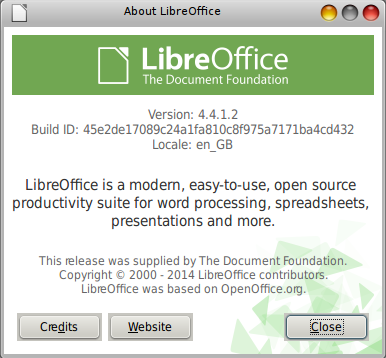
    Yesterday my laptop’s install of LibreOffice was upgraded from version 4.3.3.2 (which is the latest version available for Debian Jessie) to the latest available version – LibreOffice 4.4.1.

    As there is no specific Debian repository that I can find for newer versions of LibreOffice, this process had to be done manually.

    The first stage was to download the zipped .deb packages required, i.e. the main installer, followed by the British English user interface. These were then unzipped in preparation for installation.

    However, before installation could take place, the older version of the suite had to be removed. This was done via the command line by opening a terminal and typing (as root):

    apt-get remove --purge libreoffice-core libreoffice-common

    Now the new version could be installed, once again via a terminal opened in the folder to which the main program’s .deb packages had been unzipped. This time the command – once more as root – is again straightforward:

     dpkg -i *

    Once the main program had been installed, the British English user interface could then be installed by running the dpkg command in the folder containing the relevant .deb, substituting the asterisk for the relevant package name.

    And that was it: I now had the latest release running.

    screenshot of LibreOffice About window

    As regards this release itself, The Document Foundation blog reported that over 100 bugs had been fixed compared with version 4.4.0.

    As someone whose days are spent slaving over a word processor and quite often has to use text effects such as subscript and superscript, I’m very pleased to see that these are included as standard on one of LibreOffice Writer’s toolbars.

    screenshot of LibreOffice Writer toolbar

    Putting on my linguist’s hat, another great addition to Writer’s toolbars is the special character menu shown by the capital L bar icon (Ł). This opens up the character selector – in my case kcharselect – for those special characters whose keyboard shortcuts one doesn’t happen to know. 🙂

    toolbar showing the capital L bar icon for special characters

    My overall impression is that LibreOffice 4.4.1 is the best LibreOffice to date. The redesigned toolbars will help make me more productive since I won’t need to go hunting around through menus quite so much, which can slow one down.

    My thanks to The Document Foundation and its developers for a great piece of work.

  • Bristol City Council asked about open standards

    BCC logoWhenever I make a Freedom of Information (FoI) request to Bristol City Council, the response invariably comes back in a proprietary Microsoft Office format (e.g. .docx, .xlsx, etc.), a practice I find less than satisfactory – not to say galling – as an advocate of free and open source software and open standards.

    That being so, the following FoI request has been made today to the council:

    Dear Bristol City Council,

    This is a request for information under the Freedom of Information Act.

    In July 2014, the Cabinet Office announced the adoption of open standards for document viewing and collaboration in central government. See https://www.gov.uk/government/news/open-document-formats-selected-to-meet-user-needs for details.

    The standards adopted are:

    – PDF/A or HTML for viewing government documents;
    – Open Document Format (ODF) for sharing or collaborating on government documents.

    What plans does Bristol City Council have to emulate central government’s move and when will similar open standards be adopted by the council for communicating and collaborating with citizens.

    Yours faithfully,

    Steve Woods

    Hopefully an answer will be forthcoming by Document Freedom Day 2015 (posts passim).

  • DFD2015 is 25th March

    Document Freedom Day is an international day celebrating open standards and happens every year on the last Wednesday of March. This year it will take place on 25th March.

    It is a day to come together and raise attention towards the ever growing importance of Open Standards for all aspects of our digital communication and information accessibility.

    With the rise of new technologies and hardware, more and more communication is transmitted via electronic data. At the same time, more and more information is provided in digital formats or even created in digital format and will never be transferred to any analogue media. Various companies try to exploit these factors by offering communication or information services that use proprietary data formats to lock users into their software, hardware and services, so-called vendor lock-in.

    Celebrating Document Freedom Day is part of the fight against proprietary standards and vendor lock-in and a great opportunity to promote open standards, such as Open Document Format.

    Open standards are formats and protocols which everybody can use free of charge and restriction. They come with compatibility “built-in” – the way they work is shared publicly and any organisation can use them in their products and services without asking for permission. Open standards are the basis of cooperation and modern society: train tracks, power sockets and natural language are all examples of specifications that we all rely on and take for granted in daily life.

    DFD 2015 flyer

    In the past year there’s been a great boost to open standards in the United Kingdom with central government’s adoption of open standards for viewing or collaborating on government documents (posts passim).

    Now that Whitehall has adopted open standards, it’ll probably be a long battle to get local government to do likewise.

    For more information on Document Freedom Day 2015, visit Document Freedom.

  • LibreOffice and OpenOffice now available as web services on Firefox OS

    The Mozilla blog has announced that rollApp, a US cloud provider, is making the free and open source LibreOffice and OpenOffice office packages available as web services on smartphones running Firefox OS. Apps for Android devices will follow.

    As regards LibreOffice, the packages available for Firefox OS and able to run in a web browser are Writer (word processing), Calc (spreadsheet), Impress (presentation) and Draw (drawing).

    OpenOffice screenshot

    The programs themselves run on the rollApp server as web services. Apps for Android smartphones and tablets should follow shortly. Dropbox, Google Drive und Microsoft’s OneDrive can be used as storasge locations. Along with OpenOffice and LibreOffice, 18 other programs can be run under Firefox OS using the rollApp service, which costs about $7 per month after a free trial period of 14 days has expired.

    In addition to the applications for Firefox OS, rollApp offers a wide range of other open source packages, including graphics packages such as Gimp and Inkscape, plus games.

  • After the book and film, the HTML colo(u)r chart

    There’s been a lot of interest in the media in recent days over the impending release of the film of E.L. James’ 2011 erotic novel Fifty Shades of Grey.

    Following hard on the heels of the media interest, comes the HTML colo(u)r* chart.

    HTML grey colours image

    If you need to pick colours for web pages, fonts and the like, the W3C has a handy picker.

    * In HTML American spellings – e.g. color, center – are used.

Posts navigation